
Araroba
Have you been to Bahía?
Today’s New York Times Spelling Bee letters:
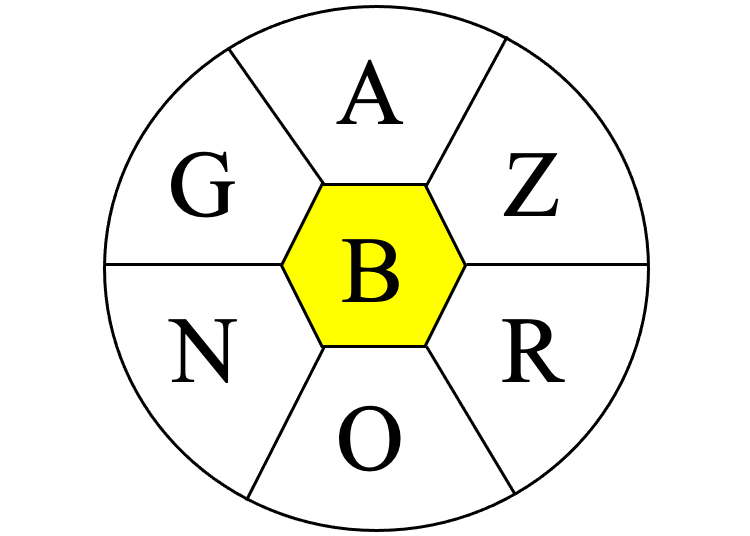
A, G, N, O, R, Z, and center B (all words must include B)
Merriam-Webster says…
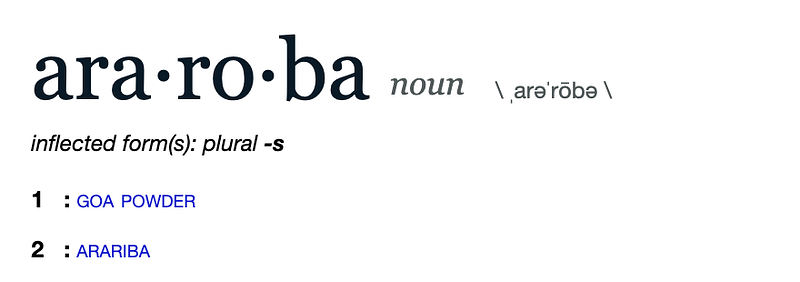
Silly little dictionary! Don’t you know that araroba can’t possibly be a word if The New York Times says it ain’t?
For a complete list of rejected words, check out the Spelling Bee Master.
What’s your favorite dord* from today’s puzzle?
My Two Cents
The combination of seven letters (or pangram) in today’s game makes it fifth overall appearance, which is might be a record since I started writing this column and using the Spelling Bee Master’s stats. Today’s center letter is B, but the puzzle has previously shown up with four other center letters:
- March 26, 2021 (Center Letter: A)
- November 30, 2019 (Center Letter: R)
- April 24, 2019( Center Letter: G)
- December 8, 2018 (Center Letter: O)
I have kept the links in case you’re interested in checking out the additional information for each instance. Silly Little Dictionary! did not yet exist in 2018 and 2019, but in March of last year I wrote about barong, a type of a broad-bladed knife or sword.
Two of the seven letters (N and Z) have not yet been used, meaning there are two more possible puzzles in the future for this group.
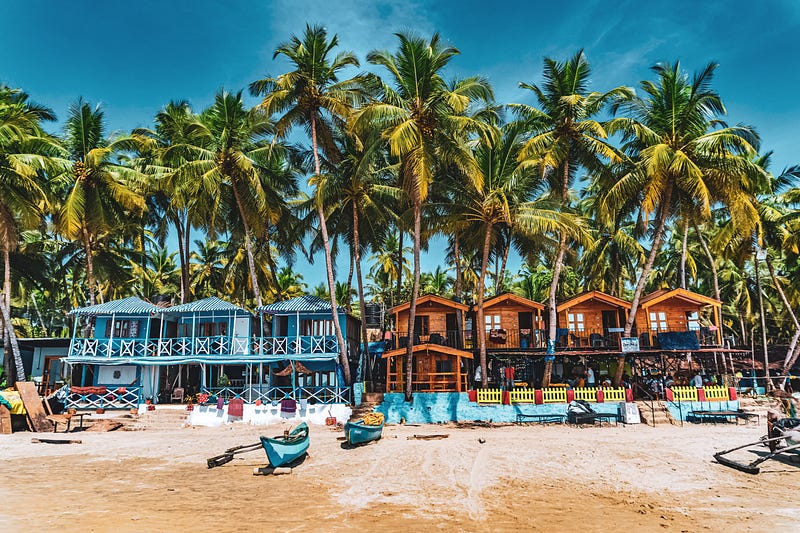
By the way, the picture at the top of today’s article is not of Bahia, as the subtitle of today’s article may have (mis)led you to believe. The photo was one of the options given to me when I typed “Goa” into the search of Unsplash. So, I assume it shows one of the beaches of this former Portuguese colony, now a state in India.
So why did I mention the Brazilian state of Bahía? Read on to find out… and connect with an old, old Disney movie.
Goa pow(d)er
Our friends at Merriam-Webster tell us that araroba was borrowed from the Portuguese, itself a word of Tupian origin; akin to Tupi araribá. (the Tupi were one of the most numerous indigenous groups in Brazil before their land was colonized by Portugal.)
The dictionary gives two definitions for araroba, one of which is arariba. However, according to Finnish herbalist Henriette Kress, “this drug [araroba] must not be confused with Arariba rubra, a Brazilian plant, the bark of which was investigated by Rieth, in 1861, and has been used as a red dye for wool in its native country.”
An official Brazilian government website clarified that Arariba rubra is now called Simira rubra, a plant in the coffee family.
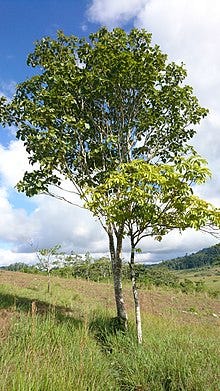
(The above tree is not a Simira rubra, but rather its cousin, the Simira salvadorensis.)
Curiously, clicking on arariba in the dictionary gave me a completely different list of plants under that name.
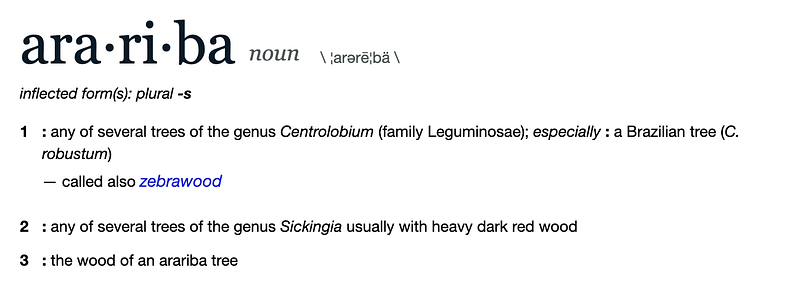
Clicking on zebrawood revealed an even longer list of plants:
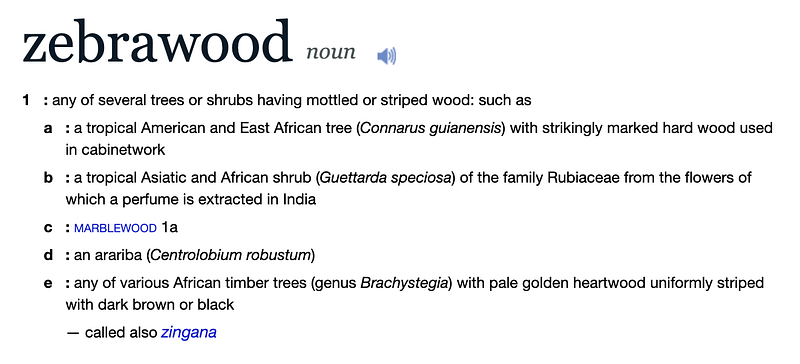
It’s Friday, so I’m sure my readers are not too keen on me going into detail about each of the above specimens. Feel free to do some investigative journalism on your own; we’ll welcome your reports in the comments section.
When I went back to the first definition of araroba given by the dictionary (Goa powder), I got this: “a bitter powder found in the wood of a Brazilian tree (Vataireopsis araroba) and valued as the chief source of the drug chrysarobin”.
This powder began trending in the late nineteenth century, to the point that the Britannica back then had an entry on it:
ARAROBA POWDER, a drug occurring in the form of a yellowish-brown powder, varying considerably in tint, which derives an alternative name — Goa powder — from the Portuguese colony of Goa, where it appears to have been introduced about the year 1852. The tree which yields it is the Andira Araroba of the natural order Leguminosae… The Goa powder or araroba is contained in the trunk, filling crevices in the heartwood. It is a morbid product in the tree, and yields to hot chloroform 50% of a substance known officially as chrysarobin, which has a definite therapeutic value and is contained in most modern pharmacopoeias. It occurs as a micro-crystalline, odourless, tasteless powder, very slightly soluble in either water or alcohol; it also occurs in rhubarb root.
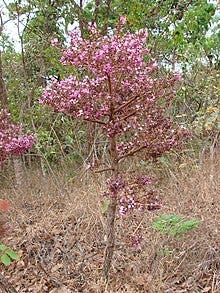
(Again… the above tree is not an Andira Araroba, but its cousin, the Andira humilis, also from Brazil.)
In 1875, Brazilian physician J. F. da Silva Lima published a letter in the Medical Times and Gazette in response to an article by a Dr. Fayrer of Calcuttaby, who described the treatment of ringoworm using Goa Powder. da Silva Lima went into further details about the Araroba tree (as he called it) and the powder that could be extracted from it. Interestingly, he used arariba as a synonym, mentioning the red dye that came out of some species. The article — which you can read here and here if you’d like— likely led to araroba also being called “Bahia powder”.
Bahia powder is extremely irritant both when ingested and when applied on the skin. It’s usefulness against intestinal parasites is mild, but it has shown some effect against ringworm, psoriasis and chronic eczema. Today the extracted chrysophanic acid is mixed into an ointment, paste, or cream base for a better effect.
Araroba powder can stain skin, hair, and clothing a deep yellow or brown color. So perhaps it is the same thing as arariba, and Henriette Kress is wrong.
Three Horsemen
I have never visited Bahia, or even Brazil, for that matter. But every time I hear the word Bahia, the first thing that comes to mind is this:
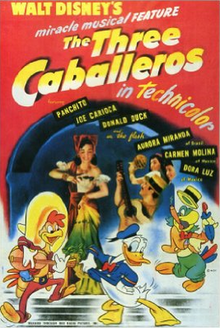
(In English caballero means “knight” or “horseman”, but in Spanish the word additionally is used for “gentleman”.)
This 1944 release was Disney’s seventh animated feature film and, like its 1942 predecessor—Saludos Amigos— combined live action actors and animated characters. Also like that movie, The Three Caballeros had its premiere outside the U.S., in this case in Mexico. The film celebrates the 10th anniversary of Donald Duck’s, who receives three presents from friends in Latin America, presents that are used to showcase stories and locations from countries in that region.
The second present, a book, is given to Donald by José Carioca, a character created by Brazilian cartoonist José Carlos de Brito. José is a green anthropomorphic parrot who wears a suit jacket and a hat, carries around an umbrella, and smokes a cigar… because this was the 1940s and no one thought there was anything wrong with kids enjoying a stogie-chomping bird. After all, Popeye was a big hit already!

Carioca’s gift to Donald is a book, and José shrinks both Donald and himself so they can enter the book and visit Bahia. They meet up with the locals and dance samba with them. Donald falls in love with one of the dancers (played by Aurora Miranda, Carmen Miranda’s sister)…
Many movie reviewers were appalled at this romantic interlude between an animated duck and a live-action human. American editor, humorist, and critic Wolcott Gibbs wrote about it in The New Yorker, saying it “is one of those things that might disconcert less squeamish authorities than the Hays office. It might even be said that a sequence involving the duck, the young lady, and a long alley of animated cactus plants would probably be considered suggestive in a less innocent medium.”
I’m not sure which alley of animated cactuses Gibbs is talking about. Perhaps this image towards the end?
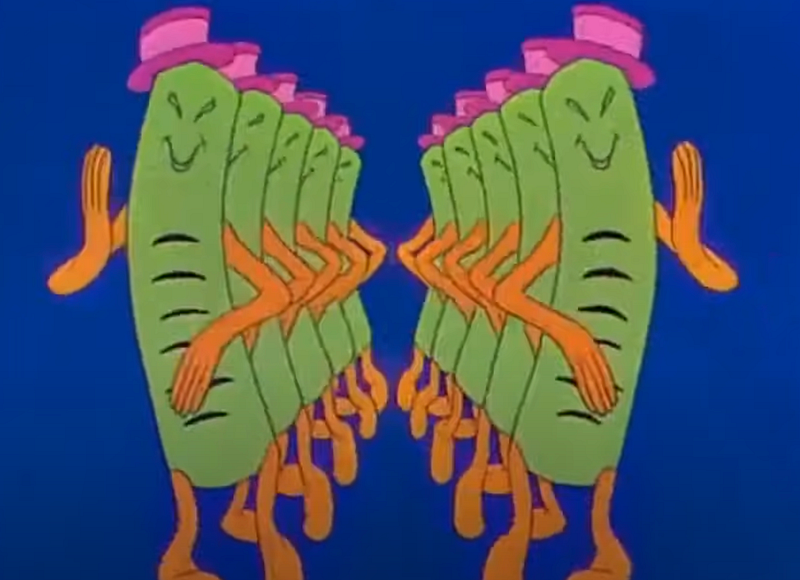
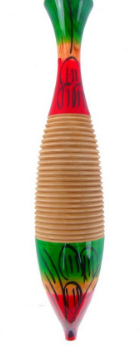
I think those aren’t cacti, but guiros strumming themselves. A guiro is a type of percussion instrument commonly used in South America.
Today we have moved beyond condemning cartoon-human relations, and we have this scene to thank for that.
Now you know. Next time you find yourself with a bad skin rash, go to your local drugstore and ask for some araroba powder. Don’t be surprised if the pharmacists tells you they can’t give you any. Not because you don’t have a prescription… but because the editors of the Spelling Bee decided that araroba is a dord*.
You can check out my previous entry on another dord* here:
*What the heck is a dord, you ask? Here’s the answer: