
Guiro
This gourd will get you into the rhythm of things

Today’s New York Times Spelling Bee letters:
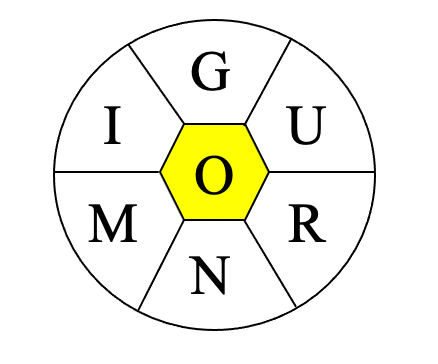
G, I, M, N, R, U, and center O (all words must include O)
Merriam-Webster says…
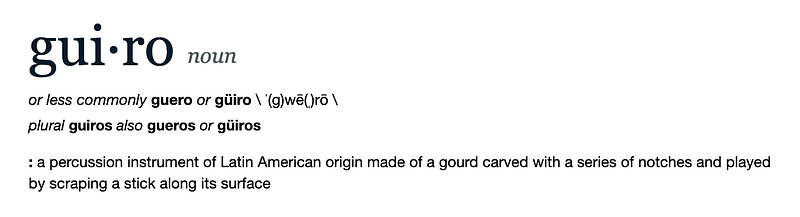
Silly little dictionary! Don’t you know guiro can’t possibly be a word if the New York Times says it ain’t?
For further fascinating facts, check out the Spelling Bee Master.
What’s your favorite dord* from today’s puzzle?
My Two Cents
The photo at the top of today’s column shows members of the Fania All-Stars circa 1980, and was supposedly taken in Caracas, Venezuela in 1980 (although I have not been able to confirm the date and place yet).
Contrary to what their name may suggest, the Fania All-Stars were not the group of employees selected to play in the company’s annual softball game during the yearly corporate retreat. They were the top artists of Fania Records, the biggest salsa music record label in the 1960s, 70s, and 80s. Sort of like the Motown of Latin American music.
Wikipedia introduces their entry on Fania Records by saying it is “a New York based record label founded by Dominican-born composer and bandleader Johnny Pacheco and his Brooklyn born Italian-American ex-New York City Police Officer turned lawyer Jerry Masucci in 1964.”
Tell me that isn’t one of the more interesting sentences you’ve read in the past couple of weeks.
If you are a salsa lover — the music, not the dip — you may recognize some of the famous musicians in the photo. The only woman (front row, center) is the ageless Celia Cruz, right behind her is Rubén Blades. The guy with his hands on Ruben Blades’ shoulders is Ismael Miranda, and to our left of Miranda (his right) is Johnny Pacheco himself, who passed away in February of this year. At the top right, with the glasses, is (I think) Héctor Lavoe, known as “the singer among singers”.
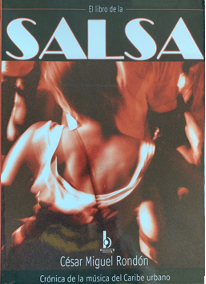
And if you’re a salsa lover and a Spanish speaker, I highly recommend César Miguel Rondon’s El libro de la salsa, which combs through the history of this music genre from the 1950s through the early 2000s.
You gourdhead you!
Although you may think you’re telling someone their head is as thick as — or shaped like — a gourd with that insult, the truth is a gourdhead has nothing to do with gourds… or any other fruit. In fact, the gourdhead is also known as the bigmouth buffalo, which is even more confusing because we’re talking about a fish here. One that is known to live past 100 years of age.

(The gourdhead is also one of the local names of the wood stork, Mycteria americana.)
In any case, the expression related to the gourd plant is not “gourdhead”, but “off one’s gourd”, or out of one’s mind.
Okay, we’ve gotten slightly off track here…
As Merriam-Webster explains, a gourd is “any of a family (Cucurbitaceae, the gourd family) of chiefly herbaceous, tendril-bearing vines including the cucumber, melon, squash, and pumpkin”. But a gourd can also refer to “the fruit of a gourd : pepo especially : one (such as the bottle gourd, dishcloth gourd, or wax gourd) that is hard-rinded and inedible, is often used for ornament or for vessels and utensils…”.
The latter is the meaning that concerns us today, as our daily dord*, guiro, is a musical instrument that was traditionally made out of a gourd. In this case, the word guiro came from the indigenous Arawak güira, which was used to refer to both the instrument and the calabash fruit it came from:

To function as a musical instrument, circular stripes were carved around the hollowed-out gourd’s shorter circumference, after which the notches are rubbed with a stick or tine to produce the characteristic ratchet sound.
The guiro is part of folk-dance music throughout Latin America and is also used in traditional religious festivals. In the 19th century it became an essential part of the orchestras that played Cuban music like son and trova, which later were melded with other styles to form the 20th-century salsa genre.
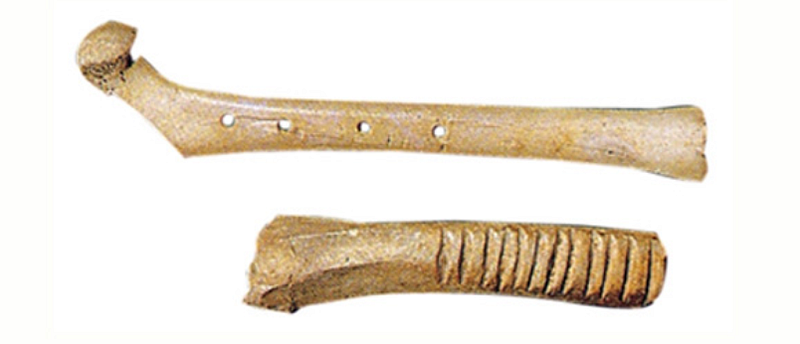
Guiros have been made not only from calabash and other gourds, but also from bone.
Today guiros are often made of wood, although fiberglass is catching on a common material, too, probably due to the fact it lasts longer. Here is a modern Cuban guiro made of fiberglass:
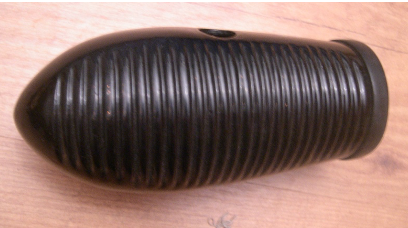
This looks like it might help while away lonely nights on the road, too.
Don’t be so naïve
In Spanish the word guiro is spelled with an umlaut on the “U”: güiro. The umlaut, or diéreses in Spanish, is not there for style points. It actually helps readers decode the word, something that the Spanish language doesn’t usually need, being a lot more straightforward when it comes to sounding out words than English.
There’s that old saying about how it’s impossible to spell a word in English unless you already know how its spelled. This happens with other languages, too (Hebrew comes to mind), but not very often with Spanish. The reason English has such complicated spelling “rules” is because the language “is really old, thus it has had the opportunity to encounter many influences and changes throughout the years.”. Nat G. explains it better in this wonderful article.
Perhaps the most famous example used to describe English’s whimsical spelling is this one:
ghoti
If you knew this word was pronounced “fish”, then you had either heard of it already or paused your vertical scrolling to look it up. For those who didn’t do either, I’ll let Batman explain it to you in English with Spanish subtitles:
This creative respelling is usually — and incorrectly — attributed to George Bernard Shaw, but was actually credited by Charles Ollier to his son William in a letter Charles wrote to Leigh Hunt in December of 1855. (Bernard Shaw was born the next year.)
Although there’s nothing like ghoti in Spanish, there are some tricky spellings and pronunciations. For example, the letters “g” and “c” can have either soft or hard pronunciations, depending on the vowel that follows them. So camello (camel) is pronounced “kameyo”, but in Cecilia the “c” has an “s” sound, like it does in English.
The soft “g” occurs before the vowels “e” and “i” (the hard “g” before “a”, “o”, and “u”), and sounds like a very hard “h”, the way an English speaker might pronounce the name Javier.
Now, when the letter “g” is followed by both “u” and “i” or both “u” and “e”, things can get tricky. The “g” sound is still hard (because it comes before a “u”) but the “u” itself is silent. The reason this happens is so you can have a “g-i” and “g-e” combination with a hard “g”. For example, the word guitarra is pronounced very much like guitar in English, with the added rolled “r” and “a” at the end. You’ll notice the “u” is silent in English, too: gitar.
So how do you pronounce g-u-i in Spanish, like, say, for example, in guiro? In order to unmute the silent “u”, you add the two dots on top, the umlaut: ü. This also works for words with the combination g-u-e, such as cigüeña (stork) which is pronounced “si-gweh-nya”.
Well, we’ve had quite an eclectic discussion today: salsa, animals, plants, a musical instrument, tricky English spellings, the use of the umlaut in Spanish, even Batman… and of course, the guiro.
And whether you write it with or without the umlaut won’t matter, because the editors of the Spelling Bee still decided that the word guiro is a dord*.
You can check out my previous entry on another dord* here:
*What the heck is a dord, you ask? Here’s the answer: