er="0" height="480" width="854">
</div>
</div>
</figure></iframe></div></div></figure><p id="e675">Having been a MacBook Pro and Air user for about a decade now, <b>I have had the pleasure of experiencing numerous chassis designs.</b> All of those had one thing in common — they felt durable. Regardless of their slimness — think Air 11” or 13” or even 13”, 15” and 16” Intel Pros, they all felt like a fight-worthy tank. One of my first 2012 15” Retina MacBook Pros that I received second-hand went through a pretty nasty fall at some point, which left some pretty visible marks on the chassis. But guess what? Nothing broke. Used that machine for another five years or so and sold it in complete functioning order.</p><p id="9ff1" type="7">I honestly don’t believe my 16” M1 MacBook Pro would survive a fall. Either the logic board or the screen would be toast.</p><p id="e5aa">The screen part, we all understand why, I think. It’s glass. But why the logic board? You see, <b>the backplate of the new MacBook designs seems to be thinner than ever</b>. It almost feels <b>uncharacteristically flimsy</b> when taken off. This is bad for several reasons. First of all, aluminium is a fairly soft metal, so the thinner it is, the more fragile and bendable it becomes. Check out any photo from iFixit, and you’ll see that even the slightest bend in that backplate ends up touching the internal components. Now, up to a point this is probably not a major concern, but here’s what I’m thinking:</p><ul><li><b>A fall hitting the back of the machine</b> could transfer all that energy into the logic board, onto components, many of which are quite fragile.</li><li>Many of us are quite used to <b>grabbing the laptop up with one hand</b>, inevitably putting pressure on the backplate as we walk around the office or the house. If we do that while keeping the laptop horizontally with the screen open, it’s even more pressure.</li><li><b>People travel</b>, and they place their laptops into various types of bags, in all sorts of positions. Not only that, they sometimes use them in very positionally awkward scenarios.</li></ul><p id="fbaa"><b>Users generally don’t think too much about how to carry a laptop, because they shouldn’t have to. </b>Travelling or just moving around with these now feels like a much more conscious effort than before. I always used to slide my laptop into my carry-on with the screen side facing inside, because I knew the back was less prone to accidents. Now, however, one side has a screen, the other side has a flimsy bottom.</p><p id="c022" type="7">I don’t know how to handle and store Apple’s newly designed laptops any more to ensure they don’t get damaged in the process.</p><p id="dabb"><b>Maybe I am the weirdo here, but since I bought the 16” M1 Pro, I handle it like an egg.</b> The old 2018 15” Intel? Just shove it into the drawer, stack a bunch of things on top, heck, another laptop even, not a care in the world. I am confident nothing is going to bend or crack. I am less confident about doing that with the new design, though.</p><div id="b900" class="link-block">
<a href="https://readmedium.com/apples-m2-macbook-air-is-the-toughest-sell-ever-7f19e31164e7">
<div>
<div>
<h2>Apple’s M2 MacBook Air Is The Toughest Sell Ever!</h2>
<div><h3>And the 13” Pro M2 just adds to the pain…</h3></div>
<div><p>medium.com</p></div>
</div>
<div>
<div style="background-image: url(https://miro.readmedium.com/v2/resize:fit:320/1*Je1hoZ1ULp93z9rzJpTk2Q.jpeg)"></div>
</div>
</div>
</a>
</div><p id="
Options
f34c">And <b>now the new M2 Air is getting the same design treatment, and likely a just as thin bottom as the 14” and 16” Pros</b>. On the one hand, these will be smaller machines, and implicitly also lighter, which could mean that perhaps there are lesser risks for backplate bending with regular day-to-day use. But when it comes to travelling, I am still anxious. The thing is, most of us don’t put protective cases on our laptops, because seriously, we shouldn’t have to. Laptops are meant to be designed and built to whitstand being carried around all the time in all sorts of scenarios and environments. That’s their whole point; otherwise we’d still all be using Mac minis and Mac Pros.</p><p id="4082" type="7">I still think the old design was perfectly fine, just needed a couple of extra ports. Instead, we got fancy branding on the back of a thin sheet of borderline tinfoil.</p><div id="cbb4" class="link-block">
<a href="https://attilavago.medium.com/membership">
<div>
<div>
<h2>Join Medium with my referral link - Attila Vágó</h2>
<div><h3>As a Medium member, a portion of your membership fee goes to writers you read, and you get full access to every story…</h3></div>
<div><p>attilavago.medium.com</p></div>
</div>
<div>
<div style="background-image: url(https://miro.readmedium.com/v2/resize:fit:320/0*plbEzbD09lLkHDbE)"></div>
</div>
</div>
</a>
</div><div id="50f7" class="link-block">
<a href="https://levelup.gitconnected.com/can-you-really-develop-apps-on-the-m1-ipad-air-66f1ef0677f3">
<div>
<div>
<h2>Can You Really Develop Apps On The M1 iPad Air?</h2>
<div><h3>The verdict is in. I tried building an iOS and a web app…</h3></div>
<div><p>levelup.gitconnected.com</p></div>
</div>
<div>
<div style="background-image: url(https://miro.readmedium.com/v2/resize:fit:320/1*3P6IZVfMPVd8l5GBJIUQbg.jpeg)"></div>
</div>
</div>
</a>
</div><div id="9413" class="link-block">
<a href="https://readmedium.com/why-i-reluctantly-ordered-the-apple-studio-display-6bf671299668">
<div>
<div>
<h2>Why I Reluctantly Ordered The Apple Studio Display</h2>
<div><h3>And many will feel the same way I do, for the same reasons…</h3></div>
<div><p>medium.com</p></div>
</div>
<div>
<div style="background-image: url(https://miro.readmedium.com/v2/resize:fit:320/0*7QXg4gpK3C9YtEi9)"></div>
</div>
</div>
</a>
</div><div id="4e0f" class="link-block">
<a href="https://readmedium.com/forget-the-critics-the-apple-studio-display-is-mind-blowing-21cceaaa06bd">
<div>
<div>
<h2>Forget The Critics, The Apple Studio Display Is Mind-blowing</h2>
<div><h3>And it took me less than 30 minutes to confirm…</h3></div>
<div><p>medium.com</p></div>
</div>
<div>
<div style="background-image: url(https://miro.readmedium.com/v2/resize:fit:320/1*sHIO8hsTXd_IHb7LAQV24g.jpeg)"></div>
</div>
</div>
</a>
</div><p id="48da"><i>Attila Vago — Software Engineer improving the world one line of code at a time. Cool nerd since forever, writer of codes and blogs. Web accessibility advocate, Lego fan, vinyl record collector. Loves craft beer!</i></p></article></body>
Apple’s New MacBook Designs Have One Major Flaw
I think it’s a mistake, and it’s not the first time Apple makes this mistake…
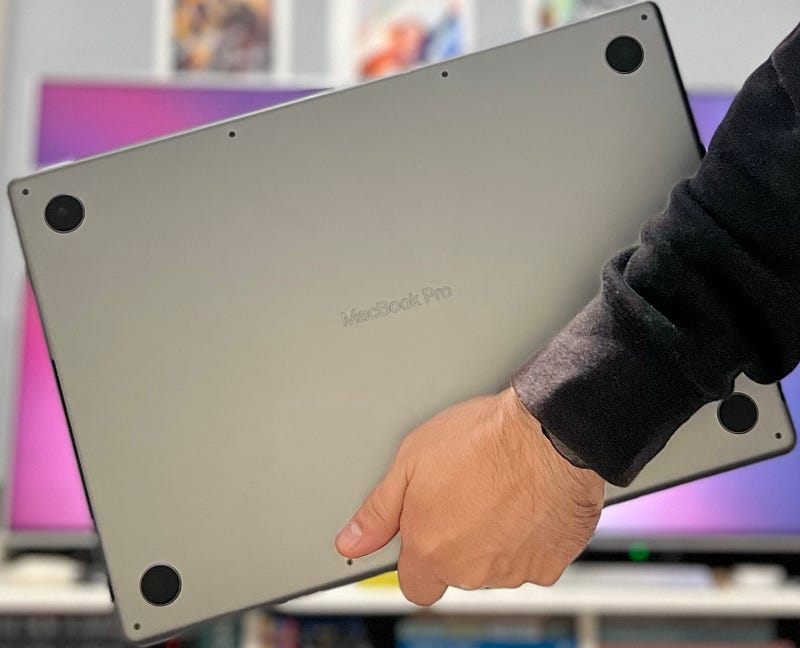
Photo by author
I sat on this one. I sat a month. I sat two. Three. I wrote a 6-month review about the 16” M1 Pro and M1 Max, and I kept avoiding the one topic that kept and keeps bugging me about Apple’s new MacBook design language. But now, seeing the M2 Airs at WWDC 2022, I really can’t keep it in any more. Even though I am well-aware how polarising the next few paragraphs will be, true to my mission of doing honest writing, and writing only about the things I genuinely care about, I’m going to say it: Apple’s new MacBook Pro and Air design is fragile. Not bad, but fragile.
I know there will be no half-way reactions here. Some of you will 100% agree, the rest of ye will 100% do the sharp opposite, but hear me out first. This post is not to rile anyone up, it’s not even an opportunistic move to cash in on the latest WWDC announcements through yet another story. This is me being genuinely worried about the physical integrity of Apple’s laptops going forward. Selfishly, I cared very little when similar worries were expressed by many Apple iPad Pro customers. I cared very little because I don’t use an iPad Pro, and even if I did, I would use it with a case. But that’s wrong. I was wrong not to care. This was a genuine problem for many users, and it should have mattered to me too because it’s not the first time Apple uses the bare minimum of aluminium and structural integrity on a device. Remember #bendGate on the iPhone 6? While that got solved, and we thought #neverAgain, well, the iPad Pro proved us wrong. And now the issue is back.
Apple seems to keep forgetting that with great thinness comes great responsibility…
I am not the first one to notice the worrisome flex in the backplate of the 14” and 16” MacBook Pros with the new design, but I did notice it the first moment I unboxed the machine. I thought I was imagining it, but then Snazzy pointed out the exact same thing, and Snazzy is rarely wrong! By far one of the most head-on-his-shoulders did-his-homework reviewer out there. And he confirmed the same thing!
Having been a MacBook Pro and Air user for about a decade now, I have had the pleasure of experiencing numerous chassis designs. All of those had one thing in common — they felt durable. Regardless of their slimness — think Air 11” or 13” or even 13”, 15” and 16” Intel Pros, they all felt like a fight-worthy tank. One of my first 2012 15” Retina MacBook Pros that I received second-hand went through a pretty nasty fall at some point, which left some pretty visible marks on the chassis. But guess what? Nothing broke. Used that machine for another five years or so and sold it in complete functioning order.
I honestly don’t believe my 16” M1 MacBook Pro would survive a fall. Either the logic board or the screen would be toast.
The screen part, we all understand why, I think. It’s glass. But why the logic board? You see, the backplate of the new MacBook designs seems to be thinner than ever. It almost feels uncharacteristically flimsy when taken off. This is bad for several reasons. First of all, aluminium is a fairly soft metal, so the thinner it is, the more fragile and bendable it becomes. Check out any photo from iFixit, and you’ll see that even the slightest bend in that backplate ends up touching the internal components. Now, up to a point this is probably not a major concern, but here’s what I’m thinking:
A fall hitting the back of the machine could transfer all that energy into the logic board, onto components, many of which are quite fragile.
Many of us are quite used to grabbing the laptop up with one hand, inevitably putting pressure on the backplate as we walk around the office or the house. If we do that while keeping the laptop horizontally with the screen open, it’s even more pressure.
People travel, and they place their laptops into various types of bags, in all sorts of positions. Not only that, they sometimes use them in very positionally awkward scenarios.
Users generally don’t think too much about how to carry a laptop, because they shouldn’t have to. Travelling or just moving around with these now feels like a much more conscious effort than before. I always used to slide my laptop into my carry-on with the screen side facing inside, because I knew the back was less prone to accidents. Now, however, one side has a screen, the other side has a flimsy bottom.
I don’t know how to handle and store Apple’s newly designed laptops any more to ensure they don’t get damaged in the process.
Maybe I am the weirdo here, but since I bought the 16” M1 Pro, I handle it like an egg. The old 2018 15” Intel? Just shove it into the drawer, stack a bunch of things on top, heck, another laptop even, not a care in the world. I am confident nothing is going to bend or crack. I am less confident about doing that with the new design, though.
And now the new M2 Air is getting the same design treatment, and likely a just as thin bottom as the 14” and 16” Pros. On the one hand, these will be smaller machines, and implicitly also lighter, which could mean that perhaps there are lesser risks for backplate bending with regular day-to-day use. But when it comes to travelling, I am still anxious. The thing is, most of us don’t put protective cases on our laptops, because seriously, we shouldn’t have to. Laptops are meant to be designed and built to whitstand being carried around all the time in all sorts of scenarios and environments. That’s their whole point; otherwise we’d still all be using Mac minis and Mac Pros.
I still think the old design was perfectly fine, just needed a couple of extra ports. Instead, we got fancy branding on the back of a thin sheet of borderline tinfoil.
Attila Vago — Software Engineer improving the world one line of code at a time. Cool nerd since forever, writer of codes and blogs. Web accessibility advocate, Lego fan, vinyl record collector. Loves craft beer!