avatarPen Magnet

Free AI web copilot to create summaries, insights and extended knowledge, download it at here

5683

Abstract

ve altered the desktop game forever, this news rarely caught anyone’s attention. <a href="https://www.bloomberg.com/news/articles/2020-11-18/apple-to-cut-app-store-fees-in-half-to-15-for-most-developers">Apple to cut app store fees in half to 15% for most developers starting January 1</a></p><ul><li>The cut will apply to small developers under <a href="https://www.apple.com/newsroom/2020/11/apple-announces-app-store-small-business-program/"><b>App Store Small Business </b></a>Program</li><li>The eligible developers will be those under 1M app store revenue under a single calendar year. All developers above 1M app store revenue will continue to pay a 30% cut</li><li>The change will take place across App Stores on the<b> iPhone, iPad, Mac, Apple TV, </b>and<b> Apple Watch</b>.</li><li>If the revenue falls below 1M / year, they will immediately return to 15% revenue share</li></ul><p id="c75a">The small developer community was quick to rejoice. <b>Curtis Herbert</b>, an indie developer and publisher of well-known App of the day (<b>22.2K+ ratings</b>) <a href="https://twitter.com/parrots/status/1329039102705094657">Slopes: Ski &amp; Snowboard</a>, tweeted:</p><figure id="d430"><img src="https://cdn-images-1.readmedium.com/v2/resize:fit:800/1*qzct8qt-QZ7g8qlM3jvhyg.png"><figcaption></figcaption></figure><p id="0172">There were dissenters too. <b>Hey</b> developer <b>DHH</b>, a well-known critique of Apple since Basecamp’s battle, <a href="https://twitter.com/dhh/status/1329043721313259521">cited the sole payment gateway</a> as extremely monopolistic.</p><p id="f939">Spotify, Apple’s prime competitor in music streaming and possibly unaffected by the change, also categorized the 15% move as <a href="https://www.bloomberg.com/news/articles/2020-11-18/apple-to-cut-app-store-fees-in-half-to-15-for-most-developers"><b>window-dressing</b></a>.</p><p id="5964">Apple is still <a href="https://ec.europa.eu/commission/presscorner/detail/en/ip_20_1073">battling with the EU</a> about its lack of an alternate payment processor mirroring the app store on iOS devices.</p><h1 id="706d">What does this mean for App Developers?</h1><p id="0dce" type="7">You bring home 850K a year, pre-tax.</p><p id="00e2">That it is way more lucrative to develop for Apple ecosystem, now more than ever.</p><p id="adee">With its industry-killing M1 macs, the desktop market is within reach for Apple. With its heavy cash flow, it is a matter of time it could also capture low-economy markets like Asia and Africa.</p><p id="4697">Since iOS Developers can now ship to M1 macs from the same codebase, it is much more value-yielding for an indie developer to develop for Apple.</p><p id="1d93">There are cross-platform tools that have benefitted developers since the arrival of React Native. However, Apple’s latest battle on privacy has forced its developers to rely less on the advertising-based revenue models and leverage Apple’s stronger hardware + latest iOS features (Core ML, ARKit, etc). Apple frequently showcases such outliers on its app store market.</p><p id="d4b2" type="7">Cross-platform tools face a grim future unlike no time in the recent past.</p><p id="5fa3">All things converging, cross-platform tools face a grim future unlike no time in the recent past.</p><div id="3afa" class="link-block"> <a href="https://readmedium.com/the-end-of-cross-platform-as-we-know-it-dad658d96b8"> <div> <div> <h2>The End of Cross-Platform as We Know It</h2> <div><h3>Rich devs’ hobby projects had it for too long</h3></div> <div><p>medium.com</p></div> </div> <div> <div style="background-image: url(https://miro.readmedium.com/v2/resize:fit:320/0*GiDf2Ch6qVEF3qxN)"></div> </div> </div> </a> </div><p id="a9fb">Startups/Indie developers who are starting out on a novel app/game and have no compulsion about the platform, have 3 options:</p><ol><li>Develop for Android and iOS using separate codebases. While Android might soon follow Apple’s 15% policy, this may still result in different revenue models because of Apple’s tighter control on in-app advertising. Google is an advertising company that cannot dump advertising. If a developer chooses the paid/subscription app model better suited for iOS, he/she has to adopt the same model on Android and be happy with the lesser Android payout.</li><li>Develop using Cross-platform tools (yet develop platform-specific code due to its shortcomings) and be ready for maintenance headaches and frequent jolts by Apple.</li><li>Develop for iOS + new macOS, thus target a much larger community using the same codebase (mostly in Swift which is much like Rust / Kotlin, or SwiftUI which is similar to React). Investment, always a bit more compared to Android development, is now less + much better with faster, newer macs costing < 1K for ultra-fast M1 Macbook Air. 15% rule under 1M applies, and if you hit big, you bring home <b>$850K a year</b>, pre-tax.</li></ol><p id="91e1">The community not only includes iOS/Mac users but also gamers who might switch from desktop game publishers like Steam to Apple’s gaming solution Apple Arcade, available under Apple one subscription.</p><p id="04c0">Apple Arcade is a much less talked-about weapon in Apple’s arsenal.</p><p id="fb3e">Apple invests <a href="https://www.gamesindustry.biz/articles/2019-11-25-why-are-developers-betting-on-apple-arcade">undisclosed amounts</a> in promising game studios to develop game experiences showcasing its superior hardware, and the payouts are anyone’s imagination. Since A

Options

pple is an entrant into the gaming market as a producer, and it promises an advertising-free in-game experience, it’s safe to assume it offers devs enough to avoid shipping to other platforms.</p><p id="5ee1" type="7">The only reason to develop from scratch for both platforms is if your app/game is not the primary source of your revenue model</p><p id="dd6c">The only reason to develop for both Android and iOS is if your app/game is not the primary source of your revenue model (e.g. retail/streaming app).</p><p id="6fd6">The other possible scenario is to be successful on one platform of your choice, then expand to the other. Here again, iOS+Mac wins on the developer revenue matrix, unless your target customer base is in a region where Apple products have lower penetration.</p><h1 id="b868">How much would this cost Apple?</h1><p id="60b6" type="7">Small iOS developers are starved from a viable revenue model. Now, Apple is fixing it.</p><p id="68ef">As I cited in my <a href="https://readmedium.com/heres-how-apple-should-respond-to-the-epic-1984-bait-df301b286628">previous article</a>, most app developers offer their apps for free. Indie developers also do not earn much revenue.</p><p id="a93a">In the absence of boost for advertising solutions that Apple just killed with iOS 14 with its tightest privacy measures, developers are starved from a viable revenue model. Now, Apple is beginning to fix it.</p><p id="b26d">According to <b>Bloomberg:</b></p><ul><li>85% of apps found on the App Store are free and aren’t part of the revenue fee system. This means that only 15% of apps are responsible for Apple’s service arm revenue from the existing 30% cut.</li><li>Shannon Cross, an analyst at Cross Research, estimated the fee changes will reduce Apple’s revenue by about 600 million in 2021, or just 3% of her firm’s projection for App Store sales.</li><li>Gene Munster of Loup Ventures estimated a larger hit of about 1.6 billion, or 0.5% of Apple’s total annual revenue.</li></ul><h1 id="dc4d">Conclusion:</h1><p id="2538" type="7">For a small developer who is starting out, 1M / year is a much better promise with a 15% cut. And it’s easily reachable because of single-codebase platforms.</p><p id="0864">With pandemic, the industry is up for fragmentation. Huge enterprises are breaking up. Whenever such an event occurs, small and indie developers flourish. The pandemic was &amp; is also the best time when millions of developers are upgrading their skillset.</p><p id="b8c6">With a lot of radical business decisions taken by Apple this year, it is much more rewarding for new programmers to be in the Apple ecosystem.</p><p id="0404">It doesn’t matter whether it is to quickly get a job, or roll out one’s own Apple app and earn big in small time.</p><p id="1f1a">The ROI is higher than at any time since 2008–2010 when the App Store was freshly launched. It doesn’t matter how big players (Spotify, Epic, Basecamp et al) evaluate Apple’s ecosystem.</p><p id="9092">For a small developer who is starting out, 1M / year is a much better promise with a 15% cut. And it’s easily reachable because of all compatible platforms.</p><p id="3b90">One only has to roll a dice.</p><h2 id="fc71">More on Apple + App Store:</h2><div id="f6b0" class="link-block"> <a href="https://readmedium.com/the-next-big-thing-that-apple-must-do-7fb90eab4d11"> <div> <div> <h2>The Next Big Thing That Apple Must Do</h2> <div><h3>Hint: It’s not a new hardware</h3></div> <div><p>medium.com</p></div> </div> <div> <div style="background-image: url(https://miro.readmedium.com/v2/resize:fit:320/0*JxA7BI_hA6VYdilQ)"></div> </div> </div> </a> </div><div id="2067" class="link-block"> <a href="https://readmedium.com/heres-how-apple-should-respond-to-the-epic-1984-bait-df301b286628"> <div> <div> <h2>Here’s How Apple Should Respond to the Epic 1984 Bait</h2> <div><h3>Developers are suppliers, not consumers.</h3></div> <div><p>medium.com</p></div> </div> <div> <div style="background-image: url(https://miro.readmedium.com/v2/resize:fit:320/0*U0PFmy89AhwSElwR)"></div> </div> </div> </a> </div><div id="4db5" class="link-block"> <a href="https://readmedium.com/the-end-of-cross-platform-as-we-know-it-dad658d96b8"> <div> <div> <h2>The End of Cross-Platform as We Know It</h2> <div><h3>Rich devs’ hobby projects had it for too long</h3></div> <div><p>medium.com</p></div> </div> <div> <div style="background-image: url(https://miro.readmedium.com/v2/resize:fit:320/0*GiDf2Ch6qVEF3qxN)"></div> </div> </div> </a> </div><div id="7470" class="link-block"> <a href="https://readmedium.com/the-next-app-store-will-be-designed-by-neural-engineers-a6495ac71f6"> <div> <div> <h2>Next App Store Will Be Designed By Neural Engineers</h2> <div><h3>Your girlfriend + 23 others know whom you secretly adore</h3></div> <div><p>medium.com</p></div> </div> <div> <div style="background-image: url(https://miro.readmedium.com/v2/resize:fit:320/0*lR2QVJNsfYGXj2Am)"></div> </div> </div> </a> </div></article></body>

Apple’s 15% Cut: Developers’ Most Direct Path to $850K/year

Photo by Frankie Valentine on Unsplash

UPDATE (6th Jan 2021):

The figures are actually higher: $1M proceeds are allowed before 30% kicks in, instead of the stated $850K. This was due to misinterpreted news at the time of writing this. Thank you @sercand8i for pointing this out. Bit late to change the title, hence the update.

Past its first announcement of Apple Silicon-based macs in June 2020, the world has been in a constant state of awe how Apple could possibly ditch Intel.

But it happened. I wrote about it in June already.

I had forecasted: The developer base for Apple will consolidate, and it would be much more lucrative to develop for Apple.

However, the true driver for Apple Silicon is common hardware platform for all apps under Apple’s roof: iOS and MacOS all running on same ARM based chipset. It is one of the many steps in Apple’s answer to cross platform development, leveraging large number of iOS Dev’s work to recreate the app store magic on mac platform.

The Epic Battle:

Soon after, Apple was embroiled in a legal spat with Epic, the creator of Fortnite. The game creator sued Apple for not allowing an alternate payment gateway on iOS devices.

iOS Developers, especially huge ones, nodded their heads in agreement: They all thought 30% was ridiculous. Many also agreed with Epic that 30% did not align with Apple’s costs for app publishing and marketing, given the sheer number of 1.8M+ apps.

On the face of it, Epic objected to the mammoth 30% cut. In hindsight, it was opposed to Apple’s sole right to be the payment processor, which doesn’t allow an alternate app market on iOS devices, unlike Android, which allows it.

The claim was in line with the sale of its own Unreal ecosystem games.

It was during this battle that I had listed possible reasons why Apple should take up this challenge to:

  • Put the money where the mouth is i.e. Services division, from where 2nd biggest pie of Apple revenue is coming from. The infamous 30% cut belongs to this revenue segment, and most developers are victims of it.
  • To realign with the developer community in the same spirit that existed in 2008 when it announced App Store with 70% developer cut — the first of its kind in the industry at that time

In my above article, the #1 suggestion was dynamic pricing — the most logical step any company would do to retain its supplier base along with its revenue.

Developers are suppliers in the app ecosystems. While Apple made history by being the first to create a groundbreaking software market with an unprecedented 70%-30% ratio, it is well beyond its point of breakeven.

It is time to empower the hand that feeds its mouth. It is time to alter the game again. If Apple does that, Google is sure to follow.

An ecosystem increasingly dependent on its suppliers revenue cut to grow its next flagship arm is a time-bomb

The writing on the wall was clear: If you provide a clear path to upward economic mobility for your developers, they will continue flocking to you with their best creations.

Seems Apple has followed.

The 15% Cut News:

App developers with < $1M / year revenue will pay 15% to Apple starting January 2021, instead of the usual 30%

Amid much noise about brand new M1 macs that have altered the desktop game forever, this news rarely caught anyone’s attention. Apple to cut app store fees in half to 15% for most developers starting January 1

  • The cut will apply to small developers under App Store Small Business Program
  • The eligible developers will be those under $1M app store revenue under a single calendar year. All developers above $1M app store revenue will continue to pay a 30% cut
  • The change will take place across App Stores on the iPhone, iPad, Mac, Apple TV, and Apple Watch.
  • If the revenue falls below $1M / year, they will immediately return to 15% revenue share

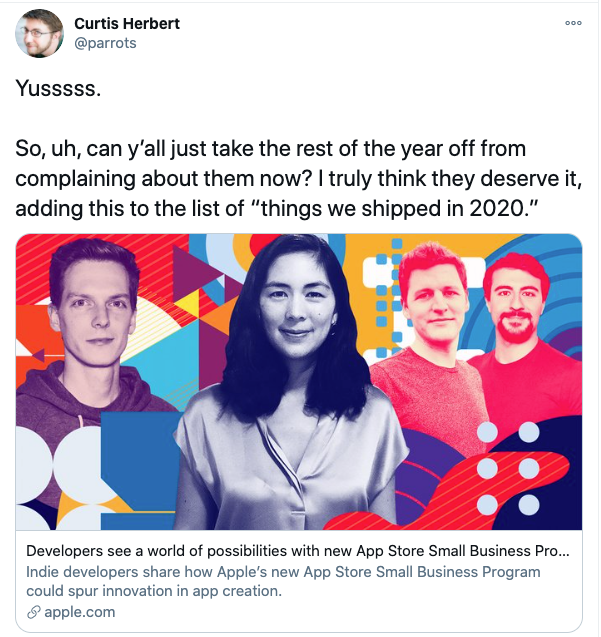
The small developer community was quick to rejoice. Curtis Herbert, an indie developer and publisher of well-known App of the day (22.2K+ ratings) Slopes: Ski & Snowboard, tweeted:
There were dissenters too. Hey developer DHH, a well-known critique of Apple since Basecamp’s battle, cited the sole payment gateway as extremely monopolistic.

Spotify, Apple’s prime competitor in music streaming and possibly unaffected by the change, also categorized the 15% move as window-dressing.

Apple is still battling with the EU about its lack of an alternate payment processor mirroring the app store on iOS devices.

What does this mean for App Developers?

You bring home $850K a year, pre-tax.

That it is way more lucrative to develop for Apple ecosystem, now more than ever.

With its industry-killing M1 macs, the desktop market is within reach for Apple. With its heavy cash flow, it is a matter of time it could also capture low-economy markets like Asia and Africa.

Since iOS Developers can now ship to M1 macs from the same codebase, it is much more value-yielding for an indie developer to develop for Apple.

There are cross-platform tools that have benefitted developers since the arrival of React Native. However, Apple’s latest battle on privacy has forced its developers to rely less on the advertising-based revenue models and leverage Apple’s stronger hardware + latest iOS features (Core ML, ARKit, etc). Apple frequently showcases such outliers on its app store market.

Cross-platform tools face a grim future unlike no time in the recent past.

All things converging, cross-platform tools face a grim future unlike no time in the recent past.

Startups/Indie developers who are starting out on a novel app/game and have no compulsion about the platform, have 3 options:

  1. Develop for Android and iOS using separate codebases. While Android might soon follow Apple’s 15% policy, this may still result in different revenue models because of Apple’s tighter control on in-app advertising. Google is an advertising company that cannot dump advertising. If a developer chooses the paid/subscription app model better suited for iOS, he/she has to adopt the same model on Android and be happy with the lesser Android payout.
  2. Develop using Cross-platform tools (yet develop platform-specific code due to its shortcomings) and be ready for maintenance headaches and frequent jolts by Apple.
  3. Develop for iOS + new macOS, thus target a much larger community using the same codebase (mostly in Swift which is much like Rust / Kotlin, or SwiftUI which is similar to React). Investment, always a bit more compared to Android development, is now less + much better with faster, newer macs costing < $1K for ultra-fast M1 Macbook Air. 15% rule under $1M applies, and if you hit big, you bring home $850K a year, pre-tax.

The community not only includes iOS/Mac users but also gamers who might switch from desktop game publishers like Steam to Apple’s gaming solution Apple Arcade, available under Apple one subscription.

Apple Arcade is a much less talked-about weapon in Apple’s arsenal.

Apple invests undisclosed amounts in promising game studios to develop game experiences showcasing its superior hardware, and the payouts are anyone’s imagination. Since Apple is an entrant into the gaming market as a producer, and it promises an advertising-free in-game experience, it’s safe to assume it offers devs enough to avoid shipping to other platforms.

The only reason to develop from scratch for both platforms is if your app/game is not the primary source of your revenue model

The only reason to develop for both Android and iOS is if your app/game is not the primary source of your revenue model (e.g. retail/streaming app).

The other possible scenario is to be successful on one platform of your choice, then expand to the other. Here again, iOS+Mac wins on the developer revenue matrix, unless your target customer base is in a region where Apple products have lower penetration.

How much would this cost Apple?

Small iOS developers are starved from a viable revenue model. Now, Apple is fixing it.

As I cited in my previous article, most app developers offer their apps for free. Indie developers also do not earn much revenue.

In the absence of boost for advertising solutions that Apple just killed with iOS 14 with its tightest privacy measures, developers are starved from a viable revenue model. Now, Apple is beginning to fix it.

According to Bloomberg:

  • 85% of apps found on the App Store are free and aren’t part of the revenue fee system. This means that only 15% of apps are responsible for Apple’s service arm revenue from the existing 30% cut.
  • Shannon Cross, an analyst at Cross Research, estimated the fee changes will reduce Apple’s revenue by about $600 million in 2021, or just 3% of her firm’s projection for App Store sales.
  • Gene Munster of Loup Ventures estimated a larger hit of about $1.6 billion, or 0.5% of Apple’s total annual revenue.

Conclusion:

For a small developer who is starting out, $1M / year is a much better promise with a 15% cut. And it’s easily reachable because of single-codebase platforms.

With pandemic, the industry is up for fragmentation. Huge enterprises are breaking up. Whenever such an event occurs, small and indie developers flourish. The pandemic was & is also the best time when millions of developers are upgrading their skillset.

With a lot of radical business decisions taken by Apple this year, it is much more rewarding for new programmers to be in the Apple ecosystem.

It doesn’t matter whether it is to quickly get a job, or roll out one’s own Apple app and earn big in small time.

The ROI is higher than at any time since 2008–2010 when the App Store was freshly launched. It doesn’t matter how big players (Spotify, Epic, Basecamp et al) evaluate Apple’s ecosystem.

For a small developer who is starting out, $1M / year is a much better promise with a 15% cut. And it’s easily reachable because of all compatible platforms.

One only has to roll a dice.

More on Apple + App Store:

iOS
Programming
Apple
Macos
Startup
Recommended from ReadMedium