
The Next Big Thing That Apple Must Do
Apple Car is already slated in 2024. That’s not what I am talking about.
It’s neither the phone with curved glass nor an out-of-the-world AR headset. Those are the things already announced. Again, I wouldn’t categorize them as big yet, given Apple’s last-minute secrecy around future product releases.
A New Hardware? (maybe not)
But it must be innovative enough, for sure.
After Steve’s demise, the word has been out that innovation had died in Apple. Nothing could be farther from the truth, though. Apple’s product line was the result of decade-long planning. Every release, planned surrounding a flashy marketing event, was micro-created to maximize profits.
It’s not unlike a suspense novel. As every layer is peeled, the story unfolds, to maximize the pleasure of the reader. In the end, it feels all nonsensical, but an experience, nonetheless.
Following the same philosophy, Apple came up with industry-shaking macs with M1. As of now, Intel is still reeling.
Apple has time and again proved. Stats or no stats, it knows how to rule the hardware kingdom.
Hardware Is Crucial, But It Is Also Hard:
To me, new, shiny, performant hardware every year is something Apple has to compulsively do, to maintain its pro-innovation image.
Its software innovations are superior, too, but they piggyback strongly on its hardware. Apple’s core focus is the consumer, not an enterprise. As Steve Jobs stated it many times:
Consumer has the real power to vote with her money. In Enterprise, people making purchase decisions are not the ones who use the product. As a result, they often make confusing decisions.
To please consumers, Apple must sell personal experiences. To make it sustainably possible, hardware must be the center point.
And Apple has done it quite efficiently over years. With experience, its supply chains are stronger than ever. The more difficult era of the China-US trade war is over. There is no threat to its position in profitability, at least on its existing product lines of iPhones and iPads.
Sustaining this momentum is difficult, though. Most hardware innovations are usually driven by costly patent acquisitions. Patents are not only hard to find, but also difficult to acquire, given the legalities surrounding their acquisitions.
Yet, acquisitions are the primary ways big tech companies innovate because they are the only ones who can afford it. They execute this strategy by acquiring small to medium size, specialized startups.
Apple’s core OS (including macOS, iOS, watchOS, and tvOS) is the result of the acquisition of NeXT (1997) — the company Steve Jobs found soon after his stormy exile from Apple previously.
Some other acquisitions, if you happen to remember them:
- Beats Electronics — AirPods
- AuthenTec — Touch ID
- PrimeSense — Face ID
- C3 Technologies — Apple Maps
- SRI International Artificial Intelligence Center — Siri
Apple’s list of mergers and acquisitions is much longer, in case you are curious. The length of the list (especially growing@speed since Steve’s demise) itself proves that:
- Not all of them have been useful to Apple
- Most of them are made to thwart potential competition
- Many of them aren’t in line with Apple’s long-term future directions — something the company was very adamant to believe in, during Steve’s time.
Beyond Hardware — Content+Data & The X Factor:
In recent years, Apple’s focus has been to deflect its profit from its main product: iPhone. Its main arsenal to accomplish this has been Apple Services.
iTunes has already been successful for 2 decades, but it is fading compared to new entrants like Spotify. In the streaming media space, Amazon Prime and Netflix rule supreme. Apple TV is far behind when it comes to content, especially when formidable player Disney is also present in the arena.
To make itself hardware-independent, Apple is trying to aggressively sell services — currently mainly bundled as Apple One subscription. It’s nothing but a new name to the bundle of things consumers already know: Apple TV, Apple News, Apple Music (iTunes), iCloud. Only Arcade and Fitness+ are the novel additions.
Don’t forget, the App Store ecosystem is also part of Apple Services. But recently, the App Store monopoly has been keeping Apple busy in lawsuits with EU and Epic. To prevent antagonizing itself against the developer community, Apple had to reduce its subscription commission rate to 15%.
But in general, services — sold via content — require cash burn. When we speak of content, we speak of all media, along with apps and games, too.
Content (barring apps and games on the App store) is costly to acquire. With so many options available in the market, Apple One will be a hard sell at least for some years, unless some groundbreaking twist thwarts its opponents.
On top of this, content is also costly to store, manage, and deliver. Here is where the X-factor steps in, which decides how quickly any content-driven company can scale.
That X-Factor is cloud spend.
The Achilles’ Heel:
Netflix predicts that it will spend around $1 Billion in its yearly AWS spend by 2021.
Dropbox saved $75M by moving away from cloud.
Lyft planned to spend $300M in 2021.
Airbnb reduced its annual cloud spend from $240M to $150M — to make itself sustainable amid the pandemic, according to a report last year.
Cloud spend is the elephant in the room for a software company’s profitability.
In the early days when the cloud was absent, it was a costly affair to establish a company. The main factor was: Prohibitive server costs. With cloud technology, it became incredibly easy and cheap.
Cloud helps not only reduce infrastructure costs. It also eliminates the need to hire DevOps — qualified programmers/developers that have historically maintained on-premises servers. Today, a company relying on cloud tech only hires DevOps in case it is absolutely needed and justified, only to manage its cloud operations.
Under $500, any startup entrepreneur can make a proof of concept demo over any public cloud (AWS, GCP, Azure, IBM), and raise a million to spend much more and scale.
It is here that the real story begins, though. Cloud providers lay down the free-trial red carpet to startup founders, only to enable frictionless entry and an enlarged customer base. It is not unlike software free trials, a practice well established since the dawn of the internet.
Big cloud spending is the Achilles' heel for companies on the growth curve. All pricing plans and buckets are designed to bleed more investor money. More often than not, investment is also made directly in terms of cloud credits. Founders have little say in directing the flow of money. Cloud spend becomes a must.
According to a research paper recently posted by Andressen Horowitz, the top 100 publicly listed companies lose $100 Billion in valuations due to increased cloud spend. In the same paper, it is cited that DropBox saved around $75m over two years by shifting the majority of their workloads to lower-cost, custom-built infrastructure in co-location facilities, directly leased and operated by Dropbox.
When a company moves from growing to big, cloud spend becomes astronomical + impossible to eliminate, for obvious reasons.
- The advantages are flexibility and comfort. The managed solutions being bundled with cloud are too hard to resist.
- In any tech company, developers are at the helm of making cloud adoption decisions. Unless their jobs are threatened, they would rarely support the go-cloudless move. After all, they built the cloud skillset just to remain relevant and comfortable. (Majority devs earn a cloud certification past paying cloud providers)
If such is the case of the compulsive server cost in big companies, what will be the impact on the infrastructure of really huge companies?
Out of the big 5, Amazon, Google and Microsoft have their own Profitable (with a capital P) cloud solutions:
- AWS — revenue $13.5B last quarter
- Microsoft —revenue $7.8B last quarter
- Google —revenue $3.5B last quarter
Facebook:
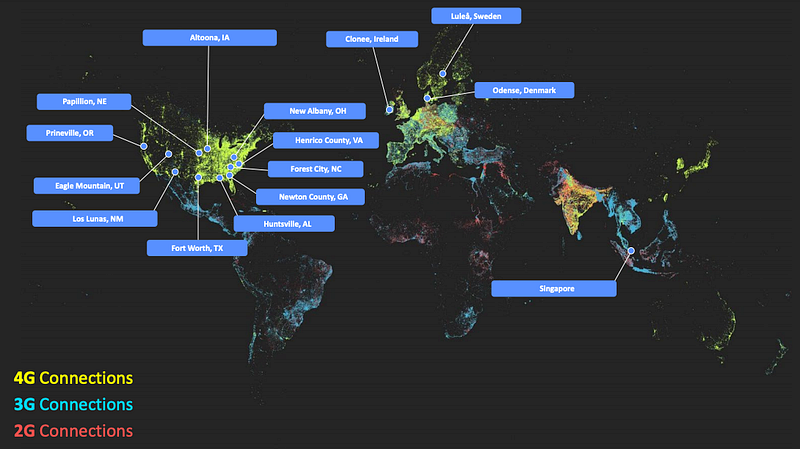
Due to its custom storage needs, and to make itself energy-efficient and also share its outcomes with the world, Facebook started Open Compute Project in 2011. So far, Facebook has been maintaining it. Instagram, after the acquisition with Facebook, also migrated from AWS to Facebook’s data centers. In other words, Facebook relies on its own private servers across the world.
That leaves out just one company: Your favorite.
The Secret:
Apple uses Google Cloud to store its data.
Not that it might be a secret — but only less known so far. Now it is known, due to a report that cites that Apple’s GCP spend might touch $300M this year. Apple’s data needs are astronomical, and the report shows it: 8 exabytes (= 8 billion Gigabytes) only on GCP.
$300M is minuscule compared to Apple’s valuation in trillions. Apple must surely be maintaining most of its data on its own servers, for sure.
But if this report is correct, it is fair to assume most of its iCloud data is also stored on Google servers. In fact, it is increasing usage of such services which has caused its GCP bill to spike.
According to a report in 2019, Apple has also been a leading customer of AWS, to store its iCloud data. Annual figure? Around $360M.
Apple Must Build Its Own Cloud:
An argument: Many such deals are the result of mutual dependency.
For example, AWS depends on Apple for its mac servers. Google pays billions to Apple to keep itself the default search engine on iPhones.
However, data needs grow exponentially. With 5G + sensor-based IoT devices (fitness trackers, Apple Car et al), the load will become limitless too soon. Recently, Apple also announced XCode Cloud — a utility for app developers to work collaboratively on the same codebase stored in the iCloud.
Not that Apple can’t handle its growing data needs. But has it predicted it?
Apple depending on other cloud providers also acts against its own privacy-focused stance. GCP must be sure as hell the safest cloud place to store Apple users’ data. But what about the public perception when Apple names Android as a malware-ridden system?
It isn’t hard for Apple to build its own cloud. If only it has the vision to build one.
For Amazon, AWS was a tool it developed to combat its growing retail data needs. Later on, it became the lion’s share in its profitability.
For Microsoft, Azure (Project Red Dog) was an extension to Windows NT system that was supposed to enable a single compute unit, sharable across multiple nodes. Azure was not only supremely profitable; it also transformed Microsoft inside out from an archaic 70s systems megalith to the 21st century IT services company.
What has kept Apple from adopting similar development is a mystery, at best. Like many other things coming from Apple.
Conclusion:
Apple’s philosophy: Originality & control over dependency
Apple’s deep-rooted philosophy has often favored originality & control over dependency. Own cloud development is in line with this philosophy.
Privacy is a great stance taken by Apple. But it is also a high moral ground, which must be continually ascended. Apple always sets the bar higher, and its customers will not like it being lowered for something as crucial as their personal data.
Having an external entity controlling its user data is a dependency it can easily & surely do without.
True, own cloud isn’t innovative enough like its flashing and amazing iProducts. It could be released at an event that no one except tech journalists and Apple devs will talk about.
But sooner Apple pulls it off, it will be much more profitable for its own services business.
If Apple goofs it up (like it did initially with maps), it would still retain a face to show to its privacy-focused customers.
Apple has nothing to lose.