avatarJillian Enright

Free AI web copilot to create summaries, insights and extended knowledge, download it at here

4096

Abstract

on of <a href="https://my.clevelandclinic.org/health/symptoms/24995-synesthesia">synesthesia</a>.</p><p id="bd24">Synesthesia happens when a person’s brain routes sensory information through multiple unrelated senses, causing them to experience more than one sense simultaneously.</p><p id="10d3">For example, some people see colours when they hear music they enjoy. Others have strong, consistent associations between numbers and colours.</p><p id="f9fa">Synesthesia is also more common in Autistics and is <a href="https://doi.org/10.1093/texcom/tgab035">linked to hyperphantasia</a>. However, one does not need to be Autistic nor hyperphantasic to experience synesthesia.</p><h2 id="5885">The beauty of neurodiversity</h2><p id="0bbc"><a href="https://readmedium.com/neurodiversity-101-458cf57c1519">Neurodiversity</a> refers to any type of brain which is different from the statistical norm. All of the above-mentioned differences are examples of this.</p><p id="a0e0">These interesting and unique variations in our cognitive styles, abilities, and experiences are all examples of <a href="https://readmedium.com/what-is-neurodiversity-b0e6e902ef9a">neurodiversity</a> in humans. No two brains are exactly alike, but some are a lot more similar than others.</p><p id="c2bb">Neurodiversity is a neutral term. It does not offer a value judgement as to whether a difference is good or bad, negative or positive. It is simply <i>different</i>.</p><p id="750f">We, as a society, need people whose brains operate well outside the statistical norm. This is not only fundamental biology — divergent brains bring us incredible inventions, scientific breakthroughs, and compelling artwork of all kinds.</p><p id="a7d3">We don’t need to have special “powers” or abilities in order to be valuable as divergent human beings, but we can certainly appreciate the results stemming from our most unique thinkers and doers.</p><p id="9f4d">© Jillian Enright, Neurodiversity MB</p><h2 id="0a20">Related articles</h2><div id="2a12" class="link-block"> <a href="https://readmedium.com/autism-and-face-blindness-b16523783de0"> <div> <div> <h2>Autism And Prosopagnosia</h2> <div><h3>“Face blindness” and difficulty recognizing people by facial features</h3></div> <div><p>medium.com</p></div> </div> <div> <div style="background-image: url(https://miro.readmedium.com/v2/resize:fit:320/1*QpRv8rgDAncLl4jbX32wjA.png)"></div> </div> </div> </a> </div><div id="7d83" class="link-block"> <a href="https://readmedium.com/working-memory-explained-cb8416846524"> <div> <div> <h2>Working Memory Explained</h2> <div><h3>What exactly is this ‘working memory’ thing?</h3></div> <div><p>medium.com</p></div> </div> <div> <div style="background-image: url(https://miro.readmedium.com/v2/resize:fit:320/1*hr551GboZaDO5MpCjAPX3g.png)"></div> </div> </div> </a> </div><div id="650a" class="link-block"> <a href="https://readmedium.com/autism-q-a-e6f2d006fb40"> <div> <div> <h2>Frequently Asked Questions About Autism</h2> <div><h3>Answering the most common questions I receive about Autism</h3></div> <div><p>medium.com</p></div> </div> <div> <div style="background-image: url(https://miro.readmedium.com/v2/resize:fit:320/1*Vj3R7Ux1SaxZdQ9WCri0tg.png)"></div> </div> </div> </a> </div><h2 id="ee3f">Ways to support my work</h2><p id="bbf9">You can leave a “tip” on Ko-Fi at <a href="https://Ko-Fi.com/NeurodiversityMB">https://Ko-Fi.com/NeurodiversityMB</a></p><p id="4ec9">Become a paid subscriber to <a href="https://twoemb.substack.com">my Substack publication</a></p><p id="876a">Check out my online store at <

Options

a href="https://NeurodiversityMB.ca/shop">https://NeurodiversityMB.ca/shop</a></p><p id="3afd">Read and share my articles from <a href="https://twoemb.medium.com">twoemb.medium.com</a></p><h2 id="5ac3">Learn more</h2><div id="851d" class="link-block"> <a href="https://readmedium.com/what-is-neurodiversity-b0e6e902ef9a"> <div> <div> <h2>The Significance Of The Neurodiversity Movement</h2> <div><h3>Exploring the meaning of the word and the significance of the neurodiversity movement.</h3></div> <div><p>medium.com</p></div> </div> <div> <div style="background-image: url(https://miro.readmedium.com/v2/resize:fit:320/1*zbnoKCjNNw47JcL87aFE-g.png)"></div> </div> </div> </a> </div><div id="5eaf" class="link-block"> <a href="https://readmedium.com/neurodiversity-101-458cf57c1519"> <div> <div> <h2>Neurodiversity 101</h2> <div><h3>For anyone new to neurodiversity and wanting to learn more</h3></div> <div><p>medium.com</p></div> </div> <div> <div style="background-image: url(https://miro.readmedium.com/v2/resize:fit:320/1*Gv2Ow71mvP5Fy7rLvP5sbg.png)"></div> </div> </div> </a> </div><div id="167f" class="link-block"> <a href="https://readmedium.com/adhd-and-autistic-assets-8774fa631500"> <div> <div> <h2>ADHD And Autistic Assets</h2> <div><h3>The strengths and gifts of divergent minds</h3></div> <div><p>medium.com</p></div> </div> <div> <div style="background-image: url(https://miro.readmedium.com/v2/resize:fit:320/1*9GPKcCAkzDFp64GL_VhZPA.jpeg)"></div> </div> </div> </a> </div><h2 id="befe">References</h2><p id="a4e7">Dance, C.J., Ipser, A., Simner, J. (2022). The prevalence of aphantasia (imagery weakness) in the general population. <i>Consciousness and Cognition, 97</i>, 103243. <a href="https://doi.org/10.1016/j.concog.2021.103243">https://doi.org/10.1016/j.concog.2021.103243</a></p><p id="8a10">Dance, C.J., Jaquiery, M., Eagleman, D.M.E., Porteous, D., Zeman, D., Simner, J. (2021). What is the relationship between Aphantasia, Synaesthesia and Autism? <i>Consciousness and Cognition, 89</i>, 103087. <a href="https://doi.org/10.1016/j.concog.2021.103087">https://doi.org/10.1016/j.concog.2021.103087</a></p><p id="0965">Jacobs, C., Schwarzkopf, D.S., Silvanto, J. (2018). Visual working memory performance in aphantasia. <i>Cortex, 105</i>, 61–73. <a href="https://doi.org/10.1016/j.cortex.2017.10.014">https://doi.org/10.1016/j.cortex.2017.10.014</a></p><p id="8ed3">Keogh, R., Wicken, M., Pearson, J. (2021). Visual working memory in aphantasia: Retained accuracy and capacity with a different strategy, <i>Cortex, 143,</i> 237–253. <a href="https://doi.org/10.1016/j.cortex.2021.07.012">https://doi.org/10.1016/j.cortex.2021.07.012</a></p><p id="f3fc">Milton, F., Fulford, J., Dance, C., Gaddum, J., Heuerman-Williamson, B., Jones, K., Knight, K. F., MacKisack, M., Winlove, C., & Zeman, A. (2021). Behavioral and Neural Signatures of Visual Imagery Vividness Extremes: Aphantasia versus Hyperphantasia. <i>Cerebral cortex communications</i>, <i>2</i>(2). <a href="https://doi.org/10.1093/texcom/tgab035">https://doi.org/10.1093/texcom/tgab035</a></p><p id="3c42">Monzel, M., Dance, C., Azañón, E., Simner, J. (2023). Aphantasia within the framework of neurodivergence: Some preliminary data and the curse of the confidence gap. <i>Consciousness and Cognition, 115</i>, 103567. <a href="https://doi.org/10.1016/j.concog.2023.103567">https://doi.org/10.1016/j.concog.2023.103567</a></p><figure id="161d"><img src="https://cdn-images-1.readmedium.com/v2/resize:fit:800/1*2vpsOuvaISBnzNNKI-9lqg.png"><figcaption></figcaption></figure></article></body>

Aphantasia and Autism

What is aphantasia, and how does it relate to neurodivergence?
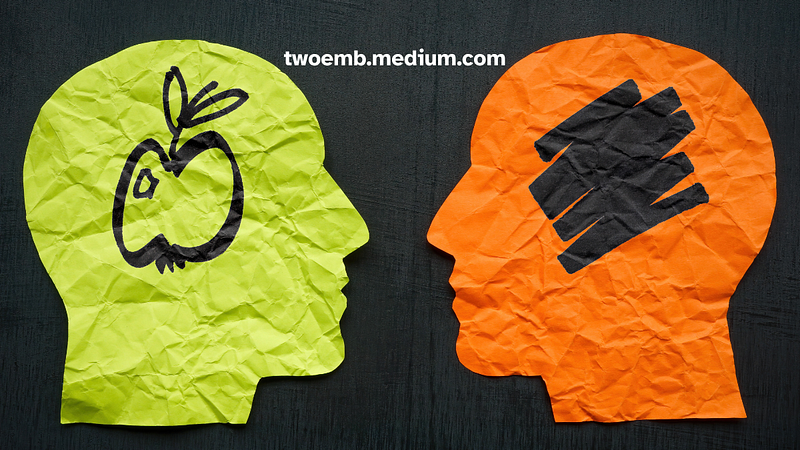
Created by author on Canva

Aphantasia

Aphantasia is the inability to form mental images, to visualize, or to create pictures in our mind.

For example: think of a book. Close your eyes if it helps.

What comes to mind for you?
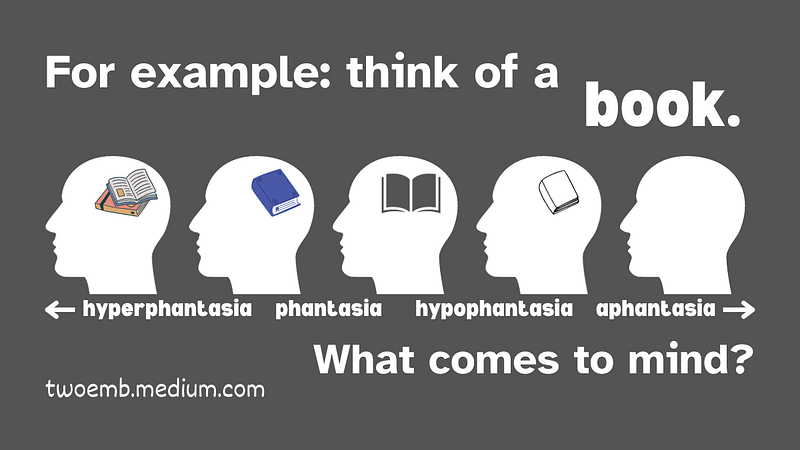
Image created by author

Some people can form very intricate, vivid mental pictures.

When thinking of a book they may be able to clearly visualize the book cover, its colours, the font type, the artwork or pictures, the words. This is sometimes called hyperphantasia.

Some people can form quite accurate, detailed mental pictures which are slightly less vivid.

When thinking of a book they may be able to call up a fairly clear image of the book cover in their minds, remembering particular details about how it looked.

Some people can form somewhat solid mental pictures, but with slightly less detail.

When thinking of a book they may be able to visualize salient aspects of the cover, details that stuck out for them, but in less intricate detail as compared to the previous two examples. This is sometimes called phantasia.

Some people can form only basic mental pictures with very minimal detail.

When thinking of a book they may be able to visualize salient aspects of the cover, details that stuck out for them, but with much less detail as compared to the previous two examples.

Perhaps they can only imagine the outline of the book, but no details at all. This is sometimes called hypophantasia.

Some people cannot form any type of mental image whatsoever.

When thinking of a book they may remember information such as the title, the author’s name, or non-visual details from their semantic memory. They will have no picture in their head at all.

This is what is called aphantasia.

The relationship to Autism

While not everyone with aphantasia is Autistic, aphantasia has been linked to an increase in Autistic traits. Similarly, while not all Autistics have aphantasia, we are more likely to have it compared with the general population.

Aphantasia can potentially lend itself to other related difficulties, such as prosopagnosia (“face blindness”).

It was previously assumed that aphantasia would cause issues with visual memory, however the evidence has not borne that out.

Studies have shown aphantasia does not impact academic performance, when other factors are controlled and accounted for, and that people with poor mental imagery can — and do — develop alternative strategies for learning and memorization.

Hyperphantasia

On the other side of the visualization spectrum is the ability to create incredibly vivid and detailed mental images, called hyperphantasia.

Hyperphantasia could contribute to increased artistic skill, visual memory, and the phenomenon of synesthesia.

Synesthesia happens when a person’s brain routes sensory information through multiple unrelated senses, causing them to experience more than one sense simultaneously.

For example, some people see colours when they hear music they enjoy. Others have strong, consistent associations between numbers and colours.

Synesthesia is also more common in Autistics and is linked to hyperphantasia. However, one does not need to be Autistic nor hyperphantasic to experience synesthesia.

The beauty of neurodiversity

Neurodiversity refers to any type of brain which is different from the statistical norm. All of the above-mentioned differences are examples of this.

These interesting and unique variations in our cognitive styles, abilities, and experiences are all examples of neurodiversity in humans. No two brains are exactly alike, but some are a lot more similar than others.

Neurodiversity is a neutral term. It does not offer a value judgement as to whether a difference is good or bad, negative or positive. It is simply different.

We, as a society, need people whose brains operate well outside the statistical norm. This is not only fundamental biology — divergent brains bring us incredible inventions, scientific breakthroughs, and compelling artwork of all kinds.

We don’t need to have special “powers” or abilities in order to be valuable as divergent human beings, but we can certainly appreciate the results stemming from our most unique thinkers and doers.

© Jillian Enright, Neurodiversity MB

Related articles

Ways to support my work

You can leave a “tip” on Ko-Fi at https://Ko-Fi.com/NeurodiversityMB

Become a paid subscriber to my Substack publication

Check out my online store at https://NeurodiversityMB.ca/shop

Read and share my articles from twoemb.medium.com

Learn more

References

Dance, C.J., Ipser, A., Simner, J. (2022). The prevalence of aphantasia (imagery weakness) in the general population. Consciousness and Cognition, 97, 103243. https://doi.org/10.1016/j.concog.2021.103243

Dance, C.J., Jaquiery, M., Eagleman, D.M.E., Porteous, D., Zeman, D., Simner, J. (2021). What is the relationship between Aphantasia, Synaesthesia and Autism? Consciousness and Cognition, 89, 103087. https://doi.org/10.1016/j.concog.2021.103087

Jacobs, C., Schwarzkopf, D.S., Silvanto, J. (2018). Visual working memory performance in aphantasia. Cortex, 105, 61–73. https://doi.org/10.1016/j.cortex.2017.10.014

Keogh, R., Wicken, M., Pearson, J. (2021). Visual working memory in aphantasia: Retained accuracy and capacity with a different strategy, Cortex, 143, 237–253. https://doi.org/10.1016/j.cortex.2021.07.012

Milton, F., Fulford, J., Dance, C., Gaddum, J., Heuerman-Williamson, B., Jones, K., Knight, K. F., MacKisack, M., Winlove, C., & Zeman, A. (2021). Behavioral and Neural Signatures of Visual Imagery Vividness Extremes: Aphantasia versus Hyperphantasia. Cerebral cortex communications, 2(2). https://doi.org/10.1093/texcom/tgab035

Monzel, M., Dance, C., Azañón, E., Simner, J. (2023). Aphantasia within the framework of neurodivergence: Some preliminary data and the curse of the confidence gap. Consciousness and Cognition, 115, 103567. https://doi.org/10.1016/j.concog.2023.103567

Autism
Aphantasia
Psychology
Neurodiversity
Visualization
Recommended from ReadMedium