
Anti-Science Attitudes are Killing Americans
Commentary: The lack of a federal response to Covid-19 is ignorant and inexcusable, and that needs to be said
Were it at all funny, America would be the laughingstock of the world for its anemic response to the deadliest pandemic in 101 years. Instead, political leaders and scientists around the world must be just shaking their heads in dismay and disbelief at the anti-science attitude of the White House, its abdication of responsibility in the face of a national crisis, and the unwillingness even of many state governors to put a lid on the surge of new Covid-19 cases and the inevitable rise in deaths to follow.
Health experts here in American are certainly fed up.
“Trump has gone from ‘hoax’ in February to ‘it’s dying out’ in June,” says Andy Slavitt, former Acting Administrator of the Centers for Medicare and Medicaid Services. “It was malpractice to leave us unprepared once. It is almost a war crime to do it twice.”
Across the European Union, which has 36% more people than the United States and had no shortage of Covid-19 outbreaks to deal with, the pace of daily new cases has been reduced from around 30,000 in late March to 4,000 today. The United States saw almost the exact same peak just a few days after Europe, but has never gotten below 20,000, and the curve has turned upward again.
Meantime, the United States has 4.2% of the world’s population yet 26.3% of global Covid-19 deaths.
What’s the difference in Europe? Germany offers a stunning example — and an example of respect for the very science that President Trump eschews.
U.S. research informs European success
Political leaders in Germany were convinced by scientists that the pandemic wouldn’t be a blip, but rather a “new normal,” likely lasting into 2022, according to The Washington Post. And get this: That conclusion — along with decisions to get serious about facemasks, social distancing, and lifting lockdowns only if and when case numbers began to fall — were based largely on the work of U.S. scientists.
“A large portion of [Germany’s] measures that proved effective was based on studies by leading U.S. research institutes,” Karl Lauterbach, a Harvard-educated epidemiologist who is a member of the German parliament, told the Post.
Stopping a pandemic is hard. But it’s not rocket science. A coordinated, national response is required, as in any national emergency. Instead, the White House has left things up to the states, even pitting them against each other in bidding wars to obtain masks and other necessary equipment for hospitals.
Beyond Europe, there are other success stories where officials have taken quick and decisive action. New Zealand crushed the coronavirus with a strict lockdown shortly after the first cases emerged. The country recently diagnosed two new coronavirus cases after three weeks without any— and Prime Minister Jacinda Ardern called the development “an unacceptable failure of the system.”
The West African nation of Ghana is being held up as a sterling example of Covid-19 response. The country implemented large-scale testing and supported it’s healthcare workers, says Tom Frieden, former head of the U.S. Centers for Disease Control and Prevention.
The secret to battling a pandemic, Frieden says: “Countries that let public health lead do better in responding.”
The White House’s utter lack of Covid-19 response is baffling to Europeans, who can only assume, as this headline in a conservative Swiss newspaper states: “The US is increasingly accepting rising Covid-19 numbers.”
The deaths of 118,000 Americans, and perhaps a million more on the way if something isn’t done, is just fine and dandy with many of our leaders, it seems. As Trump eloquently put it back in early May:
“There’ll be more death, that the virus will pass, with or without a vaccine. And I think we’re doing very well on the vaccines but, with or without a vaccine, it’s going to pass, and we’re going to be back to normal.”
Practically speaking, the White House is simply and obviously prioritizing the economy and politics over public health, and in particular the health and lives of older people and Black people, two groups whose risk of dying from Covid-19 far exceeds the population as a whole. President Trump is also dancing around his base, of course, some of whom, like the president, tend to distrust scientists and experts in general.
Sure, science is messy
Science is not perfect. Scientists will be the first to tell you that. Science evolves, it’s practitioners questioning every finding, beating colleagues up when research is sloppy or suspect, until there’s consensus, until methods and conclusions are deemed sound, confirmed by more than one study. That can be messy, and it takes time.
During the pandemic, science has been extra messy, as researchers have raced to understand a novel virus and figure out the best ways to contain it and treat it. Some apparent findings have gotten undue publicity before proper vetting. Some scientists (and doctors) have stepped out of their realm of expertise to make inaccurate claims on subjects they had no business speaking to. A virologist will tell you she’s not an immunologist (unless she’s trained in both fields) and both of them will shout down an economist who waxes on about epidemiology.
In the end, the truth emerges. The rigors of science, and collaborative efforts to investigate topics from various perspectives, by experts in various fields like those mentioned above, are what makes the process ultimately trustworthy in most eyes. But some people see its imperfections as damning.
While 63% of U.S. adults say the scientific method generally produces sound conclusions, 35% think it can produce “any result a researcher wants,” according to a Pew Research Center survey. Trust in science varies based on party lines in startling ways, Pew finds:
- Among Democrats with a proven high knowledge of science (via test questions), 86% say the scientific method generally produces sound conclusions.
- Among Republicans with a proven high knowledge of science (via test questions), 59% say the scientific method generally produces sound conclusions.
“One of the problems we face in the United States is that unfortunately, there is a combination of an anti-science bias that people are — for reasons that sometimes are, you know, inconceivable and not understandable — they just don’t believe science and they don’t believe authority,” Dr. Anthony Fauci, director of the National Institute of Allergy and Infectious Diseases and the public face of the pandemic until recently, said recently. “So when they see someone up in the White House, which has an air of authority to it, who’s talking about science, that there are some people who just don’t believe that — and that’s unfortunate because, you know, science is truth.”
Meanwhile Fauci, respected among scientists as one of the nation’s top experts on pandemics, and who has been an integral member of the White House Coronavirus Task Force, said earlier this week he hadn’t spoken with Trump in two weeks. His knowledge, it seems, his vast experience dealing with viruses, is not of much interest to the White House right now.
We’ve seen this movie before.
Before Fauci emerged as the federal government’s primary voice of reason on Covid-19, Dr. Nancy Messonnier, the director of the CDC’s National Center for Immunization and Respiratory Diseases, was conducting level-headed, informative daily briefings with reporters on the status of the handful of coronavirus infections in the United States and the emerging risk at the time. [I covered several of those briefings; here are some of her early warnings in a Jan. 24 story].
On Feb. 25, Messonnier sounded the most serious alarm to date that a pandemic was on the way, saying, “It’s not so much of a question of if this will happen anymore, but rather more of a question of exactly when this will happen.” I remember thinking, uh-oh, she’s toast. Sure enough, she was quickly silenced by the Trump administration — Trump reportedly threatened to fire her for being alarmist — and we haven’t heard from her since.
Around that time and in subsequent weeks, the president was telling Americans not to worry, the virus was like the flu and would “miraculously” go away, and people with Covid-19 should go to work.
We knew soon thereafter who was right.
Looking the other way
Lost amid the derision by some of social distancing and masks — and despite clear evidence both are effective, is this fact: Shutdowns and other measures enacted to slow the spread of coronavirus prevented 60 million additional cases in the U.S. and China, according to a study published June 8 by the journal Nature. Other research has shown that if shutdowns had happened one week sooner, 36,000 U.S. lives would have been saved.
But this sort of science will fall on a lot of deaf ears, no doubt. Humans have a strong propensity to take in facts that support their preconceived notions, and to ignore new information that refutes their views. I heard a woman today talk about driving around to hospitals and not seeing anyone going in, no ambulances lined up. Proof, she said, that this is all a hoax. This confirmation bias is at work in all of us, studies show, not just certain individuals on any one side of a given issue.
Meantime, all available evidence and appearances suggest that saving lives just is not a top priority for the current administration and some governors, who’ve been emphasizing “business as usual” over warnings from health experts that reopenings are happening too quickly and haphazardly.
In Arizona, for example, Gov. Doug Ducey lifted the state’s lockdown May 15, when cases were still rising (which went against official advice from the White House and the CDC at the time). The lack of gradual reopenings or other precautions created a party atmosphere, literally, at bars and restaurants in Scottsdale, for example. New cases have since skyrocketed, and only yesterday did Ducey throw up his hands, in effect, and tell mayors they could make their own rules on facemasks — absolving himself of any responsibility for such rules and of having to face the wrath of his base, some of who object to facemasks on twisted notions of civil liberties.
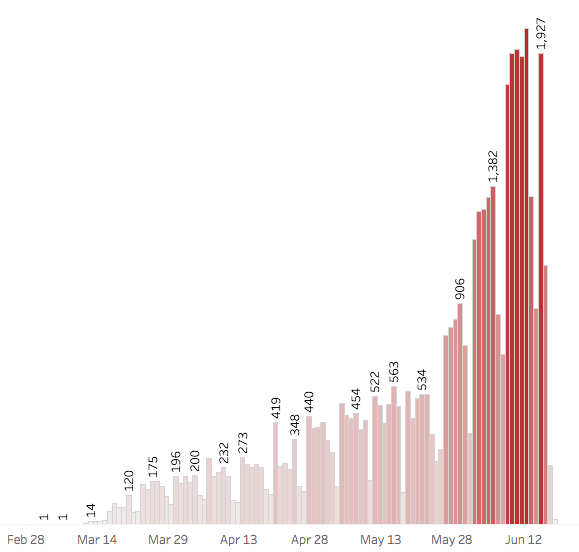
The City of Phoenix jumped in today with a 7–2 decision to require face coverings for anyone age 6 and older who is outside their home and “within six feet of another person who is not a family member or member of their household.”
“The declaration from the City of Phoenix to require face coverings is a response to the lack of accountability our state has taken to protect us from the rapid spread,” Councilmember Carlos Garcia said in a statement after the vote.
Resistance, no doubt, will be fierce, given the childish example set by the country’s leader, who thinks he knows more than the scientists and doesn’t wanna wear a mask. Trumps example and his rhetoric, has fed extreme anti-mask sentiment on what should be a benign, if inconvenient, health measure. Last week, the Orange County health officer in California resigned after saying she got threats for ordering face masks; (California this week mandated cloth face coverings statewide for public spaces where 6 feet of distancing can’t be maintained, joining 14 other states plus Washington D.C. and Puerto Rico requiring masks for everyone.)
The fact that masks work is beyond question, health experts agree. They can protect the wearer to some extent, but primarily protect others.
Just look at countries where masks are the norm, including China (84,000 total Covid-19 cases), Japan (17,000), and South Korea (12,000). Those totals each reflect fewer than 25 per 100,000 people. In the U.S., more than 2.1 million people have been diagnosed with Covid-19, or 640 per 100,000 people.
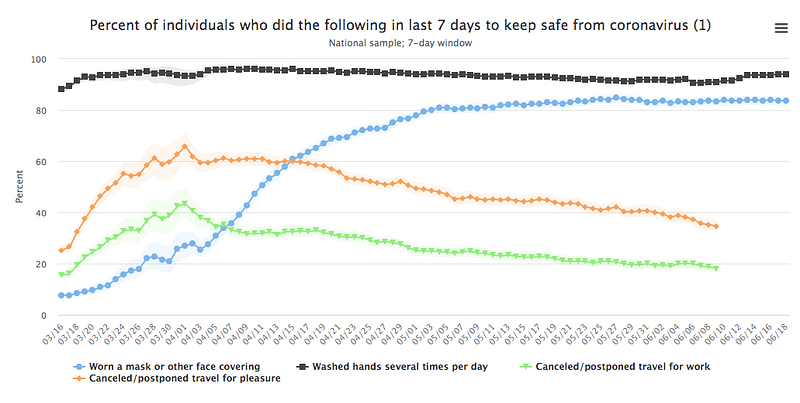
Meanwhile, more than 80% of Americans say they’ve worn a mask or other face covering in the past seven days, according to an ongoing survey by the USC Dornsife Center for Economic and Social Research.
Life, death and the economy
Here’s a stark statistic that can’t be masked: The U.S. death toll from Covid-19 is more than double any other nation. If unchecked by new preventive measures, and sans an effective vaccine, current infection and death rates — science stuff—suggest more than 1 million Americans will die before we reach any sort of herd immunity that might then naturally slow the spread.
“The scale of the threat is quite large” and “potentially within that framework,” William Hanage, associate professor of epidemiology at Harvard T.H. Chan School of Public Health, says of those estimates when I asked him about them.
The cynicism among some conservatives runs deep. Some critics think scientists don’t care about the economy, for example. That’s simply not true. Scientists like to eat out, they want their damn kids to go back to school and leave them alone, and they want to have jobs, too. On May 20, Slavitt and 20 colleagues published in USA Today a plan for re-opening safely, in stepwise fashion, involving data-driven benchmarks and widespread use of masks. It’s been largely ignored.
What Trump and others who resist the science have failed to realize — and you’d think they’d care about this, even if 118,000 deaths don’t matter much — is that an unchecked pandemic could be ruinous for the economy twice over.
An economy is only as good as the people who drive it, who make the goods and provide the services and buy the stuff and pay the rent. With a surge in new Covid-19 cases considered highly likely this fall, some economists fear a double-dip recession. Not just one cycle, looking like a V, but a W, as businesses are forced to close all over again.
“The push to reopen the economy is making a W-shaped recovery very much more likely,” says Jeffrey Frankel, professor of capital formation and growth at the Harvard Kennedy School.
Already, other economists see a tidal wave of corporate bankruptcies coming this fall—just when the pandemic itself could be surging.
It didn’t have to be this way. Even with current, mostly meager efforts at prevention, testing and contact tracing, a lot more Americans will die due to White House inaction that began in January and continues today, along with decisions and lack of decisions based on self-serving politics, not science or the public good. It’s now up to governors, mayors and other local officials, and to a greater degree individual Americans to decide how much risk they’re willing to take, for themselves and their families, friends, coworkers and neighbors. Our president doesn’t much care, so long as you get back to work.


