

Inevitable Surge in Covid-19 Deaths Looms
With new cases rising in several states, deaths are sure to increase after a time lag
Spikes in new Covid-19 cases in several states are occurring even as the daily number of deaths declines in those states and across the country. The diverging curves are mostly a matter of the lag time between diagnosis and possible death, not because of increased testing, according to data and the analysis by experts.
While cases were falling in hard-hit places like New York City, the rise in new daily cases in Arizona, Florida, Texas and other states began in late May, as the overall new-case rate across the country hit what one scientist called a “disappointing plateau.”
“And so I expect that we will see resulting deaths from those initial infections occurring toward the end of June,” says Caroline Buckee, PhD, an associate professor of epidemiology at Harvard T.H. Chan School of Public Health. “There’s no question that we’re going to see a surge in hospitalizations and deaths in places like Arizona due to the uptick in cases.”
While the timeline of Covid-19 from infection to resolution varies, the onset of symptoms is typically around five days after infection. Hospitalization, when necessary, usually happens around two weeks after infection. Death, if it comes, often occurs three or four weeks after infection but can come more quickly, or more slowly.
More testing doesn’t explain the rise
Increased testing could be responsible for some of the divergence between rising cases and falling deaths, says Robert Salata, MD, a professor of medicine in epidemiology and international health at Ohio’s Case Western Reserve University. It’s also possible that many of the new infections in late May involved younger people, who are less likely to die from Covid-19, Salata tells me. But he agrees a simple time lag is part of the answer, too.
Buckee says the increase in cases truly represents a real uptick in infection rates, not just increased testing.
In fact, in at least six states (Kentucky, Missouri, Oklahoma, South Carolina, South Dakota and Wyoming) the seven-day average of new cases has risen since May 31 even as the number of tests fell, and new cases are outpacing increases in testing in 14 other states, according to The Washington Post.
“Those are real signals across the country,” Buckee says, referring to the spike in new infections. “We would expect that to happen, because the virus didn’t go away” as states relaxed social-distancing measures.
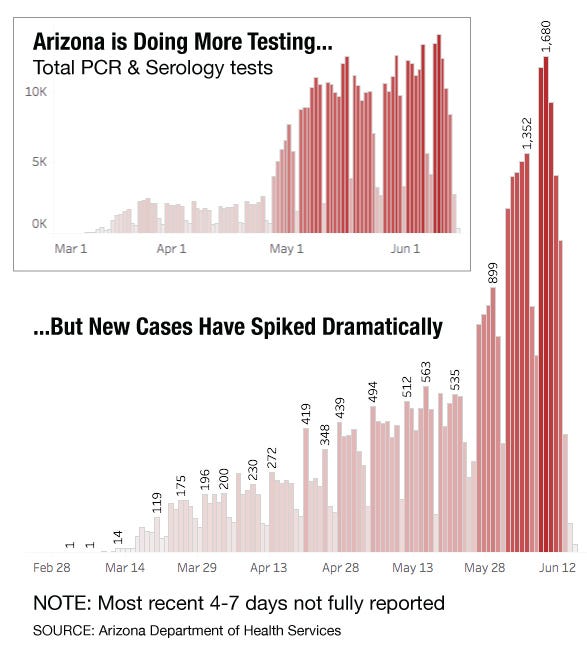
“This is NOT from more testing, it’s from more spread,” Thomas Frieden, former director of the U.S. Centers for Disease Control and Prevention, says of Arizona’s infection spike.
How many will die?
The CDC’s latest prognostication, updated June 12, estimates the U.S. death toll will be between 124,000 and 140,000 by July 4 (the tally is above 116,000 as of this writing—higher than the number of deaths from any flu season since the 1918–19 pandemic). A model from the Institute for Health Metrics and Evaluation puts deaths at nearly 170,000 by Oct. 1.
How many deaths might occur, and how long the surge will last, are impossible to predict accurately, Buckee told reporters June 16. But policymakers will have to decide “what they’re willing to tolerate for society to open up,” Buckee says, and “what people are willing to tolerate in terms of the health costs, in order to understandably address the economic costs of staying locked down.”
While a vaccine would be the best prevention, Buckee and others say an effective vaccine could be many months or even years away. Meanwhile, the ultimate death toll will depend on many unknowns, she says, including:
- Whether policymakers will react to the spike in deaths and change course on the now-relaxed preventive measures.
- The extent to which people adhere to rules or choose on their own to social distance, wear facemasks and otherwise be cautious.
- Whether any of several clinical trials underway now yield treatments in the near term that could lower the death rate for people infected with Covid-19. (Researchers in England just announced evidence that an existing drug, called dexamethasone, reduces deaths among hospitalized Covid-19 patients.)
- The extent to which the most vulnerable people, including those in nursing homes, are protected from subsequent outbreaks.
- What happens this fall if and when schools reopen and people start spending more time indoors, potentially increasing the rate of coronavirus spread, as several experts fear.
“I suspect that part of the decisions about reopening in the fall will be contingent on what happens over the summer, and whether we see really huge spikes in deaths that make policymakers revisit their reopening strategies and change course,” Buckee says. “The fall and the winter months is something we should be very concerned about.”


