
Anicca, Dukkha, Anatta.
#WednesdayWisdom
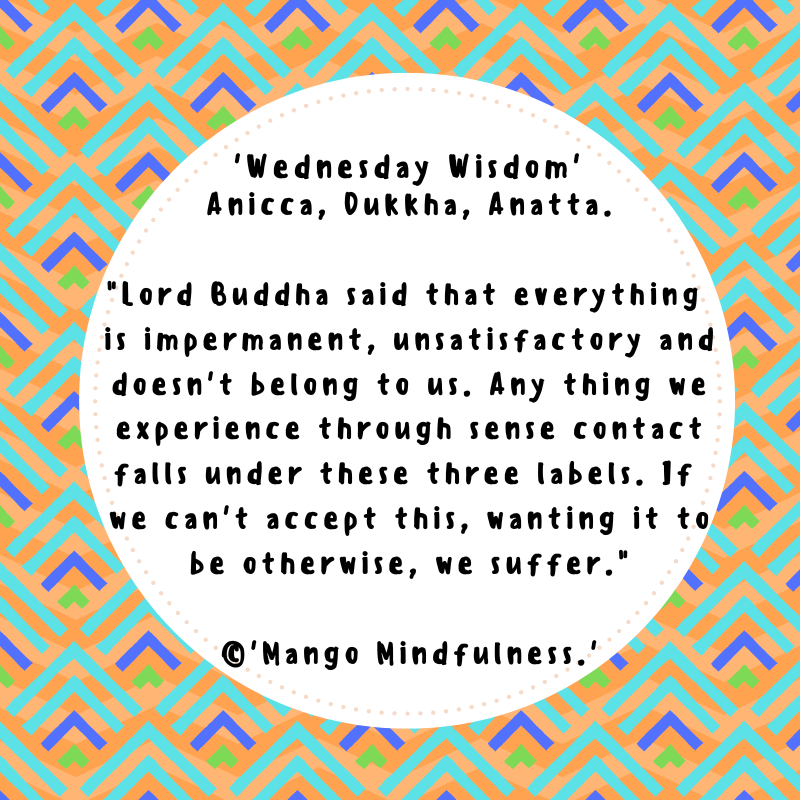
The Three Marks of Existence or Three Universal Truths in Buddhism help us to understand the truth of reality and bring ourselves to liberation from suffering and ultimately to Nibbana. It goes against the grain for us to correct the wrong views which we have always held but we can start to chip away by altering our understanding little by little.
Anicca — impermanence, change. Everything is ‘uncertain’ — this is a rule which can be relied upon. Take the body and mind which are always with us. Our body has been changing since the moment we were born and will continue to do so until it breaks down and dies. How many times does our mind change its view during a single day? We can watch the body and the mind and reflect upon this.
Dukkha — dis-satisfaction, discontent, what we like and dislike. It is our wanting and not wanting — desire and aversion, greed and hatred — which is the cause through which we create suffering in our own minds. The mind gets so wrapped up in the things that annoy it and make it upset. We can’t let them go can we and so we suffer. This mostly comes from us wanting experiences or people to be ‘other than they are’ but we can’t change nature and we can’t change our family, partner, colleagues etc. We have to learn to accept things as they are.
“If we could admit to the fact that the suffering comes from our own stupidity and heedlessness, there would be no need to complain about it.” — Luangta Maha Bua
Taken from the book: ‘A Life of Inner Quality’ — Talk: ‘Medicine for the Mind’, p68
Anatta — not self. We identify with a self, using the labelling me and mine, which automatically creates ‘other’ but, in Buddhism as in reality, since this physical body which we regard as a self has no permanent or lasting qualities how can that be correct? This body will age, get sick, deteriorate, die and disappear. What is left, but can’t be seen, may be thought of as a soul or spirit. In Buddhism we can call it the citta (heart-mind), the driver. This is what remains, becomes free and is reborn into a new vehicle.
So, when we use anicca, dukkha, anatta to look at every experience, sensation and person we come into contact with we will begin to see more realistically and realise that:
- everything within the world of samsara is constantly changing
- we are constantly dis-satisfied because we have wrong view and wrong understanding
- despite our egoistic personal identification none of the things we come into contact with is a self or is of a self
May this teaching lead you to happiness; may it help you grow in truth. May you be freed from the suffering of birth and death.

You may also like these Dhamma articles :