
An Unbeliever In A Holy City
Visiting Medina on the sly
The family and I take a rented car from Ta’if, Saudi Arabia, on a circuitous route through the small towns of Umm Aldoon, Maqar Shanif, and Hafir Kishb. These are simple, concrete settlements surrounded by sand, listless camels, and an abundance of litter.
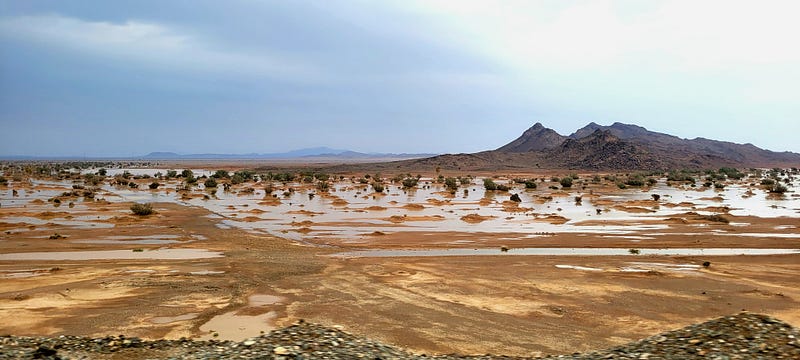
Late afternoon rainstorms roll in and cross our path many times. Sheets of water flood over the empty desert road, but at no point is it too deep for vehicle clearance. Not quite what one expects in the Arabian Desert, but it has been a wet winter.
Today’s journey ends in Al-Medinah Al-Munawwarah, the second holiest city of Islam. We arrive there in heavy rain as evening sets in. This is one of our many intended destinations in the Kingdom of Saudi Arabia over three weeks. It has been possible to come here as a casual visitor only since regular tourist visas became available in 2019.
I went back and forth for months with the idea of visiting Medina. The official Saudi websites merely state that ‘non-Muslim visitors are restricted from entering the cities of Mecca and Medina’. But I knew that other non-Muslim travelers had come here within the last few years without incident. This opened enough of a legal ‘gray area’ that I was willing to try.
The Qur’an specifies only that the holy city of Mecca cannot be entered by non-Muslims. The first passage, in the Surah at-Tawbah 9:28, explains that polytheists are impure and cannot be allowed in. At the time (7th century CE), the term polytheist applied to Hindus, and by default would apply to any animist or worshipper of multiple deities. In the Surah at-Tawbah 9:30, the Qur’an also suggests that Christians are, in a sense, polytheists, because they believe in a ‘son of God’, and in their veneration of the Virgin Mary. Hence, they are also banned from entry.
However, the longstanding ban on non-Muslims entering Medina, the second holiest city, seems to just be a traditional convention. Only the inner mosque complex, called Al-Masjid an-Nabawi, is labeled as haram, which translates as ‘sanctuary’ (and also as ‘prohibited to non-believers’).
I do see a large concrete monument, as we cross the Medina city limits, that says ‘ENTERING THE HARAM AREA’, but opt to ignore it. I was told that there were signs along the highway stating that non-Muslims were required to take a detour around the city, but these were removed in 2022. Such signage still exists around Mecca.
Two major circular roads make Medina look a bit like a bullseye in map view. They are concentric around the major complex of mosques in the center. They are called First Ring Road and Second Ring Road. The latter is several kilometers out from the first. As a precaution, I reserved a hotel room far from the city center, in case there was some issue with us being any closer. The hotel’s name was only in Arabic on the booking site, and I only know we are there based on Google Maps coordinates. There is no name on the building itself, so I go in alone to check.
There is no one at reception. I sit in a chair and wait. A man in Umrah dress walks up with two women and eyes me curiously. Umrah dress consists of simple white robes, sort of like a toga, that Muslims often wear when on pilgrimage to the holy cities. It is commonly seen during Hajj. I ask, in Arabic, if this is Hotel Ghazali Wings and he confirms that it is.
He then switches languages and asks what I am doing there and if I am Muslim. He is from Sri Lanka, so speaks English fluently. I say I am there to visit the city but not a Muslim. He looks confused.
“How can you get permission to come to this city? It is only for Muslims.”
“I can go everywhere but the Al-Masjid an-Nabawi,” I declare, pretending confidence.
He smiles, “Then you are very fortunate. This city is one of the best in the world! All Muslims dream of coming here, if they haven’t yet been.”
The interior of this hotel looks like what we see everywhere we have stayed in the kingdom so far. There is a sort of lazy opulence, with marble floors, gold paint, and a lot of empty space. Foreign ‘guest’ workers scurry up and down the hallways, bowing and greeting us as we walk to our room. Like in other Arab nations on the Arabian Peninsula, their jobs are entirely at the whim of their employers, and they can be deported to their home countries at a moment’s notice.
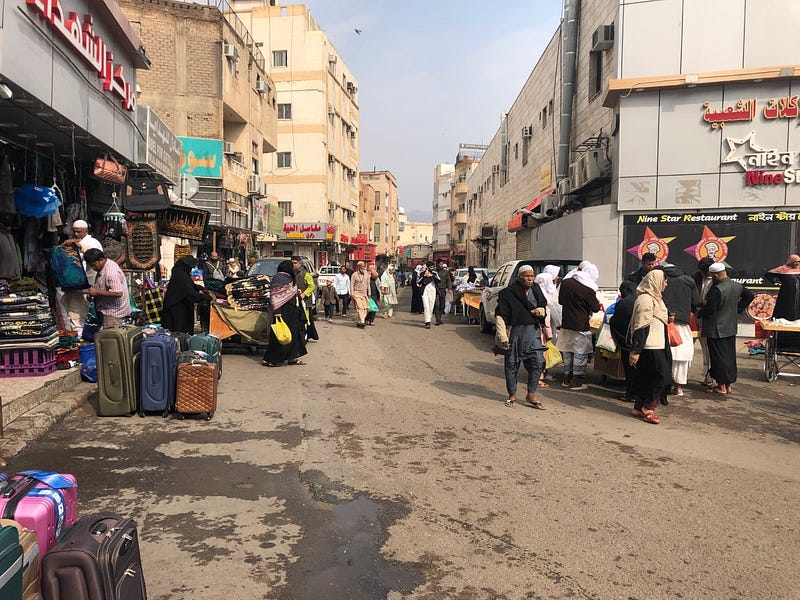
The next morning, we drive toward the city center and find a parking spot in an alley just north of the First Ring Road. It feels like South Asia. There are Punjabi and Bengali restaurants. A bus pulls up and most of the men disembarking have the deep red henna-dyed beards of Pakistanis or Bangladeshis.
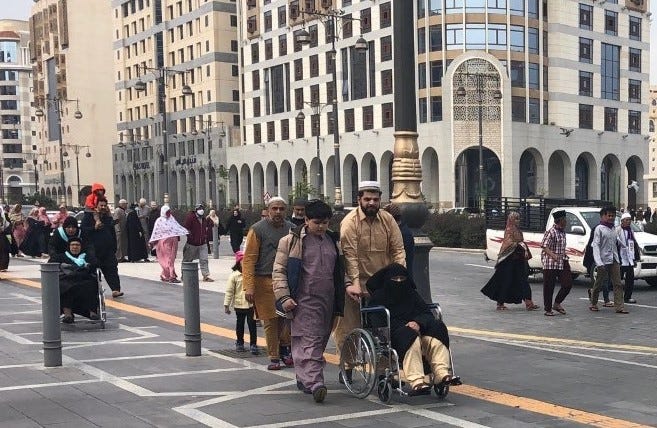
In front of us is the First Ring Road, the divided highway that separates ‘normal’ Medina from the religious core of the city. The only crossing is a pedestrian tunnel that goes underneath it. Now, all the foot traffic is moving inward, toward the mosque complex. We see no religious police or any other menacing authority, so we go down and through the tunnel. It feels like being caught up in a vortex.
I’m feeling out of place, clothed in my normal travel gear. My wife and daughter, on the other hand, wear full black, hooded dresses called niqabs and are nearly invisible in the crowd. Not knowing what to expect here, we had decided beforehand that they should suit up as conservatively as possible.
From there on, we just let ourselves get sucked along with everyone. It is the strangest feeling being there. No one is hurried, no shouting or pushing, just an intense, gravitational pull toward the mosques.
I am taken up with the diversity of people: Men in typical Gulf Arab dress, Egyptians in galabeyas, a chatty cluster of women in colorful, coordinated shirts and scarves declaring them to be from an Indonesian group tour, an old man with a Tajikistan flag hanging from his shoulders like a robe.
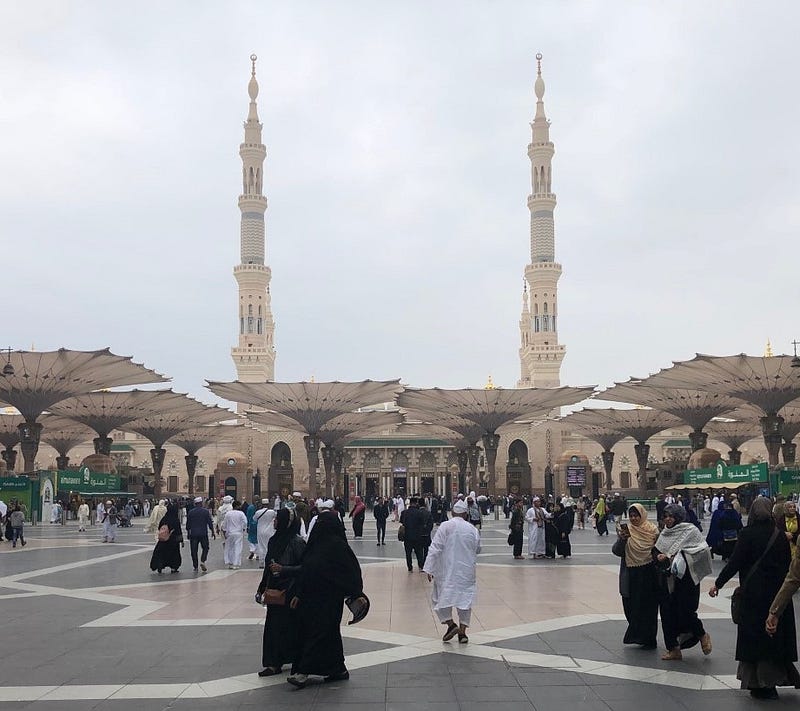
We get as far as the mosque complex itself. There is a gate here. Again, no one seems to be paying attention to us, but I decide this is as far as we should go. While it would certainly be thrilling to go inside, I feel like we are imposters.
The thundering call to prayer has begun emanating from the minarets, marking the dhuhr, or the second prayer session of the day. Still, there are people slowly flowing in, silent or talking to each other in hushed tones.
This complex of mosques is hugely important in Islam. The first religious structure here was constructed with the help of the Prophet Muhammad himself in 622 CE when he arrived in the city at the invitation of the local clan leaders. Since then, it has been expanded and modernized many times. In 2012, the Saudi government announced a $6 billion investment into renovations and further expansion.
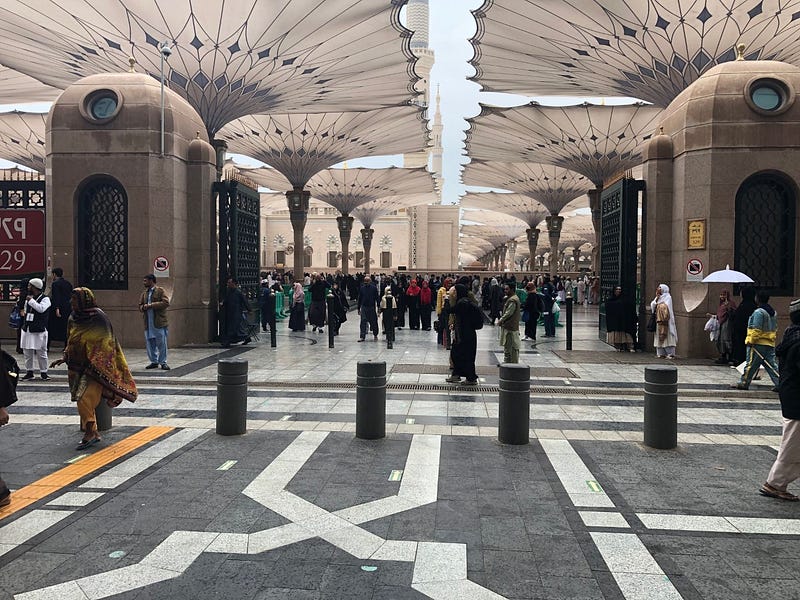
Going around to the western side of the complex, we cross a huge courtyard. This is where people pray when the mosque is full. Based on one map I pulled off the internet, it also lies within the ‘inner haram area’. But there is no gate to pass through, so it seems safe enough. It is nearly empty now, not being Hajj season. There are small green arrows painted on the tiles to show the direction to face while praying toward Mecca.
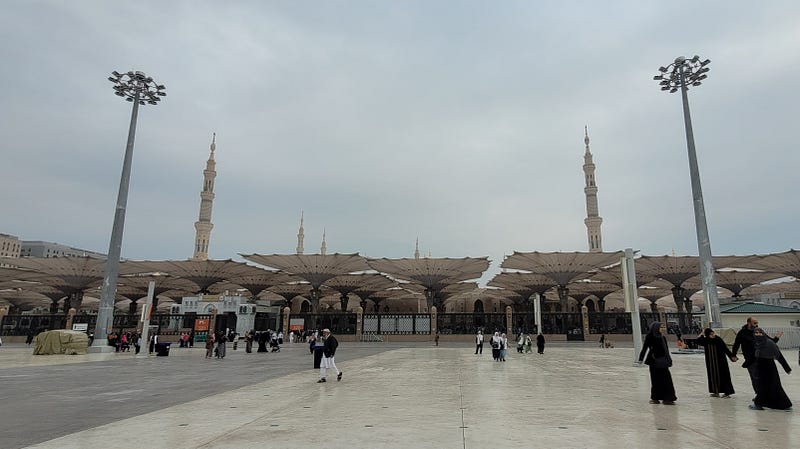
There are more mosques and other monuments in this area, so we spend a few hours walking around to see the Ghamamah, Quba, and Anbariya mosques, and the Hejaz Railway Museum.
While Medina is not your average tourist attraction, there is an abundance of shops selling souvenirs. My wife buys a refrigerator magnet. There is a group of people inside the shop, dressed in colorful Nigerian robes, asking (in English) where they can change money. Many non-Arab Muslims visiting here are likely to use English to communicate, not knowing Arabic.
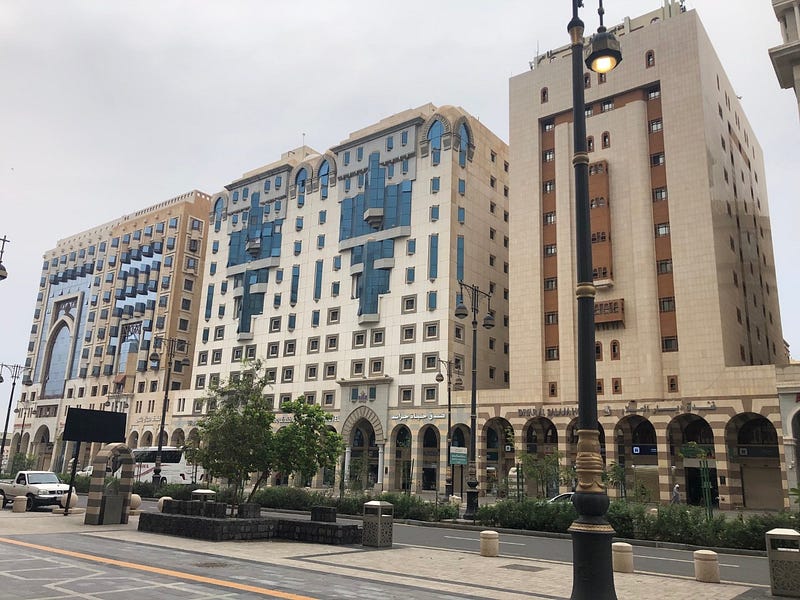
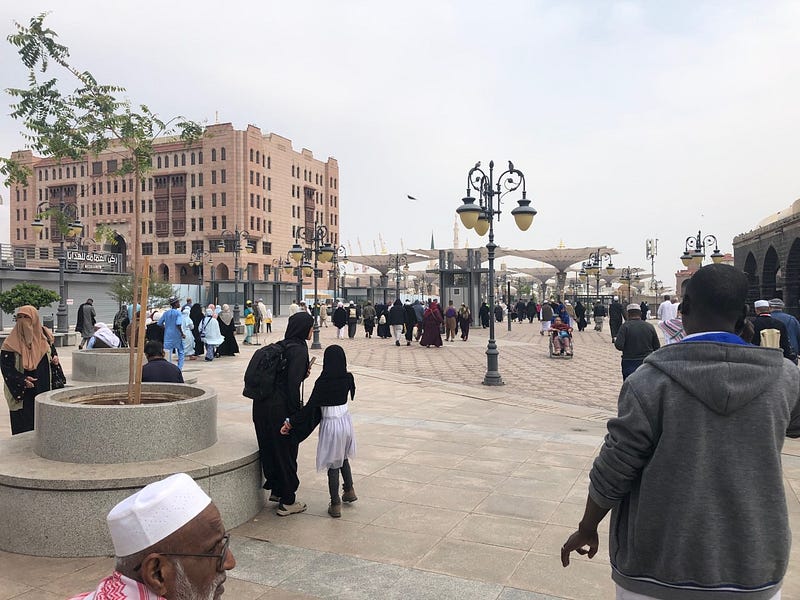
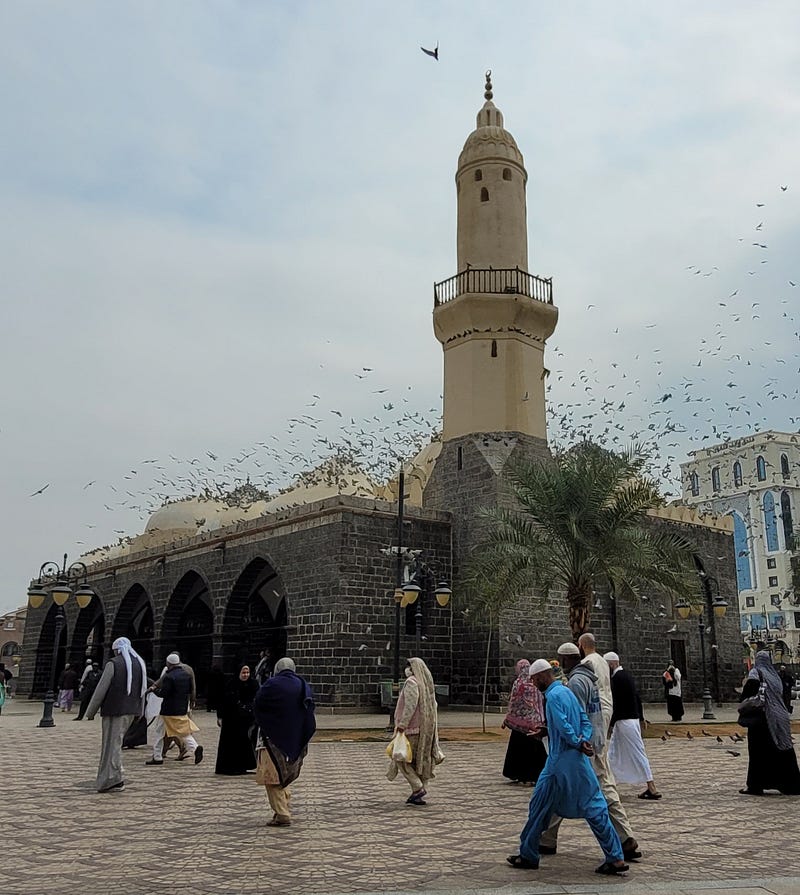
At some point in the afternoon, we feel like we’ve seen enough. This place is not touristic in any conventional way. It is an active religious site, one of the most important in Islam, and as far as I can tell we are the only oddballs wandering around, taking photos, and otherwise not praying.
After eating at a South Indian restaurant outside of First Ring Road, we head back to the car in the rain. Taking a road north, we pass by the foot of Mt. Uhud. It is composed of rich, red-brown, bare rock, now alive with spontaneous waterfalls from the recent downpour. Cars are stopped haphazardly along the highway as people stop to take photos of this unusual phenomenon. The streets are flooded, and it takes a long time to thread our way back to the hotel.
I’m happy and relieved we got to see what we did today. This was our single day here, as tomorrow we leave for the next town. It felt unique and thought-provoking. It seems ironic that, as an atheist, I end up spending so much time visiting sites of religious significance in the countries I travel to. While they don’t hold a spiritual significance for me, they do offer a revealing glimpse into what they mean to others. And sometimes, like today, they exude an emotionally driven energy that is captivating to witness. Like a synchronicity, flowing between worshippers.
Back near our hotel, I duck into a small shop selling fruits and vegetables, picking out some oranges for tomorrow. The fruit vendor asks me in Arabic where I am from. He smiles broadly at my response, places one hand on his heart, and says “Welcome, thank you! Praise be to Allah!”
Please check my profile for other travel-related articles at Brad Yonaka, and consider joining Medium to read many great stories by using my referral link. I receive a portion of your subscription fee.
One of my earlier articles about Middle Eastern travel:
For an interesting series of articles about traveling in Saudi Arabia, Jay Davidson gives a five-part account of a trip he took, long before tourist visas were available:


