
Saudi Arabia, Part 1 of 5
First stop: visit to a State Department friend in Dhahran
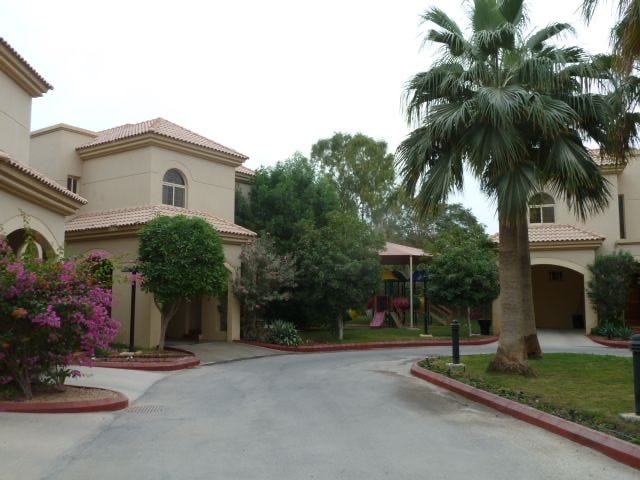
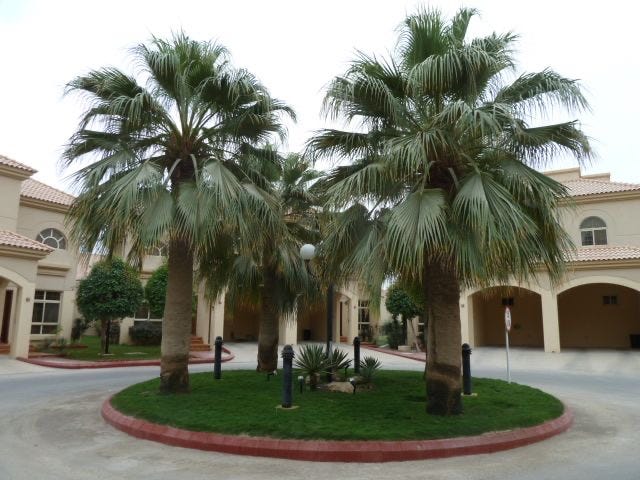
How this visit came to be
I served in the Peace Corps after I retired from teaching in 2003. Several of my fellow Peace Corps Volunteers went on to become diplomats with the State Department. I tried to visit as many of them as possible, especially when they were in hard-to-visit places. At the time, the KSA [common abbreviation for Kingdom of Saudi Arabia] did not grant tourist visas. With my diplomat handling a visa for me, though, I had it within a week after I applied for it.
Arrival in Dhahran
My friends were returning to KSA from a vacation in Thailand. Their flight landed in Manama, the airport in neighboring Bahrain, where they picked me up at about 2:00 in the morning and brought me to their home.
We arrived at their place at about 5:15, when it was just starting to get light.
They lived in a gated compound; see the photos above. We headed to the compound’s poolside restaurant for our breakfast. The air was pleasantly warm, with no humidity.
Non-Saudis living and working in Saudi Arabia must live in gated compounds like this, where no Saudis may live, work, or enter. The residents are predominantly from Western countries, working for various industries such as oil and aluminum. The workers are from countries such as India, Bangladesh, Pakistan, Nepal, and the Philippines.
In Saudi Arabia, the weekend is Thursday and Friday. Therefore, though it was Saturday, it was a work day. It’s a bit disorienting having Saturday as Monday at home.
As a result, workday schedules present several challenges to those who are working here, especially if they need to be in touch with colleagues in such countries as the USA. First of all, the only work days in common are Monday, Tuesday, and Wednesday. Secondly, because of the time difference, with Saudi Arabia being eight hours ahead of the East Coast, if you need to speak to somebody from your office to theirs, you have about an hour or so at the end of your work day, which coincides with the beginning of theirs.
The hospital looks like a four-star hotel!
In the afternoon we got picked up by a consulate driver and went to a medical center so that my friends could attend to various issues. The building was richly appointed; the common areas looked more like a fancy hotel than a medical center, as it was loaded with gorgeous marble, stained glass, huge mirrors, and framed art.
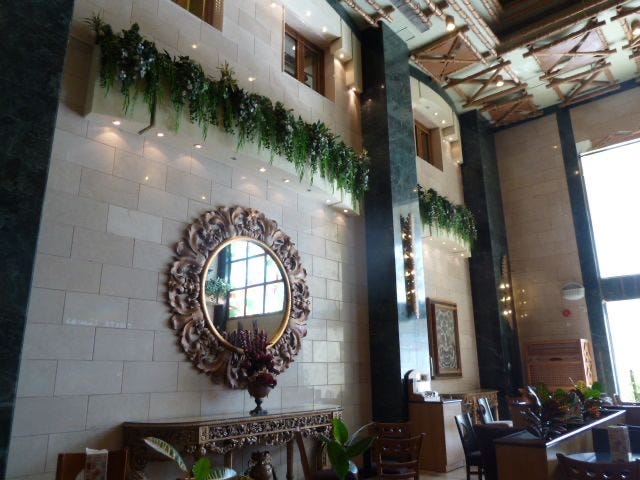
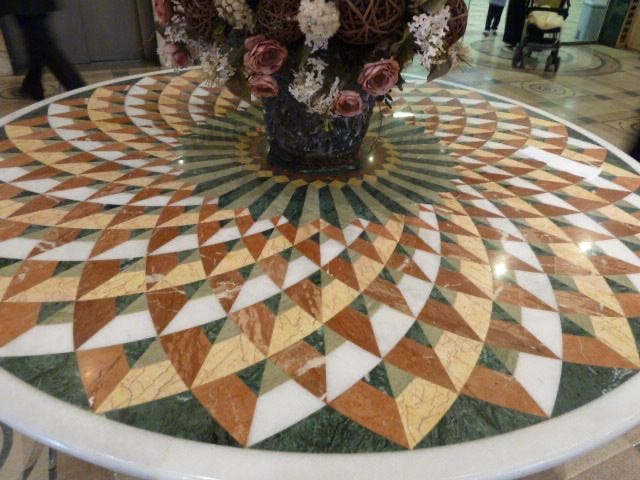
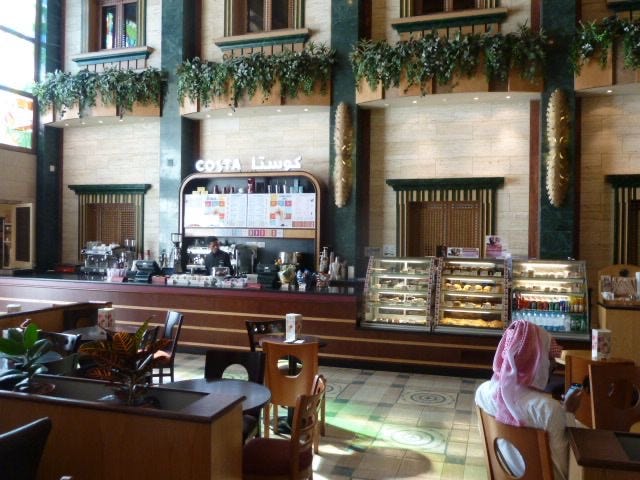
As we walked and rode around, I began to notice that there were restaurants labeled as being “family” or “single.” A family restaurant or a family section of a restaurant is open to women, children, and men who are with them; unaccompanied men are not allowed into these. The “single” places are men-only.
Heading into the town of Dhahran
It was Sunday, a work day for my friends, who headed off to work, which left me to my own devices.
The compound has a shuttle bus service that residents (mostly the spouses who are not working) use in order to get out during the day. Some of these people have the possibility to be driven around by drivers employed by the agencies for which they work. Other than that — especially since women are not allowed to drive in Saudi Arabia — they use these shuttle buses to get out, where the only destinations are shopping malls.
I took the earlier bus out at 8:50 and arrived at the Mall of Dhahran before most of the stores opened.
It’s a huge shopping center. I wrote down the names of many (but not all) of the stores with familiar names, just to be able to give an idea of what is there: Tommy Hilfiger, Birkenstock, Armani Exchange, Skechers, Aéropostale, Ecco, Nike, Clarks, Express, Esprit, Pottery Barn, Pottery Barn Kids, Nine West, Timberland, Nokia, H & M, Guess, Gap, Sephora, Banana Republic, Jones New York, Cole Haan, Coach, L’Occitane, Debenhams, Marks & Spencer, Swatch, Bebe, Zara, Aldo, The Body Shop, Claire’s, Next, Mango, Payless ShoeSource, and Calvin Klein. There are also lots of stores I don’t remember having seen before.
As for restaurants, both in the food court as well as sprinkled throughout the mall, the familiar names were Cinnabon, Tony Roma’s, Starbucks, Baskin Robbins, McDonald's, Outback, Sizzler, Krispy Kreme, Seattle’s Best Coffee, Swensen’s, KFC, Hardees, Popeye’s, Subway, and Carvel.
From the looks of it, this could have been almost anywhere in the USA or Europe.
All women in the mall — both Saudis and expats — were wearing an article of clothing called an abaya. In this case, they were all black. It’s a long gown worn over other clothing. The expat women did not wear any coverings for their hair or faces. By contrast, the Saudi women had a few different varieties of coverings. Some covered their faces, except for their eyes, and some covered only their hair.
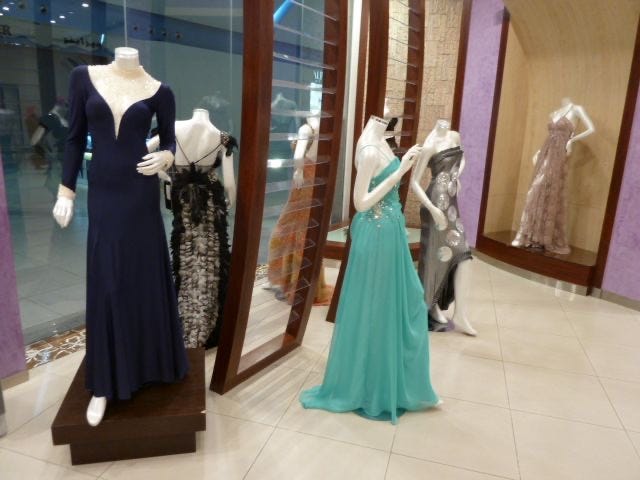
I was intrigued by the display of revealing evening dresses, pictured above. Who could possibly wear these, considering the modest dress code? My answer: Saudi women! And how does that happen? All the celebrations are segregated by sex, so when Saudi women are dressed like this, there would never be any men in the room.
Men’s clothing is much more varied, with some in completely Western attire and some wearing the white gowns (thobes) and headdress.
By the time the shuttle bus came to pick us up at 11:25, all the shops in the mall were closed for prayer time.
Monday
I decided to spend the day at home and within the compound. I ventured out in the morning and met two Australian women at the clubhouse. Their husbands work for Alcoa.
Meanwhile, in the house, I made some soup for lunch.
Saudi Arabia is very strict concerning its prohibition of alcohol for its citizens. There are ways around this for foreigners, though. Expats have access to a few private outlets for buying alcoholic beverages. Recycling does not exist here, so all garbage gets thrown away together. There is an exception for empty liquor bottles: they may not be thrown away in the trash. They need to be returned to the under-the-radar locales from which they were purchased.
In any event, my friends had access to one of these private outlets, so I gave them some money and they brought back some wine for me. I wanted to have some at the house as well as to be able to bring a bottle along with me to each of the Thanksgiving events we will be attending later in the week.
I am moving onward to Riyadh on Saturday, so I needed to look into getting my train ticket. There seemed to be three ways to get the ticket: (1) online, (2) by phone, (3) in person at the train station in Dammam.
My first approach was to go online. That one couldn’t work because one of the required fields on the form was Saudi ID card number, and I don’t have one of those.
My second approach, then, was to phone. I was doing well with all the prompts on the phone (press 2 for English, press 3 if you have never ridden on the train before, etc.), and all of those prompts eventually led me to a ringing phone… that was never answered. I checked the time; it was not prayer time, so that was not the reason.
My third option, and the last resort, would be to go to the train station in person. Fortunately, the compound has a shuttle bus that goes to Dammam once a week — every Tuesday — and that was the next day! So I planned to do that! It’s a good thing I tend to plan ahead!
I stayed in for the rest of the day. Even at home, I love days like that: reading and cooking dinner for my friends.
Tuesday
Early in the morning, I heard what sounded like heavy rain outside. Then, a lot of noise accompanied it. I left my room to see that my friends were awake and downstairs. They had parted the drapes and we could see not only the heavy rain but hail as well. That doesn’t often happen around here.
I headed for the shuttle bus to Dammam. This morning, the one going to the local shopping areas was quite full, but there were only three of us going to Dammam. On the way there, I explained to Ali, the driver, that I needed to go to the railway station. He pointed it out to us when we passed it on the highway, but it was nowhere near his destination on the other side of town.
Ali asked me if I would like his help negotiating a taxi ride. I said yes, that would be nice. Then, when we arrived at the shopping center, the two other passengers got off the bus and Ali told me that since I was new around here he would drive me to the railway station himself. He just didn’t want the other passengers to know that he was going to do that because he felt that they would continue to ask him to do special drop-offs and pick-ups.
He stopped in front of the station and waited for me while I bought the ticket. By the time we got back to the shopping center pick-up point, I had only about forty minutes to walk around before the return to Dhahran. That was fine, in that there was really nothing I needed to buy at the shopping center. I had hoped there would be a supermarket nearby because my friend asked me to pick up something for her. But there was none to be seen.
In the evening we attended Thanksgiving, Part 1 with some of my friends’ work colleagues. They were an enjoyable bunch.
During the gathering one of the guys brought up the subject of the price of gas for cars. It takes a bit of mathematical gymnastics to figure it out, first converting Saudi riyals to dollars, and then getting the equivalent of gallons from liters. Once the math is completed, though, we figured that the cost was about fifty cents a gallon.
Wednesday
My American friends here have a three-day weekend because of Thanksgiving. The typical weekend here is Thursday and Friday. Since Thanksgiving is on a Thursday, they have Wednesday off. Think of this as being along the lines of getting Monday off if a holiday falls on a Sunday.
In the morning, my friend and I went to a crafts fair that was held in the social hall of the compound. Since there are people in Saudi Arabia whose origins are from all over the world, the items for sale reflected that. I spoke to participants who they told me about their goods from Afghanistan, China, Indonesia, the Philippines, and India. The English speakers were from the USA, Britain, Ireland, and Australia.
Many of the items for sale were related to the Christian holiday. Strictly speaking, it is forbidden to sell these items in KSA. Kristen explained that the holiday for which the government really cracks down is Valentine’s Day.
At about 15:30, we took a ride to an older area of town known as Al Khobar. The streets in this neighborhood are laid out in a grid and there are sidewalks. It is a small downtown commercial area with shops: tailors, restaurants, travel agencies, a post office, banks, and grocery stores.
One of my friends wanted to have a suit made, so we spent some time at a tailor shop. While we were in there, it was prayer time. The proprietor of the shop let us sit there, but he came to the front area, locked the door, turned the “open” sign around to reveal the “closed for prayers” side, turned off the lights, and then returned to the workshop area in the back.
On his way back there, he closed the curtain to cover the window in the door that would otherwise have exposed the worker to the eyes of the police. If anyone were caught working during prayer time, he could be arrested. Kristen saw some mutaween (religious police) walking by, making sure that all people were in compliance. She explained that once we were in the shop, we were allowed to stay, and that if we were to be caught leaving, the proprietor could get in trouble.
Once the coast was clear and everything opened up again, I went to a nearby shoe store and had a minor repair made to one of my sandals.
Al Khobar is the home to a lot of the Filipinos who live and work in the area. Travel agencies have large signs promoting flights to Manila. Restaurants advertise the Filipino dishes that they serve.
On the outskirts is a newer area referred to as the Corniche. Along the Corniche are very expensive shops and department stores. It also more closely resembles a slice of Americana, with Starbucks, Taco Bell, Chili’s, Hardees, and numerous other familiar brands.
My friends and I had dinner in a beautiful restaurant that had a large family section. We sat at a table where we could be seen by anyone sitting nearby. But there were also many tables that had large wooden screens surrounding them. We know there were people there because we could hear them (especially that screaming baby!), but we could not see them.
After dinner, we walked over to the newest of the supermarkets. Its name is Tamimi and there was something very familiar about it: it looked just like Safeway, and that is because it is Safeway!
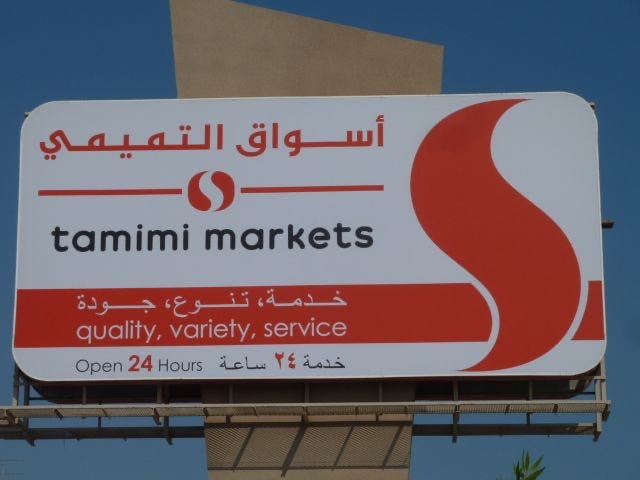
Inside, if it weren’t for the Arabic signage, it could very well have been a typical US Safeway supermarket.
A link to Part 2:


