
An Introduction to Polyvagal Theory for Anxiety Relief
Self-regulating your nervous system may be the best gift you can give yourself
In about six weeks, I’ll turn 50 years old. Born in 1972, the only child of Baby Boomers, I’m about as Gen X as it gets. Since I was a teenager, I’ve bounced between my individual spiritual quest and my zest for communing with artists of all stripes. I’ve met a lot of “fringe” people on my path, and those are generally my favorite sorts. I’ve known a lot of people who (over)indulged in drugs and alcohol, and I’ve known a lot of sober people. I’ve also known a lot of people in “recovery,” which has in my experience generally meant endeavoring to recover from active addiction of some sort.
Although I do have a history of substance (ab)use, that’s not to what I refer when I say that I’m in “recovery.” It goes deeper even than that for me. My recovery has been and is a total life overhaul. A complete reworking of my life, starting with my own brain and nervous system. I am endeavoring to recover from a lifetime of (often self-inflicted) agony, and I’m so happy to report that it’s going very, very well.
Recovering from Life
So that brings me to the question: what if we all broadened that term to mean recovery from any number of things that plague our minds and bodies? How about recovery from self-hatred? Or, maybe more to the point, recovery from neural pathways that lead us down some dark and dangerous alleys? Recovery from an out-of-whack nervous system that thinks it’s doing us a favor by keeping us in a permanently agitated state that exhausts us on all levels?
This is not something that would have occurred to me until very recently, and that’s probably because I was a victim of my own nervous system. And had I not survived the decades-long war with my brain and nervous system (I nearly didn’t), I’d not have lived to learn that it was all a grave (but simple) misunderstanding.
Depression and anxiety ruled the first 50 years of my life, for the most part; but I know now that’s only a portion of the story of what was really happening. From where I stand now, it’s easy to get really bummed out about losing so much of my life to my own brain. But I survived, and if I’m able to help other people — specifically other women — get control of their lives, it’s been worth it. I never thought I’d live to say that my life, with all its pain, was worth it. But now that I’m on the other side of that pain, I can say that it is. That’s huge.
I know, without a doubt, that depression is real. As to its connection to what I’ve learned about my dysregulated nervous system, I have no idea. I do know that there are times when medical intervention in the form of medicine is called for. There’s absolutely no shame in that. I take daily medication that keeps me even-keel and able to do the inner work that makes my life worth living. If I didn’t take the medicine, I could not do the work. It’s not an either-or. I require both the medicine and the work that I do for myself to keep me operating optimally.
That being said, as I repeat ad nauseam, there’s no such thing as one size fits all. In fact, that idea is a harmful lie. So while I know that the discoveries I’ve made about the human nervous system in general and mine, in particular, have vastly enhanced my quality of life, I’m afraid I can’t hand you prepackaged happiness. I can only gesture wildly toward inflection points on my meandering path and help you, if you’ll allow me, to find your own.
I’ve written widely about my life and my history of mental illness. I’ve also written about how I hit the absolute bottom of despair just as the pandemic began, and how the circumstances around it allowed me to build a wonderful life from the ashes of what had been. That set the stage for the leap of faith that led me to where I am today, just embarking on an incredible new life. Leah 2.0, if you will.
It’s Not a Tiger, Baby
One of the most useful concepts that I’ve discovered in my recovery is polyvagal theory. I suppose that it’s trendy at the moment, if a theory can be said to be trendy. Its popularity should in no way undermine its importance, though, especially for those of us who deal with anxiety to a degree that it interferes with our lives.
For our purposes here, let’s think of the nervous system as two branches. There’s the sympathetic branch, which sounds very nice and friendly, but is really the branch that’s responsible for keeping us alive in emergencies. It’s the “fight or flight” branch, and it’s crucial to survival, but it’s the home of stress and anxiety. Not a comfy place to dwell.
On the other hand, we have the parasympathetic branch, which is really the place to be. That’s where we “rest & digest,” and it’s where we’re meant to live when we’re not actively engaged in mortal combat.
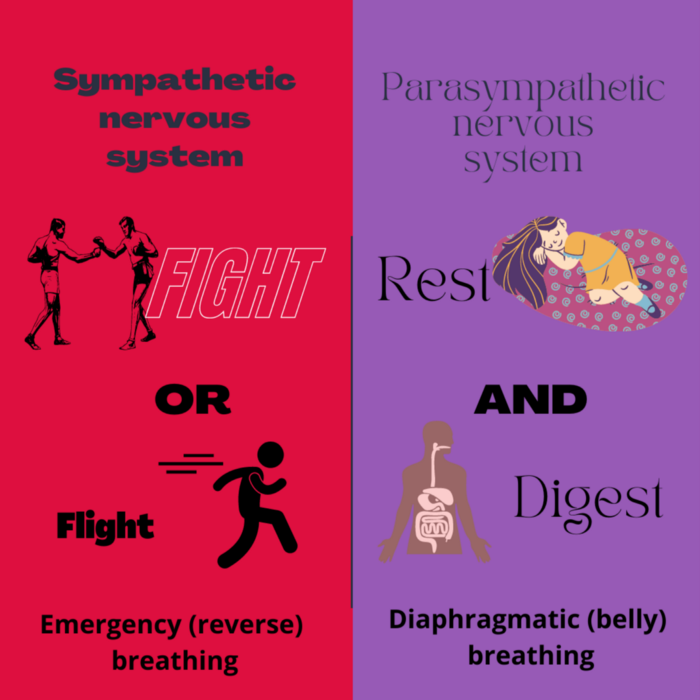
The problem comes when the two get out of whack, or “dysregulated,” which for some of us becomes sort of a standard state of being. Considering that we have the same brain & nervous system as our distant cavepeople ancestors, getting out of whack is easily done — the world we’ve designed and now reside in simply doesn’t match the one that humans succeeded in for tens of thousands of years. This modern life is extremely new, in the scale of time. It’s freaking a lot of us out. A lot.
While our brains and nervous systems are tuned to detect danger (literal, life-threatening danger) and either evade or battle the impending predator, for most of us, that’s not literal “reality” anymore. But our poor nervous systems didn’t get the memo.
In trying to protect us, our nervous systems may go into fight or flight when someone, say, bumps into us in a grocery store. Or when our boss calls unexpectedly. Then an “irrational” reaction may occur, seemingly beyond our control. We’re rattled. We may realize that our reaction is out of scale with what occurred, but that doesn’t matter. We may rage or cry or internalize, or all three, depending on our pre-existing mental/emotional state. And then comes the guilt and self-hatred. The shame. And then we endeavor to self-soothe in some way that’s likely self-destructive (self-care can easily veer into the self-destructive when we’re dysregulated). Rinse and repeat.
That was my constant reality before my recovery.
I read a quote recently that brought this reality home:
“We don’t do compulsive behaviors because we lack willpower. We do them because it’s the only we we know to self-soothe. Soothing is an instinctual behavior, not a moral one.” — Dr. Nicole Lepera
I had developed a pattern — or should I say we (my nervous system and I) had developed a pattern. I’d get dysregulated. Then I’d get angry at myself for that. Then I’d use any number of crutches I’d developed to self-soothe. Then I’d sleep, sometimes for days. Then I’d emerge from my depressive mode way behind the ball, nervous and playing catch up. Then it would all happen again.
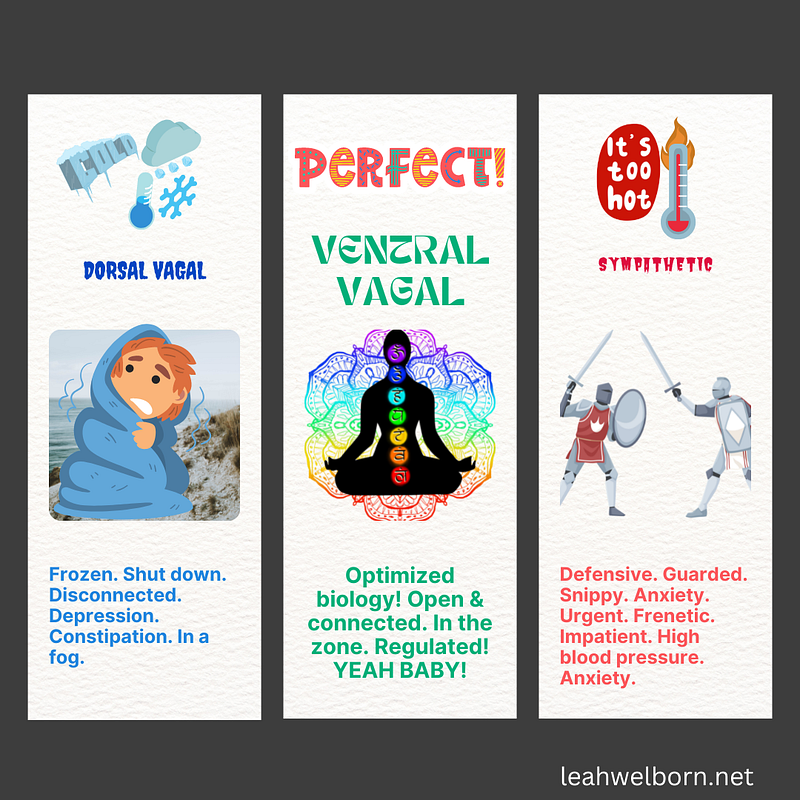
I lived in the extremes of “fight” and “flight” and I never quite hit that sweet “ventral vagal” balanced spot where I wanted to be — or I’d hit it just by chance and then go desperately chasing that feeling, only to fail again.
How was I to know that I was simply chasing regulation?
A huge part of my recovery has been learning how to regulate — specifically how to self-regulate. This quest has yielded such bountiful results that I’m teaching my method to others by writing and coaching/mentoring/teaching women in empowering themselves through various somatic and spiritual techniques.
Here are my go-to tips that I recommend for anyone who thinks they might need help with self-regulation (and don’t we all?).
⭐ If you’re dysregulated in the moment and need to get regulated, get out of your head and into your body. Trust me. Look to somatic exercises like:
- Breathing exercises. Your breath is the gateway between your inner and outer worlds.
- Tapping. Here’s a 1-minute video I created to give an overview.
- Shaking. And another little video I share with clients!
⭐ Like everything else worth doing, getting regulated isn’t a one-time deal. In my opinion, the most helpful thing you can do for yourself (like, possibly, the most helpful thing in the universe) is to get regulated on the regular if you want to avoid those dysregulated moments as much as possible.
I’ve come to call my method of self-regulation my Soul-Lit (as opposed to my diet. Corny, I know, but it brings me joy!) and it’s the essence of what I teach and coach.
It’s a process that I intend to spend the rest of my life engaged in. I’d be happy for you to join me!