
About Me — Leah Welborn
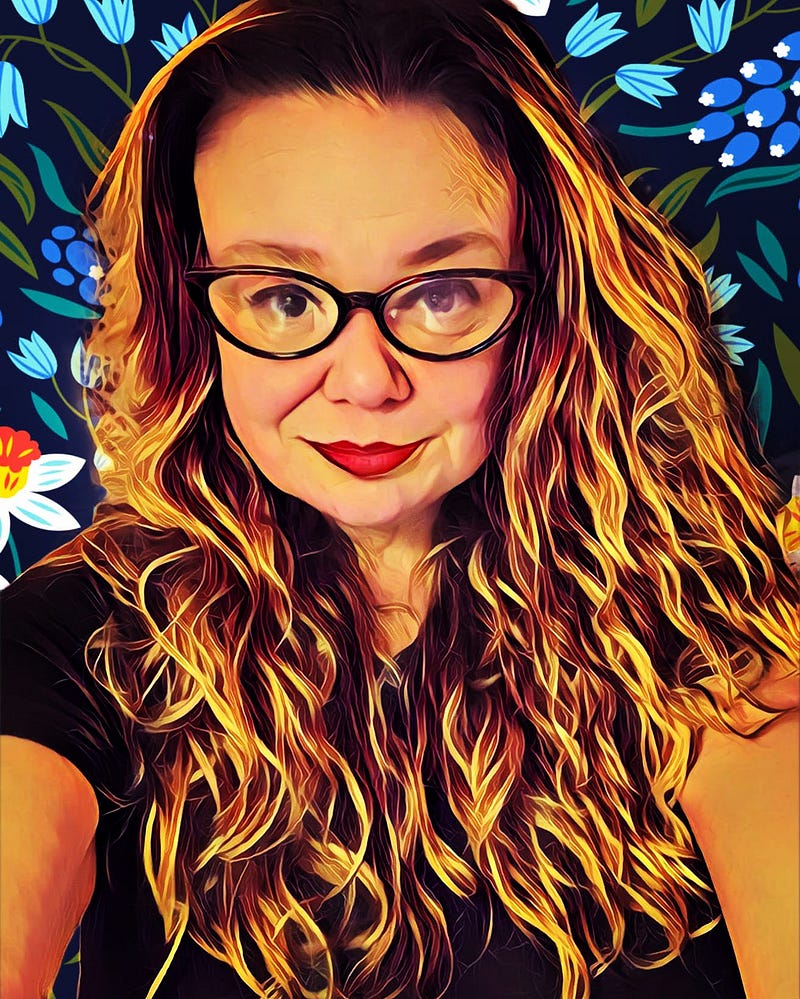
1.) I was born near the end of the Nixon administration — perhaps that’s what set me off on the wrong foot. It was a few days before Christmas in 1972 when I made my debut in Austin, Texas, the only child of my parents’ union and the only child my mother would ever have. My father had a daughter from a previous marriage, but I wouldn’t find out about her for years; always the victim, he claimed he’d been driven away from her by the child’s mother and her family. Whatever the truth, his barely contained rage and rampant mental illness made everything about him difficult and ugly to me. My mother and I lived on a floor of eggshells as my father glowered at us from the other side of the house, forever bemoaning his fate and targeting one or the other of us for special disdain. I was ecstatic when my parents split up, but the lack of a father has been a painful wound to bear. I’ve not always handled it well.
2.) The first thing that I knew about myself was that I was a writer. My earliest memories are of copying letters from a printed alphabet template into my Big Chief pad of pulpy paper. I couldn’t break the code, and it was exasperating. Why would some combinations of marks carry with them meaning when others wouldn’t? Painstakingly, with my jumbo pencil gripped in my sweaty little left hand, I’d recreate the letters, crammed together in whimsical combinations, one small child’s search for meaning.
Surely this is a word?
I’d hand the moist sheet of paper with something like JKQA scrawled on it to my mom. She’d shake her head, sorry to disappoint me.
Was she sure?
Yes, she was sure. The code remained unbroken and I worried I’d never be able to crack it.
3.) My body and I have often not been cooperative nor even cordial with one another. I was born with hyperhidrosis, which basically means that I sweat a lot. My hands, my feet, my face, and my armpits are often dripping with sweat and have been since infancy. It’s a lot to deal with as an adult, but I have much more control over my situation now. As a child, I was forever being forced to hold hands with some brat who would pull away from me in horror, shrieking about how “juicy” I was. And then there was the early physical development that I prayed for then was horrified to realize. I wanted to be like Dolly Parton, like Charo, like the women I saw on TV who seemed to control adoring crowds with their curvy bodies and abundant charm. Then when I was eight, my prayers were answered when seemingly overnight I had the body of a buxom 16-year-old. The other children quickly labeled me a slut (though I had no idea what that meant) and grown men often whispered lewd things to me and licked their lips as I walked by. My father let me know in no uncertain terms that my body was disgusting. For once, I agreed with him.
4.) The other children weren’t like me, and thus didn’t much like me. I was absurdly uncoordinated and sweaty and obsessed with books and history. I didn’t understand why other kids were so loud and uninhibited, and I would express that to them — which, of course, doubled their dislike for me. I was anxious and depressed and thought about suicide a lot. I found comfort in community theatre, and when I was 16 I was accepted into the high school for the performing arts in Dallas, the big city that was 70 miles away. I was going to a Fame school! My mother and I moved to Dallas and I got my first taste of city life. Can you guess what happened when I, a curvy teenager with daddy issues and virtually no self-esteem, moved from a school in the sticks to a city high school for young artists? If you guessed that I became the valedictorian and moved onto an Ivy League, you have very little understanding of human nature, Dear Reader.
5.) It was the boys in bands that did it. I mean, of course, it wasn’t their fault (not solely), but they loved the role they played. I was desperately unhappy and my stressed-out mom had told me there was no use in even thinking about college as we had no money. What was the point of anything? But those boys with their angst and their amps somehow made me want to live (at least when I wasn’t wanting to die) — all that sound and fury was so overwhelming, surely it signified something! So I quit high school my junior year but remained bookish in my own feral way. I spent a lot of time in museums and libraries between and during tortured affairs with long-haired guitar players. I wrote bad, overwrought poetry. I moved for one summer to San Francisco where I squatted with some other kids in a decrepit Victorian in lower Haight and mooned among the eucalyptus trees in Golden Gate Park, dramatically sadder than ever, feeling chronically misunderstood and victimized by the world.
6.) Back in Texas and feeling utterly defeated at 19, I went to community college for two years before I began attending the University of Texas. I worked at restaurants and bookstores and loved school but hated life. I got my first “just mine” pet — a fluffy Maine Coon cat I named Mookie after Spike Lee’s character in Do the Right Thing. I took a class in African American Women’s literature where I met my best friend, Kate. I covered arts & entertainment for the University newspaper…I let the other college kids write about the bands. I wanted to write about books and theatre.
7.) After college, life came in fits and starts — I couldn’t find any sort of job that suited me, and I missed being in college. I got into a relationship with a promising young engineer because I thought I’d be safe with him. It was a horrible match, but it bought me time. I went to grad school and got an MA in Art History, an MFA in Creative Writing, and moved to the Bay Area for a second time. But this time I moved with the engineer, and in vastly different circumstances than I’d been in a decade before. But I was just as miserable as ever, and this time I felt trapped in a fancy cage.
8.) When I broke up with the engineer, I set my sights on Los Angeles. I lived there for three years and learned what it means to be broken by a city.
9.) It could have been a number of places, but it was Denver where I landed when I fled from LA in 2010. I’ve lived here since then — longer than I’ve lived anywhere as an adult. I started working as a copywriter for a cannabis conglomerate in 2017, and though that job didn’t stick, I discovered that my writing skills serve me well in the marketing field. I’m supporting myself by writing, but not with my own creative work — yet.
10.) Because the pandemic has made remote work more possible, I’m able to work without the anxiety that offices provoke in me. That, more than anything else, has made it possible for me to turn my life around. The prospect of knowing I can successfully do a job that I enjoy from my home has changed the trajectory of my life.
11.) How odd to say, during a pandemic and as what might become WWIII begins: I’ve never felt better than I do now — physically, mentally, emotionally, and spiritually. It seems ugly and wrong to credit my wellbeing to the pandemic, but the circumstances that arose as a result of COVID have saved my life. I’m not a person who is constitutionally attuned to life the way it was before the pandemic. That way of life came close to killing me many, many times. Back then, I hated myself because I couldn’t seem to keep up — even more, I really had no desire to keep up. I was always labeled as “too sensitive,” “too emotional,” always “too much” something. I hated myself for my discomfort in crowds, for my strong emotions and easy tears, for what was labeled my weakness. So I numbed my pain with whatever would do the trick. And that made me hate myself more.
12.) With some distance, I can see now that a big part of my problem was that I picked up everything — if I was anywhere near someone with a cold, I’d get it. If someone was angry nearby, I caught that, too. The pandemic-imposed slow-down and distance have saved my life.
13.) It’s 2022 now, and I’m 49 years old, just a few months away from celebrating 5 decades on earth in this body of mine, this body I’ve come to love. And believe me when I say that it will be a celebration. Having reached a point when I can say with near certainty that I’m at least halfway through this life, I’m happy. And having never really been happy before, the novelty of the feeling tells me that it’s real.


