
The Authentic Eclectic
Chasing Spaces
Unfortunately, I inherited my father’s difficulty with finding happiness
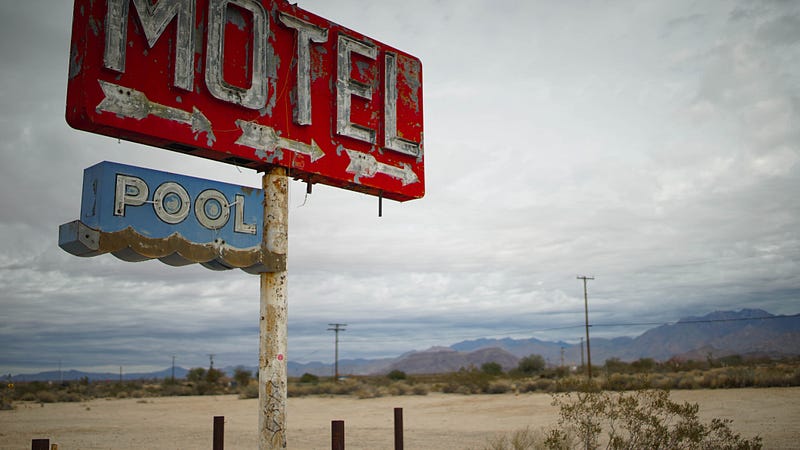
As writers, we’re often told to write about place as if it’s a central character in our work, as rich and deeply considered as our carefully crafted protagonists. They tell us to write about our place of origin, to claim in writing that land which birthed us, because that, they say, is where we’ll find truth. But I’ve always bristled at that directive. The first part of my life story occurred in Texas, and it was so painful that it left me with a scar tissue carapace I’m still working to dissolve almost half a century later. As for me, my place of origin has been cast as an archvillain in my story; but, to be fair, who or what was responsible for the casting is a matter of interpretation.
The other villain in my story, the wolf who never even bothered to don sheep’s clothing, is my own father. I associate him so deeply with Texas that the two, the state and the man from whom I sprang forth, form a sinister duo in my mind, collectively filling more space than they’re due. But I know that I’m unable to be objective about either. They are, after all, the bad guys in my story.
Though I would love to say I’m nothing like my father, that would be a lie. From him I inherited a panoply of negative mental attributes — one is an easy-to-spark rage that lies just beneath my surface. Another is a sort of obsession with geography, and an almost superstitious sense that my own happiness is tied to place, that my destiny relies on me heeding my urge to relocate to someplace I barely know and have romanticized beyond recognition.
My father had profound mental and emotional health issues, and he never was able to locate happiness within himself. It was always elusive, somewhere out there just beyond this or that impediment. Increasingly, it seemed that impediment took the shape of my mom and me. He simply didn’t like the way we filled space.
And that space I filled, that inner space of mine, was an uncomfortable and inhospitable place to be.
I was born with a rare nervous disorder called hyperhidrosis, which basically means I sweat all the time, regardless of environment or circumstance. Which, as you may imagine, translates to constant physical discomfort and anxiety. Too, I physically “blossomed” as they used to say, absurdly early. I had the body of a well-developed high school girl when I was nine, making me the source of inappropriate male attention I simultaneously craved and feared. Whether because of my sweaty and buxom physical reality, the long line of genetic mental illness in my family, or, most probably, a combination of the two, I’ve dealt with chronic, profound depression and anxiety since I was a little kid. Until very recently, I assumed that my suicide was inevitable and that I was simply staving it off as long as possible.
When I was a small child, my family (which consisted of my mother, my father, and me) moved often for two reasons — either my father would fly into a rage and quit or be fired from his job of the moment, or he would announce that there was absolutely no way for him to be happy if he didn’t live in (fill in the blank). My mother, ever capitulating to his whims (and later, to mine), would simply make it happen for him. When I was nine years old (again, that terrible age!), he insisted that we move to the Pacific Northwest. This change of space, he assured my mother, would alter his psyche as well. No more pouting withdrawals from the family. No more public rages that caused passersby to stop and gawk at us, wondering if they should intervene. No more prolonged passive-aggressive silences. If we would just move 2,000 miles away, to a town where he had no job and we knew no one, everything would be different. Obviously, he said, if my mom loved him and wanted him to be happy, she would go along with this. A good wife would go along with this.
That particular move involved him quitting his job as a high school teacher. My family sold the house where I’d lived since I was three and we drove with everything we owned in a U-Haul across the country to a house they had rented sight unseen. That was in May, at the end of the school year, in 1981.
The move itself was nothing short of horrific. The air conditioner in the car went out in the middle of the desert in 116-degree heat. My parents argued constantly, they had very little money, and something was happening to my dad that scared me. He was acting weirder than ever, saying bizarre things to me about sex. In a grimy motel bathroom somewhere in Nevada, he exposed himself to me as I was brushing my teeth. He laughed at my panic and told me I needed to loosen up. I didn’t want to be anywhere near him, but I didn’t want to tell my mom because I knew we had nowhere to go. We were lost in space, trapped in his orbit. That’s what I believed. But I was only nine.
During that summer while we lived in Washington, my father got a job delivering newspapers. He hammed up the Texas thing so much with his cowboy hat and boots and twang that his coworkers called him Tex. I guess that made him homesick, because by the beginning of the school year we were back in the same terrible small Texas town, though in greatly diminished circumstances. No more two-story house with a big backyard. Now we lived in a 2 bedroom apartment right off the interstate. It overlooked the asphalt parking lot and had gross matted brown carpet and paper-thin walls through which I could hear people’s angry voices and smell acrid cigarette smoke.
My parents finally separated when I was 12, after my father told my mother that he wanted to start a whole new life. He simply couldn’t be happy with her, he said, for a myriad of reasons. Chief among them was that she was too overweight for him. I couldn’t wait for him to be out of our house.
And once he was, just like that, I unironically picked up the mantle he’d dropped. Immediately I wanted to move to the next bigger town up the road. And then to Dallas. And then I set my eyes on California.
How obvious and predictable, looking back, the role that space would come play in my life. How carelessly my father threw to the wind that thread of madness that he had spun. And, most obnoxiously, how oblivious was I to what I was doing as I picked up that thread and ran with it, trying desperately to weave a life from that deeply corrupted material I’d inherited.
I’m almost 50 years old now, and I suppose I’m geographically settled, more or less. Earlier this year I bought a home in Colorado, just outside Denver where I’ve lived for almost a dozen years, after stints spent in San Francisco, Austin, San Jose, and Los Angeles. Prior to moving to Colorado, I was always chasing the perfect space, the place where I’d finally feel at home, where things would click and I’d be happy at last. In saying that, I don’t mean to imply that Colorado is that mythical happy place. What I do mean to say is that I no longer believe that place exists. What I do mean is that I’ve come to accept that so much, if not all, of what I need is not geographically dependent. It’s one of those things that I’ve always “known” but never really accepted, and certainly never internalized. I believe that the pandemic, with its mandated stillness, forced me to understand that.
And oddly, during the pandemic I came to profoundly accept myself as I’d never been able to before. Blessed social distance helped me to appreciate and feel more comfortable in my personal bubble, that space that’s within me and without me, at least to the tips of my fingers. Fingers that are and have been at most times throughout my life dripping with sweat, but are nonetheless mine and have served me well.
Until recently, my own inability to find happiness within myself matched that of my father’s. My natural proclivity for a quiet life of the mind, withdrawn for the most part from the public, had always embarrassed and shamed me. I wanted to be social and popular the same way I’d wanted to live somewhere, anywhere else. I wanted to not be me.
But the space I’ve found, here in this modest little house, in this flawed but hardworking body, in this mind that has struggled and fought so hard for so long, I’ve finally found, if not utopia, a safe space where I can live in peace.


