
America Has Always Been A Brutal, Lonely Wilderness
The movie ‘First Cow’ is a tragic love story about frontier outcasts
My fiancee’s mother watches old western TV shows Saturday mornings, and I have started watching them with her. The pandemic has totally upended my daily routines. I’m hiding out in the suburbs of New York City. My daily commute is a slow walk to the kitchen. I saw a bunny rabbit in the backyard the other day and thought: “is that an adorable rat?”
My life is different. I use to eat out at restaurants and now I mostly grill, which isn’t that terrible. And now, Saturday mornings, I watch buckaroos shoot banditos. Once upon a time, Hollywood was a giant cultural machine that manufactured nothing but cowboy adventures for screens big and small.
These western TV shows are broadcast on a cable network called Me-TV, which curates sitcoms and dramas from yesteryear all day long. The cowboy shows are all from the ’50s and ’60s and have names like Gunsmoke, Wanted: Dead Or Alive, and The Rifleman. Each of them a parable about white hats and black hats.
Then there’s Maverick, starring immortal charmer James Garner as a card shark who ends up doing the right thing every time. He’s a con man with a heart of gold.
The West of these shows was a time and a place that never was and never happened where white men fought and won the whole enchilada, from sea to shining to sea, and everything in between.
This is what I do Saturday mornings. I drink my coffee, and she eats slices of pears or apples. We watch black and white horse operas. The actors playing TV lawmen are handsome and clean-shaven. Their boots are shiny. The bad guys are dirtier. The women kindly. There are no people of color because mid-century America didn’t want to see them.
The western is America’s most basic myth. If a country could have a therapist, that therapist would want to talk about the 19th century, when America was young and hopeful, and hungry. The country knew itself better back then, I think. The truth is, the West was first won by men who spilled blood and then lawyers who spilled ink.
I actually enjoy watching these old TV shows, which recycle the same one-saloon town sets and Southern California desert locations. The costumes, too. The plots are picturebook simple, the endings predictable. White people love stories about white people riding horses. I also enjoy spending time with my future mother-in-law who grew up watching these quick-draw melodramas. They remind her of a similar time when life made sense.
Maybe life makes sense only in retrospect?
I talked her into watching a new western, which she dutifully did. It was a recent western feature film called First Cow. No one else wanted to watch it with me. The movie told a different story from her Cold War-era shoot ’em ups: America has always been an ugly country for sad men.
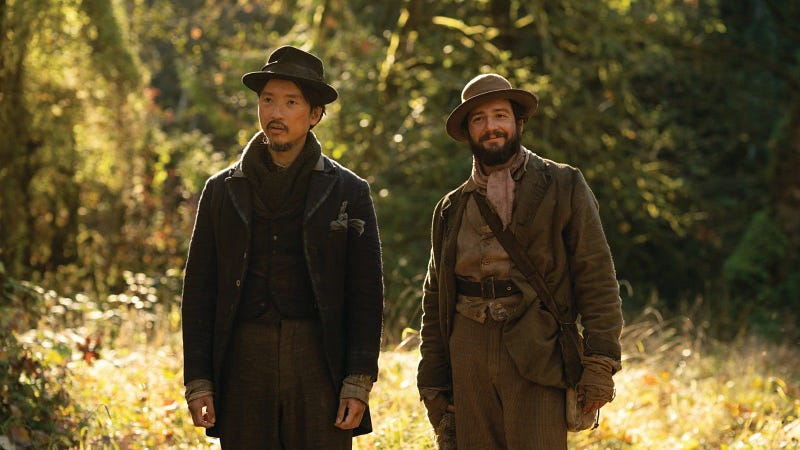
First Cow opens in the present day on a woman walking in the woods whose dog unearths a skull. She digs deeper and discovers two skeletons laying side-by-side, like a married couple sleeping in bed. This is our first introduction to the two main characters: a sensitive white man who can bake wonderful cakes and a wily, entrepreneurial Chinese immigrant who meet each other in the Oregon Territory of the 1820s.
The movie never returns to this woman’s grim discovery but the message is clear: history is a shallow grave, a thin layer of soil separating fact from fiction.
The American frontier in First Cow is a brutal and lonely wilderness populated by a diverse collection of men and women from all over the world. That is one fiction that First Cow dispels: the epic push westward was not just noble white men looking to make their fortune as the old TV westerns suggested. The faces in First Cow are from many different races, the accents from many different countries.
America has always welcomed hustlers and opportunists and, worst of all, dreamers. We then exploit them and their children and their children’s children. And by “we” I mean the very wealthy and their patrons, the extremely wealthy.
The movie is full of small moments that speak to the complexity of America’s experiment with racial diversity. Early on, the Chinese main character, thinking out loud to his new best friend, mentions wanting to starts business in Canton but how he’s from the North and the Cantonese hate Northerners as much as white men. In another scene, a local tribal chief enjoying the company of a homesick Englishman who gave up London for the new world gently mocks his guests for taking beaver fur but leaving the delicious tail.
In each brief scene, these men of color reveal that white men are not the center of their worlds.
The two skeletons we meet at the beginning are Otis and King-Lu. Otis is a quiet cook who we first meet picking mushrooms in an attempt to feed a group of barbaric fur trappers. He survives an unforgiving forest trail that leads to a hastily-built fort those residents live in squalor. Along the way, he quietly helps out a Chinese man on the run after killing a Russian.
The man, King-Lu, is worldly and confident and speaks English better than Otis. They are reunited back at the fort where a gentle, loving friendship is formed. The plot blooms from there: ambitious King-Lu discovers his friend's talent for baked goods and concocts an idea. What if they stole milk from a nearby prized cow and used that precious dairy to make cakes they could sell at the fort, where the only pleasures are whiskey and fighting?
And so that’s what they do. Every business is a legal scam, every businessman a pickpocket in a suit.
First Cow is a tragic love story about outcasts crushed by greed. It is cruelly ironic that a country founded on a right to pursue happiness would adopt an economic system that conspires to keep its citizens unhappy. The only truly valuable earthly currency is love and but love cannot flourish if people are forced to choose “mine” instead of “ours.” Businessmen will sing all day long about the wonderful choices capitalism provides but it only provides one: “mine.”
In First Cow, capitalism moves through the primitive society of the early 1820s like an infection.
Here’s another fact: the West wasn’t tamed, it was pillaged. First Cow is a soft-spoken critique of capitalism because the entire western genre is about capitalism. Every western movie or TV show deals with money, poker chips, and gold. The plots are all about robbing banks and stagecoaches and trains. The Western is the 20th Century trying to make sense of the 19th Century, an era of sorrow and hardship and impossible economic growth.
The heroes of westerns are looking for fresh starts and new beginnings. They toil, and some strike it rich. Which is the point of this entire country? It is the organizing principle of these united states. Get rich or die trying.
The western genre is as much about friendships between men as it is poker games and shootouts. Augustus McCrae and Woodrow Call, Wyatt Earp and Doc Holiday, Butch Cassidy and the Sundance Kid, to name a few. The relationships between these men are deeply intimate. This is partly because the west itself was a living nightmare that forced men to depend on each other, for survival’s sake. A few even learned to love one another.
The friendship between Otis and King-Lu is tender and when their scheme is uncovered their love is also destroyed because capitalism won’t allow two people to be happy just existing. They must make money.
I’m happy I finally got around to watching First Cow, which premiered last year but due to the pandemic was released on VOD only this past July 10th. It’s a hypnotic, and heartbreaking, drama directed by Kelly Reichardt, and based on the novel The Half-Life by Jonathan Raymond, who co-wrote the screenplay with Reichardt. I loved it, but I love movies about life west of the Mississippi before the arrival of automobiles and electricity and other modern wonders.
A few of my favorite modern westerns include the Coen Brothers darkly hilarious anthology The Ballad of Buster Scruggs, the creepy Slow West starring Michael Fassbender, and 2014’s The Homesman, starring Hillary Swank, and Tommy Lee Jones, who also directed it. The Homesman is one of the bleakest westerns I’ve ever seen. It’s almost Cormac McCarthy-level madness.
Have you seen Silverado? If not, you should. How about Robert Altman’s McCabe & Mrs. Miller? One of the stars from that movie, the late René Auberjonois, has a cameo in First Cow, his brief appearance a loving nod to that influential movie’s deconstruction of the western’s jejune morality.
And then, of course, there are the classics I never get tired of like Duel In The Sun, The Good, The Bad & The Ugly, and The Man Who Shot Liberty Valance. That last one is my favorite John Wayne movie, and I don’t like many John Wayne movies. Here’s a fact: he was an old-school racist.
First Cow is just another western, but a western that wants to warn us that nothing much has changed over the last two hundred years. America is still a vast land of violence and selfishness where love is crushed for profit.


