
The Old-Fashioned Virtue Signaling Of Tom Hanks
‘America’s Dad’ excels at playing men with strong moral codes
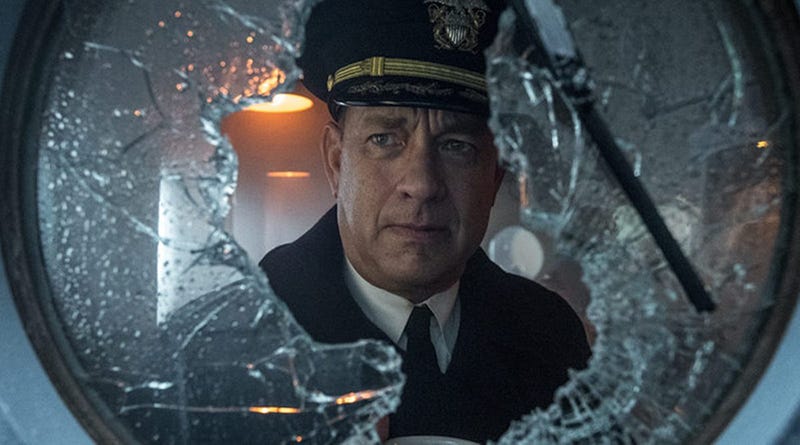
In the new war film Greyhound, Tom Hanks stars as a US Navy commander who has to escort an Allied convoy across an Atlantic ocean patrolled by German U-boats during World War II. You can stream it on Apple TV +.
Hanks’ character, Captain Ernie Krause, is a god-fearing man married to the sea. He’s humble, serious, and steady. When a pair of sailors caught fighting are hauled before him he is fair. When he gives orders that result in the deaths of Nazis, he does not cheer.
The man is self-reflective. He is thoughtful. Hanks’ Krause is vulnerable but not weak. These are old school virtues, from another time when men were strong and silent, unlike now, when men are cruel and loud.
There isn’t a minute in Greyhound when Hanks’ character isn’t virtue signaling, the popular right-wing political insult that men throw at men who publicly express upright beliefs.
Captain Krause is a leader of men and to lead men, to truly lead them, a leader must be able to distinguish between what is right and what is wrong. They must then live by those values. That’s an inconvenient standard for many men today, specifically those who lurk online.
Instead, they mock those who are compassionate. Demands of justice are booed. They wag a finger at the merciful and whine about “virtue signaling.’ It’s a blunt rhetorical device but an effective one. No one wants to be smug or self-righteous, especially those who are neither. The result is some men are shamed into silence by their peers.
A goody-goody can be insufferable, but they’re preferable to cowards and assholes.
There are rare times in history when principles and power align. This not one of those times in history. The men who accuse others of virtue signaling are admitting they have chosen politics over all else. They will hurt other people if it earns them, or their allies, a crumb of power or influence.
Those same dudes will quibble that there’s a difference being virtuous and virtue signaling. There isn’t. It is impossible to be virtuous and silent in the face of injustice. They know they’re wrong but they argue anyway.
Hanks’ Captain Kruise is a man driven by duty, above all things. He is responsible for his destroyer’s crew and the 37 other ships in the convoy. Duty is a virtue that has lost its luster in the popular imagination. No one wants to be responsible for their actions or words or wants anymore. They just want to heckle others who make them feel insecure.
Hanks is no stranger to playing nice guys. He recently earned an Academy-Award nomination for playing the famous PBS broadcaster Mr. Fred Rogers in the well-meaning, if treacle-y, biopic A Beautiful Day In The Neighborhood.
He’s played an astronaut in trouble, a modern-day Robinson Crusoe, and a man with the heart of a boy, literally. Even if Hanks hadn’t starred in a classic rom-com like Sleepless in Seattle or the groundbreaking AIDS drama Philadelphia, he’d be famous forever as Forrest Gump, a movie that should be buried in a shallow grave after a brief and polite eulogy.
I’m assuming everyone reading this essay has seen Forrest Gump but if not, here’s a short description of the 1994 mega-hit: Forrest Gump is the story of a sweetheart of low intelligence who does everything the government tells him and accidentally ends up a peripheral figure in American history.
At the time, it was a cute fable starring the most likable movie star of all time. I’m sorry, Gump fans. The movie doesn’t hold up. The bad news is the movie was always a fable for conformists and fascist-curious suburbanites. The good news is Tom Hanks is very likable. I mean, he won an Oscar for the role.
Hanks has taken risks, like wannabe Christmas classic The Polar Express where he played a seemingly undead computer-generated train conductor. It’s the exact opposite of Hanks’ Toy Story movies, which are charming little parables about childhood and family and living plastic dolls that he has lent his voice to for twenty-five years. There’s the confounding and misunderstood Cloud Atlas, a sci-fi movie that jumps around hundreds of years. His gentle 2011 romantic-comedy Larry Crowne is about one impossibly nice guy’s midlife crisis (he gets to fall in love with Julie Roberts.) I actually re-watch Larry Crowne ever so often, especially when I’m sick because the movie is bland like saltine crackers.
But Tom Hanks is most popular playing members of the Greatest Generation, which he did as a drunken baseball manager in A League of Their Own, which is his best live-action movie, in my opinion. And then there’s Saving Private Ryan, the Spielberg-directed World War II epic.
That movie is remarkable for three reasons: One is Spielberg de-glamorizing the horrific violence in that war. Two, Tom Hanks’ battle-hardened everyman is a melancholy warrior who joylessly does what he does to spare others. And three, Saving Private Ryan mesmerized the Baby Boomers, the children of those who fought in WWII, who became more powerful and wealthy than their parents could ever imagine.
The Boomers watched that movie and envied their parent’s sacrifices. They envied them but did not make their own sacrifices.
Greyhound is a taut 88-minutes of maritime mayhem. The computer-generated action scenes are harrowing. U-boats surface and dive into grey waters like iron leviathans. Sailors shout “torpedo” and dozens scramble. Depth charges explode and heave the ocean skyward.
The scenes on the Greyhound are tense and claustrophobic but the U-boat battles often have a seagull’s-eye view of ships on fire, sinking into a vast, endless ocean.
Director Aaron Schneider and screenwriter Hanks are not interested in telling a complicated story. This is about getting from point A to point B. It’s also about a man assuming his first command and his first crossing through hostile waters. He is scared but he cannot show it to his crew of mostly boys.
The Battle of the Atlantic ended up costing tens of thousands of lives and Greyhound nails the terror of being hunted by submarines during rough seas at midnight. It’s a movie about sonar pings and coordinates and steely-nerved men working together to survive.
The dialogue is mostly commands and updates and Tom Hanks’ character occasionally quoting scripture. It is an excellent war movie about men under pressure but never cracking.
The movie doesn’t waste time on backstory or historical context, either. There is one flashback scene between Hanks and a love interest played by Elizabeth Shue in what amounts to a brief cameo. The point of the scene: Hanks’ character really loves boats.
One of the only subplots in the movie concerns Hanks’ messman Cleveland, a Black man assigned to feed and care for Captain Krause when he’s not helping reload guns on the deck. The army of World War II is still a segregated one and will remain so until 1948. In the few scenes between Krause and Cleveland, you see the racial pecking order within the Navy’s rigid hierarchy, and you feel for Cleveland, who bravely serves his country.
But this history lesson is implied, it is never announced. I think this is meant to be subtlety. Except Greyhound is not a subtle movie.
It’s a straightforward Nazi-killing war movie designed to show off Tom Hanks’ talent for re-creating forgotten men with moral codes. I don’t want to romanticize mid-century American men too much. They were red-meat eating misogynists who sucked down cigarettes like the cancerous anxiety-soothing drugs they are before dropping dead of a heart attack at 50 years old. They did the best they could, which included giving the world nuclear weapons. A few dreamed of a more equal world though.
There are worse worlds than one where men compete to express their values, and then live up to them. Actually, we’re living in one of those worse worlds. I don’t think modern men try for shit. How’s that for virtue signaling?
I think I may be on the wrong side of history though. In 50 years, people will question whether World War II ever really existed. Old movies about strong, silent soldiers who did their duty will become fictions, like knights-errant. Virtue signaling will no longer be an insult between men because virtues will be forgotten, too.