
‘Saving Private Ryan’ Broke The Boomers
The children of ‘The Greatest Generation’ want to be great, too
I blame everything wrong with America right now on director Steven Spielberg’s 1998 movie Saving Private Ryan. The celebrated World War II drama was unsentimental in its portrayal of what American soldiers went through in Europe. It was a huge hit.
I wonder, sometimes, if that blockbuster glorifying the very real sacrifices made by their parents made the Boomers enthusiastic for war. But not the cruel quagmire that was Vietnam, the senseless conflict that haunted their youth. Nor the shadowy clash of empires that was the Cold War. But their war. A war they could start. An epic struggle between good and evil.
I can’t help but think the Boomers watched Saving Private Ryan and thought: ‘We should save the world, just like Dad.’ But instead of confronting metastasizing inequality or climate change they sent their children off to fight evil terrorists in the Middle East for 18 years.
I know Boomers are sensitive to criticism but, really, they’re rich and powerful. They can tough it out.
World War II, of course, wasn’t silver screen make-believe. It was a very real catastrophe that killed 75 million people around the globe. Those who lived through that should be honored and remembered but never envied.
The thing is, Saving Private Ryan wasn’t flag-waving patriotic pornography nor was it the kind of glossy journey into America’s heart of darkness that Hollywood thinks is profound. Instead, it told a sleepy late-90s nation fat with plenty that the only difference between yesterday and today is timing.
Anyone who has ever sat through a high school history class knows the famous black and white photo of heroic G.I’s storming the beaches of Normandy. Saving Private Ryan shows us some of those G.I.s were blown apart by machine gunfire before they stepped off the boat.
And those GIs? They looked like you or I. Some of them were kids. Others, teachers or construction workers or doctors. They were no different from your neighbors or coworkers. Just people living lives that would be cruelly interrupted by unstoppable forces.
Saving Private Ryan is about the value of a single human life. The plot revolves around a mission to locate and bring home the titular character, whose brothers have been killed-in-action. It’s a small story set in a big war but every gruesome, oftentimes pointless, death is heartbreaking.
The violence in Saving Private Ryan is brutal. When a grenade explodes a man is thrown in the air and falls back down legless. Bullets punch through helmets suddenly, without warning. The wounded scream and cry in pain far from help. Time heals all wounds but Saving Private Ryan wants us to look at one of humanity’s most gruesome wounds when it was still fresh. Before history disinfected it.
The same year Saving Private Ryan came out NBC news anchor Tom Brokaw’s book ‘The Greatest Generation’ was published. The book further mythologized a group of people who had suffered greatly and did so without making a fuss.
The Depression was a nightmarish economic collapse. The Second World War an unprecedented orgy of killing. Meanwhile, during those disasters, the United States treated people of color as second-class citizens. The men and women who fought that cruel system across decades are too often forgotten. What a miserable time to be alive.
But that didn’t stop Brokaw, and the Boomers, from bragging on behalf of their parents. ‘The Greatest Generation’ is just marketing. A tagline. The Boomers turned the sacrifices of the previous generation into a product to be worshipped and consumed. That generation didn’t need to call itself great. That was not their style. They had endured unimaginable hardships and nothing more. That’s more than enough, frankly.
And then, in addition, they rebuilt a ruined world and gave it to their children. It is not hyperbole to write that the post-war years were prosperous. The Baby Boomers inherited a Golden Age and I won’t’ say they squandered it but only because they still have some time to, for lack of a better term, pay it forward.
Not much time, though.
The Boomers were raised on a steady diet of the adventures of the generation that came before them. World War II was the ‘good’ war. Their fathers and uncles were larger-than-life heroes who jauntily punched Nazis. The Boomers came of age in the shadow of giants. But Saving Private Ryan shrunk that generation down to the fragile humans they were, just regular men trying to survive hell on earth.
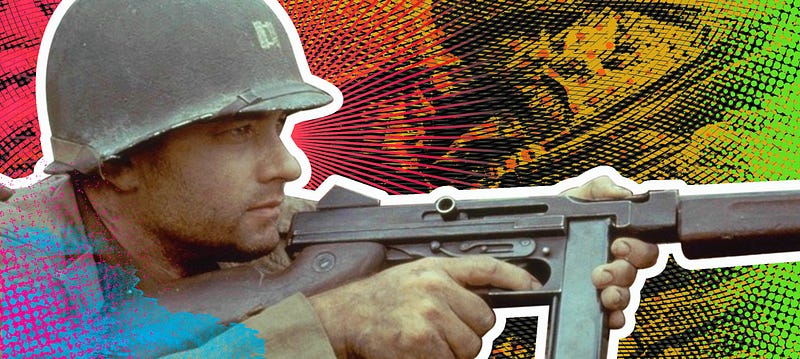
For the first time, on the big screen, they saw the truth dramatized as only a blockbuster can, loudly, spectacularly, with little subtlety. They watched everyman Tom Hanks play an anti-John Wayne character: a melancholy man wrecked by death who still, somehow, manages to stay sane. The men who fought in WWII were, in fact, permanently traumatized by the incomprehensible bloodshed.
I grew up watching Vietnam war movies like Apocalypse Now and Platoon, both directed by Boomers. Those movies explored the horrors of that morally-ambiguous conflict. The soldiers in those grim and cynical films were usually as bad, if not worse, than the enemy. For almost ten years the American empire shoveled it’s young into a faraway jungle on fire to score points in a larger geopolitical contest between superpowers. That lost war was the brainchild of the generation that had fought the Nazis.
To say Vietnam was unpopular is an understatement. I know today it is common to thank those in the military for their service but, once upon a time, Americans turned their backs on veterans returning from war. Times have changed, of course. We honor those who fight for their country. Thanking a veteran for their service is a proper and respectful thing to do but as a citizen of this country, you should also be supporting politicians who will fight for quality veteran healthcare and who will use American power wisely. The military is, ultimately, run by elected civilians so never forget your responsibility to those who serve. We all have a duty to each other.
I don’t exactly know why Americans are obsessed with generations. The actual story of this country is the story of the haves, the have-nots, and the have-it-alls. I am fairly confident that hundreds of years from now The Greatest Generation will be remembered but the rest of us will be footnotes.
The first time I felt any friction between generations was when I was asked to pick a movie for the family to see together and I chose Pulp Fiction. My parents hated it with a passion, especially that scene where Vincent accidentally shoots Marvin in the back of Jules’ car. I loved it.
My parents, though, weren’t Baby Boomers. My dad was a Depression-era kid, the son of a Baptist preacher. My mom was born in El Paso during the war. Her uncles would fight in both Europe and the Pacific. My dad served in post-war Korea.
I was raised to loathe hippies which, in retrospect, may have been a little harsh. The hippies I would meet in the early ’90s mostly just wanted to smoke weed and spiral dance in meadows and what’s the problem with that? But in the opinion of my mother, the mostly white suburban flower children didn’t care that her Mexican-American friends were getting shipped off to Vietnam until the draft came knocking at their door. Those kids always complain the loudest.
At the same time, however, I was being taught that the anti-war protests of the late 1960s were uniquely noble acts of civil disobedience. I remember a public high school history teacher who loved to mention he had gone to Woodstock. It is an irony that the ‘Baby Boomers’ would mythologize that youth movement for so many years only to reflectively dismiss the young now that they are older and richer and more powerful.
I was not raised by Boomers but I live in their world. I have spent my life watching them pat themselves on the back with one hand while stealing from the cookie jar with the other. The Greatest Generation wasn’t the most perfect collection of people but at least they knew we’re all in this life together.
The Boomers will never be ‘great’ like their fathers and mothers. No one should have to suffer the way that generation did. But they did and, afterward, dreamed of a world without war. A free world where, finally, marginalized people could fight for rights that should always have been theirs. A safe and equitable world that is clear-eyed about the future. The Boomers should spend their final years trying to make that dream come true.