
Best Of Humungus
What Men Don’t Say To Each Other
The classic western ‘Lonesome Dove’ is full of action, adventure — and tenderness
A few months ago, one of my oldest friends asked me for a book recommendation, and I told him to read my favorite of all time, Larry McMurtry’s Pulitzer-prize-winning cowboy epic Lonesome Dove.
I told him it was the only book I’d ever read more than once. That it was the first book to make me cry. Oh, and it's action-packed! I was desperate for him to read it, so I texted him this: Lonesome Dove is the Lord of the Rings of Texas. I thought, for sure, that would intrigue him.
He did not read it.
I am fairly certain, however, he will read this article because he always reads what I write. He proudly posts my articles on social media like he’s family. And I guess he is: nineteen years ago when I was drunk and lost and scared, he shocked me by asking if I’d be his newborn daughter’s godfather. He had sobered up long before I did, and, for a time, he had more faith in me than I had in myself.
Men aren’t supposed to say “I love you” to each other unless they’re falling down drunk. That sentiment is reserved for romance and family. But platonic relationships between men are as meaningful as either of those.
I don’t think I’ve ever explicitly told him how I feel about him, but he let me know how he felt about me, long ago, when introduced me to his little girl. She is in college now. Last time I saw her, we binge-watched Netflix’s Queer Eye in my tiny one-bedroom apartment in Harlem.
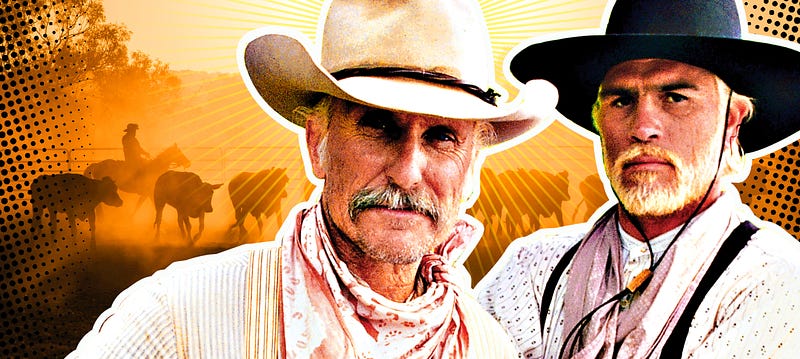
I suppose I should have told him to watch the 1989 Lonesome Dove miniseries instead of the book. The iconic eight-hour made-for-TV movie starred Robert Duvall, Tommy Lee Jones, Danny Glover, Angelica Houston, and a half-dozen other stars, including a couple of faces who would become much more famous later. The landmark series brought big-screen quality to the small screen and, in its way, presaged today’s golden age of television.
Either way, I hope he reconsiders. I know he likes to read nonfiction; he’s a high school history teacher in California. I also know he enjoys complex science fiction. He’s from Oklahoma, and I shouldn’t expect him to care as much as I do about Texas mythology. That I refer to Oklahoma as ‘North Texas’ doesn’t help.
I should have told him to read Lonesome Dove because it’s McMurty’s attempt to write a story about the real American West. The American frontier was a post-apocalypse; lawless, pitiless, and racist—a brutal locomotive of violence fueled by greed and hope. I don’t think this country has ever fully recovered from that trauma.
And yet, every time I read it I am moved. Yes, it’s a corny western. The prose ping-pongs between pulp and purple. It’s a long book that takes its sweet time getting started. The story is simple but I still find it stunning.
Life is a long, treacherous, breathtaking journey, like a cattle drive from the Rio Grande to the Rockies, and the only way to get through it all, from start to finish, is with those you love.
If you haven’t read Lonesome Dove, like my friend, but are interested in reading it, unlike my friend, do not worry: there are multiple copies of the novel, and VHS tapes of the TV miniseries, in every thrift store in America. Especially in the great state of Texas.
My dad introduced me to Lonesome Dove. He read it and passed it on to me as if it were a holy text. He was a proud Texan. I was not born in Texas but no one in my family holds that against me.
My people, as they say, are all from the Lone Star State. Specifically El Paso, the largest border town in the country. My dad’s father started out as a Baptist preacher there but eventually drifted to Arizona. Mom is Mexican-American. My great-grandmother was from Juarez, across the river, but legend has it, my great-granddad was a sweet talker. That’s the thing about Texas: god bless it, but it will always be occupied Mexico.
There’s a scene early in Lonesome Dove when the main characters decide to buy cattle by selling horses they steal from a bandit in Mexico. The Mexicans should have built a wall in the 1870s.
The Texas of Lonesome Dove is an unforgiving land recently civilized, thanks in part to the Texas Rangers, a state-sanctioned vigilante mob tasked with hanging horse thieves and murdering Comanche, fierce natives who bravely fought an enemy with the time and resources to steal an entire continent from tens of millions of people.
Lonesome Dove does not find any poetry, or moral clarity, in Texas or the west. Instead, it focuses on humans trying to survive a cruel and capricious time. The men and women in this world die hard and often. In Lonesome Dove, everyone is doomed.
Here’s the plot: a ragtag fellowship of broken men, lead by two aging rangers, strike out on one final adventure to become the first cattlemen in Montana, the last frontier. The book is a quest, like Lord of the Rings, only instead of an endless march to destroy an evil ring, it’s a perilous trek to chase a dream that was always dead.
The two main characters are a pair of men, one a wily porch philosopher, the other hard, like an anvil. They’re both constantly confounded and consumed by emotions they struggle to understand and articulate. In a way, the duo are cursed from the outset. The violence they committed on behalf of civilization eventually follows them to paradise.
I love both of these characters, not because they drink whiskey and pistol whip rude men, who they cannot abide. But because I struggle with emotions, I don’t always understand. I frequently fail to tell the people in my life how I feel. Both these main characters wrestle with their affection for each other. And, in the end, their loyalty and kinship is the only thing that matters.
Lonesome Dove and Lord of the Rings are both books about friends. They’re about the people who follow you into the darkness. The tenderness the cowboys show one another is as important to their cattle drive as their toughness. The little hobbits would never have made it to Mordor without each other and without help from new companions.
In JRR Tolkien’s classic Return of the King, the exhausted ringbearer Frodo is carried by Samwise, on his back, up a mountain to fulfill his destiny. In Lonesome Dove a dying man makes his friend promise he’ll carry his body back from Montana to Texas to bury him by a creek where he once had a picnic with a woman he loved.
I hope my friend picks up a copy of Lonesome Dove or watches Robert Duvall turns in his best performance. That would make things so much easier for me. I don’t think I can look him in the eyes and blurt out “If we lived in the hell that was late 19th century Texas I would have your back, my dear friend!”
Look, like I wrote before, the book isn’t perfect. The heroic African-American scout is pretty thinly drawn (although I did sob when he met his fate). The villain, a renegade Comanche, is likewise a flimsy invention. The women aren’t underwritten, but they’re either sex workers or mothers. But it’s still a cracking good read about two beat-up old men who love one another.
You see, there were times when he, my friend, would call me when I didn’t want to live anymore. There were years when the booze didn’t stop the pain. He’d call, or visit, and hang out. Talk to me. Listen without judgment. He carried me then.
I hope he knows I would do the same.