
Tico Tales
Amaranth: The Plant that Could Feed the World
About a decade ago, my late partner and I were traveling with a band of Harley dudes across the great American Southwest. This was an annual jaunt with the club, composed mostly of retired bankers, accountants, veterinarians, businessmen of all sorts, and their significant others.
Traveling in a throb of monster motorcycles — Harleys are huge and heavy and loud — is less like gang of thugs and more like Carnival in New Orleans, where everyone decks out in the appropriate (or sometimes very inappropriate) costumes.
Harley Dude costumes comprise heavy-soled black boots, leather chaps, leather jackets with too many zippers, chains, and heavy-duty snaps, black leather gloves, and a hard helmet, sometimes with a visor but always with goggles. For us girls, we soften our look with a colorful neckerchief, a little fringe on the jacket, bling for ears, and a ponytail that spills out in waves when the helmet comes off.
We are bad. Ba-a-a-ad to the bone. With jackets and helmets removed, cleavages exposed, and high-fives exchanged for an accident-free trip so far, we hit the saloons in every ghost town along our route.
On one dusty trip through the American Southwest, my partner and I headed back home on our own, avoiding major highways, enjoying sleepy mining towns and desert landscapes, and stopping to relieve our aching butts when we simply couldn’t take it a minute longer.
But this isn’t about motorcycle adventures
Somewhere in Arizona, we pulled into an off-track state park where a preserved colonial settlement welcomed visitors, the lonely ranger desperate for human interaction. Touring the grounds, where traditional Hopi agricultural practices and plantings had been lovingly maintained, we learned about the “three sisters” — beans, corn, and squash — and about a highly nutritious plant, believed to have been brought from Central America by the Hopis, called Amaranth.
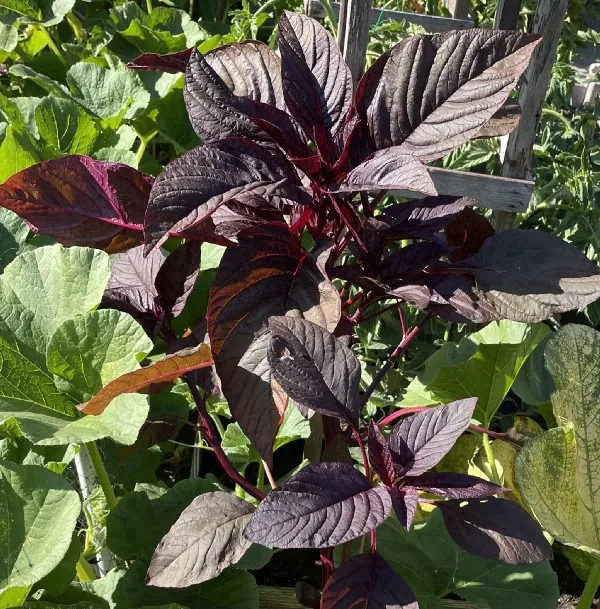
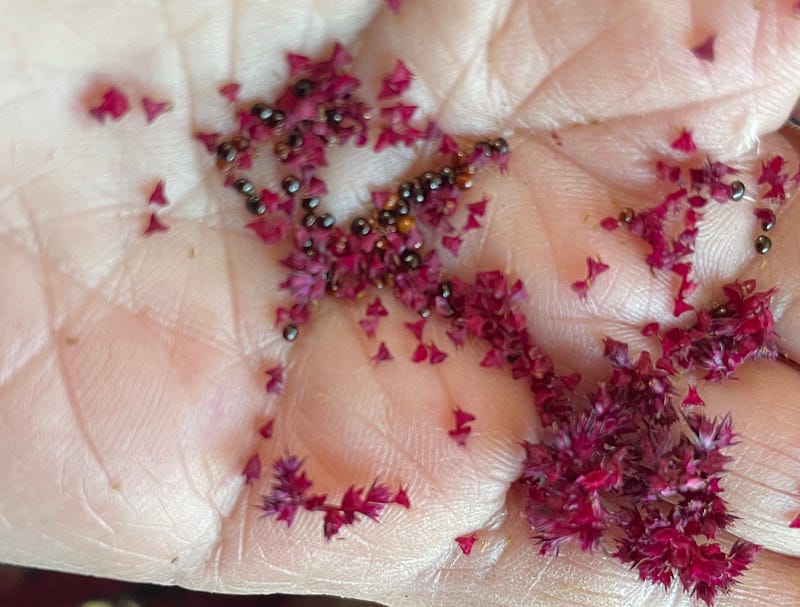
As an avid vegetable gardener, I was fascinated with this plant, a tall purple and dark-green leafed staple, one which produces a prodigious amount of tiny, shiny round seeds, also highly nutritious. The lonely ranger on duty recounted the origins of this beautiful plant, showed me how to thresh the seeds from the floral plume, and how to use every part of this remarkable plant for food. We left with his gift of a tiny sack of these precious maroon-black seeds the size of pinheads.
I could hardly wait to get these seeds planted in my veggie garden. But first, I wanted to know more about this ancient plant: Who grew it and where? What was it used for? How was it prepared for eating? Why had I never heard of it before now?
What is Amaranth?
Amaranth is not a well-known plant and is rarely found in vegetable gardens. Amaranth is a pseudocereal — not a grain, but a seed, like quinoa and buckwheat — indigenous to Mesoamerica. Black amaranth (Amaranthus hypochondriacus), the type I prefer to grow, has a fascinating history, going back thousands of years.
The seeds and leaves of amaranth are highly nutritious, packed with essential amino acids, vitamins, minerals, and dietary fiber. Its protein content is considerably higher than that of other grains, which made it a valuable food source throughout Central America.
Black amaranth, in particular, was revered as a sacred crop and considered a staple food by ancient civilizations, among them the Mayans, Aztecs, and Incas. The plant’s dark, purplish-black leaves and deep red flowers—also used for making dyes—held symbolic significance in religious rituals and ceremonies.
It’s delicious, highly nutritious, easy to grow, and self-seeds every year. What’s not to like? And, this plant was so important to pre-Columbian Central America that it even held religious importance.
So why don’t we see this vegetable in the produce sections of our grocery stores?
The answer? Amaranth all but disappeared with the arrival of the Spanish conquistadors in the 16th century. It turns out that the colonizers considered indigenous beliefs surrounding amaranth as pagan — and therefore a threat to Christianity — and sought to suppress those beliefs by threatening to cut off the hands of anyone who grew the crop.
Could Colonialism be one of the two worst things to happen to this planet? Others say it’s Capitalism. Organized religion is also at the top of many lists. Amaranth overcame them all.
Survival of a species
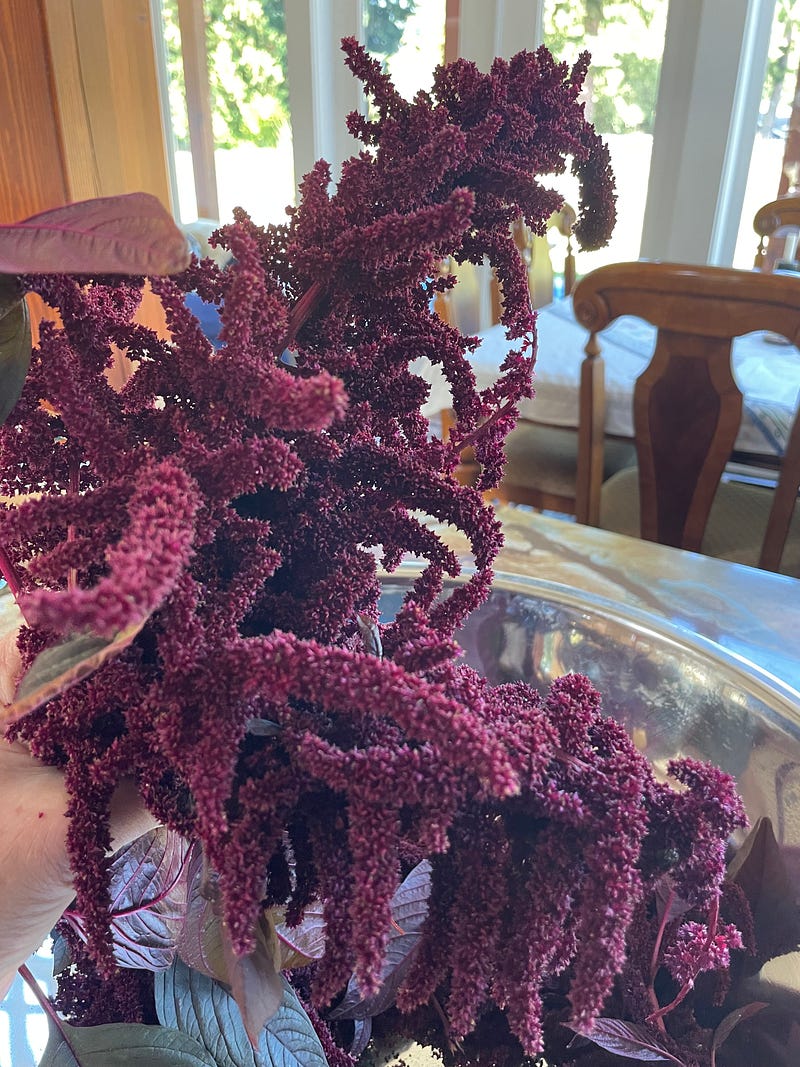
What the colonizers (terrorists) didn’t know was that each amaranth plant produces thousands of seeds, which, when ripe, drop freely from the long magenta flower plumes and reseed themselves. It’s virtually impossible, once started, to stop growing amaranth. So, despite the risks, farmers continued secretly growing this amazing plant, which sprouted up like weeds in their fields — even as far north as the modern-day United States.
Although it is not known specifically how the Hopi, in what is now modern-day Arizona, acquired amaranth, it is believed that Native American tribes, including the Hopi, exchanged resources and goods through extensive trade networks. Archaeologists continue to uncover these highways through jungles and over mountains in vast networks covering virtually the entire subcontinent of Central America.
Despite the centuries-long decline, black amaranth is once again becoming a sought-after crop in Central America, now cultivated in several countries, including Mexico, Guatemala, Honduras, and El Salvador. The plant’s versatility is showcased in traditional dishes and modern culinary creations, with its leaves, seeds, and flour incorporated into soups, stews, tortillas, and baked goods.
As Central America again embraces its rich heritage and traditional crops, black amaranth stands as a symbol of resilience, sustainability, and the revitalization of ancient agricultural practices in the region.
Growing Amaranth in Costa Rica
As a complete protein with all nine essential amino acids, amaranth is a highly nutritious source of manganese, magnesium, phosphorus, iron and antioxidants that may improve brain function and reduce inflammation. Several of these plants are growing in my garden right now, already having produced thousands of seeds and already having nourished me almost daily in one form or another.
Here are six more reasons to grow amaranth:
- It’s super easy to grow. Plant it once and it’s in your garden forever.
- Plant one seed, and stand well back with a flame thrower, just in case it gets out of hand.
- It’s a beautiful plant, also useful as an ornamental with its spectacular dark green and magenta leaves and magnificent magenta floral plume and seed head.
- Small leaves are delicious in salads for extra flavor and a pop of color.
- Steam the larger leaves to use in quiches or to serve as a side dish, even more delicious than spinach.
- Sprinkle the seeds on oatmeal or use in any recipe calling for poppy seeds. (N.B., they don’t give a false positive when you’re being tested for opiates. Just sayin’.)
I have not yet seen a resurgence of amaranth in Costa Rica. It is not well-known here but I hope to change that. I have already started giving seeds to friends and neighbors in hopes the word—and the plant—will spread.
This plant is the best thing that has ever happened to my vegetable garden. Check online for sources — there are many — and remember that this plant is sometimes called “Red Amaranth” in the USA. And also remember what this plant has overcome in order to continue bringing humans the best possible nutrition along with its beauty, prolific nature, and its pleasant disposition.
Happy gardening! Adelia Ritchie