
Health
How To Get Rid Of Dandruff — The Mess That Affects One In Two Adults
First step to defeat the enemy is to learn how they function.
Did you know? Humans shed their entire body skin every 4 weeks. We shed about a million skin cells a day. We hardly notice this cell-level activity.
This means we also shed our scalp — the skin on our head — every month.
What is dandruff?
Dandruff is a condition causing scaling, flaking, itching, and sometimes redness of the scalp. Dandruff results in accelerated and clumpy shedding of the scalp. Far more noticeable as the skin cells combine to form flakes and fall off. One in every two adults suffer from dandruff.
Dandruff can be categorized into two types — Dry and Oily. Dry dandruff is more prevalent and is the focus here.
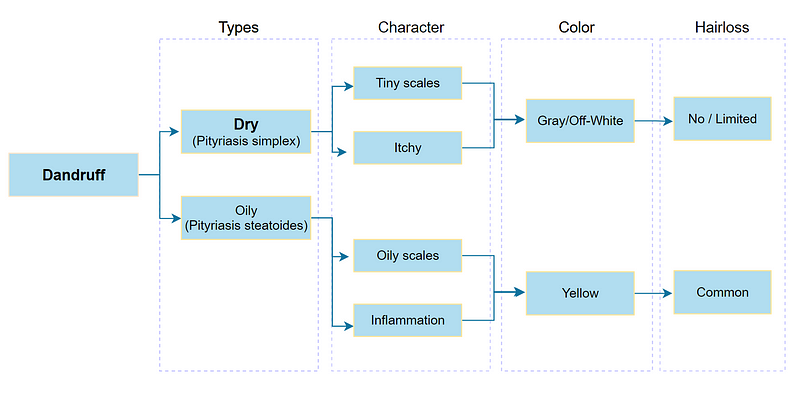
While dry dandruff is not characterized by hair loss, researchers observed in a study that the hair fall is 2x-3x higher than normal.
What causes dandruff?
Our body is home to over a billion different organisms. Among them is Yeast. Yeast is a single-cell organism part identified under the fungus family. There are over 1500 known variants of yeast. Many are harmless organisms and we use them in cooking, making alcohol, etc. Some are pathogens, e.g. Candida and Malassezia.
A form of yeast — Malassezia — is widely accepted by experts as the leading cause of dandruff. Malassezia occurs naturally on our bodies. When you have dandruff, the population of Malassezia increases by 50–100%. Yeast usually survives on sugar. Malassezia survives on fat/oil.
You can think of Malassezia as yeast on the Keto diet!
The fat in oils consists of fatty acids. If you are a fitness freak you know about keto and heard of Long-chain fatty acids and medium-chain fatty acids (MCT). Malassezia feeds on oils made up of long-chain fatty acids.
Malassezia can occur in many parts of our body other than the scalp. It is found in areas with a high concentration of oil-secreting glands (sebaceous glands).

Research has identified seven subspecies of Malassezia. All of them can cause dandruff in humans except M. pachydermatis which is mostly found in animals. The existence of multiple variants can be one reason some anti-dandruff remedies work well for some people but not for others.
What contributes to dandruff?
Here are some factors that can facilitate or create an environment for Malassezia to thrive.
- Over shampooing
- Allergy (to some cosmetics, shampoos, etc.)
- Stress
- A weakened immune system
- Oily scalp
- Dust, dirt
- Poor hygiene can be a catalyst for dandruff
- Weather — Dandruff gets worse in winter
How to control dandruff
Simple changes to our lifestyles and routines can have a significant impact on the growth of dandruff. Some of the suggestions I found helpful are
- Proper use of shampoo. When using shampoo make sure it is not applied superficially over the hair. For proper effect, the active ingredients should reach the scalp.
- Regular showers
- Gently exfoliate the scalp like you would other skin, to remove dead skin.
- During the shower make sure water reaches and rinses the scalp sufficiently.
- Reduce oil in the scalp. Malassezia thrives in oily skin.
- Reduce stress. Easily said than done. At least identify physical vs mental stress and take steps to reduce them.
- Eat healthy food for better skin and overall health.
- Vitamin and mineral supplements to treat deficiencies, if necessary, after consulting a doctor.
Dandruff treatment
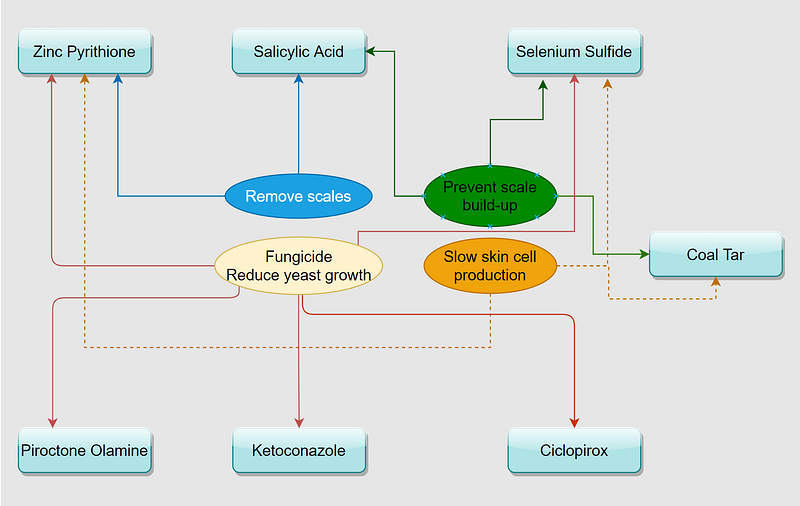
There are several shampoos available on the market to treat dandruff. The active ingredients differ in how they affect and treat dandruff. The commonly found active ingredients are below.
- Salicylic Acid
- Coal Tar
- Zinc Pyrithione (Most common)
- Ketoconazole
- Selenium Sulfide
- Piroctone Olamine
Herbal and natural defense
Some of us may not be very receptive to synthetic products. Whatever the underlying reason, there is still hope.
- Tea-tree oil Based on research, Tea tree oil is effective against dandruff. You can look for shampoo containing tea-tree oil as an active ingredient. It can be a viable herbal alternative. I have personally used tea-tree shampoo and loved it.
- Coconut oil We know the food for Malassezia is oil. Malassezia cannot absorb medium-chain (MCT) oils like coconut oil. Coconut oil also has anti-fungal and anti-microbial properties.
- Vinegar and baking soda are popular home remedies, but there is no substantial research to back them. It doesn't mean that they are ineffective.
The suspicious role of bacteria
Most of the existing research and products are skewed towards Malassezia. At the same time, there is also new research into identifying the role of bacteria in causing dandruff. Just like Malassezia, bacteria also inhabit our scalp. Two of the predominant bacteria being Cutibacterium a.k.a Propionibacterium and Staphylococcus.
In a study, the ratio of Staphylococcus to Propionibacterium was found to be higher in people with dandruff. This observation led to the consideration of Staphylococcus as a potential cause of dandruff.
Takeaway
The first step in defeating the enemy is to understand how it functions. The information provided here should help you in understanding the workings of dandruff and its causes. With this knowledge and persistence, you can defeat dandruff!
References:
- Anti-dandruff activity of synthetic and herbal shampoos on dandruff causing isolate: Malassezia Zoya, Mistry & Bhikhu, More & Shah, Gaurav. (2016). International Journal of Applied Research ISSN Print: 2394–7500. 2. 80–85.
- DANDRUFF: THE MOST COMMERCIALLY EXPLOITED SKIN DISEASE Ranganathan S, Mukhopadhyay T. Indian J Dermatol. 2010;55(2):130–134. doi:10.4103/0019–5154.62734
- Common Dandruff Shampoo Active Ingredients — Neoteric Cosmetics, Inc.