
How Intermittent Fasting Affected My High Cholesterol and Triglyceride Blood Levels
See the impact of Intermittent Fasting and One Meal a Day on cholesterol with data from years of personal experience.
My battle with Cholesterol and Triglycerides dates back more than a decade. A fight most of the world would have to undertake after a year-long snooze.
The triglycerides especially in my case have been high and difficult to reign in.
Both cholesterol and triglycerides are important indicators for heart health.
Even when someone is accused of being heartless, they are still expected to have this organ at varying levels of functionality.
Cholesterol and triglyceride levels in your blood should be maintained under recommended ranges for a healthy heart.
What is cholesterol?
Cholesterol is a type of lipid — fat for the common man — in your blood. It is required for the normal functioning of the body, they are the key building blocks for cells and are used to make vitamins and hormones.
They are naturally manufactured in the liver and also comes from dietary sources —meat, dairy, fatty food.
Cholesterol is further categorized into LDL and HDL cholesterol.
- LDL — usually known as bad cholesterol.
When in excess, they start to deposit on the artery walls and make them thicker over time. This leaves less and less space for the blood to flow. When it gets too narrow and gets blocked, the result is a heart attack or stroke.
“In my case though, the stress from looking at the blood reports, and constant reminders from family, would have killed me before a stroke or heart attack.”
- HDL — usually known as good cholesterol. Good HDL cholesterol levels help reduce LDL cholesterol in the blood.
Exercise and an active lifestyle help improve HDL levels. (More on that in a future article.)
You can also read about how I controlled Uric Acid levels below.
What are triglycerides?
Triglycerides are yet another type of lipid.
Our body converts excess calories from our food into triglycerides. Triglycerides are stored in fat cells. When in need of energy, our body retries it from this storage pool. High levels contribute to heart diseases.
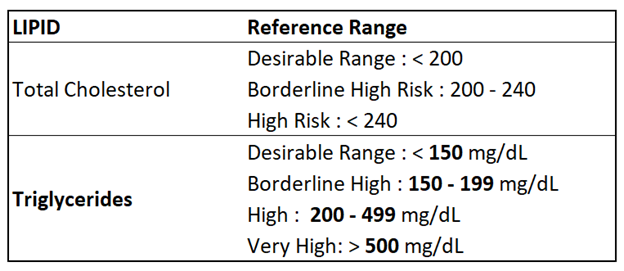
Here are the reference ranges or recommended levels of Cholesterol and Triglycerides.
Unfortunately, my long-drawn battle to rein them in did not bear fruit.
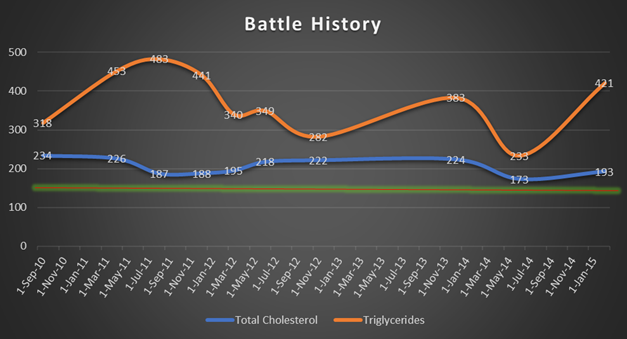
In my case, triglyceride was the primary concern. Levels mostly averaged around 400 — way higher than the desired range of 150 or below.
Like every other bloke who had high lipids in the blood, I have tried a variety of methods to rein them in.
- Dieting
- Exercise
- Olive Oil
- Medicines
- Oats
- Flax seeds
- Honey & lemons
*More on these in a future article.
These remedies, some recommended by doctors, others from the infinite wisdom of the Internet, had only a marginal impact. Even when the lipid levels reduced, they always came back with a vengeance.
Even the lowest levels I was able to achieve using these remedies remained in the high-risk range.
Enter Intermittent Fasting & One Meal A Day
When I started with OMAD and IF, the primary reason was better health, energy levels, and focus. Controlling lipids were not the main goal of the exercise as I had by now almost given up on the fight.
I started OMAD & Intermittent Fasting in April 2017. I had continued to track my lipids throughout this period.
In Mar’17, I started by preparing myself for OMAD. Since you cannot just jump into OMAD, I conditioned my body by first eating salads and light food during breakfast. This continued for 10 days and soon I skipped breakfast. Then in another two weeks, I started skipping my lunch as well and on April 26th my wedding anniversary, I started with One Meal A Day.
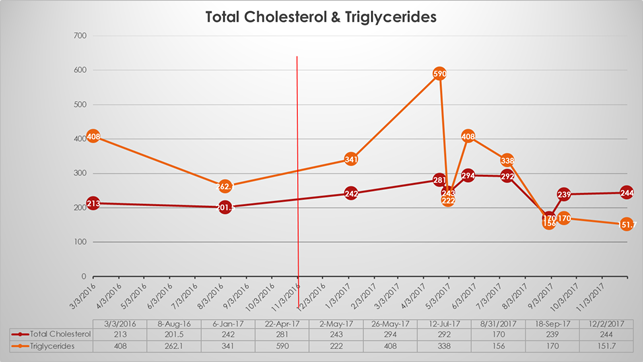
The first 3 months were OMAD and then I switched to intermittent fasting.
As you can see from the chart above, my triglycerides were at the peak just before I started @ 590.
The subsequent month, I saw a sudden drop in triglyceride levels from 590mg/dL -> 222mg/dL.
But by end of the month (May-17), when it returned with a vengeance like always, I had given up any hope of future gains.
Surprisingly, in the upcoming months, I saw what I believed to be near impossible!
The level of triglycerides, not only came down, it stabilized over a 3 month period.
Not just that, the new levels were now within the suggested/desirable reference range of 150 mg/dL.
So that is the story of how I won over my high triglyceride problem.
Hope this helps you improve your health.
I continued OMAD and intermittent fasting for several more years. Stay tuned if you want to know more about my journey.
I intend to share my experience with intermittent fasting and cover these in later articles:
· Effect of OMAD and IF on Uric Acid levels
· Benefits I experienced during Intermittent Fasting
· The downsides of OMAD/IF
· Why I had to stop Intermittent Fasting
Important Note: The information presented here is my personal experience and does not substitute medical advice. Please consult your physician to plan a safe regime that works best for you.