
Albahaca
This rejected word will make your pizza taste better
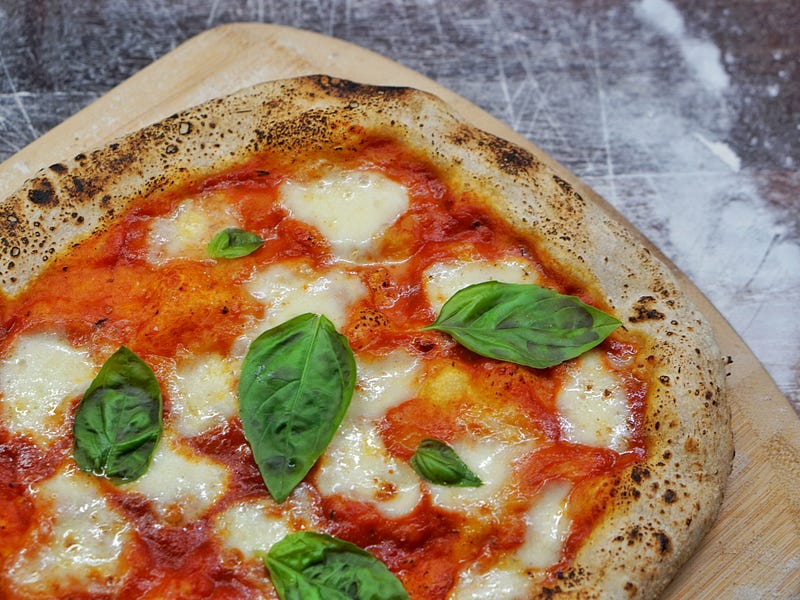
Today’s New York Times Spelling Bee letters:

A, B, E, H, L, Y, and center C (all words must include C).
Merriam-Webster says…
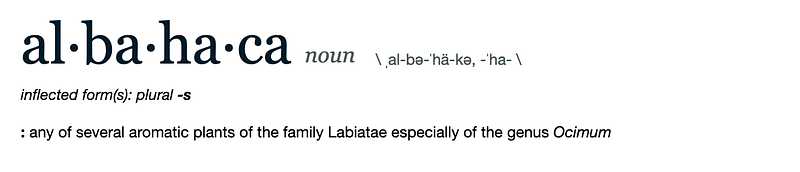
Silly little dictionary! Don’t you know that albahaca can’t possibly be a word if the New York Times says it ain’t?
For further fascinating facts, check out the Spelling Bee Master.
What’s your favorite dord* from today’s puzzle?
My Two Cents
Like many words that begin with “al-”, albahaca comes from the Arabic language. Spanish has a plethora of these, including everyday usage almohada (pillow) and road trip alcabala (checkpoint). English has fewer instances, although some of the common ones include alkali, alchemy, and the groan-inducing algebra.
O Simon!
I mean, Ocimum. As in Ocimum campechianum and Ocimum basicilum. Those are the two species people talk about when they talk about albahaca. Especially in Spanish, since albahaca is the common word for basil. In English, however, the common word for basil is… well, basil.
There is also a perennial shrub called albahaca in Puerto Rico, of the genus Celosia, but this sentence is all I’m going to write about that.
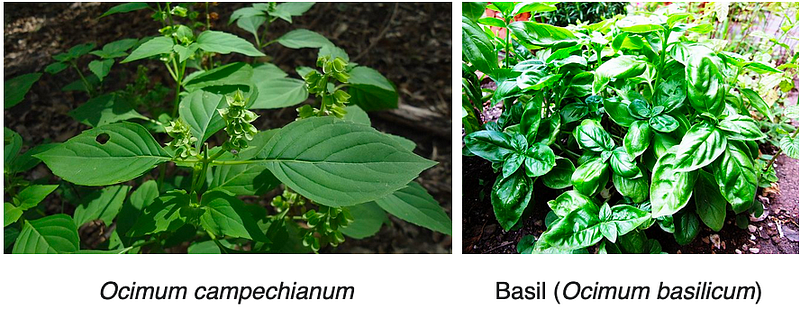
Can you tell which one of the two plants is the basil? Fair enough, I included the word basil underneath one of them. How about now, smarty-pants? Can you tell which one is the basil?
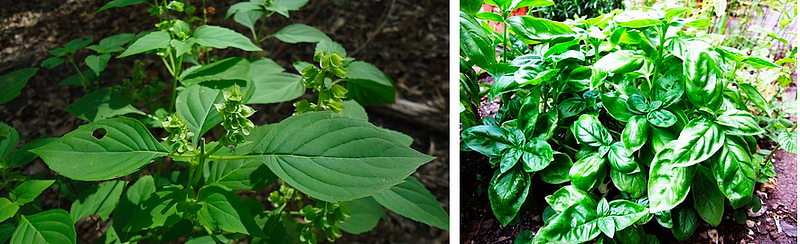
Anyway… the plant on the left, Ocimum campechianum, is found across Mexico, Central America, South America, the West Indies, and Florida.
Leaves of Ocimum campechianum are chewed in the Amazon jungle of Brazil and added to their psychoactive brew called ayahuasca. This plant is called xkakaltun in some regions of Mexico… so it’s probably easier to stick to Ocimum campechianum. This bastard stepbrother of basil has a similar pungent flavor but more antioxidants. It also can kill yeasts that spoil food. So there, basil! See what your bastard stepbrother can do? Nah-nah-nah-nah-nah!
Basil, of course, needs no introduction. So I’ll skip and just say I love how it makes pizza and Caprese salad fifty times better. My favorite pizza is probably a white pizza with anchovies, black olives, and basil, lightly seasoned with spicy olive oil. So, if you’re in the pizza business, feel free to make and sell that pizza in your shop. Just please do two things: (1) call it the Desert Harvest, and (2) crumble the anchovies and spread them out across the entire pie. Please please please don’t just slap on one anchovy across the center of each slice.
As for Caprese salad, it brings me to a…
New York state of mind
More specifically, New York City. As that old saying goes:
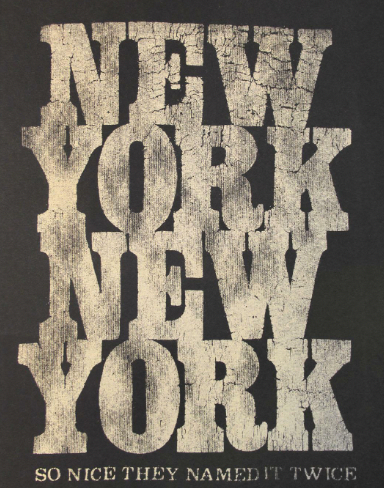
I actually used to have a t-shirt stamped with those words. But that was when I was a tourist, before I moved to NYC. You don’t really wear those touristy things when you live there. And you don’t do other touristy things either, like visit the Empire State Building or go to the Statue of Liberty. Or any museums. Especially not the wax museum in Times Square.
Or at least you say you don’t do any of those touristy things if anyone asks.
What you do do (doodoo, snicker!) as a local in New York City is find great places to eat. And then brag about them. As if you discovered them before anyone else did.
That’s what basil makes me think of. The lower, western part of the city. The Bermuda Triangle of Soho, Greenwich Village, and Tribeca. I worked in a building on Varick Street for several years, and that combination of Manhattan neighborhoods became my favorite of them all. Being a movie buff, I had my choice of several art houses, including the Film Forum on West Houston Street and the IFC theater on Sixth Avenue, in front of “The Cage” (the famous West Fourth Street basketball courts where stars like Dr. J, Jayson Williams, and Anthony Mason played).
Although most days I brought with me lunch from home (usually a sandwich), I would occasionally go out to eat, mostly with coworkers, or order in when the mood struck us or the boss was treating.
Around that time — maybe twenty years ago — I discovered a little treasure called Pepe Rosso To Go. And while preparing to write this article, I checked online and it still exists!
The bare-bone website reflects the bare-bone, hole-in-the-wall eatery. Now, they had tasty pasta dishes, but what I loved most was their Caprese salad sandwiches. Silky, creamy mozzarella with juicy tomatoes and roasted peppers, topped with fresh basil leaves, all inside homemade focaccia.
Just typing about this awesome combo makes my mouth water… and I already had dinner.
Now, I don’t see this sandwich or any other listed on the menu, so I don’t know if they still make them. They had other heros, but I never tried them. I think I tried their pasta once or twice, when I actually ate at the micro-restaurant. They have a handful of tables and cute, sarcastic signs, very New-York-City-ish. Like for example:
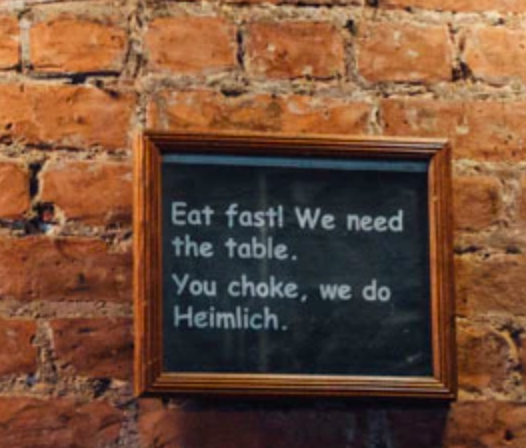
(I apologize for the blurriness. Reztok is not at his best today.)
Or another sign that sardonically asked you to bus your own table.
But I usually ordered “to go”, as per the place’s name. And when I did, I ordered the Caprese salad sandwich. It always hit the spot. The guy who took the orders over the phone sounded like he had been transported out of a 1950s gangster flick. The sandwich makers were Mexican (I think from Puebla, based on their accent) and they had the perfect touch for making these delicacies.
So, if you’re ever in New York City and want to have a great, simple, homemade meal, check out Pepe Rosso To Go, on Sullivan Street just south of Houston. Oh, and don’t call it HUGHS-ton, call it HOWS-ton. You’ll fit right in.
Ah, basil…
Despite its success as a culinary herb and a word that can bring back memories, the editors of the Spelling Bee decided that albahaca is a dord.*
You can check out my previous entry on another dord* here:
*What the heck is a dord, you ask? Here’s the answer: