
AI-Generated Music, Explained
This year alone we’ve seen several advancements in music technology, specifically with the use of AI. While the barrier of entry for programmers and musicians is getting lower, music generation software hasn’t been commercialized yet.
So why are people suddenly taking notice now, especially considering AI has been used in the industry for years?
Music Creation vs. Curation
Let’s get specific for those who don’t think much about AI-generated music. Broadly speaking, machine learning and statistical modeling have been allowing companies like those in FAANG to make better decisions on what content to show users. The YouTube algorithm, for example, analyzes and organizes around a billion videos, providing you with a tiny percentage of the available content to maximize ad revenue. Other streaming platforms (and platforms in general) do the same. If a company is trying to sell something, chances are they’re using ML to help sell it.
But while AI has been around on the curation side, the same is not true for content creation. Only recently have computers been able to generate realistic-seeming text and images, and even more recently have they started catching up to human capabilities of video and audio creation. What does this mean for artists?
Technological Consequences
Techniques for making music have always been pushed forward by advances in technology. The commercial production of microphones, for example, paved the way for music splicing, which allowed for more complicated editing and sampling. From a tech perspective, these innovations were primarily in electrical engineering — that is, turning changes in air pressure into electric signals to be stored and transmitted more easily and cheaply than ever before. These changes occurred in the mid- to late- 1900s.
This century, we’ve seen more improvements in music production, but mostly on the software side. As many of us have access to computers, we now take for granted the ability to access audio samples on the Internet, splice them together, and mix/master them in digital audio workstations (DAWs). Some of the best software is completely free to install and learn. Again, just more examples of technology lowering barriers for music.
While computers have previously allowed us to be more creative in our access to, and our ability to manipulate, audio information, ML presents a new advantage in that it can do much of the accessing and manipulating for us. We technically no longer have to search through hundreds of samples to find the ones that we like — we can just ask a computer to generate them. And instead of using basic probabilistic rules to randomize songwriting (as Brian Eno has done for decades), our computers can now write much more sophisticated rules for us.
I signed up for access to Google’s MusicLM, downloaded the iPhone app, and was able to generate music just from some text!
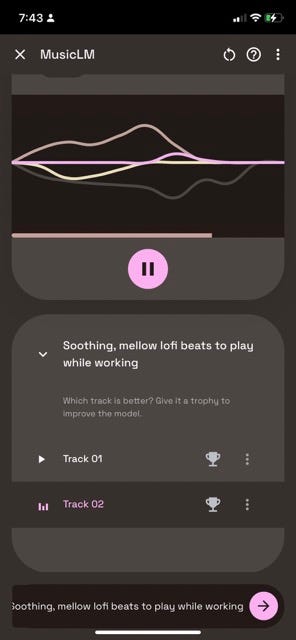
We don’t have to rely on fully-generated music, though. For those of us who have some experience with songwriting and production, we can take a step back and work with AI where it makes our lives easier (instead of letting it replace us altogether). For example, you’ve probably seen the huge influx of deepfaked covers of “AI Kanye” performing your favorite songs. These songs rely on different ML models than the language models we hear about daily, but are being popularized by the same AI hype we’ve seen this year.
As someone who has found that creating even simple audio deepfakes is difficult, I was excited to find that I could now suddenly take a Bruno Mars song and turn it into this Ariana Grande (feat. The Weeknd) cover. Stay tuned for the tutorial on how to do that. (Edit: here it is!)
Business Consequences
So the technology is cool and the music sounds alright… but what does this mean for the industry? Has anyone been able to (legally) make money off of their AI music, and if so, how?
As of now, it’s too early for full business models to take shape; we’re still in the Napster era of AI music. You may have heard that Ghostwriter977’s original song “performed” by modeled versions of Drake and The Weeknd was taken down by Universal Music Group right after it went viral. As always, big labels will be the most successful in exploiting new technology for profit. And as always, this will probably come at the cost of artists.

But independent artists who have a more deterministic (and fast-paced) view on technology will find that they can grow along with this AI movement. Grimes, for example, recently tweeted that she would split “50% royalties on any successful AI generated song” that used her voice, thereby treating AI artists as any other collaborator. Symbiosis is possible, and is definitely more productive than copyright takedowns and lawsuits.
Analyzing the rest of the music value chain, we have to wonder what will happen to the distributors — streaming services like Spotify and YouTube. Obviously, Google seems to be in favor of AI in music, but it currently fails to address how artists’ likenesses will be collected and, eventually, monetized. It is also currently failing to protect artists. In fact, many AI-generated covers are still on YouTube with ads enabled… so there is definitely some shady business at play here which Google is letting slide.
We’ll soon find that, just as YouTube and music labels partnered to find copyright abuse, they will deploy similar methods to find AI-generated music and promptly flag it or take it down altogether. Spotify will also remain at the mercy of the biggest labels, but time will tell if it ends up being a winner by further partnering with labels — and preventing more Ghostwriter situations — by allowing for shared revenue.
For the time being, though, AI music is like the wild west. Spotify also recently took down thousands of AI songs which came from a newer platform, Boomy, not because of copyright this time but because of the use of bots in artificially boosting streams. We will need to wait for this emerging technology to be embraced by the big players before it finds a legitimate, permanent place on our platforms.
With that, I’ll leave you with a Khalid song I interpolated with some Ariana. (And no, I’m not profiting off of this music.) Enjoy!


