
How Will Spotify Know You Better in 2023?
For the past few years, I’ve been referring my friends and co-workers to “How Does Spotify Know You So Well?” by Sophia Ciocca. Although there have been some updates to the blog since 2017, there are some newer technical and business moves which I’d like to touch upon here.
I’ll cover the major points in Ciocca’s article to get you up to speed. The issue raised is that Spotify is hardly the first music streaming service, or the first to use algorithmic curation. So what has enabled its success?
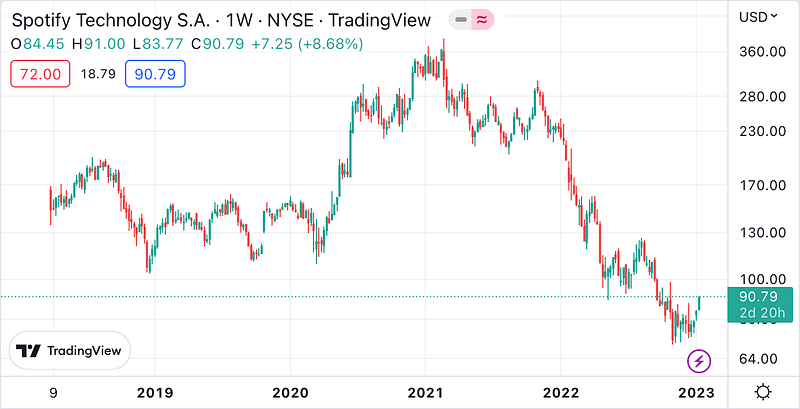
The most significant metric we have for any platform’s success is probably the number of monthly active users. Spotify has posted an increasing user count in almost every quarter since 2015, and is now approaching half a billion users, according to Statista. Compare these numbers to its direct competitor, Apple Music, to find that Spotify is almost 7 years ahead in attracting listeners.
Spotify As A Social Network
Considering that major streaming services all have millions of licensed songs, user count really is what sets Spotify apart in the industry. It is what allows for the collaborative filtering which Ciocca covers first in her article. With more users comes more potential overlap between those users — allowing for Spotify to make better-informed curation decisions. So it makes sense that your recommendations will get better overtime, even if Spotify changes nothing technically.
My take here is that collaborative filtering is Spotify’s attempt to be a social network without letting us access the network itself. We are shown a simple “Friend Activity” feed on the desktop app, and Spotify recently added support for curated “Blends” between friends. So Spotify does know who our friends are, and also how to embarrass us in front of our friends. But we can’t make individual posts or send direct messages like on our traditional social media apps.
While we’re on the topic of social features, though, I have to give a special shoutout to Spotify Wrapped, which, despite being a bit laggy this year, found its way all over my Instagram and Twitter feeds.
Spotify As An AI Company
Despite these trendy features, Spotify is seen as less of a social media app finding content overlap (which is a basic data science technique in itself) and more of as AI-intensive curation app. Sure enough, the company hires only the best data/ML engineers, and usually only those with masters or doctoral degrees. So when it comes to scalable natural language and audio processing — again, covered extensively by Ciocca — it’s hard to compete with the top of the class.
Unfortunately, since I’m not an employee, I can’t tell you exactly what kind of NLP and DSP is going on under the hood. But as a programmer in this space, I can take you through some recent industry advancements which Spotify will definitely be working hard at implementing this year.
- Speech-to-text: As I covered in my article “Audio Processing for Detecting Piracy on TikTok,” getting words from audio can be much harder for computers than for humans. This problem only intensifies for singing and rapping, as words may be morphed or pronounced in new ways. Musixmatch attempts to solve this problem by providing AI-generated lyrics, which may help provide on-demand metadata when artists forget. But you’ve probably noticed that these lyrics have not quite caught up to the human collaborators on Genius.com.
- Vocal and instrumental isolation: Spleeter is the best free option we have for splitting an audio track into its individual stems. Rumor has it that Spotify attempted to implement a “Karaoke Mode” in 2021, but the technology hasn’t quite caught up to human producers, who don’t need computationally-expensive neural nets to isolate vocals.
- Crossfading and DJ-ing: Spotify has a basic feature to automatically fade tracks, which reduces empty space. But, again, this feature comes nowhere close to the abilities of human DJs, which is part of what makes the acquisition of Soundtrap — a cloud-based digital audio workstation (DAW) — so interesting.
All of these features tease at the broader idea that eventually, music curation and creation will be the same thing. As AI advances, apps will not just personalize content for subgroups of users, but will actually generate live content for each individual. Personalization will indeed be personal — we may just have to wait awhile.
Spotify As A Podcast App
In the meantime, Spotify seems largely focused on becoming a one-stop shop for both music and podcasts, which has definitely kept investors confused in recent years. Despite acknowledging that podcasts will not overtake music engagement, CEO Daniel Ek has held true to his strategy in acquiring podcast apps, such as Anchor and Podz.
This reasoning is strange to many, especially considering that Spotify already leads in music streaming and is taking on some tough competition with Apple and Google Podcasts. As a business strategy, we’ll have to wait and see how this plays out, but as a data engineer and product manager, I can see why the new focus on podcasts can be appealing.
Not only do podcasts increase engagement with apps by potentially hours a week per user, they also demonstrate non-musical interests of users and can give insights onto what kinds of celebrities and temperaments are most appreciated. The fact that The Joe Rogan Experience topped the charts in 2022 makes one thing clear: Spotify users like controversy, and they didn’t seem to be getting enough from their music.
Here’s to a new year of streaming!