
Afraid Of Being Sued For Photo Copyright Infringement? Stop Using Google!
There are better options out there. One of them is DuckDuckGo! And no, this is not an ad.

Whenever the topic of copyright comes up, I see two major camps. One does not give a flying fudge about the matter and assumes everything on the web is fair-play. The other camp falls into the other extreme and says that anything you didn’t make yourself, you have got to pay for or ask permission to be used. The first camp, I fear, is entirely ignorant. The second camp is playing it overly safe, which is neither practical nor beneficial to anyone.
I’m here to say, there is a third camp, and all you have to do to join it, is get a few facts right and develop some good habits. Some of them will be technical, but just a little bit, and if you pay attention, you’ll get it, and it will make a lot of sense. I speak as both someone who used to work in the music industry where copyright is king, as a software developer and also online writer.
When I started writing online, but more specifically here on this platform, my immediate concern was the ethical and legal sourcing of images. Being an editor of three publications, too, I also had the responsibility of advising writers on where to get their images in a way that won’t backfire later.
Use the appropriate search engine
The first and natural thing people do is go to Google, search for an image. The large majority will just take the image they like, save it, add it to their article, and call it a day. The more copyright conscious ones will use the search tools and flip open the usage rights dropdown and opt for Creative Commons licences.
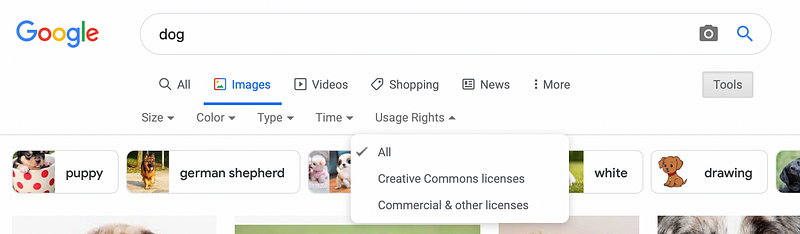
Now, that’s not a bad attempt at doing the right thing, but it has been proven a few times that it might not be the safest way, it can potentially carry some risk. My fellow writer Susie Kearley has written extensively about it and the potential dangers of the CC copyright. All valid concerns and great reads. My only additional comment would be that CC in itself is a fantastic tool that allows the world to share the value of certain types of work. The problem is not so much with CC, but rather that certain individuals (ab)use it maliciously.
However, there is a much less risky approach to getting images into your articles or whatever you may need them for. It’s called the Public Domain licence, and the best tool to find them is another search engine called DuckDuckGo. It’s been around for many years now, but one of their lesser-known features is a filter on image searches that goes well beyond what Google offers.
Let me illustrate the same search I did in Google but now in DuckDuckGo:
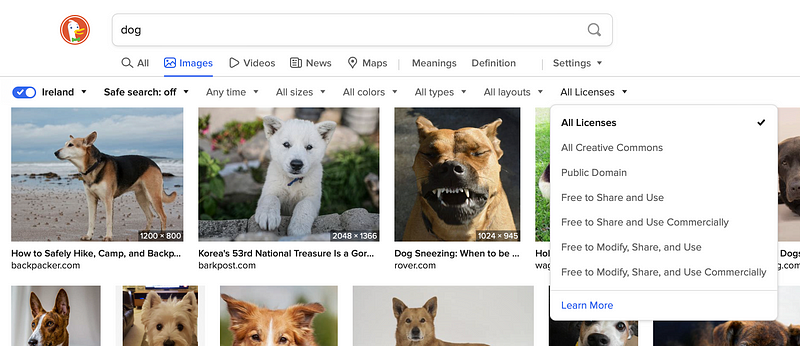
Not only do I get Public Domain filtering, but I even get variants of the CC licence! Just this dropdown alone will expose some potential risks of using CC because it turns out CC has its own layers to keep in mind.
If Public Domain images don’t give you exciting enough results, at least on DuckDuckGo you can make a much more informed choice on exactly which type of CC licence you want to filter by! This is super powerful. As a software engineer, I would advise you generally stop using Google search and shift to DuckDuckGo for every search, on every device, but if that feels too drastic to you, then just do it for images you want to use.
The Unsplash Conundrum
What makes Unsplash a special case, is its tight integration with Medium. It is by far the most popular way of adding images into articles. This feature, for someone who has been on the platform for eight years now, is actually a new one. Back in the day, people added whatever they felt like, and it was entirely up to the writer to decide whether they had the right to add it or not. That capability is still there, of course, for valid reasons, but as we all know, it’s much less used.
OK, so what happens when you click the search icon and use an image from the embedded Unsplash service? Well, a number of things. Let take the header image from this article of mine:
When I inspect the code of the image, it looks like this:
<img alt="" class="dm pn po" src="https://miro.readmedium.com/max/1400/0vNrQ4sgEXuQ9LIJ1" width="700" height="469" role="presentation">
The part after the src property stating miro.readmedium.com indicates that we’re still within the Medium servers. This is not yet Unsplash. However, once you navigate to the author’s page and find the same image, you’ll find that the URL it’s connected to is different, and this time it’s pointing to the Unsplash servers.
https://images.unsplash.com/36/yJl7OB3sSpOdEIpHhZhd\_DSC\_1929\_1.jpg?ixlib=rb-1.2.1&ixid=MnwxMjA3fDB8MHxwaG90by1wYWdlfHx8fGVufDB8fHx8&auto=format&fit=crop&w=867&q=80So, what does this all mean? Technical details aside, this means that there is an agreement between Medium and Unsplash. Every time a writer adds an image through the search button, a version of that image from Unsplash goes under the jurisdiction of Medium, essentially creating what appears to be a copy. Now, if this has you spooked, it should not. Given that this can only happen with Unsplash’s agreement in the mix, Medium has the legal right to “copy” the file. You are not involved. In fact, what’s likely happening, you’re not even the first to use that image, so both you and several other people are pointing to the same file. This info is, of course, shared with Unsplash, so they can track how many times an image is used and report back to the uploader of the original.
What’s important to remember here is that on Medium specifically, you, as a writer are not creating copies of an image when using the image search function, you’re merely surfacing them in your content via Medium, who does the copying for you for various technical reasons. If ever any copyright infringement happens, that is between the author of the image, Unsplash, and Medium. You, as the writer, cannot be culpable. If there’s a dispute, Unsplash will have to remove the image which should trigger a removal from Medium as well, and voilà, you have an article without an image, but you’re not in court.
Now, this is a little known fact, but from a legal perspective, there is a thing called the “server test”. Long story short, this claims that if you are merely surfacing the image through your content via an HTML image tag, you are just linking to it, not making a copy, as the original image still resides on the original server. This is true; however, it was challenged a number of times quite recently. This, does not affect the Medium — Unsplash scenario. Simply because the two have a legal agreement between themselves to offer you this embedding solution, which is a great segue to my next point.
Embedding and linking is fine
Embedding for all intents and purposes is basically a service a platform offers as a “window” into their platform via another platform, be that your own little site, Medium, The New York Times, etc.
You can embed anything and everything that has embed as an option.
Many of these platform give great control to content creators to toggle this capability on and off, so as long as you have the option to do so, it’s all fair-play. You can Embed YouTube videos, Spotify, Apple Music, tons of things. The reason this is perfectly fine, is because you’re essentially giving your reader a view into their platform, which generates them views and revenue as well.
Linking is also very similar. While a link alone is nothing exciting, when referencing sources or whatever else, it’s an essential capability.
The whole World Wide Web is basically a gazillion links interlinked!
The reason this will never cause you copyright issues is that as soon as the user clicks it, they end up on the source platform, so essentially you’re advertising them for free.
If you ask me, it’s really not that hard to stay on the right side of the law when it comes to copyright, especially with photography. If anything, the most responsibility is born by the copyright owner. You as a writer, if you just use a more capable search engine like DuckDuckGo, and keep in mind the rules around embedding and linking, you should be more than fine.
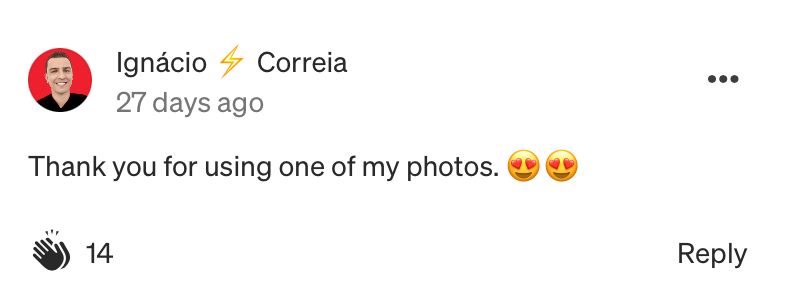
Many (vast majority) copyright holders are really nice people who get a lot of satisfaction from seeing their work being used. Not long ago, someone reached out to me on this article in the comments and thanked me for using one of their photographs!
I mostly write about tech and programming…
But I do sometimes touch on writing related topics, so here’s a few you might enjoy. 😁
Attila Vago — Software Engineer improving the world one line of code at a time. Cool nerd since forever, writer of codes and blogs. Web accessibility advocate, Lego fan, vinyl record collector. Loves craft beer!