
Activity U (II): Unit of Analysis, Niches of Analysis, Levels of Analysis
Understanding Idea Ecology with Niches of Analysis and other thinking tools
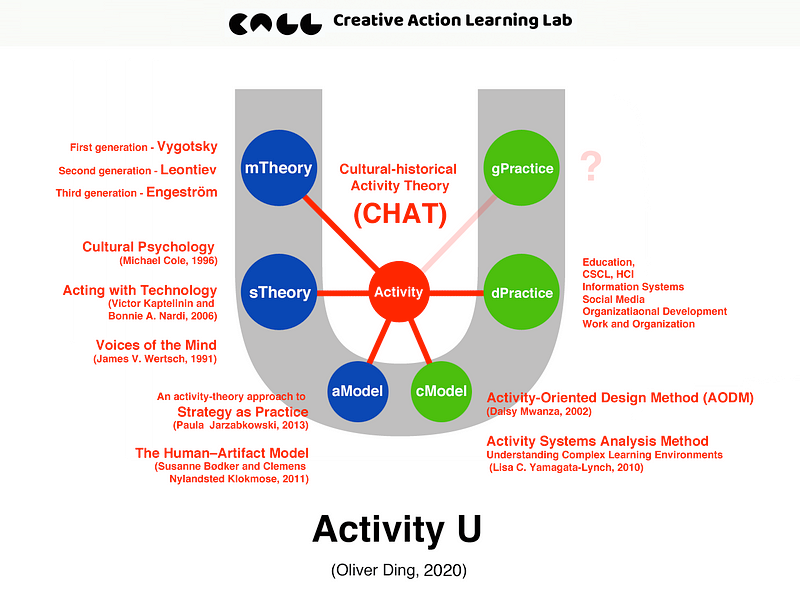
I am recently working on a case study called Activity U. The latest article Activity U: The Landscape of Activity Theory (Part I) used the Diagram U to represent a large knowledge enterprise: Activity Theory or Cultural-historical activity theory (CHAT).
This article will share one of several insights I learned from the study: Unit of Analysis. I will also introduce my own idea Niches of Analysis and other people’s Levels of Analysis.
1. A Chart about Activity Theory
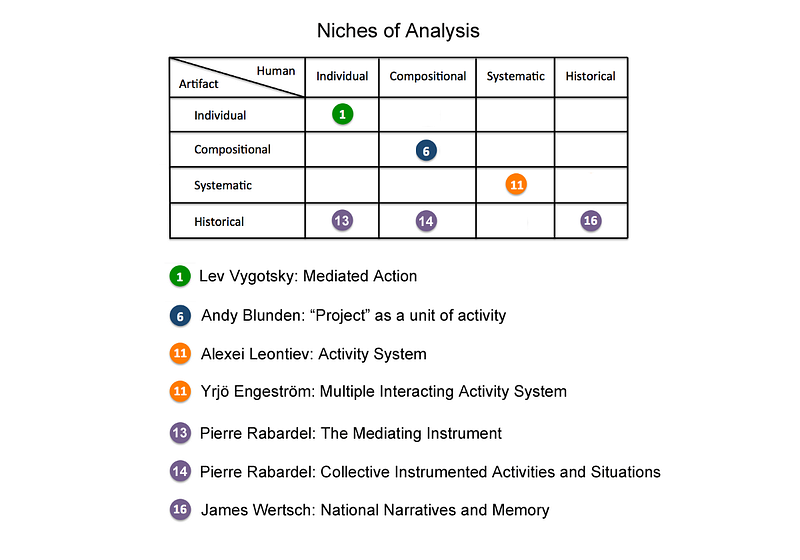
During the process of writing, I reviewed the theoretical development of Activity Theory with four dimensions of complexity and drew the following chart.
Yrjö Engeström (2010) has mentioned the evolution of activity theory, he said “The first generation built on Vygotsky’s notion of mediated action. The second generation built on Leont’ev’s notion of an activity system. The third generation, emerging in the past 15 years or so, built on the idea of multiple interacting activity systems focused on a partially shared object.” I made the diagram below to present diagrams for these three generations of theoretical development.
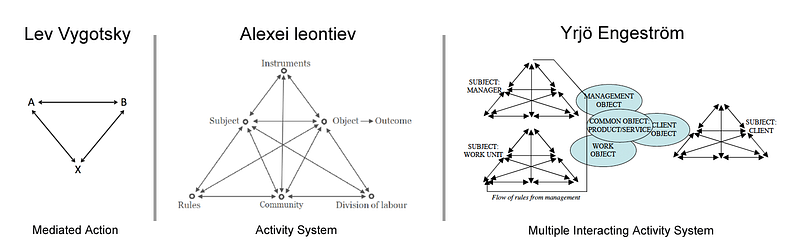
Based on Engeström’s description, I place Vygotsky’s work in niche #1 because the concept of “mediated action” is about individual level analysis. Leontiev’s Activity System and Engeström’s Multiple Interacting Activity System are placed in niche #11 which means systematic level analysis, the former focuses on a single system while the latter focuses on multiple systems.
Some researchers argued that the third generation of activity theory shifted from a focus on individuals-in-society toward organizations. Spinuzzi (2020) said, “Whereas 1GAT and 2GAT both represented a cultural psychology, 3GAT has more or less become an organizational sociology”. Spinuzzi and Guile (2019) also pointed out the limits of the third generation of activity theory, “3GAT has built-in limits. Specifically, activity theorists have noted limitations that 3GAT faces when accounting for social production, peer production, and similar cases of post-bureaucratic work, cases that do not resemble traditional work with known cycles and an agreed-upon object. Unlike cases traditionally explored by activity theory (e.g., education, health, law, and other longterm, stabilized activities), these cases tend to be unsettled, unstable, and interconnected with many other activities (e.g., open source software, coworking, entrepreneurship, and client-focused projects). Such cases tend to include objects that are fractional rather than unified; emergent rather than established; and transformed through multiple, loosely synchronized cycles rather than a single developmental cycle.”
The compositional dimension and systematic dimension both consider multiple entities, but the former refers to a loose relationship within a group of entities while the latter refers to a group of entities with a stable structure. I placed Andy Blunden’s “Collaborative Projects” in niche #6 because collaborative projects are less stable than organizations.
In 2014, Andy Blunden edited a book titled Collaborative Projects: An Interdisciplinary Study and argued that there is a need to establish a concept of “project” as a unit of activity theory and human sciences. He said, “There are already many writers who address themselves to collaborative projects as part of their research, and among these, some who share a commitment to Activity Theory or the Cultural-Historical Psychology which underpins Activity Theory. However, these writers do not constitute a coherent current of thinking, as each writer does not take the concept of ‘project’ as central to their own project. Nonetheless, this literature providers a beginning for interdisciplinary research in the human sciences which can reach across the chasm between the sciences of the individual and the science of society… In what follows I will outline the origins of ‘project’ as a unit for the human sciences and its value as an interdisciplinary concept, and then briefly review the foundation of the concept in different domains of theory, and conclude with a concise definition of the concept of ‘collaborative project’.”
Pierre Rabardel’s Instrumental Genesis theory is unique, his idea “utilization schemes” is about using artifacts. Thus, I placed his ideas in niche #14 and niche #16. The mediating instrument considers individual level analysis while the CIAS (Collective Instrumented Activities and Situations) model works on the collective level.
James Wertsch chose the historical dimension as his unit of analysis and focused on national narratives and memory, collective memory, and identity, especially in Russia and other countries of the former Soviet Union, as well as in the United States. I placed his work in niche #16.
2. Unit of Analysis
Activity theorists often talked about “Unit of Analysis”. According to Andy Blunden (2017), “Vygotsky appropriated the term ‘unit of analysis’ from social science, in which it meant the ‘resolution of the analytical microscope’, so to speak, the smallest entity which is taken account of in a given theory. In mainstream social science the unit of analysis is usually taken to be individuals, sometimes groups, classes or even nations. The difference between how Vygotsky uses the term is that for him, the unit of analysis already represents a concept of the whole. That is, he merged this analytical concept with Goethe’s idea of the Urphänomen as a representation of a Gestalt.”
The unit of analysis is the starting point of a creative thinking project. According to Robert Brandom, “Kant takes the Judgment as the unit of experience, Frege takes the smallest expression to which pragmatic force can be attached, and Wittgenstein the smallest expression whose utterance makes a move in a language game. In line with this analytical tradition, Brandom takes the proposition as his unit of analysis. Hegel used a different concept for the unit of analysis for each of the Books in his Encyclopedia of the Philosophical Sciences.” (cited in Andy Blunden, 2017)
Following Vygotsky, other Activity theorists chose their own unit of analysis and developed their theoretical accounts. For example, Michael Cole and Leontiev selected different units of Analysis. According to Andy Blunden, “Michael Cole (2000) reads Vygotsky’s unit of analysis for psychology as ‘joint artifact mediated activity.’ Absent the specialized meaning given by Leontiev to ‘activity’ as opposed to ‘action’, this is not an issue of principle. For his own work, Cole extends this unit of analysis to ‘joint, mediated, activity in context’.”
Engeström (1999) pointed out there is a need for a new unit of analysis for activity theorists, “Activity theory has a strong candidate for such a unit of analysis in the concept of object-oriented, collective, and culturally mediated human activity, or activity system. Minimum elements of this system include the object, subject, mediating artifacts (signs and tools), rules, community, and division of labor.”
In fact, the issue of the unit of analysis is a critical challenge for activity theorists. Andy Blunden (2010) argued, “…there are some problems with Vygotsky’s legacy, namely, that his unit of analysis fails to adequately capture the narrative context of an action, by means of which actions can be interpreted. Activity Theory arose as an extension of his psychology to resolve this problem. Leontiev’s and more recent versions of Activity Theory do address this problem, but it seems that no-one can provide a viable suggestion for a unit of analysis for activity, i.e., what constitutes an activity, which can function as a prototype for the activities making up the social life of human beings? Perhaps a unit of analysis is not required?” (p.213)
The idea of a unit of analysis has an obvious value that sets a starting point for a science and a theory. It can also be used by business strategists and product innovators, especially for founders of general platforms.
3. Niches of Analysis
In the above discussion, I use a heuristic tool called “Niches of Analysis”. Originally, I developed it for discussing Artifact-centered Interaction. I named the following chart “the landscape of Artifact-centered Interaction”.
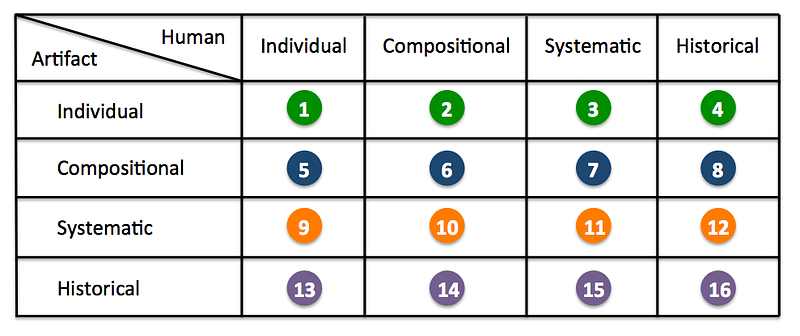
I used four dimensions and two components (artifact and human) to make the chart. The four dimensions are individual, compositional, systematic, and historical. I don’t consider the imaginative and fictional dimensions, you can add them to the chart if you need them.
As a heuristic tool for thinking, this chart identifies 16 niches which mean creative spaces of theory-building. For example, we can place Gibson’s affordance in nice #1. My own idea Curativity theory is about curating pieces into a meaningful whole, thus I can place it in niche #5. My other idea Social Platform Design is about one systematic artifact with many people, and it locates in niche #10. Most researchers of IS (information systems) and communication pay attention to the context of organizations, thus their ideas belong to niches #3, #7, #11, and #15. For some archaeologists, their theories can be placed in niche #16. For example, Ian Hodder’s entanglement theory (Entangled, Hodder 2012) can be seen in niche #16 but his other idea assemblage (Assembling catalhoyuk, Hodder and Marciniak 2015) should be placed in niche #7.
By renaming it as Niches of Analysis, we can use it as a general heuristic tool. We can modify its basic components and four dimensions. We can also use it with the Unit of Analysis.
4. Levels of Analysis
Both Units of Analysis and Niches of Analysis are all about the methodology of theoretical thinking. A related idea is “Levels, Layers and Rhythms” mentioned by Hamid R. Ekbia and Bonnie A. Nardi (2017) in their book Heteromation, and Other Stories of Computing and Capitalism. They said, “This level-specific approach is at the foundation of how academic disciplines are traditionally organized, and while it might work for some topics some of the time, it does not for others most of the time. A case in point is the topic of the present book, which seeks to explore the relationship between computing and capitalism, with a focus on the division of labor between humans and machines. This relationship can be traced on many different levels, layers, and rhythms, from individual psychology and subjectivity all the way to the economic, political, and epochal changes of the embedding social system. As such, the topic can be meaningfully studied only through a conceptual lens that can smoothly shift back and forth between different levels of analysis. This is the tack that we have followed in this writing.”
Ekbia and Nardi coined and introduced a new term “Heteromation” to present their conceptual lens: the extraction of economic value from low-cost or free labor in computer-mediated networks. They identified five types of Heteromation: communicative labor, cognitive labor, creative labor, emotional labor, and organizing labor.
In their original research paper Heteromation and its (dis)contents (2014), they said there are four perspectives for studying computing and human behavior:
- The history of computing: the mainframe era, personal computing, the Internet, and Web 2.0…
- The human-computer interaction (HCI)
- Information Systems: the development of computing from an organizational perspective
- The political economy of computing
In the introduction section of the paper, they also claimed that “the paper provides an analysis of the ‘division of labor’ between humans and machines from the perspective of political economy.”
If we see their 2014 paper and 2017 book as a whole theoretical work and ignore the writing style of academic papers and books. We can claim they adopt the perspective of the political economy of computing for their level of analysis.
In fact, Bonnie Nardi is an activity theorist within the field of HCI. The root of Activity Theory is Marxist theory. The concept of “division of labor” is an essential element of activity systems. For the Heteromation project, the “division of labor” is the unit of analysis.
5. Challenge: Adopting Event Theory
Now let’s use the above two ideas for our own theoretical development. I’d like to give a challenge to you and other readers. There is an emergent theory called Event System Theory: An Event-Oriented Approach to the Organizational Sciences. It was developed by organizational scientists Frederick P. Morgeson, Terence R. Mitchell, and Dong Liu (2012). We can place the Event System Theory to #6, #7, and #10.
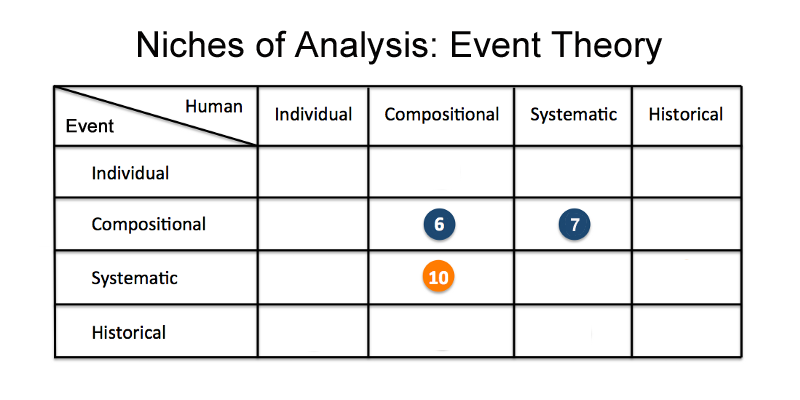
Now, our challenge is detaching it from organizational science and attaching it to a new field. You can choose a unique niche for your own creative space. How about “individual event # individual person” or “compositional events # individual person”?

Four months ago, I coined a new concept “Re-Engagement” as a new type of event for engaging people who participated in a past event. This idea can be placed in the niche of “historical event # compositional people”. The past event is a historical engagement, the existing event is a Re-Engagement.
6. Challenge: Platform Thinking
We can also apply these ideas to practical business thinking. I published the #SocialPxD framework (Social Platform Experience Design) in March. If we use the metaphor “Platform as Artifact” for thinking of Platform Experience, we can find that niche #10 is a perfect fit.
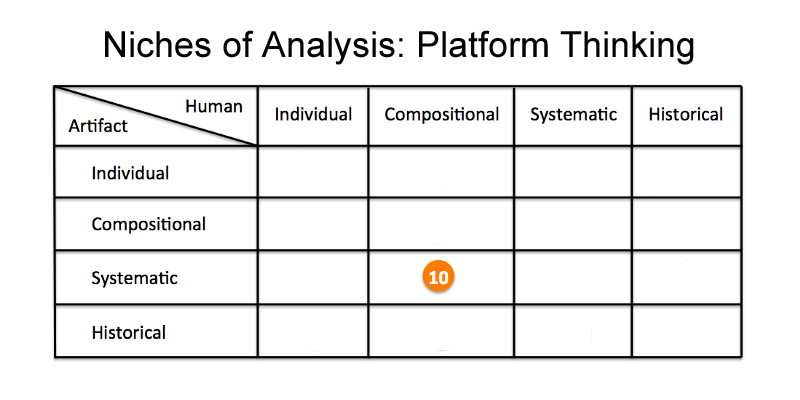
Then, we can also consider another metaphor “Platform as Activity”. We have learned the Activity Theory, and by adopting the new metaphor, we can apply Activity Theory to Platform Thinking. We can try different versions of Activity Theory for discussing different types of Platform Activities.
7. Understanding Idea Ecology
A theory is a special type of Idea Ecology. As a case study, “Activity U: The Landscape of Activity Theory” aims to develop a method for understanding complex theoretical enterprises. I will share more insights from this case study in the following posts.
Finally, I’d like to share John Hagel’s message with you.
It’s all about perspective and curiosity — don’t let your imagination spiral into fear. Take a breath, be curious, and flip through different points of view until you find one that works.
What a wonderful journey!
You are most welcome to connect via the following social platforms:
Twitter: https://twitter.com/oliverding Doowit: https://doowit.co/profile/gm0k2ax9 Linkedin: https://www.linkedin.com/in/oliverding
License
This work is licensed under the Creative Commons Attribution-NonCommercial-ShareAlike 4.0 International (CC BY-NC-SA 4.0) License. Please click on the link for details.
References
Andy Blunden (2010). An Interdisciplinary Theory of Activity. Koninklijke Brill NV.
Andy Blunden (2014). Collaborative Projects: An interdisciplinary study. Koninklijke Brill NV.
Andy Blunden (2017). The germ cell of Vygotsky’s science. In Silva, D.N.H. (Eds.) Vygotsky and Marx: Toward a Marxist Psychology. Taylor & Francis.
Engeström, Y. and Miettinen, R. (1999). Introduction. In Engeström, Y.; Miettinen, R. & Punamaki, R-L. (Eds.) Perspectives on Activity Theory. Cambridge University Press
Engeström, Y. (2009). The Future of Activity Theory. In Sannino, A.; Daniels, H. & Gutierrez, K. (Eds.) Learning and Expanding with Activity Theory. Cambridge University Press.
Frederick P. Morgeson, Terence R. Mitchell, and Dong Liu (2015). Event System Theory: an event-oriented approach to the organizational sciences. AMR, 40, 515–537, https://doi.org/10.5465/amr.2012.0099
Hamid R. Ekbia and Bonnie A. Nardi (2017) Heteromation, and Other Stories of Computing and Capitalism. The MIT Press.
Hamid R. Ekbia and Bonnie A. Nardi (2017) Heteromation and its (dis)contents: The invisible division of labor between humans and machines. In First Monday, Volume 19, Number 6–2 June 2014 doi: http://dx.doi.org/10.5210/fm.v19i6.5331
Spinuzzi, C. (2020) “Trying to predict the future”: third-generation activity theory’s codesign orientation, Mind, Culture, and Activity, 27:1, 4–18, DOI: 10.1080/10749039.2019.1660790
Spinuzzi, C.& Guile, D. (2019) Fourth-Generation Activity Theory: An Integrative Literature Review and Implications for Professional Communication.


