
ACE2 Variants: Another Reason for Sex and Ethnic Disparities in Covid-19
Sex chromosomes might play a more prominent role in Covid-19 than initially thought
Males and black ethnicity are at a higher risk for Covid-19 infection and disease progression compared to females and white ethnicity, respectively. Multiple reasons have been proposed, including immune-related genes of X-chromosome, estrogen signalling, and disease comorbidities.
Recently, science has unravelled ACE2 variants as another plausible reason for the sex and ethnic disparities seen in Covid-19. “ACE2 genetic variants that could affect its gene expression, protein conformation, and protein stability are one of the most questionable underlying factors involving in genetic predisposition to COVID-19 infection,” Iran researchers wrote in Medical Hypothesis.
In a published research this May, Behrooz Darbani Shirvanehdeh, a bioengineer researcher at the Technical University of Denmark, extracted and analysed data from publically available genetic databases. He looked at genetic variations of receptors SARS-CoV-2 uses to enter cells in different human populations. These receptors include angiotensin-converting enzyme 2 (ACE2), endosomal cysteine protease cathepsin B (CTSB) and L (CTSL), and transmembrane serine protease 2 (TMPRSS2).
What Genetic Variants Mean
Genetic variants arise from changes in nucleotides, which is called single-nucleotide polymorphisms (SNPs). SNPs lead to different amino acid sequences, which then results in altered protein structure and function.
“Amino acid substitutions in several variants can potentially influence the interaction between the ACE2 and the viral S1 protein, and thereby the viral infectivity,” Dr Shirvanehdeh explained. “Different amino acid residues distributed all over the ACE2 receptor have been found very influential either by facilitating or by hindering the viral infectivity.”
In other words, ACE2 variants might either enable or prevent virus entry. Too many ACE2 variants would provide more variability in how SARS-CoV-2 interact with the host, either for the better or worse.
ACE2 Variants and Ethnicity
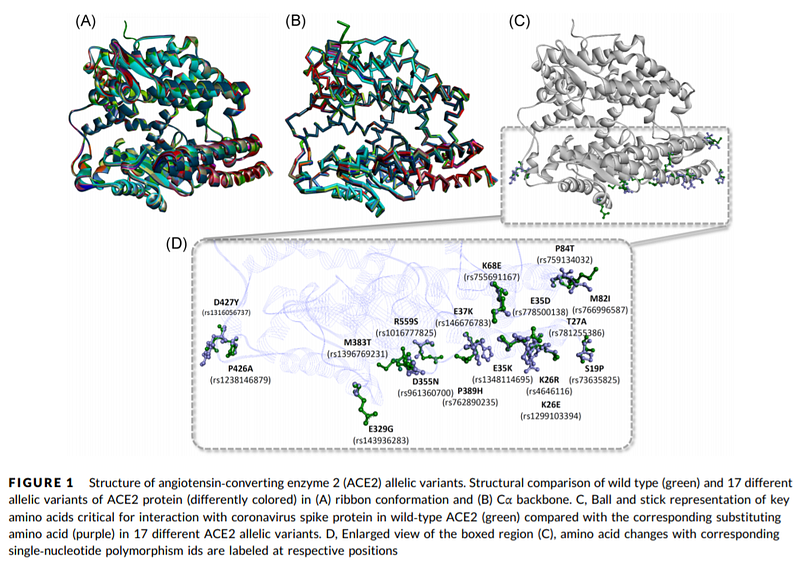
Dr Shirvanehdeh found that Tmprss2, CtsB, and CtsL variants are present in the genomes of all human populations equally. ACE2, on the other hand, has many different genetic variants, where “13 variants were found as the interaction-booster between ACE2 and S1,” he said.
To reiterate, S1 is the surface spike protein of SARS-CoV-2. So, 13 ACE2 variants bind more efficiently to SARS-CoV-2. Importantly, two of these 13 ACE2 variants — H378R and S19P — are present specifically in Europeans and Africans, respectively.
Additionally, 18 ACE2 variants were identified as interaction-inhibitors, meaning they bind less efficiently to SARS-CoV-2. And two of these — Q388L and M82I — are specific for Americans and Africans, respectively.
The lack of ACE2 interaction-booster variant in Americans could explain their higher resistance to Covid-19 infection or disease progression. The picture is less clear for Africans as they seem to possess each of ACE2 interaction-booster and -inhibitor variants. For Asians, differences in these ACE2 variants are not apparent.
Still, these ethnic-specific ACE2 variants have very low allele frequencies, meaning they rarely occur in the population, probably at <1% or <0.1%. Despite being statistically significant, these ACE2 variants might not be a substantial contribution to the ethnicity bias in Covid-19.
ACE2 Variants and Sex
“Finally, 7 out of 10 interaction-booster variants (S19P, I21V, I21T, K26R, N64K, T92I, and H378R) and 9 out of 14 interaction-inhibitor variants (E35K, E37K, N51D, M62V, K68E, F72V, E329G, Q388L, and P389H) were also found in males,” Dr Shirvanehdeh wrote.
He only analysed male data because ACE2 variants are X-linked, meaning they are located in the X-chromosome. And X-linked variants have less of an impact on females than males.
Females have two X-chromosomes, conferring a “mosaicism buffering effect,” which is absent in males with only one X- and Y-chromosome. Thus, any genetic variants in the X-chromosome are present only in half of the cells in females but present in all of the male’s cells. That’s why X-linked variants — including ACE2 — would have a more profound effect on males than females.
“Taken together, the human ACE2 has a rich pool of rare variants, which can explain the individual competence in the battle against the SARS viruses,” Dr Shirvanehdeh concluded. “Accordingly, the interaction-booster variants of ACE2 can explain the gender bias towards a higher mortality rate caused by SARS-CoV-2 in males.”
To Close on ACE2 Variants
Though it should be noted that this study is based on molecular modelling of protein-protein interactions. Results output is only a prediction and may not necessarily translate to actual biochemical processes in a living organism.
“It is possible that in some individuals, if not all, the positive prognosis of the COVID‐19 may be due to the existence of ACE2 variants,” researchers of another protein modelling study in the Journal of Medical Virology wrote. “The findings…provide clues to screen frequencies of the candidate alleles in different populations to predict the prognosis of COVID‐19.”
Back to the X-Chromosome
Previously in “X-Chromosome: A Double-Edged Immunological Sword,” I discussed how females with double X-chromosomes might have a higher expression of immune-related genes for pattern recognition of pathogens and, unfortunately, own tissues as well.
This help explains why females are generally more resistant to infections but susceptible to autoimmune diseases than males. This phenomenon is apparent even in infants and children where the effects of sex hormones (at puberty) or disease comorbidities can be ruled out.
Sex chromosomes might play a more prominent role in Covid-19 susceptibility than initially thought, considering that immune-related genes for pathogen recognition and ACE2 variants are found in the X-chromosome. And double X-chromosomes in females would enhance pathogen detection and blunt the effects of ACE2 variants that interact favourably with SARS-CoV-2.


