
X-Chromosome: A Double-Edged Immunological Sword
Why women are more resilient to infections (including COVID-19), but more susceptible to autoimmunity, than men.
Sex Bias in COVID-19
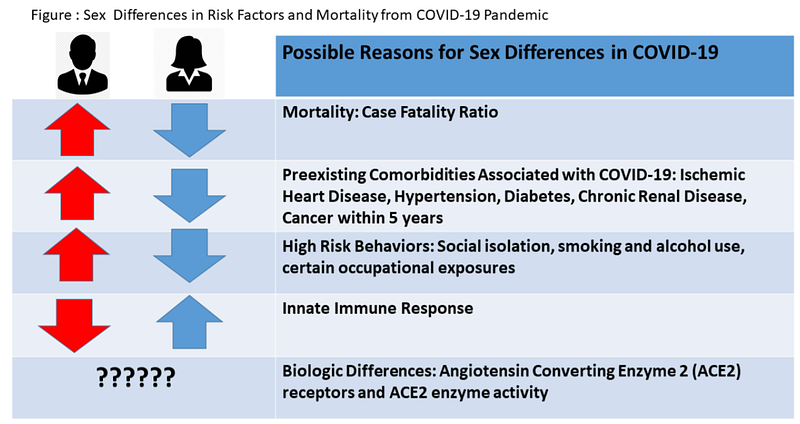
A May published paper titled “Sex Differences in Mortality from COVID-19 Pandemic: Are Men Vulnerable and Women Protected?” — written by Garima Sharma, MD, and colleagues at Johns Hopkins University School of Medicine — outlines some reasons for the obvious sex bias in COVID-19 death.
Men succumbed to COVID-19 more often than women. Other coronaviruses like SARS and MERS infect more men than women too. Why? Dr. Sharma et al. acknowledged that behavioral differences do contribute. Women are more likely to follow hygiene practices, for example. Or men are more likely to have other disease comorbidities. But sex biology could play an equally important role, she emphasized.
Dr. Sharma and colleagues mentioned some possible sex factors — estrogen signaling, sex chromosomes, pregnancy, and ACE2 receptor levels— that might explain why women are more protected against COVID-19 death. Among these, the sex chromosome — pair of chromosomes carrying genes that determine sex — factor is particularly compelling.
Women have two X-chromosomes, while men only have one. “And the X-chromosome contains a high density of immune-related genes; therefore, women generally mount stronger innate and adaptive immune responses than men,” Dr. Sharma wrote. But an extra X chromosome also comes at a cost — that it predisposes women to autoimmune diseases, Dr. Sharma added.
Double X-chromosomes: The Good
X-chromosome has more genes than Y-chromosome (~1100 vs. ~100 genes). In women with double X-chromosomes, one is randomly silenced. The body doesn't want too many X-linked genes — genes of the X-chromosome — to be expressed as they could lead to physiological anomalies.
But some X-liked genes sometimes escape silencing. The X-chromosome becomes partially reactivated. Expression of X-linked genes becomes higher in women than men, particularly genes in recognizing pathogens.
When battling pathogens, early recognition is key (like how vaccines work), which alerts other immune cells to swiftly annihilate the pathogen before it multiplies and generates excessive inflammation. As a result, women mount a quicker antibody response than men.
Because of this, men suffer from inbreeding depression — reduced fitness from infancy to adulthood — due to lesser expression of X-linked genes, said a 2008 paper titled, “Hypothesis: Increased Male Mortality Caused by Infection Is Due to a Decrease in Heterozygous Loci as a Result of a Single X Chromosome.”
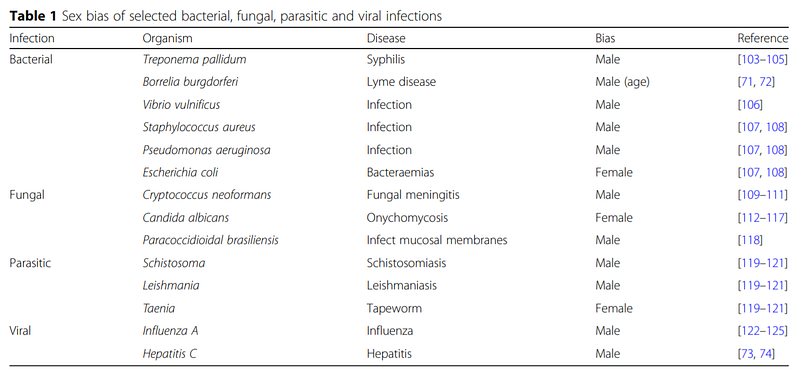
The postdoctoral geneticist, Haiko Schurz, and colleagues provided a 2019 updated data (see above table) showing the clear sex bias in susceptibility to infections. Now the sex bias seen in COVID-19 is no longer that surprising.
Male newborns and children are more prone to infection as well — suggesting that double X-chromosomes bestow an immune advantage, regardless of other life factors such as sex hormones (which start to differ at puberty), diet choices, hygiene practices, disease comorbidities, etc.
Double X-chromosomes confer an immune advantage in attacking infections.
“It is clear that sex-specific effects contribute to infectious disease susceptibility and females have a major immunological advantage over males,” Dr. Schurz et al. concluded. “While socioeconomic and behavioral factors, as well as sex hormones, do influence sex bias, these factors do not fully account for it, which leads to the conclusion that the X chromosome itself is likely to greatly influence the immune response and sex bias in disease susceptibility.”
Why are females better immunologically equipped with two X-chromosomes? A 1979 paper titled, “Immunological Bases for Superior Survival of Females,” said that it’s an evolutionary adaptation to preserve life when the immune system temporarily weakens during pregnancy.
Double X-chromosomes: The Bad
The immunological advantage of double X-chromosomes only applies when the right X-linked genes escaped silencing. If this process involves other less-desirable immune-related genes, autoimmunity happens, which happens all the time. The sex bias in autoimmune disorders is far more apparent than the sex bias in infection susceptibilities.
Hashimoto disease, Sjögren’s syndrome, Addison’s disease, and systemic sclerosis are autoimmune disorders affecting women 90% of the time. Systemic lupus erythematosus, antiphospholipid syndrome, autoimmune chronic hepatitis, and Graves’ disease affect women 80–89% of the time. Rheumatoid arthritis and giant cell arteritis affect women over 70% of the time. The most common autoimmune disease in men is vitiligo (~50%) and multiple sclerosis (~35%) — still a sex bias towards women.
Recall that X-linked genes include genes in pathogen recognition. Sadly, it also includes genes in self-recognition. This increases the chance of immune cells being poly- or autoreactive — mistaking their own cells as foreign and attack it. The resulting type of autoimmune disease depends on the type of cell/tissue being self-recognized and attacked by immune cells. Autoimmunity is indeed largely genetics in nature.
Double X-chromosomes confer an immune disadvantage in autoimmunity.
“Females are more immunoreactive than males and, although sex hormones have an important role in immune functions, the X chromosome is fundamental in shaping sex-specific immune responses,” Professor Claude Libert and team at Flanders Institute for Biotechnology explained in their paper titled, “The X chromosome in immune functions: when a chromosome makes the difference.”
The “sex-specific immune responses” include both pathogen- and self-recognition. Double X-chromosomes is a double-edged sword with infection susceptibility at one edge and autoimmunity at the other. Still, it’s just one component in the health equation. Other lifestyle factors also influence how X-linked genes are being expressed.


