

Population Studies Confirm Risk Factors for Catching Covid-19
But the UK Biobank study on vitamin D and ethnicity need to be interpreted with caution.
Risk Factors for Contracting Covid-19
A new study titled “Vitamin D concentrations and COVID-19 infection in UK Biobank” is just published in Diabetes & Metabolic Syndrome: Clinical Research & Reviews this May. Researchers at the University of Glasgow obtained baseline demographics data from the UK Biobank study conducted between 2006 and 2010. They match this data with Covid-19 test outcomes provided by the Public Health England.
While the UK Biobank study recruited 502,624 people, only 1474 had undergone Covid-19 testing, of which 449 people were tested positive. Factors that independently predict Covid-19 positive test — after adjusting for covariates such as socioeconomic and lifestyle factors — are illustrated below.
The UK Biobank study corroborates another recent population-level study published in Lancet Infectious Disease, titled “Risk factors for SARS-CoV-2 among patients in the Oxford Royal College of General Practitioners Research and Surveillance Centre primary care network: a cross-sectional study.”
From a surveillance program, Oxford researchers identified 587 people with positive Covid-19 and 3215 with negative results. Independent risk factors that increase the likelihood of contracting Covid-19 are shown here:
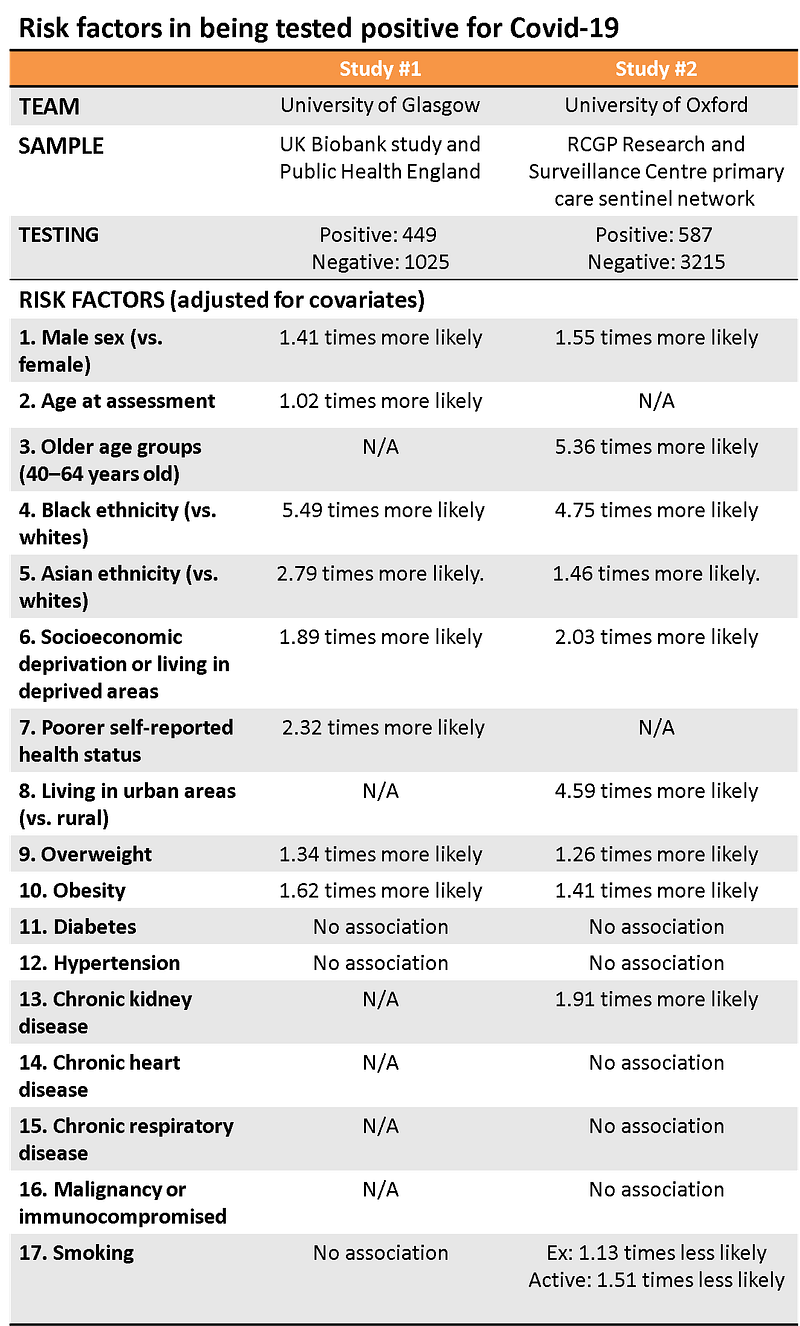
A note on smoking: It may decrease the likelihood of contracting Covid-19, probably due to interactions between nicotine and ACE2. But meta-analyses have shown smoking increases the risk of severe Covid-19, which I covered here.
Interpreting the UK Biobank Study on Vitamin D and Ethnicity
In the UK Biobank study, those tested positive for Covid-19 had lower median vitamin D levels in the blood than those tested negative. Vitamin D deficiency was also associated with Covid-19 infection. After controlling for covariates, however, results became non-significant. Moreover, adjusting for vitamin D levels or deficiency “made little difference to the magnitude of the associations” between ethnicity and Covid-19 infection, the authors said.
“Our results suggest that vitamin D is unlikely to be the underlying mechanism for the higher risk observed in black and minority ethnic individuals and vitamin D supplements are unlikely to provide effective intervention,” they concluded.
A flaw in this data is the UK Biobank study measured the vitamin D levels between 2006 and 2010. That’s 10–16 years of possible variations in vitamin D blood levels. Another point is that they measure susceptibility to Covid-19 infection — i.e., who is more likely to be tested positive. Their data doesn’t explain who is more likely to suffer from severe Covid-19 condition, or who is more likely to die from Covid-19.
Other preliminary data have revealed vitamin D insufficiency or deficiency as an independent risk factor of Covid-19 death. I’ve detailed these studies — as well as an ongoing phase 3 clinical trial assessing the ability of vitamin D to prevent Covid-19 death and observational data on vitamin D levels and Covid-19 death rate in different countries — here.
New Things We Now Know
Rachel E Jordan, MD and Peyman Adab, MD and Professor of Public Health at the University of Birmingham, wrote a comment to these population studies. They mentioned other confounders not covered. These include “social and workplace exposures, interactions, and behaviors,” which might explain the elevated risk seen in specific populations.
These two studies, nonetheless, do provide inherent value. We now know that specific subsets of people are more likely to be infected with Covid-19, for unclear reasons.
“As the UK prepares to loosen lockdown measures, knowing who is most at risk of infection is vital,” Dr. Jordan and Professor Abad added. “This [population] study highlights the more susceptible subgroups among those with relevant symptoms, although we cannot be sure why they are more susceptible.”
Still, it should be remembered that these two population-level studies examine risk factors in catching Covid-19, not how one responds to it.


