
A Transparent Look at Earning My First $10,000 Writing on Medium
The tips and strategies that have allowed me to succeed.
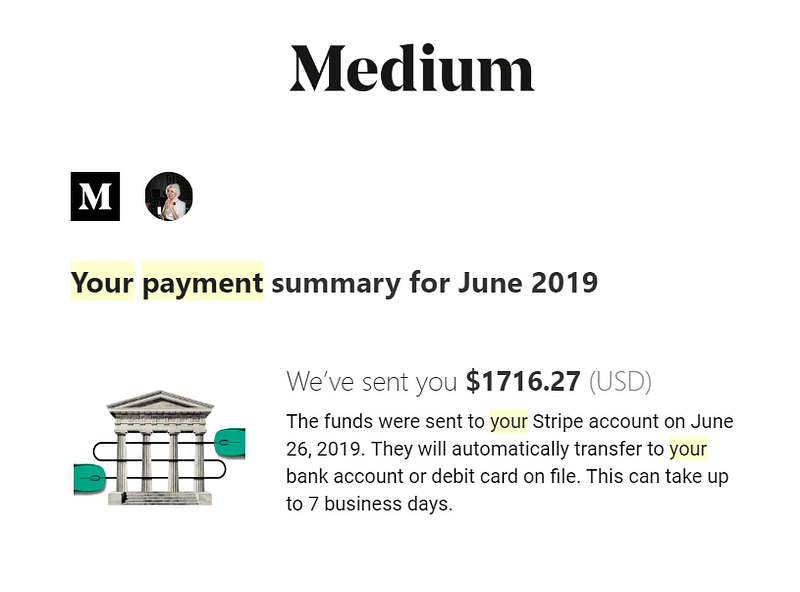
This month marks a total of over $10,000 I’ve made with Medium since September 2018 ($10,362.23 to be exact). Honestly, it’s been a wild ride — when I first started out, I thought I’d be writing a blog about my cats. Since then, I’ve written about everything from parasitic mind control to the altruism of blood donation.
For contrast, here’s my first story I ever published:
Talk about a trip down memory lane! (I’ve deleted most of my other early stories, but I left that very first one up to remind myself of how far I’ve come.)
While writing on Medium, I’ve ticked lots of boxes that meant “success” for me: I’ve earned over $5,000, published stories on the Startup, the Ascent, the Writing Cooperative, and P.S. I Love You, started to get nice emails from people. I’ve also been fortunate enough (and I do think luck plays a large role in this) to average an 80% curation rate in recent months which has definitely helped me achieve other milestones.
Before I go any further, I want to say that I am not an expert on Medium. This is an accounting of my experiences, of what I think has worked for me. It might diverge from what other people have said, and that’s fine. Different techniques work for different people.
That being said, when I first started on Medium, I wish someone had been completely honest, breaking down their strategies and being transparent about the process.
More importantly, I wish they’d been open with what they struggled with, as well as what made them successful. I’m going to do my best to do that here. Let’s go!
1. Don’t check your stats.
This is probably the one I adhere to the least, but the one that makes me the happiest when I stick with it.
Because I’m friends with several other writers on Medium, and I’m incredibly prone to competitiveness, I have an unhealthy relationship with my stats page. I know how well others are doing and I wonder why why why I’m not as good as them. Having real numbers to back up how “well” or how “badly” others are doing makes it feel like a quantitative measure of success. It is not.
I used to check it constantly, always aiming to improve, taking every dip hard and every rise as a sign of my imminent “real success,” only to be disappointed when it would dip yet again.

Checking my stats page always gave me a reason to be disappointed. Instead of using it as useful feedback, I used it as a way to make me continually feel bad about myself, like I wasn’t good enough and I never would be.
I probably don’t have to tell you, but it finally occurred to me that an attitude like that isn’t conducive to creativity, productivity, or actual enjoyment. It didn’t help me write, it didn’t motivate me to try harder. It just made me feel shitty. So I stopped.
By not checking my stats, I remind myself that I’m not doing this for fame, or money, or followers (though those things are nice!). I’m doing this because I love to write stories, and Medium lets me do that. Even if they earned just a penny each, that is worthwhile to me. Every second I spend writing instead of checking my stats is a second better spent, in my opinion.
2. Don’t answer every comment.
There are people who will tell you that the only way to build a following is to engage with everyone and reply to every comment.
If you can do that, more power to you. Me, honestly, I can’t.

I get anxious and stressed out and nervous looking at comments. I get het up and angry and fiery. When they’re nice, I have trouble coming up with a way to express my genuine thanks that they read and commented. When they’re negative, I often spend a looong time thinking about them and feeling angry.
When you put personal stuff on the internet, you’re opening yourself up to comments — and criticism — about the very personal way you live your life. If you’re at all thin-skinned like me, this is going to hurt. Sometimes there’s no getting around it.
If I forced myself to reply to every comment, I would have stopped writing long ago. I only reply to a manageable amount — the ones that make me laugh, or inspire me, or as me a question I know the answer to.
The others? I leave them. It hasn’t stopped me yet. I’m sorry to those I don’t get around to, but hopefully those who wish me well understand, and those who don’t, well, I don’t know what either of us would gain from me replying.
3. Ignore which stories “succeed.”
For a long time when I started out on Medium, I tried to emulate the “successful” voices I saw featured on the homepage. I copied the topics they wrote about, I experimented with telling stories the way they did.
You know what the problem was? I wasn’t interested in what they were interested in. Their voice didn’t tally with what I was aiming for. My mirrored stories fell flat AF, and they were unsuccessful by whatever metric you want to measure with. Plus, I hated writing them. It felt like a homework assignment instead of chasing my bliss.
I resisted writing about “unconventional” stories for a while, preferring productivity hacks, or trying to draft what looked like would be “successful” on Medium.

Don’t make the same mistake as me, and don’t try to copy the biggest voices, and find your own instead. You might not have one — just like you might not have one niche — but there will be something out there that’s uniquely yours.
Some of my most-read articles have been written off the cuff of a random thought, rather than trying to stick to a formula or pattern.
4. Investigate your curiosity.
On a similar note to the above, one of the most wonderful things about writing on Medium is that you’re not limited by niche.

Unlike traditional blogging where it seemed you needed a hyper-specific niche in order to stand out and gain followers, Medium lets you write about literally anything, and help interested readers to find you.
That is a gift. Don’t squander it.
What are you curious about? What sparks your interest? What keeps you up at night? What makes you chuckle? It doesn’t matter if you’re not an expert or have never written about it before — write about what makes you wonder why? Ask any question, find the answer, and write about it.
5. Ask the support team questions.
I see a lot of speculation running rampant on Medium, about Medium.
Let me be clear: there may be some things about which Medium never opens up. They might never disclose their payment algorithm, they may never open up about their curation strategy.
But just about everything else is fair game.
Wondering why the Medium Partner payment hasn’t been posted yet? Email them and ask. Wondering if there’s a way to change email addresses on your account to become more anonymous? Email them and ask. Wondering why you were given curation only for it to be taken away?
You guessed it: email them and ask.
(I’ve done all these things and been rewarded with informative answers at every turn.)
Don’t fret, speculate, worry or wonder. They’re some of the fastest and most helpful support team I know (speaking as a member of a current support team). Instead, spend time writing more, reading more, and thinking more.
6. Curation isn’t everything.
I know, I know: everywhere else you’ll see that curation is the holy grail of Medium! Get the ‘trifecta’ and be curated in three tags, and watch your stats skyrocket!
And I’ll be honest: if I rank my stories in order of views, reads, fans, money, whatever, you have to go a long way down before you find one that hasn’t been curated. Curation certainly helps.

But there’s no guarantee. I’ve had stories curated in some of the most popular tags (like relationships) only for them to fall flat. Meanwhile, stories curated in unusual or quieter tags sometimes do remarkably well.
Obviously I have no way of knowing how many followers each tag has (as far as I know, nobody does. The number that comes up when you publish a story and pick tags is the number of stories written in that tag, not number of followers). So it’s hard for me to say what’s popular or not.
But just remember, if something isn’t curated, it might still go on to do very well. And if it is curated, it might not go very far. Catchy titles, followers, and publications still matter more than other people think.
My top story ever was only curated in two tags. Stories curated in 3+ tags sometimes do well, sometimes not. Instead of spending time predicting how well/badly a certain story will do, or trying to write for a curator, crack on with the next one!
7. Write what you feel, not what you know.
There’s a piece of writing advice that never fails to irritate me:
“Write what you know.”
“Oh my god,” I babbled nervously to myself when I first encountered this piece of advice and desperately dreamed of being a best-selling novelist. “I don’t know anything. I’ll never be a writer.” (I was fifteen at the time, so you have to forgive me.)
With some thought, of course, I think most people can understand it’s been misinterpreted. (Did J. K. Rowling know what it was to be an eleven-year-old wizard? I think not.)
I don’t know much: I don’t know about parenting, I don’t have the answers about love, I can’t say what makes people like one another. But I have a lot of feelings about all those things.
“Write what you know” isn’t about events, says author Englander. It’s about emotions. Have you known love? jealousy? longing? loss? — Jason Gots
When you’re struggling to think of something to write, write what makes you feel. Write about what makes you happy; write about what makes you angry. Emotions will spark greater verve and passion than knowledge in my experience.
8. Try not to compare yourself to others.
Let me get this out of the way: there are writers on Medium who are better than you, and there always will be. There are writers on Medium who are worse than you, and there always will be. Don’t dwell on it.
I suck at this, I’ll be upfront. I do it every day. I think, Why don’t I have as many followers as X? Why can’t I publish as much as Y? How come Z’s story got curated and mine didn’t?

Or I’ll feel smug that I “succeeded” where others “failed,” despite the fact that I have no knowledge about what counts as a success for anyone — least of all myself.
It helps n o t h i n g and it made me feel really garbage about myself. For one, I’m not comparing apples and oranges. People start in different places, they write about different things, their audiences vary.
Secondly, if I feel superior or inferior to someone, chances are I’m not being fair on them or myself. When you don’t know what the standards are, when you don’t know where the goalposts are, it’s not helpful or useful to try to measure up against others.
And none of us really know what goes on in the Medium back-end.
Plus, you know, we’re all in this together. Just because others succeed doesn’t mean we fail, and vice versa.
The longer you spend thinking about how you stack up to others, the less time you spend drafting your next story.
9. Don’t feel like everything’s been written.
This one gets me even now. I feel like every time I have a good idea, someone beat me to it, wrote it faster, better, and to a more adoring audience.
Frankly, that’s bullsh*t. Here’s why.
Nobody has written your story yet. Nobody has written your take, your feelings, your experiences. What you have is your own unique life.
I think originality is overrated. I prefer emotion, value, and uniqueness. Those are the stories I love reading most, and I think they’re the stories my readers enjoy the most from me, too.
Take this story from Rebecca Renner:
How many stories are out there about writing for a living? A lot. And how many of them are able to tell her story, share her experiences, give her advice? Exactly one.
The value of unique stories about unoriginal situations is that while lots of people may have written about quitting their jobs to write, only Rebecca can offer her perspective. And because many people dream of quitting their jobs to write, her unique advice is globally applicable.
I held off from writing for a long, long time because of this, and sometimes I still do trash a draft because I feel like it’s just a worse version of a story that’s already out there. I’m telling you and myself that it’s just not true: our stories, no matter how many times the topic has been done, are valuable.
In short, I could probably boil my advice down to this: keep your head down and keep writing. Don’t get caught up on what others are doing, don’t waste time fretting about things you can’t change, don’t spend energy worrying about what other people think of you.
I’ve been very hard-working on this platform, but I’ve also had a lot of luck. I can’t be totally honest about what’s helped me make this much money because I genuinely don’t know all the factors.
All I can say is I write a lot, I write about what I feel, and I write for myself.
Want my four-day email course on how to start making money on Medium?


