
A PRACTICAL GUIDE TO WRITING ON MEDIUM, PART 2
Master Medium’s Social Structure
Everything you need to know about responses, highlights, claps, and following
This is part of an occasional series giving you the inside scoop on Medium. Here are the other guides: Part 1, Part 3, Part 4, Part 5, and Part 6.
[NOTE: Most of this information can be found on the Medium Support Pages, but it’s hard to find because their search engine is lousy. Also, not all of these features will work on mobile touch-screen devices.]
Medium created a number of ways for people to interact.
The focus of this guide has to do with how to find and build a community within Medium, not how to get the maximum number of claps (there’s a big difference).
#1 Responses
For many new writers to Medium, responding to an article is a good way to start. It’s not as intimidating as writing a completely separate article, publishing it, and then wondering why no one is reading it.
Here are a few things to think about:
The vast majority of authors will read and respond to your comment, so think about how you would act if you met the author in real life. Compliments, questions, new ideas, your emotional reaction, or sharing a relevant personal experience will probably create a positive interaction.
And it could create a message thread where the discussion goes deeper.
One new writer asked in a story, “Am I tilting at windmills by writing responses on stories looking for more discussion from the author or other commenters? Is this not a place for discussion?”
She was responding to people who wrote about deeply personal issues that are usually a confession or a form of anonymous group therapy.
Can you see a difference between these responses?
A. Preaching, self-help platitudes, playing psychologist, or giving advice that you wish you had followed.
B. Validation: “I feel your pain because I experienced the same thing.”
Response A is not looking for discussion — people won’t respond if they don’t feel you are empathetic.
Response B is an honest attempt to make a personal connection. Ddepending on the mental condition of the author, you may get some responses or have a discussion.
#2 Highlights
The highlight function in Medium (mobile users, you will need to download the app to do this) is a fantastic tool, in my opinion. Here’s why:
- Writers want to know if their writing is good. They also want to know which parts work and which ones don’t. When someone writes something beautifully, or makes an especially perceptive point, I point it out with a highlight. Without saying a word, it’s a direct message to a new writer, “this is great,” in the hopes that they will begin to recognize their great stuff as they are writing, even with no one giving feedback. It can also be short hand for “this is really good,” without using more time to write a response. In any case, writers are always interested in your highlights. Here’s a story which explains the importance of highlights in more detail.
- When you highlight something, you can immediately create a response. This is what happens after you highlight a passage. The dialogue box allows you to click on the speech bubble to make a comment:
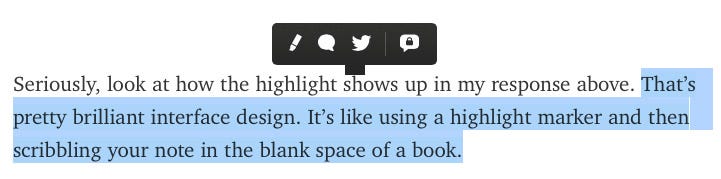
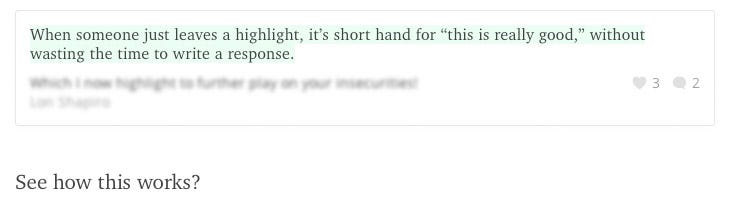
When you post your response, the highlight shows up at the top of the box. (see below) This helps the writer understand exactly what you were writing about. And, if you click on the highlight, you will jump to the exact location in the original article. This can be very helpful when you are trying to find specific information in a long article.
#3 Claps
Clapping is a really misunderstood part of Medium; it is far more complicated than liking something on Twitter or Facebook. When you clap, you not only show the author that you liked their story, they get a tiny amount of money.
[NOTE: There has been a long raging battle between the content marketers who push self-help, life hack and start-up articles and traditional writers who are trying to create art. If you want to learn about it, go here. There is also a subset of writers who spend their time sucking up energy and attention on Medium by writing rants about content marketers. I address them in detail here.]
Medium’s algorithms are based on who recommends a story as well as how many people recommend it, so claps takes on much more importance than a like. If you like a story and want to share it, then clap for it. Sometimes, you may think the story was only good for you, but maybe not all of your friends, so maybe you don’t want to publicize your interest. No matter how fascinating you find an article about medieval torture, looking into the dark soul of a neo-nazi, or reading about sexual bondage, there’s a chance you don’t want your grandmother to think you’re saying it’s must read entertainment.
For more details on clapping etiquette, please check out:
On the other hand, claps can be a false currency. If you don’t like reading listicles all day, you might be very frustrated that some of the worst crap on Medium is constantly featured as a top article, and dominates your email feed.
One of the biggest complaints about the algorithm is that the good stuff get ignored. That’s true, but you still have tools to find great unknown writers.
How to explore Medium:
Step 1: do a search for a topic you like. Seriously, people, if you can Google “best fire retardants to use when extracting flaming gerbils* from your ass,” I think you can type into the space next to the magnifying glass icon and find a topic.
[WARNING: Medium’s search tool is like any other search engine — it’s just a crap shoot. Depending on how you word your search, you may have wildly different results. Keep doing searches until you find what you want. It can be a laborious process, but it’s like anything else with regard to computers, “garbage in, garbage out”]
Step 2: read through the comments. There’s gold in them thar hills. I can’t tell you how many great writers I have found by reading their comments. If they can write something hilarious or thought provoking in a paragraph or two, there’s a good chance they’ve got the goods. Which leads me to the final step in getting your Cub scout badge in finding online nourishment:
Step 3: read an author’s profile to find articles they have written. Just scroll down through their writing history (or, if they have one, a personal archive located just below their profile). And take the time to read a few articles. I’m sure you’ll find something you will like, even if you find a dud once in a while. Hell, one of my favorite stories about my dad has been almost completely ignored by the readers of Coffeelicious. Could 94,000 people all be wrong? F*ck yeah, they are. That’s what writers do. We speak to our truth, regardless of whether anyone else likes it.
*No animals were harmed in this Google search
#4 Following
This is another nuanced piece of Medium’s social media programming. Some people follow everyone in the hopes that everyone follows them back. Some people follow new writers as a means of encouraging them. And some people follow others because that person is immensely popular, so the assumption is they must be a great writer.
There are a lot of ways to follow and be followed, and while I understand the reasoning between each method, I’m going to explain my methods, based on how Medium’s algorithms work and how I use the platform to build my own community and to support new or unknown writers.
- Who I follow: great writers who deliver on a consistent basis; people who have really good taste in what they read and recommend; and, a small number of new or inexperienced writers who I try to encourage.
- Who I don’t follow: writers who focus on areas that aren’t my normal cup of tea (regardless of how well they write); writers who follow huge numbers of writers, but have few followers themselves; and new writers who aren’t consistent.
Here’s why. As explained above, Medium’s algorithms determine what kind of articles you will see.
The problem of quality: If someone is following thousands but has very few followers, I don’t want my feed flooded by all the writers they follow. There’s no way you can like thousands of articles, without giving up a lot of the stuff you love.
The problem of choice: If you follow hundreds or thousands of people, you are going to be flooded with stories and sifting through them will be too much work. It doesn’t make you a snob to have a huge following but only follow a small group of people; you have no choice over how many people follow. If I learn about two or three new writers in a week and want to follow them, that’s fine.
Freakonomics did a wonderful podcast on the economics of choice. Whether it’s electronics or dating sites, there is a sweet spot for choices. Too few and we are limited and will feel like we haven’t found the beset option; too many and we are paralyzed by over analysis and the dread FOMO.
The ideal group size: In addition, British anthropologist Robin Dunbar found a correlation between primate brain size and average social group size. He suggested that there is a cognitive limit to the number of people with whom one can maintain stable social relationships. Dunbar’s number is proposed to be about 150, and we see that historically in things like village size, unit size of armies and notions of appropriate company size.
I feel the same way about Medium. I’ve got a small group of online friends I have developed over the last few months on Medium. We comment on each other’s writing, bounce ideas off each other or riff on some in-joke. We are part of a small community within Medium. This is our table in the Medium cafeteria and we can define ourselves however we want, because it’s own hearts and minds that determine who were are, not that horrible hair style, or the wrong clothes or all that acne from high school. Well, maybe none of that has changed, but we’re online so who’s going to know, amiright?
My goal is connection, not monetization: As someone who is not trying to sell seminars or get rich quick schemes, I don’t need thousands of followers; I couldn’t possibly keep track of them. That’s not to say that I would tell people to stop following me, or not mention that they should buy the collaborative book I put together featuring the quotes of over 50 online writers (talk about herding cats!). The point is, there is a huge difference to me personally between a group of friends and a group of fans.
If I ever got famous enough as a writer where I couldn’t answer every request and comment, I would have to reevaluate my online community relaitonships at that point.
Popularity comes with unseen costs. The average person is not set up to deal with minor “celebrity.” One new writer hit a nerve in the community with her piece “I was never raped, but…”, and received 277 responses.
Even if she made a lot of money, she was overwhelmed with the response. It’s time consuming to read and respond to people. If you do anything more than ten times, trust me, it becomes a grind. She is still an unknown, underpaid writer, but feels like she has the obligations of a NY Times bestseller, minus the agent, publisher, assistant, webmaster, etc.
With that kind of notoriety, she will begin to attract the sharks and trolls that prowl around the internet, so now there is a psychic and emotional cost when the vitriol starts to roll in. All I’m saying is, be careful what you ask for.
Who can I take under my wing? Most new writers are very self-conscious. They will read and lurk on the outside, afraid to join in some of the wacky collaborative fun I’ve had with our little group of cynics, subversives and degenerates. We’re not making our living writing, people. If you can’t have some fun here, what’s the point?
[Side rant: We’re all innudated with sh*tty news on a constant basis. We know about tons of problems facing our families, our communities, the nation and the world. But you can’t be on a soap box 24/7. And if you are, then you should step off the damn box and start working on a problem in the real world. If you think you’re going to start a political revolution by liking posts on Facebook, instead of doing campaign calls, get used to seeing big gold shiny letters erected on the front facade of the White House.]
When I find new writers who have something to say, I try to support them. I highlight, comment, follow and recommend them to others. When I say recommend, I don’t mean just hearting them, I’m talking about writing a story that mentions how great they are, like I’ve done here, and here, to give a couple of examples. I also praise other established writers and recommend their writing, as I’ve done here, here and here.
Don’t be afraid to cull the herd. When I first started out, I did what most people do. I read the super popular posts that were in my feed, and then followed the massively popular authors. After a while, I realized that these articles were overly repetitive, and full of repurposed content. In some cases, the articles were unbearably stupid. So I decided to unfollow certain writers in the hopes that I would no longer see all their stories in my feed.
[UPDATE: Also, you need to read Part 4 and learn the power of the mute button.]
What kind of interaction do you want? Another thing to consider is whether the authors are responsive. If you compliment them and they respond and recommend your comment, that’s great. But if you point out a different perspective they didn’t consider, and they ignore you in those cases, is this someone you really want to be friends with?
Do you want your feed clogged with garbage? Medium’s software looks at any writing as a story. If someone you follow writes anything, regardless of its length or importance, it goes in your feed. If they recommend anything, regardless of its length or importance, it goes in your feed. That is one of the huge complaints on the site with regard to the unholy trio of self-improvement, life-hacks and tech-bro posts that dominate Medium — even if you don’t follow these writers, if anyone you follow recommends their stories, they still show up in your feed.
The only way to avoid the clog would be for everyone, including the content marketers (whose sole purpose in life is to get the maximum number of views, reads and rec’s) used unlisted stories and private notes for their responses. In the words of that well-known basketball media legend Jalen Rose:
Some people just like everything. You may be flattered that they follow you, but when your feed is clogged because they like everything in the world, maybe it’s better to cut that flow by unfollowing them. It’s something to consider.
Conclusions
As with any manual, I have probably forgotten to answer some questions that everyone was asking. So guess what? Ask a question in the comment section below. If it’s a good one, I will update this article so others can get help.
Next time, we’ll discover the power of archives and publications.

This is part of an occasional series giving you the inside scoop on Medium. Here are the other guides: Part 2, Part 3, Part 4, and Part 5.
If this article helped you, pass it along to help other inexperienced users.


