
A PRACTICAL GUIDE TO WRITING ON MEDIUM, PART 6
How Much Can You Earn on Medium? Well, What Year Is It?
A history of changes to the almighty algorithm
Note: This is part of an occasional series giving you the inside scoop on Medium. Here are the previous guides: Part 1, Part 2, Part 3, Part 4, Part 5, and Part 7.
Today’s subject is a brief history of how the algorithm has changed and how it affects earnings.
Before the paywall, the only green you could earn was a bunch of hearts.
As a newbie in November 2015, everything thrilled me. Prestigious publications like Coffeelicious accepted my stories. It was a big deal when the editors chose to feature one of my articles in Medium’s then-Mt. Rushmore, the above-the-fold section of the homepage.
I even appreciated some of the self-help articles.
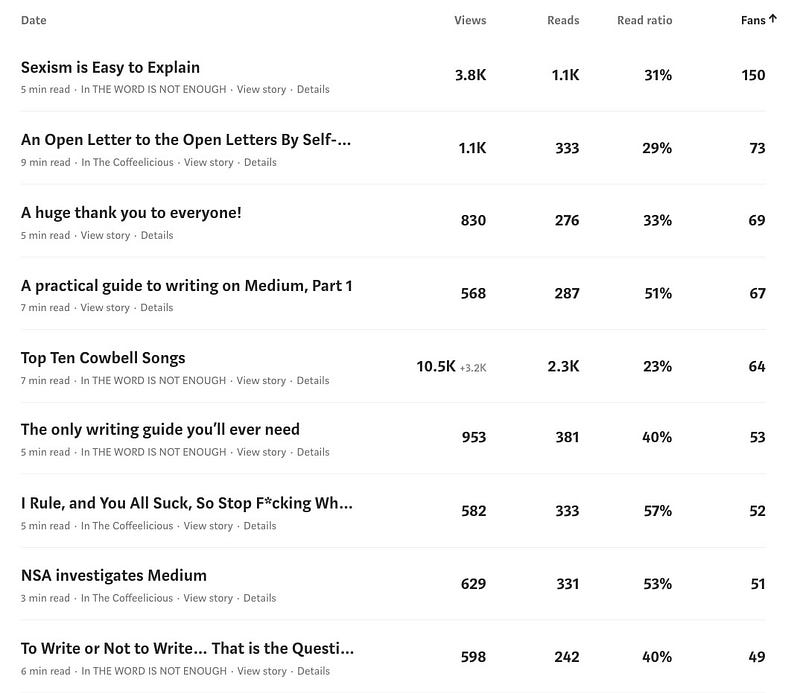
Many of my stories achieved the 50-fan badge. Sometimes, they ended up near the top of Google’s organic search results, like the “Top Ten Cowbell Songs.”
Paywall 1.0: Exodus
From May to August 2017, the best publications on Medium left because of reduced traffic. This included: The Ringer, Think Progress, Pacific Standard, Backchannel, and Film School Rejects.
I lost 90% of the stuff I loved on Medium, but Ev promised to bring in new material with professional writers hired to work for the site.
Regular writers didn’t make any money.
Paywall 2.0: a bad case of the clap
In October 2017, Medium introduced the Medium Partner Program. Anyone could earn money for writing locked articles. At the time they introduced the MPP, Ev Williams wrote this about content (my emphasis in bold):
The current reward system that drives content online looks like this: Attention = Money… Attention is rewarded, regardless of quality, context, or whether it was earned by conscious choice.
He didn’t lie.
Self-help gruel, tech bro humble brags, and get-rich-quick schemes have always dominated Medium.
His solution — the almighty algorithm — made big promises but delivered the same old s̶h̶i̶t̶ g̶a̶r̶b̶a̶g̶e̶ b̶u̶p̶k̶i̶s̶ stuff:
Medium is the only “open paywall” for thoughtful content on the internet.
But I have a question. Shouldn’t this website feature writing, instead of something that settles during shipment?
A month later, I wrote my first article satirizing the MPP. I asked six questions to consider before people start a new career as a professional blogger.
Was I the first person to point out that Medium is a zero-sum game? This method to generate revenue will never raise all boats nor be a sustainable business model.
Paywall 3.0: let me in on that clickbait!
The Partner Program page states, “Quality over clickbait.” But quality is a word roared by people to justify their bullshit. After reading in the August 2019 newsletter that the top writer earned $22,639.47 that month, my response was clear.
It was time to start writing horrible clickbait headlines.
Research showed that Medium was a simple numbers game — 2,000 claps put a story in the top 1%. Content marketers dominated, as they only needed 5% of 4,000 followers to clap ten times each to reach this milestone, no matter how boring or unoriginal the story.
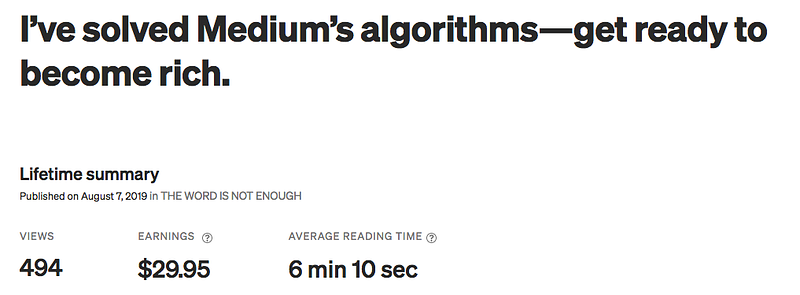
Even though I did the research and provided valuable insights, I wasn’t proud of my headline. But it was my first 50-fan paywall story and received significant reader engagement in the form of comments and highlights.
The proof was in the bread pudding (as long as that bread is green and accepted as legal tender):
Paywall 4.0: the gods of curation dispense salvation.
Only three weeks after that first 1,000 clap story, Medium curated my first writing article. Considering how many times I mentioned Medium — a clear violation of curation guidelines — I have no idea why.
I thought they had made a mistake and removed it, so I took a screenshot as proof, so they could never take that sweet memory away from me.
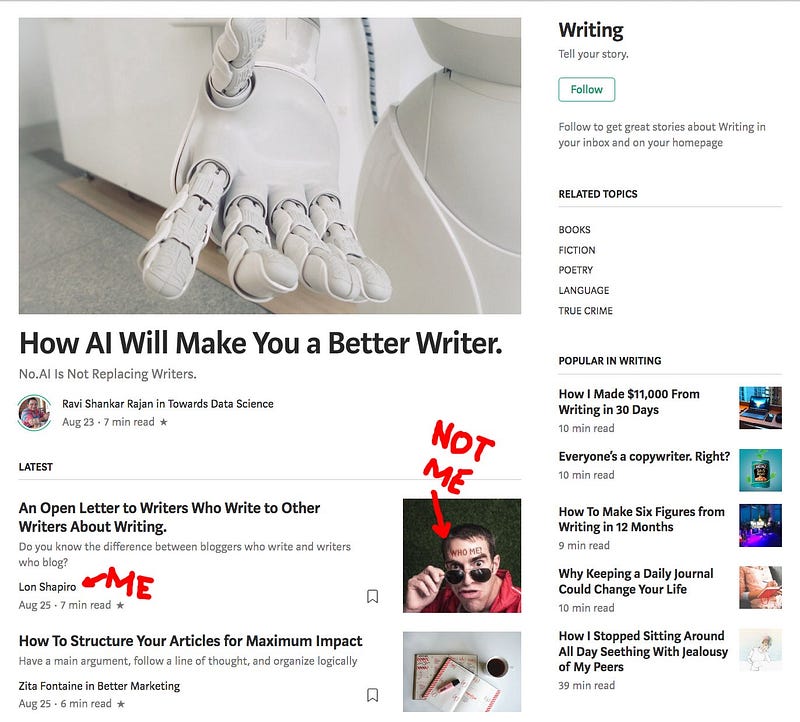
This was the first and only time one of my stories ascended to the top 1%. And wouldn’t you know? It was full of shit.
The story started with the dangers of needing to take a dump while hiking, and ended with online writing editors that check for bullshit. In between, I covered every example of shitty writing I could think of.
The one thing the article didn’t do was talk about how to make money on Medium and focused instead on helping new writers avoid going to the dark side.
I didn’t think this was close to my best writing, but I stumbled onto something I’ve never been able to recapture.
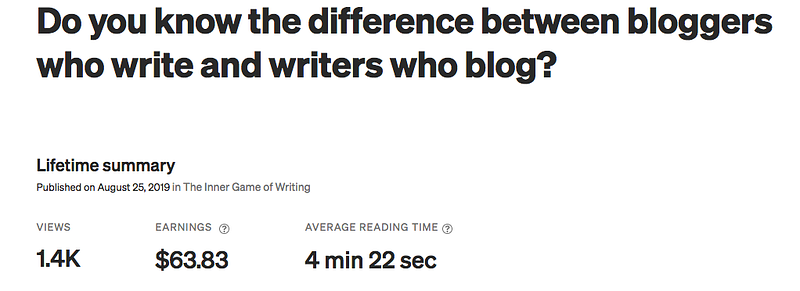
2018–2019 was a high point for Medium writers. Yes, there was all the garbage and fluff that dominated the feed. But it was easier to write about non-clickbait topics and receive a little compensation.
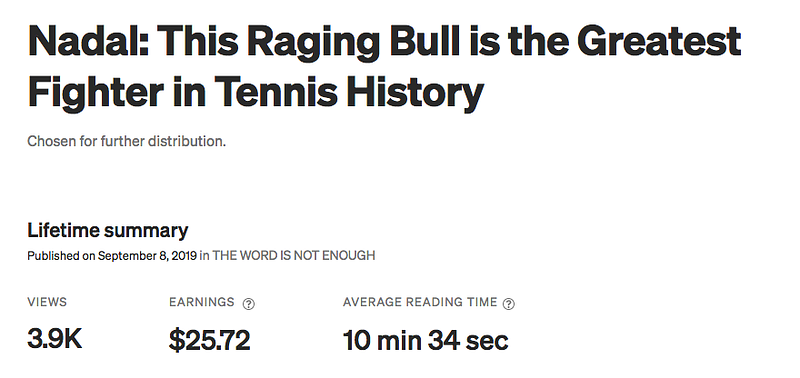
One of my best tennis articles brought in thousands of views from people who follow me on Quora.
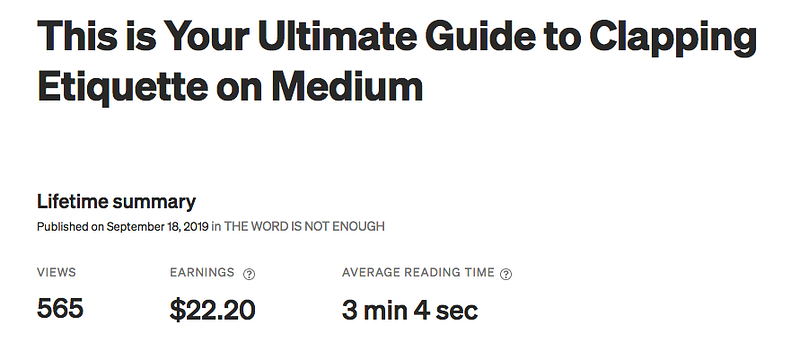
And this humorous article about clapping made more than a cup of coffee.
October was my best month. I was building a loyal readership and made $77.52, the closest I’ve ever been to reaching the hallowed $100 milestone. I guess I came too close to figuring out how the game worked because big changes arrived before the month was over.
As a young professional tennis player, I felt true frustration over my failure to reach the top 1% of the top 1%.
Not reaching the top 7% felt more like fake Tantulus — the grapes only dropped to the height of a basketball rim and the wine only rose to the level of my junk. And I don’t even drink.
Paywall 5.0: Medium kills humorists, cartoonists, poets, and short fiction.
At the end of October 2019, Medium changed the compensation guidelines from the simple-to-understand number of claps to a murky stew of reading time and other mysterious metrics.
Here’s when my exploration of the game turned toward bare-knuckled satire, which our corporate overloads did not seem to appreciate.
A lot more wonderful, creative writers left the platform, while those in the “asshole rich category” with a “bomb-ass writing style” (no lie, that’s from a real article) made big money by l̶y̶i̶n̶g̶ promising to teach people how to make $10,000 a month.
Paywall 6.0: And the gods of curation taketh away.
In November 2019, people started writing about an algorithm function called “Curation Jail.” This was one more way for Medium to shake up the loony bin (and yes, we are all inmates) and keep people active on the site.
Being a leading-edge kind of a guy, I was among the first to be thrown down the virtual pit.
I gave my new home the name Curgatory™.
A lot of people reported a 50–75% reduction in their earnings. In Curgatory, my earnings dropped 80% within a couple of months. Finally, an area where I outpaced the competition!
Then the pandemic shut down the world.
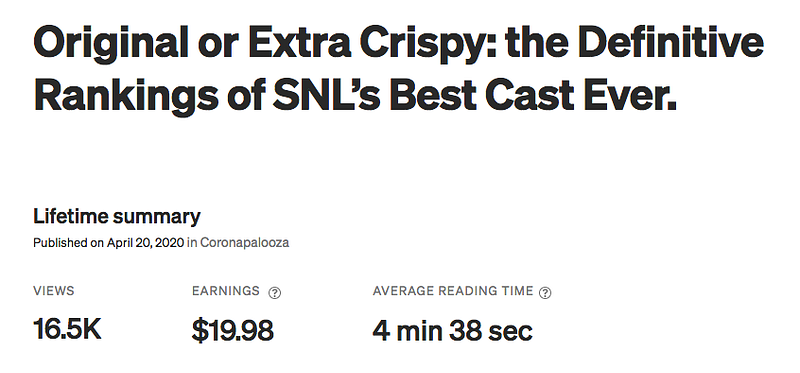
Without any work, I wrote a ton, focusing on humor, song parodies, politics, and the pandemic. This article became a viral hit but all those external views didn’t add anything for earnings.
Paywall 7.0: Free at last, free at last, but still working for free.
In August 2020, Ev Williams announced the creation of a more relational Medium. The good news was that people trapped in Curgatory reappeared to their fans again. The bad news was it was even harder to build a larger readership by writing a killer article that got curated in a particular topic.
I wrote about topics other than Medium, and income dropped to 12.5% of what I earned ten months before.
Millions of articles are published each year and they will bury your best writing. So don’t count on a lot of passive income from your backlog unless you promote the hell out of it.
The social media marketing experts have and will always dominate this site, regardless of the topic. They may not be able to teach you how to write better, but they can teach you how to promote your work.
Paywall 8.0: who needs money when you can get a participation trophy?
Corporate restructuring swept away the gods of curation. Kind of like how Stalin “reorganized” the Russian army’s officer corps in 1941.
We, the damned were finally released from Curgatory.
Your guess is as good as mine why almost every article is being distributed, but I wrote about it anyway.
Paywall 9.0: who knew participation trophies could be so valuable?
The latest tactic in keeping the writing mill primed is the $500 bonus for reader engagement. You can find boatloads of articles on this subject. I guess my 3,787 responses did not meet the standard for participation.
With Medium’s lack of transparency, there is no way to know how long these cash windfalls will continue.
I don’t know where we go from here, but one thing remains constant.
People who write articles about how much money their article earned often make more money than on the original article.
If you enjoyed this rant, I’ve got an entire publication filled with nice, short bite-sized ones for your snacking pleasure!

Here’s to better writing.
Many thanks go to Medium Formatting who performed the Herculean feat of compiling a history of Medium. This helped me verify my sometimes faulty memories and sped up the research process.