avatarJair Ribeiro

Free AI web copilot to create summaries, insights and extended knowledge, download it at here

11620

Abstract

omen’s movements advocating for gender equality in an intersectional way, where feminism should meet the experiences of this demographic of women, is at her intersection of <b><i>culture</i></b>, race, and gender oppression that is at a cross-road with the traditional, white, female-focused movement in the first (1840–1920), second (1962–1980s), and possibly arguably even third (1990s) <a href="https://www.history.com/news/feminism-four-waves">waves of feminism</a> that mainly all focused on the experiences of oppression from a predominantly western white female perspective alone.</p><h1 id="034e">Female Gender Oppression: Population Control via The Medical Profession</h1><p id="531d">Kim Jiyoung’s friend falls pregnant, and what a drama it caused; this was around the time when the government implemented “birth control” policies they called “family planning.” Abortion was legal for medical related reasons. What if I told you that being born female was also considered a “medical problem” and a reason for her friend to consider abortion? And clearly some medical professionals felt the same way. The author cites this as a common dilemma for women throughout the 1980s-1990s. While the author does not go deep into this subject as part of the plot, I did do some investigation myself into this. According to the <i>Feminist Majority’s</i> short report they released in <a href="https://feminist.org/news/korean-women-pressured-to-abort-girl-babies-to-try-for-sons/">January 1997</a> they confirmed that:</p><blockquote id="cdaa"><p>“Although fetal sex identification and abortion are against the law in South Korea, women continue to feel pressure to abort girl fetuses in order to try for sons.”</p></blockquote><p id="5cf4">Also</p><blockquote id="fe88"><p>“Compared to a natural ratio of 105 boys born for every 100 girls (which later evens out to 1:1 since boys die earlier), some regions in South Korea have rates of 125 boys born to every 100 girls resulting in 30,000 fewer girls born each year than would be the case without sex-influenced abortions.”</p></blockquote><p id="9143">And</p><blockquote id="41f7"><p>“A Chinese government report in 1992 found the ratio in China at 118.5 boys to 100 girls, statistics which embarrassed the government enough that it never formally released the results.”</p></blockquote><p id="9f55">When looking the pressure Korean women face to have sons, taking a simple glance at the birth rate ratio would lead a critical mind to see the ratio supports the argument that the medical profession had what I would call “a silent compliance” to help embed and maintain female oppression, by aborting female babies. Sure, no doctor with his or her head on straight will announce to the world, “come to me for female terminations, I’ll gladly help you.” But that doesn’t mean it wasn’t going on. The stats on the birth rate ratio show that at this point in time, in the nineties when the rates were released, female terminations must have been carried out at a high rate.</p><p id="1f4d">What is key to note about the male to female birth rate ratio is: any parent will probably remember the scan they were given when their fetus was eighteen to twenty weeks old. Around this time, when you’re offered a nice photo of the baby, you can also <a href="https://www.healthline.com/health/pregnancy/when-can-you-find-out-sex-of-baby#medical-tests">learn the sex of the baby</a>. For the Korean women it’s at this point that terminations logically must have been happening for females babies. This is as late as five months into pregnancy; abortions done then come with a higher risk to the mother as stated in the research done by <a href="https://www.ncbi.nlm.nih.gov/pmc/articles/PMC9614144/"><i>Frontiers in Women’s Global Health’s</i></a><i> </i>2022 study across southern Ethiopia. Their report asserts that:</p><blockquote id="eb57"><p>“Second-trimester abortion accounts for 10–15% of all induced abortions, with varying rates across countries, and is responsible for two-thirds of major abortion complications. It is also associated with higher medical costs, morbidity, and mortality rates than first-trimester abortion.”</p></blockquote><p id="e44f">With only 10–15 % as a norm for abortions at this stage, we can assume it’s not the norm globally. The <a href="http://aidtowomencenter.org/abortion-secondtrimester"><i>Aid to Women Centre</i></a> also cites a lot of risks and complications post abortion for women who have second trimester abortions. The Korean women have been subjected to a health risk, for the sake of maintaining their cultural patriarchy, which is not something we see a lot of for the western woman, in western culture.</p><p id="d54f">If we further compare the western gender oppression to the Koren women’s via the outcomes for female babies, and the medical profession’s willingness to partake in oppression, and lastly the health risk of a woman choosing late termination (even if the practice was more common in the eighties-nineties), you see that this type of oppression is not a cultural norm in the west. It could be argued that pressure should be placed on the Korean medical profession for better regulation of abortion practices.</p><p id="67d5">For Korean women their intersection of cultural oppression includes a key aspect western woman do not have. Which is: from the womb, females leave a bad taste in society’s mouth. Whether you have a girl or a boy, generally speaking, for the western woman it is a cause for celebration, not abortion.</p><figure id="d363"><img src="https://cdn-images-1.readmedium.com/v2/resize:fit:800/1*i1XzuPmk2jAonENWjAYxTA.jpeg"><figcaption>Photo by <a href="https://unsplash.com/@thatsherbusiness?utm_content=creditCopyText&amp;utm_medium=referral&amp;utm_source=unsplash">That’s Her Business</a> on <a href="https://unsplash.com/photos/white-ceramic-mug-on-white-ceramic-plate-8KHPeh9mNvs?utm_content=creditCopyText&amp;utm_medium=referral&amp;utm_source=unsplash">Unsplash</a></figcaption></figure><h1 id="3e35">The Role of Korean Women: Their ‘Double Jeopardy’ and Work</h1><p id="a483">Being a woman with another characteristic that can be used for oppression (such as race or class), has been defined as ‘a double jeopardy’ by the black feminist Frances. M. Beal, in her work <a href="https://en.wikipedia.org/wiki/Double_Jeopardy:_To_Be_Black_and_Female"><i>Double Jeopardy: To Be Black and Female (1969)</i></a><i>. </i>In relation to the Korean woman, her double jeopardy is being female and living in a <b>culture which defines her role in a specific way</b>. Korean females are often not shunned for working or discouraged from working. In the west, the “right to work” caused a ruckus from predominantly white women in the second wave (1963–1980s) of feminism, against white men’s oppression. But the Korean woman is often expected to work, not for herself but to support the males in her family so that <b>they can progress</b> in life. Woman will work in substandard conditions with risks to their health, for terrible wages, to gain a few pennies to rub together in the contribution pot of male success. In <i>Kim Jiyong, Born in 1982, </i>the author writes:</p><blockquote id="b3ac"><p>“This was at a time when people believed it was up to the <b>sons</b> to bring honour and success to the family. The family’s wealth and happiness <b>hinged upon male</b> success. The <b>daughters</b> gladly supported the male siblings.”</p></blockquote><p id="e10a">This narrative comes in a scene where we see a Korean lady struggling with work to provide for a man and fulfill her cultural duty. Yet she could not dream for herself, and she could not be a success, and she could not work in the profession of her own desire.</p><p id="f2e2">Where culture meets feminism from this angle of work and roles in society, is a need to recognise the “double jeopardy” for Korean women — that is focused on <b>cultural roles and norms</b> for her as a woman in the world of work. Outside of being white and female, the cultural roles for women often do look very different for the black, brown, and minority woman; I have said this before and will keep saying it.</p><p id="bac4">The Korean woman is in a similar position of not being able to pursue her dream of her ideal career, just like white feminists fought for the right to work against white men. However, what is unique to women in different communities is that it is <b>a necessity for them to work and they are expected to</b>, <b>but not for them</b>, for the <b>patriarchy</b>, in the context of Korean women. For black women this looks different which I do plan to write about in a future story. Sticking to the Korean women’s plight and experience, now, if this is not oppression worth noting, or checking the patriarchy’s behaviour to show them how it damages the Korean women, then I don’t know what is.</p><p id="f1a9" type="7">Where culture meets feminism from this angle of work and roles in society, is a need to recognise the “double jeopardy” for Korean women</p><h1 id="7d11">Education of Korean Girls and Women</h1><p id="7ff4">In addition to being expected to work minor jobs to support the patriarchy, the Korean woman’s education is sacrificed. Boys are prepared for school with the right equipment, books, lunches etc., as mentioned earlier. Later on, when it comes to further education, boys are encouraged to attend higher education to access the degrees that will land them high paying jobs. While girls are not put in this position, but it’s fine for them to work on lower paying jobs, in risky environments, to support this cultural norm and the patriarchy. If you’re a woman in the west, tell me: when was the last time this was expected of you, as a woman?</p><h1 id="3ac5">How Cultural Oppression Embraces Sexual and Physical Harassment</h1><p id="7490">One of the most heartbreaking things about the cultural oppression Korean women face, for me as a reader of the author’s work, was how vivid it was that sexual and physical harassment is something Korean girls should just get used to. It appeared to be a cultural norm, something that starts from an early age and doubles down on the learning Korean girls gain around their status being lower than boys.</p><p id="fe7a">It appears that if a girl or woman is a victim, she is questioned over what she possibly could have done to bring the assault on herself. We do see this today in the western culture at times; it would be a lie to say we don’t.</p><p id="a618">The difference is when comparing the western woman’s potential experience of the doubt around her experiences, and the Korean woman’s, culturally it seems more acceptable to disbelieve a Korean woman. Also, it’s more culturally acceptable to physically/sexually harass women. For women, it’s almost like harassment is an expected life experience that is a woman’s responsibility to avoid.</p><p id="669c">One of the most dramatic examples of this embedded culture was while Kim Jiyoung was at school. She was bullied by a boy, and the teacher blamed her. The truth only came out when another young girl was brave enough to raise her hand and say what she saw. Later on, we follow young Kim Jiyong’s story as she makes her way home from school. A boy follows her, and even attempts to intimidate her with sexual advances on the bus. Her father’s response is to ask her, “what did you do?” for her to bring on his attack.</p><p id="4479"><a href="http://dis.hanyang.ac.kr/lyceum-vol-1/sexual-harassment-in-south-korea/"><i>The Hangyang Dis Division of International Studies</i></a> backs up the ex

Options

periences of Kim Jiyoung; they reported in 2018:</p><ul><li>a sexual assault is reported across south Korea at a rate of 3 cases an hour.</li><li>98% of assaulters being men, and 86% of victims being women.</li><li>One of the most common places of assault happening in the workplace.</li></ul><p id="cca9"><a href="http://dis.hanyang.ac.kr/lyceum-vol-1/sexual-harassment-in-south-korea/">The <i>Hangyang Dis Division of International Studies </i></a>also says in their report:</p><blockquote id="cdd6"><p>“Before you ask yourself why these women don’t speak-out, you must first understand the culture background of their society.”</p></blockquote><p id="1008">Supporting the last point above, we see workplace sexual harassment when Kim Jiyoung enters the world of work, in the field of marketing. A male security guard takes it upon himself to install secret cameras in one female toilet, then uploads the images to a pornographic site. He shares his assault with other men in the workplace, the cat is only let out of the bag when the word reached Kim Jiyoung’s female friend via her boyfriend — who warned her to use a different bathroom. The women engage in sexual assault litigation against the company; then the male CEO of the company responds to the women who were victims of the pornographic website experience:</p><blockquote id="62fc"><p>“It’ll ruin this company’s reputation if word gets around in the field, The accused male employees have families and parents to protect, too. Do you really want to destroy people’s lives like this?”</p></blockquote><p id="3a9e">What we see here is sexual harassment at its finest, with a spoonful of misogyny mixed in. It could be argued that any boss would respond like this, especially a male boss, to protect their company. Yet the men themselves who were part of the sexual assault admitted what they did but see no wrongdoing — that’s the cultural dynamic around overlooking women and sexual assault the <i>Hangyang Dis Division of International Studies</i> is probably referring to in their citation about understanding culture, above.</p><p id="7201">When compared to western culture, this is not something that would be taken as lightly. It could even be argued that a CEO (for the good of their company) is more likely to disassociate with the offenders of sexual assault to protect their brand. <a href="https://en.wikipedia.org/wiki/Sean_Combs">Sean ‘Puffy’ Combs,</a> the American rapper who currently at the time of writing has <a href="https://www.latimes.com/entertainment-arts/business/story/2023-12-06/sean-diddy-combs-sexual-assault-harve-pierre-fourth-woman">four sexual assault</a> cases against him, has been dropped from all of his lucrative money making deals by big companies. <a href="https://en.wikipedia.org/wiki/Russell_Brand">Russell Brand,</a> who is also caught up in sexual assault cases, lost his <a href="https://www.theguardian.com/culture/2023/sep/19/youtube-suspends-russell-brand-revenues-channel">YouTube monetised channels</a>, and <a href="https://en.wikipedia.org/wiki/Jonathan_Majors">Jonathan Majors</a> was <a href="https://www.independent.co.uk/arts-entertainment/films/news/jonathan-majors-assault-projects-dropped-b2324039.html">dropped from his acting roles</a> due to his accusations of sexual assault; this has all happened in 2023 at the time of writing this. In the west what we see here is a different response to women’s sexual assault. We have a “cancel culture” for men. Korean has a “what did we really do wrong? You can’t cancel us” culture. For the fourth wave feminist, this is something to challenge when culture meets feminism. The patriarchy needs checking around their handling — literally of women and their bodies, which they feel are free to access for all.</p><figure id="550f"><img src="https://cdn-images-1.readmedium.com/v2/resize:fit:800/1*fuRradtidxYvIirUNUppbg.jpeg"><figcaption>Photo by <a href="https://unsplash.com/@sandym10?utm_content=creditCopyText&amp;utm_medium=referral&amp;utm_source=unsplash">Sandy Millar</a> on <a href="https://unsplash.com/photos/gold-wedding-band-on-white-textile-8vaQKYnawHw?utm_content=creditCopyText&amp;utm_medium=referral&amp;utm_source=unsplash">Unsplash</a></figcaption></figure><h1 id="afc3">About Married Life and Korean Women’s Oppression</h1><p id="736c">For the Korean woman, she is often forced to give up work (if she has been lucky enough to find it), once she gets married. The pressure to get married is high, and her choice between work, marriage, and children is due to cultural expectations; this is not a woman who can have it all in any way shape or form. Once a woman is married it is an expectation, demand, and almost her duty to now start popping out babies — that are male, mind you. So that he can “bring the success, prosperity, and respect to the family,” as mentioned earlier.</p><p id="f56f">It was around 2014 when Kim Jiyoung finally secured work, battling through the sexism she faced as a Korean woman, which I deep dive into in my essay, <a href="https://readmedium.com/is-feminism-to-blame-for-korean-women-taking-down-the-patriarchy-870090bcc034?sk=ab5fcd0da5d394069b13b6107ad7dbe3"><i>Is Feminism to Blame For Korean Women Taking Down The Patriarchy</i></a><i>. </i>Then Kim Jiyoung left work, just as one in five Korean women quit their job citing: marriage, pregnancy, childbirth and care, or the education of their younger children, according to <a href="https://eng.kwdi.re.kr/inc/download.do?ut=A&amp;upIdx=101628&amp;no=1"><i>Women’s Lives Through Statistics in 2015, Statistics Korea</i></a><i>. </i>Around the time Kim Jiyong was faced with life changes the author asserted that:</p><blockquote id="fe06"><p>“The workforce participation rate of Korean women decreases significantly before and after childbirth. Its percentage starts at 63.8% for women aged twenty and twenty-nine, drops to 58% for women aged thirty to thirty-nine.”</p></blockquote><p id="da10">What this shows is that when culture meets feminism in this area for women, there is greater pressure, expectation, and demand for them to leave work to have male children, and if they do return to work after birth — to work to support their son’s progression. The latter, the author demonstrates, often means taking a lower paying job and giving up a career. Kim Jiyoung went from being a marketing executive in a male, sexist, environment — but she made it! — to considering part-time work in an ice cream parlour. This expectation is not a cultural norm for many of us western women, but one we need to be sensitive to, if we are to be inclusive female advocates.</p><p id="c887">Husbands also add to this pressure to leave work but fail to see what their wives are giving up. This plays out for readers clearly when married Kim Jiyoung is pressured by in-laws to have a child, then discusses it with her husband. They have barely been married five minutes at this point:</p><blockquote id="0c7b"><p>“And what will you be giving up <i>Oppa</i>?</p></blockquote><blockquote id="844d"><p>“What?”</p></blockquote><blockquote id="5852"><p>“You said don’t just think about what I’ll be giving up. I’m putting my youth, health, job, colleagues, social networks, career plans, and future on the line. No wonder all I can think about are the things I’m giving up. But what about you? What do you lose by gaining a child.”</p></blockquote><p id="e500">Her husband, true to his culture, did not see Kim Jiyoung’s personal goals, dreams, and rights to work go down the pan, in favour of producing child after child until she has a boy. Only to then take work well below her skills to provide for the male child.</p><p id="3643">For intersectionality to really make an impact in this fourth wave of feminism, as I said in the opening, eyes must be opened, ears must be fixed, and the advocate for women’s rights must step outside not only their <a href="https://readmedium.com/the-intersection-when-race-meets-feminism-the-unfinished-conversation-d39e2dda8062?sk=ecfa9780caf2ab4cc78d4d86dc2d29b3">race</a>, class, sexuality, able body, but also their<b> culture</b> to understand how oppression looks different for different demographics of women. This is how the patriarchy’s behaviour oppresses some women; the men do nothing to change a son’s position being more valuable than daughter’s from the moment they are conceived. They take this status norm in their culture as chance to exploit women sexually, physically, and even financially with Korea having the largest gender pay gap in the Asian countries. The patriarchy’s behaviour is culturally harming women; this is not my opinion, this is based on the data, statistics, and evidence presented. My message to the patriarchy is: don’t argue with me, argue with the evidence, and do something about it.</p><p id="0517"><b>What are your thoughts and feelings now that you’ve seen cultural oppression by reading these words?</b></p><p id="319a"><i>Thanks for your readership, I hope my writing gave you something to think about. If I’ve caught you in a good mood or you’re feeling kind, you can buy me a coffee here: <a href="https://www.buymeacoffee.com/meandmymuse">https://www.buymeacoffee.com/MeAndMyMuse</a>. Why not follow me for more of my thought-provoking muse?</i></p><p id="b84b"><b>Further reading:</b></p><div id="b269" class="link-block"> <a href="https://readmedium.com/is-feminism-to-blame-for-korean-women-taking-down-the-patriarchy-870090bcc034"> <div> <div> <h2>Is “Feminism to Blame” For Korean Women Taking Down The Patriarchy?</h2> <div><h3>And they are using their wombs!</h3></div> <div><p>medium.com</p></div> </div> <div> <div style="background-image: url(https://miro.readmedium.com/v2/resize:fit:320/1*dlbaZB-GAzJKEHITvpsrLA.jpeg)"></div> </div> </div> </a> </div><div id="e914" class="link-block"> <a href="https://readmedium.com/the-intersection-when-race-meets-feminism-the-unfinished-conversation-d39e2dda8062"> <div> <div> <h2>The Intersection When Race Meets Feminism: The Unfinished Conversation</h2> <div><h3>Who is wiling to have it?</h3></div> <div><p>medium.com</p></div> </div> <div> <div style="background-image: url(https://miro.readmedium.com/v2/resize:fit:320/1*9ssL5l5Hjai5yhg3riC6Jg.png)"></div> </div> </div> </a> </div><div id="9ef5" class="link-block"> <a href="https://readmedium.com/intersection-where-class-meets-feminism-are-the-women-of-latin-america-class-less-dc3ff334e521"> <div> <div> <h2>Where Class Meets Feminism: Are the Women of Latin America Class-less?</h2> <div><h3>And whose responsibility is it to improve their lot?</h3></div> <div><p>medium.com</p></div> </div> <div> <div style="background-image: url(https://miro.readmedium.com/v2/resize:fit:320/1*b5hexyyoSq8tEGd10Fdf2w.jpeg)"></div> </div> </div> </a> </div><p id="08a1"><i>For more of the good stuff, follow <a href="https://medium.com/fourth-wave">Fourth Wave</a>. Have you got a story, essay, or poem that focuses on women or other disempowered groups? <a href="https://readmedium.com/submit-to-the-wave-7c92f095e86f">Submit to the Wave!</a></i></p></article></body>

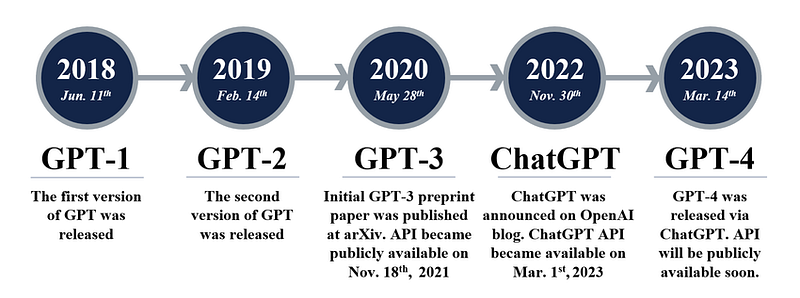
Source: Evolution of GPT Models

A Look into the Evolution of GPT Models From GPT-1 to GPT-4

A brief history of Resilience and Revolution: The Birth of OpenAI and the Rise of Generative AI

In the kingdom of artificial intelligence, language is the final monarchy. And at the beginning of this exciting new era, we are witnessing a revolution that is reshaping our understanding of human language and its limitless possibilities.

I’ve been following OpenAI from the genesis of GPT-1 to the groundbreaking advancements of GPT-4, and even before it was cool, I observed that the startup founded by Sam Altman was at the forefront of a revolution, pushing the boundaries of what’s possible and redefining the landscape of natural language processing.

This article takes you on a journey through the evolution of these transformative models, with each iteration bringing us closer to the dream of creating AI that can truly understand and generate human-like text. So, buckle up and prepare to dive into the fascinating world of GPT models, where the line between human and machine is becoming increasingly blurred.

Today, I want to take you on a journey through the evolution of OpenAI’s Generative Pre-trained Transformer (GPT) models. But first.. let me tell you a story… about resilience…

The Foundation of a Revolution: The OpenAI Story

In the world of startups, resilience is a trait that stands out. It is the ability to weather the storm, bounce back from adversity, and keep pushing forward even when the odds seem stacked against you. This is the trait that Sam Altman, the founder and CEO of OpenAI, believes is the key to success.

Altman’s journey into artificial intelligence (AI) began with his tenure as the President of Y Combinator (YC), an American technology startup accelerator that has helped launch more than 4,000 companies. During his time at YC, Altman observed thousands of entrepreneurs and identified resilience as a common factor among the successful ones. He noted, “The whole experience of the beginning of a startup is quite miserable…most people just give up.”

However, Altman is not one to give up. He learned to code at the age of eight and studied computer science at Stanford University before dropping out to work on building a mobile app with a few classmates.

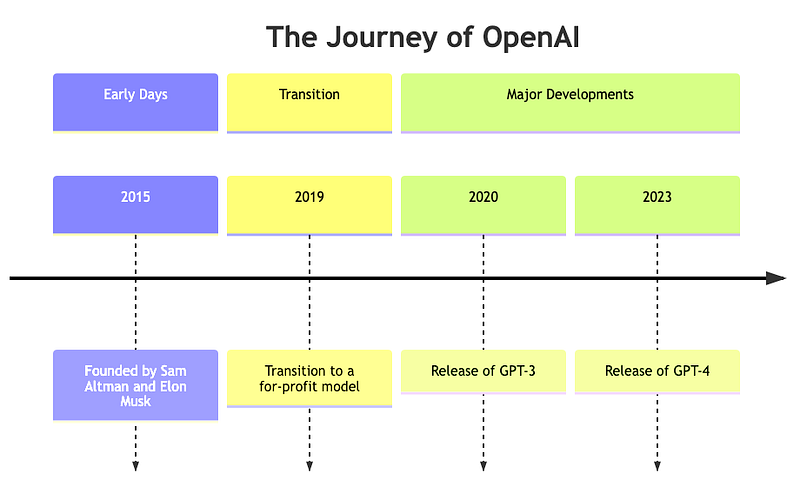
His resilience and determination led him to co-found OpenAI with Elon Musk in 2015. They aimed to create AI that would benefit humanity, a concept many initially thought was crazy or even a scam.

Altman’s superior communication skills played a crucial role in overcoming these initial doubts. He became the chief evangelist for OpenAI, convincing people that their ambitious project was possible and valuable.

OpenAI started as a non-profit, but in 2019, it transitioned into a for-profit company. Despite this change, Altman remained committed to the original goal of creating beneficial AI.

Altman’s journey with OpenAI is a testament to his resilience, communication skills, and long-term orientation. It is a story of how a startup founder can revolutionize an industry and positively impact humanity.

As Altman continues his global tour, advocating for a global coalition to regulate the development and use of AI, his story inspires entrepreneurs worldwide.

For me, it is a reminder that one can lay the foundation of a revolution with resilience, good communication, and a long-term vision.

As an AI leader, I’ve had the privilege of witnessing the development of these models as they were released, and I can tell you, it’s been nothing short of revolutionary.

So, let’s dive deeper into each model and its technical aspects, but first things first, let me explain what a GPT model means in this context.

About GPT Models…

A Generative Pretrained Transformer (GPT) model is an artificial intelligence language model that uses machine learning to generate human-like text.

It’s based on the transformer architecture, which uses self-attention mechanisms to understand the context and generate relevant text. GPT models are pre-trained on a large corpus of text data and then fine-tuned for specific tasks such as translation, question-answering, or text generation.

These models have significantly advanced the field of natural language processing, enabling more sophisticated and nuanced interactions between humans and AI.
A brief history of GPT

Now, let’s embark on an enlightening journey through the brief history of Generative Pretrained Transformers (GPT).

From the foundational GPT-1 to the revolutionary GPT-3, each iteration of this innovative AI model has brought us closer to the frontier of natural language understanding.

GPT-1: The Genesis

GPT-1, introduced by OpenAI in 2018, was the first language model built on the Transformer architecture, a novel approach that uses self-attention mechanisms. With 117 million parameters, GPT-1 was a significant leap forward from the language models of its time. It was trained on the Common Crawl and BookCorpus datasets, which provided vast and diverse text data.

Given all the previous words, the model was designed to predict the next word in a sentence. This simple yet effective approach allowed GPT-1 to generate coherent and contextually relevant sentences. However, understanding complex language structures and maintaining context over longer passages still needed to be improved.

GPT-2: The Evolution

GPT-2, released in 2019, was a substantial upgrade from GPT-1. It boasted 1.5 billion parameters, making it significantly larger and more powerful. The training data was also expanded, combining the Common Crawl dataset with WebText, a larger and more diverse dataset.

GPT-2 demonstrated an impressive ability to generate logical and plausible text sequences. It could also mimic human-like responses, making it a valuable tool for various NLP applications, including content generation and translation. However, it needed to maintain coherence and context in longer passages, a challenge to be addressed in the next iteration.
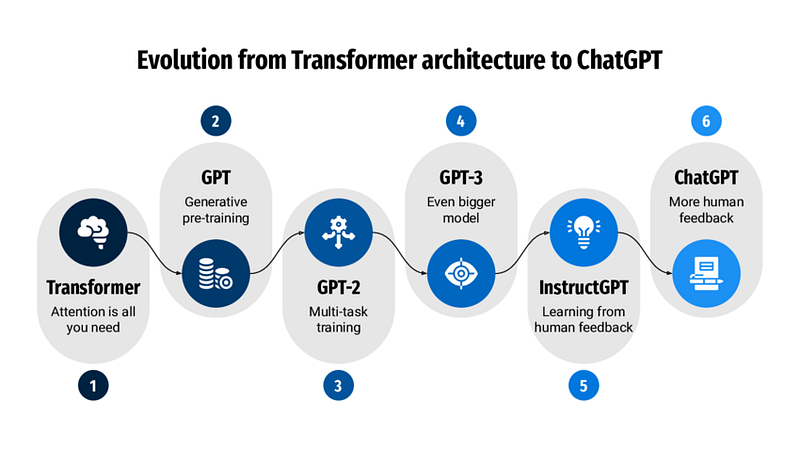
Source: Development of autoregressive models...

GPT-3: The Revolution

GPT-3, released in 2020, marked a period of exponential growth for natural language processing models. With 175 billion parameters, GPT-3 was more than a hundred times larger than GPT-1 and over ten times larger than GPT-2.

The training data for GPT-3 included BookCorpus, Common Crawl, and Wikipedia, among other sources. GPT-3 could produce high-quality results on various NLP tasks with approximately a trillion words across these datasets with little to no additional training data.

GPT-3’s capabilities extended beyond text generation. It could interpret the context of a text and generate relevant responses, write computer code, and even create art. However, these advancements also raised concerns about the potential misuse of such powerful language models, with fears that they could be used to generate harmful content.

GPT-4: The Future

GPT-4, released in 2023, was built upon the revolutionary advancements of GPT-3. While the exact details of its architecture and training data have yet to be made public, it’s clear that GPT-4 addressed some of the shortcomings of GPT-3 and introduced new features.

One of the defining characteristics of GPT-4 is its ability to operate in multiple modes, allowing it to treat an image as a text prompt. This multimodal capability opens up new possibilities for NLP applications, blurring the lines between text and image processing.

The Importance of Variants

OpenAI’s approach of developing multiple variants of the GPT models allows for a diverse set of applications. Each model has its strengths, weaknesses, and cost structure, enabling users to choose the model that best fits their needs.

For instance, while Da Vinci, the most advanced model in the GPT-3 family, is suited for complex tasks requiring deep understanding, Ada and Babbage are designed for simpler tasks where speed and efficiency are prioritized.

Data Privacy and OpenAI’s Current Models

OpenAI places a strong emphasis on data privacy. As of March 1, 2023, the OpenAI API no longer uses user data for model training or improvement unless users opt in. API data is also deleted after 30 days at the latest.

OpenAI’s current models, including GPT-4 Limited Beta, GPT-3.5 series, DALLE Beta, Whisper, and various embedding models, cater to various applications, from natural language processing and code generation to voice recognition and image processing.

As you can see, the journey from GPT-1 to GPT-4 represents a remarkable evolution in natural language processing. Each iteration has brought us closer to creating AI models to understand and generate human-like text.

As we look forward to future developments, it’s clear that the revolution is just beginning.

Conclusion

The journey from GPT-1 to GPT-4 is a story of technological evolution and a testament to human ingenuity and our relentless pursuit of knowledge.

Each iteration of the GPT models has brought us closer to the dream of creating machines that can truly understand and generate human-like text, opening up a world of possibilities that were once science fiction.

The advancements in these models have revolutionized the field of natural language processing and redefined our relationship with technology. They have given us a glimpse into a future where AI is not just a tool but a partner in our quest for knowledge and understanding.

However, as we marvel at our strides, we must also acknowledge the challenges. The ethical implications and potential misuse of such potent language models are concerns we must address as we continue to push the boundaries of what’s possible.

Ultimately, the story of GPT models is a story of us — our curiosity, creativity, and capacity for innovation. It’s a story that reminds us that even in the face of the unknown, we continue to explore, learn, and grow. And as we look to the future, one thing is certain — this is just the beginning.

The revolution is well underway, and we are all a part of it. So, here’s to the journey ahead and the exciting new chapters yet to be written in the history of artificial intelligence.

Links, sources, and references

Here are some articles on Medium about Generative AI that you might find interesting:

  1. A Gentle Introduction To Generative AI For Beginners
  2. My experience through the new (free) Microsoft AI Training
  3. Top 10 Best Generative AI Tools Worth Checking Out In 2023
  4. The Future of Business Decision-making and The Transformative Power of AI and Large Language Models
  5. Generative AI: How Algorithms are Revolutionizing and Unlocking the Power of transforming imaginations into Art, Music, and More
  6. Leading in the Generative AI Era
  7. Generative AI in the Newsroom
  8. Meta Unveils Open-Source Multimodal Generative AI System
  9. A Primer on Generative AI
  10. What’s Generative AI: Explore Underlying Layers of Machine Learning and Deep Learning
  11. Riding the Wave of Change with Generative AI
  12. Generative AI and use cases.
  13. Generative AI: The Next Frontier in Artificial Intelligence
  14. GPT-4 Is Ready To Unleash Multimodal AI-language Capabilities, and You Can Try It.
  15. What is Generative AI and Why You Should Be Aware of it
  16. The Game Will Change Again: GPT-4 is Coming.
  17. Generative AI: To unleash its potential, more than just an AI solution needs to be in place
  18. ChatGPT and the Future of Work: Revolutionizing Key Skills

These articles cover a wide range of topics related to Generative AI, from introductions and use cases to exploring its potential and understanding its underlying layers. Happy reading!

Follow me on LinkedIn for more info: www.linkedin.com/jairribeiro

Do you like my articles? Would you like to support me as a passionate writer?

Consider signing up as a Medium member for unlimited stories for just $5. In addition, if you sign up using my link, I’ll receive a small commission (at no extra cost).

Follow me on LinkedIn for more info: www.linkedin.com/jairribeiro

This story is published on Generative AI. Connect with us on LinkedIn to get the latest AI stories and insights right in your feed. Let’s shape the future of AI together!

OpenAI
Generative Ai
Gpt Model
Artificial Intelligence
AI
Recommended from ReadMedium