avatarDesiree Driesenaar

Free AI web copilot to create summaries, insights and extended knowledge, download it at here

5470

Abstract

y. But if you produce your own energy, it is not costly anymore. This is the synergy at work!</li><li>When all inhabitants are co-owners, they care. They will not overuse or waste freshwater and electricity.</li><li>And even more importantly: if all inhabitants are co-owners, the money stays on the island, people have more to spend and that will trigger other entrepreneurship.</li></ul><h2 id="7b60">Food and Feed</h2><p id="47bd">The picture at the top of the article is there not only to illustrate transport, and electricity for electric scooters. Every day at around ten in the morning, a boat full of sacks of grass for the horses is arriving. The sacks are carried out manually (as is every other bit of import, also the very heavy stuff…)</p><p id="b4bc">It is a daily ritual involving many people as unloaders. Feet in the water, and sacks with heavy stuff on the back of men. Or on the heads of women.</p><p id="6c90">What if the island was capable of farming the feed needed for the horses? And the food needed for the people?</p><p id="c16d">There are many empty patches on the island where the soil is laying bare. Large heaps of organic waste (palm leaves, branches, etc.) are stacked and towards the evening burned for no other reason than that it is seen as waste.</p><figure id="aac0"><img src="https://cdn-images-1.readmedium.com/v2/resize:fit:800/1*EGw011IUdJ5CBpAwX73NRQ.jpeg"><figcaption>Space enough for some regenerative farming. Organic matter will be burned in the evening. Photo by author.</figcaption></figure><p id="1023">What a waste! Organic matter is one of the most important ingredients to regenerate the soil. We need organic matter, we need micro-organisms, we need mycelium networks in the soil.</p><p id="e6cb">And as a very important side-effect, we need to capture carbon in the soil to reverse climate change.</p><p id="2e66">Here’s some inspiration about food and regenerative farming, including practical tips on how to start creating healthy, living soil.</p><div id="fa2d" class="link-block"> <a href="https://readmedium.com/growing-high-quality-food-for-a-future-without-hunger-10f55a70c417"> <div> <div> <h2>Growing High-Quality Food for a Future without Hunger</h2> <div><h3>Food is the bridge between natural systems and human systems. Regenerative farming and healthy, living soil will…</h3></div> <div><p>medium.com</p></div> </div> <div> <div style="background-image: url(https://miro.readmedium.com/v2/resize:fit:320/1*3PLW9yk6Td24rU8KQN2A3Q.jpeg)"></div> </div> </div> </a> </div><h2 id="fbb1">Fisheries</h2><p id="bca8">Islands are surrounded by water. So how neat would it be if islanders found ways to enjoy self-sufficiency with what the ocean provides.</p><p id="467b">On El Hierro, they have shielded part of the ocean and allow fish to become as old as they can be. The <a href="https://conservationbytes.com/2010/04/18/the-spillover-effect/">spillover effect</a> is tremendous. Because the fish lay millions of eggs every year, the ocean is being regenerated.</p><p id="3075">The fishermen cooperatives decided to fish only with lines. As a result, the communities thrive and we can eat really sustainable tuna fish on El Hierro.</p><h2 id="6f8f">Restoration of the Corals</h2><p id="05ad">On the Gili isles, the dying of the corals is a problem. Corals provide very important functions within the ecosystems. As the <a href="https://www.qm.qld.gov.au/microsites/biodiscovery/05human-impact/importance-of-coral-reefs.html">Queensland Museum, Australia explains</a>, corals:</p><ul><li>protect coastlines from the damaging effects of wave action and tropical storms</li><li>provide habitats and shelter for many marine organisms</li><li>are the source of nitrogen and other essential nutrients for marine food chains</li><li>assist in carbon and nitrogen-fixing</li><li>help with nutrient recycling</li></ul><p id="1233">Gili Eco Trust is trying to do something about this problem with Biorock technology.</p><div id="ff65" class="link-block"> <a href="https://giliecotrust.com/"> <div> <div> <h2>Gili Eco Trust</h2> <div><h3>The Biorock technology is a novel technique to create artificial coral reefs, this way Gili Eco Trust restores the…</h3></div> <div><p>giliecotrust.com</p></div> </div> <div> <div style="background-image: url(https://miro.readmedium.com/v2/resize:fit:320/0*RiSMV-rP2dK49lr5)"></div> </div> </div> </a> </div><p id="4c74">From what I’ve seen underwater, I think they use the same geo-therapy methods <a href="undefined">Daniel Christian Wahl</a> describes in his <a href="https://readmedium.com/geotherapy-not-geoengineering-e4734273c0c6">interview with Tom Goreau</a>.</p><blockquote id="f19c"><p>“Over more than 30 years, Tom has been a pioneer in experimenting with the use of very low (direct current) electrical stimulation applied through fine steel grids to increase the settlement rate and growth, “and reduced mortality for a wide variety of marine organisms, including corals, oysters, sponges, sea-grasses, and salt-marsh grasses.” — Daniel Christian Wahl about Tom Goreau.</p></blockquote><p id="f6c4">When snorkeling, I saw the

Options

metal structures. And yes, the corals upon it looked healthy. Vibrant colors. Flourishing…</p><h2 id="e4fc">Transition Steps</h2><p id="d8f8">So, what are the steps toward transitioning an island (or another bioregional area) toward a regenerative economy?</p><p id="2cf4">1 Get together with a group of people and explain the regenerative-economy-mechanisms I’m describing. Brainstorm together about a cool future for your area. What do you want to be?</p><p id="b8ca">2 Visualize that future in words and preferably also illustrations. Make it as tangible as you can. And have fun doing it! The fun will show in the variety of words, videos, pictures, infographics, illustrations…</p><p id="cbfb">3 Tell the story as widely as possible to groups around your community. Light the spark in as many diverse people as you can. Involve lots of young people. It’s their future! Involve primary and secondary schools, entrepreneurs, universities, and just light the spark…</p><p id="1ba3">4 Help each other to get some real action going. Bottom-up projects that create value upon value. Link these projects (profit, non-profit, all of them) to each other and share proceeds to invest in new initiatives.</p><p id="2cf1">5 When the group is big enough, go to your local government and demand some action. Let them invest in the first steps for local basic needs production: renewable energy, restoring water cycles for drinking water, regenerative farming…</p><p id="aef6">6 Make sure the money is kept local. Use economic principles to convince people. If the whole community will be profiting, they will have more money to spend locally.</p><p id="2602">7 On a personal level: stop buying from multinationals. Keep your money local and active, as much as you can. No more large beer brands like Heineken or InBev. Start local beer breweries with all kinds of tastes. Start partying with local beer and fruit juices. Make it fun with a message!</p><p id="3d3d">8 Then you can attract outsiders in. Outsiders, travelers, with respect for what you’re doing. Tell the stories and they’ll want to be part of the fun! Their outsiders’ money can help you fund new projects too.</p><p id="eeea"><b>Happy transitioning!</b></p><p id="0e78">I dedicate this story to <a href="undefined">Agnes Louis</a>, an author who inspires me with her reflections on Mother Nature.</p><div id="4a73" class="link-block"> <a href="https://readmedium.com/repossession-b482d4f125b9"> <div> <div> <h2>Repossession</h2> <div><h3>a Reflection</h3></div> <div><p>medium.com</p></div> </div> <div> <div style="background-image: url(https://miro.readmedium.com/v2/resize:fit:320/1*gdxJABoAlZKGfi1L9L16sw.jpeg)"></div> </div> </div> </a> </div><p id="0714">I read you’ve been snorkeling near Gili Meno, Agnes. Not far from Gili Air, where we met the most amazing sea turtle ever and swam with her.</p><figure id="2ce1"><img src="https://cdn-images-1.readmedium.com/v2/resize:fit:800/1*Pf5k0x4Od0LdTb2fRLecug.jpeg"><figcaption>Photo by <a href="https://unsplash.com/@kmkr?utm_source=unsplash&amp;utm_medium=referral&amp;utm_content=creditCopyText">Kris Mikael Krister</a> on <a href="https://unsplash.com/s/photos/sea-turtle-indonesia?utm_source=unsplash&amp;utm_medium=referral&amp;utm_content=creditCopyText">Unsplash</a>. Taken also in Indonesia, but in Raja Ampat instead of Gili.</figcaption></figure><p id="76c1">If you want to connect, you can find me on <a href="https://www.linkedin.com/in/desireedriesenaar/">LinkedIn</a>, <a href="https://www.facebook.com/desiree.driesenaar/">Facebook</a>, <a href="https://twitter.com/driesenaar">Twitter</a>, <a href="https://www.instagram.com/driesenaar/">Instagram</a>, or <a href="http://www.driesenaar.nl/">my website</a>. Or somewhere on an island, helping local people restore their ecosystems…</p><p id="1ce0"><i>Thank you, Mike, for adding your wise energy to my words.</i></p><h2 id="5952">Further reading</h2><p id="1263"><i>About the real-life case of El Hierro</i></p><div id="e925" class="link-block"> <a href="https://readmedium.com/heroes-of-el-hierro-part-i-e6e45fa6ee85"> <div> <div> <h2>Heroes of El Hierro, Part I</h2> <div><h3>A European Regenerative Economy. It can be done!</h3></div> <div><p>medium.com</p></div> </div> <div> <div style="background-image: url(https://miro.readmedium.com/v2/resize:fit:320/1*63VdxjgT3VuTaj6NvM1VHg.jpeg)"></div> </div> </div> </a> </div><p id="d436"><i>About Import, Export, and Tourism on Bali</i></p><div id="4b14" class="link-block"> <a href="https://readmedium.com/how-to-build-a-strong-island-economy-without-mass-tourism-7c2401930b28"> <div> <div> <h2>How to Build a Strong Island Economy without Mass Tourism</h2> <div><h3>El Hierro is already on it. Will Bali be next?</h3></div> <div><p>medium.com</p></div> </div> <div> <div style="background-image: url(https://miro.readmedium.com/v2/resize:fit:320/1*JzffwXU74L-QLTXumkD6bg.jpeg)"></div> </div> </div> </a> </div></article></body>

A Healthy Island Economy Is Self-Sustaining

Islands can be perfect regenerative economies. They can restore water cycles, grow food on healthy soil, and embrace renewable energy
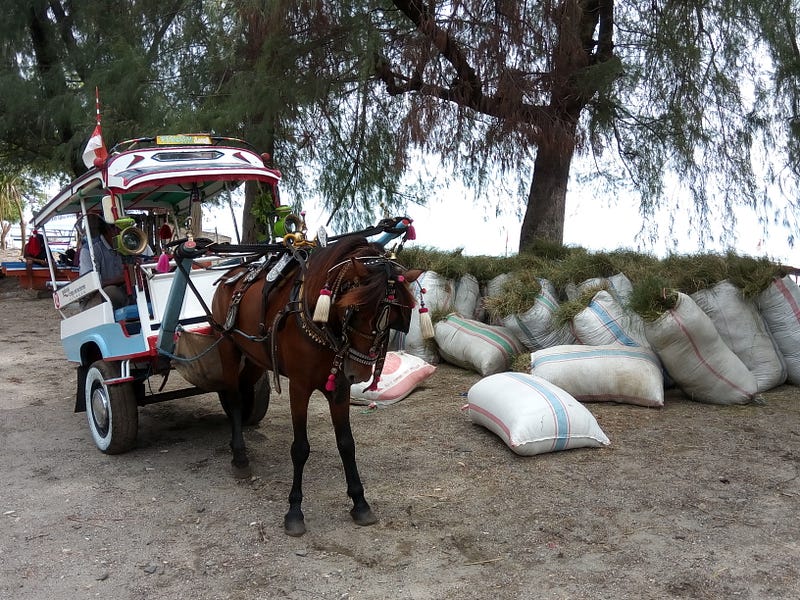
On Gili Air, Indonesia, transport is only done on foot, or by horse cart, bicycle or electric scooter. The food for the horses is transported by boat from Lombok. Photo: Desiree Driesenaar

Many countries look at their economy through import, export glasses. And they stimulate their economies by motivating entrepreneurs to export goods or offer services in tourism. Whatever brings in the money from outside.

The effects can be seen all around. We have linear business models, so yes, the money flows in. But the problems related to these businesses flow in as well.

And who needs to solve those? Society. Mass production of goods ruins a lot, mass tourism ruins even more. Why is that?

  • Mass anything has no close connection to a local place. The benefits are limited to the company, while the local society pays the price of pollution, waste, transport movements, noise, etc.
  • Tourists are often separate from local people. They do not interact, have no connection to the local culture, let alone contribute to the local community
  • Mass anything has surpassed the human scale. It is too big for its shoes. Mass tourism is often combined with mass buses, mass waste, mass noise-levels, etc.
  • Job creation, yes. But are they inspiring, soul-satisfying jobs? Often that is not the case…

What if there would be another way? What if we could give an impulse to the economy and at the same time improve the ecology in a region? This article gives some explorations and explanations.
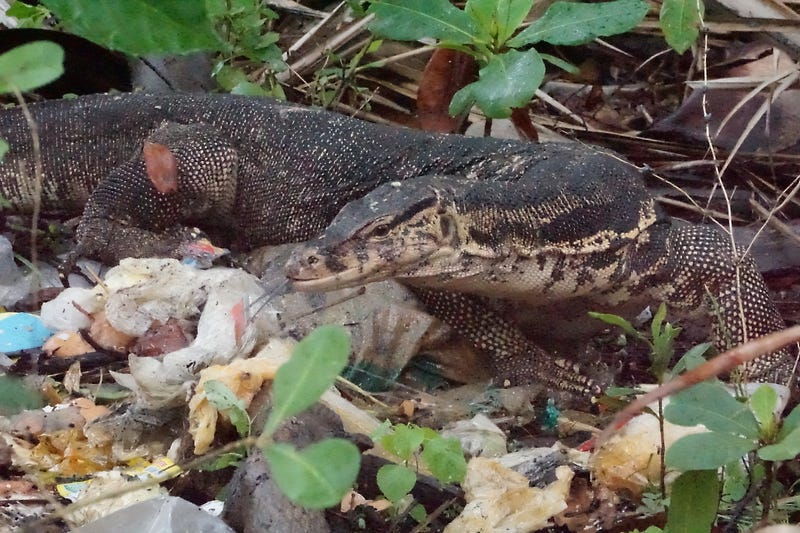
A monitor lizard on Gili Air eats discarded waste. Photo by author.

Exports and Imports

In a globally oriented economy, there are exports, and also imports. And it might just be a good idea to start minimizing imports to give our economy the impulse it needs. How does it work? Let’s look at an island to clarify.

In my recent travel through Indonesia, I was for some time on Gili Air, an island just off Lombok. And with my eye for regeneration, I see opportunities arise on every corner.

Okay. What’s regeneration? The term originally comes from the biological field. I quote Wikipedia.

“In biology, regeneration is the process of renewal, restoration, and growth that makes genomes, cells, organisms, and ecosystems resilient to natural fluctuations or events that cause disturbance or damage” — Regeneration, wikipedia

Okay. So what is it in an economic sense? Regeneration is a movement that’s taking us beyond sustainability. Regeneration combines economy and ecology and finds ways to reinvent our economic system in such a way that we stay within the boundaries of our planet.

The regeneration movement wants to restore ecosystems and learn together as humans how to live without damaging them. Humans as part of ecosystems. Economy and ecology aligned.

Basic Needs

But that’s a sidetrack. We were going to talk about Gili Air. What if this island would work on becoming self-sustaining in some basic needs first?

E.g. energy, water, and food. It would keep a lot of money inside of the economy that would otherwise have gone out.

No import, no spending. The money saved can be invested in new projects. And the projects will feed on each other moneywise by using synergy instead of scale as a driver. And there will be less need for export and its devastating effects.

In practice: what could Gili Air do as a start? In the picture at the top of this article, you see one of the horse carts that inhabit the island. On Gili Air, transportation is only done on foot, by bicycle, by horse cart, or electric scooter. Great first step!

But what if the island would dedicate itself to producing the fuel for these means of transport inside their own economy? What if they would have a small-grid system of renewable electricity, so the houses could have light and the electric scooters would have their renewable fuel?

El Hierro Real-life Example

On the island of El Hierro in Spain, they have even taken it one step further. They have merged the electricity and water company and made all inhabitants co-owners.

The advantages?

  • Electricity and water companies don’t compete anymore. They collaborate.
  • The electricity system could be combined with the desalination process for drinking water. Normally desalination is an expensive process because it needs lots of energy. But if you produce your own energy, it is not costly anymore. This is the synergy at work!
  • When all inhabitants are co-owners, they care. They will not overuse or waste freshwater and electricity.
  • And even more importantly: if all inhabitants are co-owners, the money stays on the island, people have more to spend and that will trigger other entrepreneurship.

Food and Feed

The picture at the top of the article is there not only to illustrate transport, and electricity for electric scooters. Every day at around ten in the morning, a boat full of sacks of grass for the horses is arriving. The sacks are carried out manually (as is every other bit of import, also the very heavy stuff…)

It is a daily ritual involving many people as unloaders. Feet in the water, and sacks with heavy stuff on the back of men. Or on the heads of women.

What if the island was capable of farming the feed needed for the horses? And the food needed for the people?

There are many empty patches on the island where the soil is laying bare. Large heaps of organic waste (palm leaves, branches, etc.) are stacked and towards the evening burned for no other reason than that it is seen as waste.
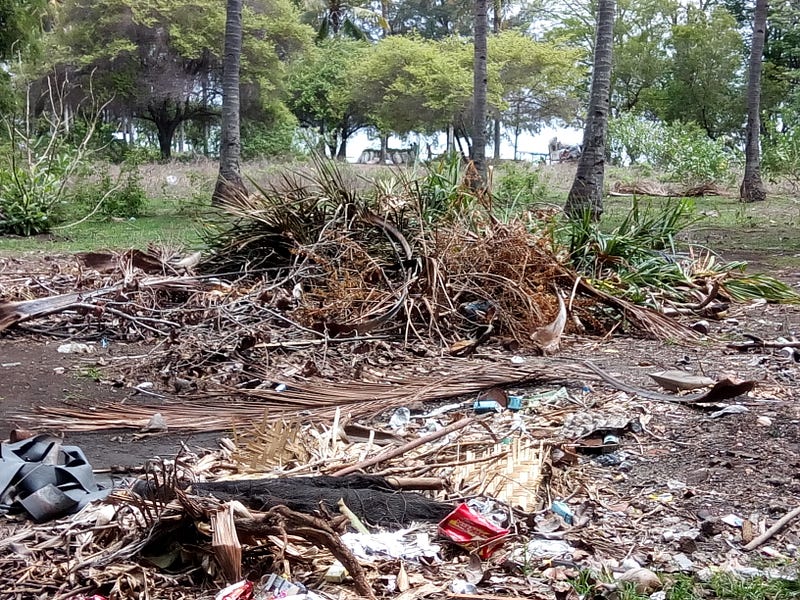
Space enough for some regenerative farming. Organic matter will be burned in the evening. Photo by author.

What a waste! Organic matter is one of the most important ingredients to regenerate the soil. We need organic matter, we need micro-organisms, we need mycelium networks in the soil.

And as a very important side-effect, we need to capture carbon in the soil to reverse climate change.

Here’s some inspiration about food and regenerative farming, including practical tips on how to start creating healthy, living soil.

Fisheries

Islands are surrounded by water. So how neat would it be if islanders found ways to enjoy self-sufficiency with what the ocean provides.

On El Hierro, they have shielded part of the ocean and allow fish to become as old as they can be. The spillover effect is tremendous. Because the fish lay millions of eggs every year, the ocean is being regenerated.

The fishermen cooperatives decided to fish only with lines. As a result, the communities thrive and we can eat really sustainable tuna fish on El Hierro.

Restoration of the Corals

On the Gili isles, the dying of the corals is a problem. Corals provide very important functions within the ecosystems. As the Queensland Museum, Australia explains, corals:

  • protect coastlines from the damaging effects of wave action and tropical storms
  • provide habitats and shelter for many marine organisms
  • are the source of nitrogen and other essential nutrients for marine food chains
  • assist in carbon and nitrogen-fixing
  • help with nutrient recycling

Gili Eco Trust is trying to do something about this problem with Biorock technology.

From what I’ve seen underwater, I think they use the same geo-therapy methods Daniel Christian Wahl describes in his interview with Tom Goreau.

“Over more than 30 years, Tom has been a pioneer in experimenting with the use of very low (direct current) electrical stimulation applied through fine steel grids to increase the settlement rate and growth, “and reduced mortality for a wide variety of marine organisms, including corals, oysters, sponges, sea-grasses, and salt-marsh grasses.” — Daniel Christian Wahl about Tom Goreau.

When snorkeling, I saw the metal structures. And yes, the corals upon it looked healthy. Vibrant colors. Flourishing…

Transition Steps

So, what are the steps toward transitioning an island (or another bioregional area) toward a regenerative economy?

1 Get together with a group of people and explain the regenerative-economy-mechanisms I’m describing. Brainstorm together about a cool future for your area. What do you want to be?

2 Visualize that future in words and preferably also illustrations. Make it as tangible as you can. And have fun doing it! The fun will show in the variety of words, videos, pictures, infographics, illustrations…

3 Tell the story as widely as possible to groups around your community. Light the spark in as many diverse people as you can. Involve lots of young people. It’s their future! Involve primary and secondary schools, entrepreneurs, universities, and just light the spark…

4 Help each other to get some real action going. Bottom-up projects that create value upon value. Link these projects (profit, non-profit, all of them) to each other and share proceeds to invest in new initiatives.

5 When the group is big enough, go to your local government and demand some action. Let them invest in the first steps for local basic needs production: renewable energy, restoring water cycles for drinking water, regenerative farming…

6 Make sure the money is kept local. Use economic principles to convince people. If the whole community will be profiting, they will have more money to spend locally.

7 On a personal level: stop buying from multinationals. Keep your money local and active, as much as you can. No more large beer brands like Heineken or InBev. Start local beer breweries with all kinds of tastes. Start partying with local beer and fruit juices. Make it fun with a message!

8 Then you can attract outsiders in. Outsiders, travelers, with respect for what you’re doing. Tell the stories and they’ll want to be part of the fun! Their outsiders’ money can help you fund new projects too.

Happy transitioning!

I dedicate this story to Agnes Louis, an author who inspires me with her reflections on Mother Nature.

I read you’ve been snorkeling near Gili Meno, Agnes. Not far from Gili Air, where we met the most amazing sea turtle ever and swam with her.
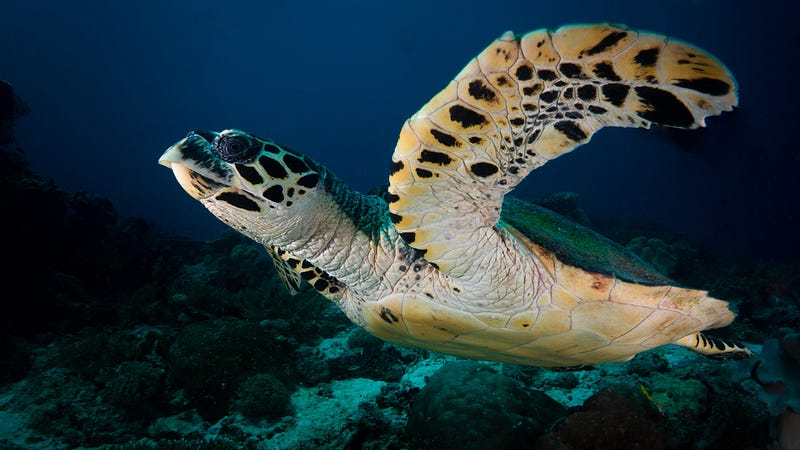
Photo by Kris Mikael Krister on Unsplash. Taken also in Indonesia, but in Raja Ampat instead of Gili.

If you want to connect, you can find me on LinkedIn, Facebook, Twitter, Instagram, or my website. Or somewhere on an island, helping local people restore their ecosystems…

Thank you, Mike, for adding your wise energy to my words.

Further reading

About the real-life case of El Hierro

About Import, Export, and Tourism on Bali

Regenerative Economy
Tourism
Systems Thinking
Island
Recommended from ReadMedium