
A FILM TO REMEMBER: “THE LORD OF THE RINGS: THE RETURN OF THE KING” (2003)
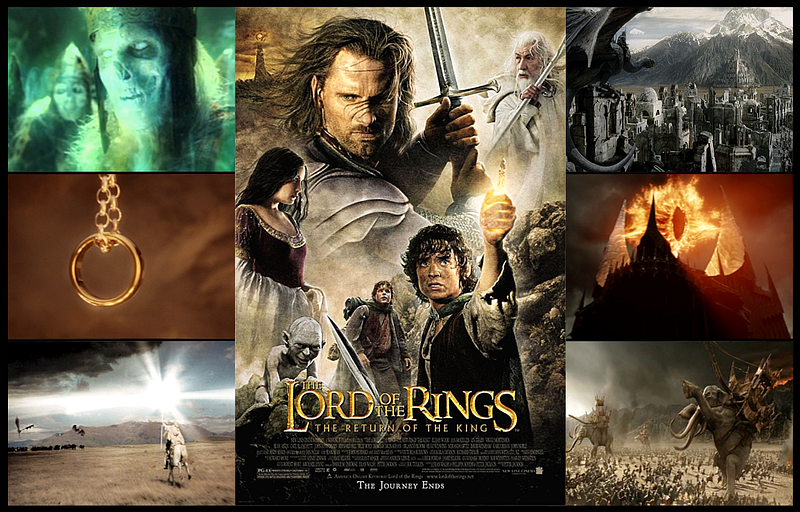
Before I get into this, I want to make mention “A FILM TO REMEMBER” will be a series about films that have reached a milestone anniversary since their origin in being culturally, historically, or aesthetically significant. The articles will contain the film’s plot outline, director, cast, a compilation of trivialities, various photos, movie trailer, critical reception and more. So, let’s start:
We are here to mark the celebration of the 15th Anniversary of Peter Jackson’s “The Lord of the Rings: The Return of the King”. Let’s take an inside look at the film:
PLOT OUTLINE:
The final confrontation between the forces of good and evil fighting for control of the future of Middle-earth. Hobbits: Frodo and Sam reach Mordor in their quest to destroy the “one ring”, while Gandalf and Aragorn leads the forces of good against Sauron’s evil army at the stone city of Minas Tirith.
STUDIO:
New Line Cinema
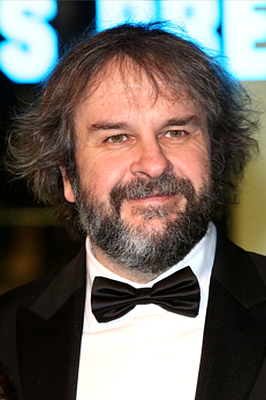
DIRECTOR:
Peter Jackson
CAST:
- Elijah Wood … Frodo Baggins
- Ian McKellen … Gandalf
- Sean Astin … Samwise Gamgee
- Viggo Mortensen … Aragorn
- Billy Boyd … Pippin Took
- Dominic Monaghan … Merry Brandybuck
- John Rhys-Davies … Gimli
- Orlando Bloom … Legolas Greenleaf
- Andy Serkis … Gollum / Smeagol
- Bernard Hill … Théoden
- Miranda Otto … Éowyn
- Liv Tyler … Arwen Undómiel
- Hugo Weaving … Elrond
- David Wenham … Faramir
- Karl Urban … Éomer
- John Noble … Denethor II
- Cate Blanchett … Galadriel
- Lawrence Makoare … Witchking of Angmar / Gothmog
- Ian Holm … Bilbo Baggins
- Paul Norell … King of the Dead
- Marton Csokas … Celeborn
- Thomas Robins … Déagol
- Ali Astin … Elanor Gamgee
- John Bach … Madril
- Sadwyn Brophy … Eldarion
- Alistair Browning … Damrod
- Bruce Hopkins … Gamling
- Ian Hughes … Irolas
- Bret McKenzie … Elf Escort
- Sarah McLeod … Rosie Cotton
- Maisy McLeod-Riera … Baby Gamgee
- Bruce Phillips … Grimbold
- Todd Rippon … Harad Leader 1
- Shane Rangi … Harad Leader 2
- Harry Sinclair … Isildur
- Peter Tait … Shagrat
- Joel Tobeck … Orc Lieutenant 1
- Stephen Ure … Gorbag
- Alan Howard … Voice of the Ring (voice)
- Phil Grieve … Orc Commander (extended edition)
- Christopher Lee … Saruman (extended edition)
- Brad Dourif … Gríma Wormtongue (extended edition)
- Bruce Spence … The Mouth of Sauron (extended edition)
- Sean Bean … Boromir (extended edition)
GENRE(S):
Action | Adventure | Drama | Fantasy
TAGLINE:
There can be no triumph without loss. No victory without suffering. No freedom without sacrifice.
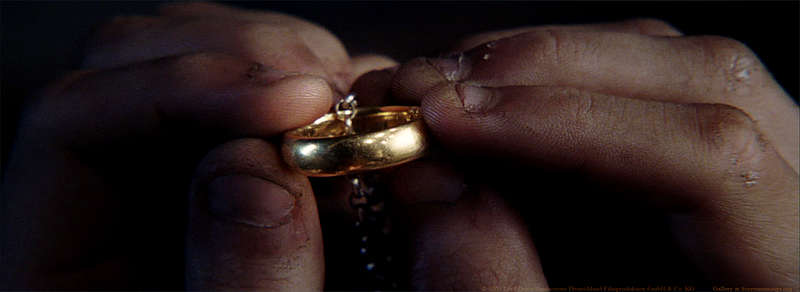
The film is known for being the grand and resounding climax of “The Lord of the Rings” trilogy of a rich, layered narration of a king, a wizard and two little hobbits whose courage saved their world as it achieves a resonance not frequently matched in cinema of any genre — its boundless fraternity and hopefulness makes it truly something special that’s masterfully captivating, inherently grand, vibrantly vivid, invitingly arousing and whimsically overwhelming that packs an urgent sense of vitality into this third installment that’s purely monumentally magnetic. Director Peter Jackson captures the visual grandeur and thematic complexities of the source material well, while moving gracefully from moments of the intensely personal to grandiose scenes of staggering enormity, that’s filled with a sublime ensemble cast and regal performances in this awe-struck fantasy saga of wondrous effects, breathtaking scenery, labyrinthine battles, sweeping emotion and a dramatically compelling conclusion of a landmark trilogy. The film is based from the J. R. R. Tolkien novel series of the same name from the second and third volumes, it received mostly critical acclaim despite some criticism towards it but has become widely considered as being one of the greatest fantasy films ever made and the trilogy itself being one of the greatest cinematic achievements of all-time.
Here’s what some of the critical receptions have been for the film over the years:
Todd McCarthy from Variety says: “Peter Jackson’s final installment in his monumental ‘The Lord of the Rings’ represents that filmmaking rarity — a third part of a trilogy that is decisively the best of the lot.”
Eleanor Ringel Cater from Atlanta Journal-Constitution says: “With ‘The Lord of the Rings: The Return of the King,’ Peter Jackson brings his epic series to a glorious finish. And in doing so, he’s made the greatest film trilogy in cinema history.”
Stephen Whitty from Newark Star-Ledger says: “Like all the other installments in the saga, ‘Lord of the Rings: The Return of the King’ is part of a good movie, but only mediocre on its own, full of awkward pauses and redundancies.”
Terry Lawson from Detroit Free Press says: “It not only stands as fantasy filmmaking on a peak of previously unscaled proportions, it now officially takes its place in the Great Hall of Movie Mythology, the place we return to again and again to share our dreams.”
Roger Moore from Orlando Sentinel says: “The thrilling conclusion to what has become the film event of our time — the definitive screen fantasy — features more spellbinding moments, bigger battles, more emotion and more poetry than the terrific first two films in the trilogy.”
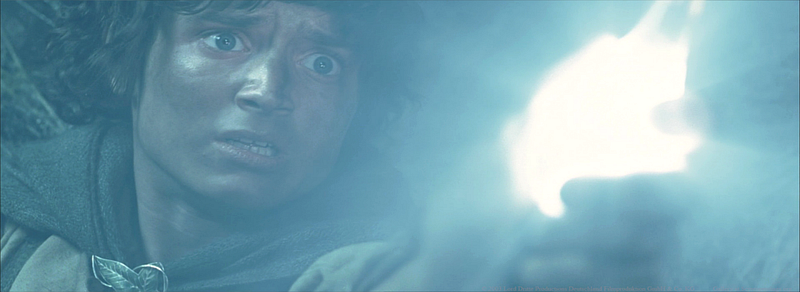
As you can tell by the critical reactions, the film was critically renowned consensually but some pundits found it to be overlong, others considered it nothing more than eye-candy and grand events with no real substance. In spite of the criticisms from the small-scale naysayers, Jackson establishes a visual scope and grandeur with emotional power and relentless momentum in making a passionate and literate, detailed and expansive that’s all conceived with a risk-taking flair for old-fashioned movie magic at its best. The film is a model for how to bring substance, authenticity and insight to the biggest of fantasy adventure yarns that entertains, enthralls and awes of a prime filmic coda that’s anchored with a splendid cast and superb performances in this rip-roaring spectacle, stylistically thrilling, emotionally poetic, grippingly dramatic and sweepingly conclusive epic of a definitive masterwork achievement in the annals of cinema. But I’ll let you decide…
So, to get a better look at the film, here’s a link to the movie trailer of Peter Jackson’s “The Lord of the Rings: The Return of the King”:
Here I have provided 12 interesting and intriguing trivia facts (I wanted to keep it limited) about “The Lord of the Rings: The Return of the King”:
- “The Lord of the Rings” film trilogy is unusual in that it was, up until the release of Jackson’s prequel trilogy “The Hobbit,” the only series whose separate installments were written and shot simultaneously (excluding pick up shoots).
- The film was originally the second of 2 planned films under Miramax from January 1997 to August 1998, and more or less in its finished structure as the first film was to end with The Two Towers’ Battle of Helm’s Deep.
- Middle-Earth as envisioned by director Peter Jackson was primarily designed by Alan Lee and John Howe, former Tolkien illustrators, and created by Weta Workshop, who handled all the trilogy’s weapons, armor, miniatures, prosthetics, and creatures, as well as the Art Department which built the sets. Richard Taylor headed Weta, while Grant Major and Dan Hennah organised the planning and building respectively.
- The city of Minas Tirith, glimpsed briefly in both the previous two films, is seen fully in this film, and with it the Gondorian civilisation. The enormous soundstage was built at Dry Creek Quarry, outside Wellington, from the Helm’s Deep set. That set’s gate became Minas Tirith’s second, while the Hornburg exterior became that of the Extended Edition’s scene where Gandalf (played by Ian McKellen) confronts the Witch-king. New structures included the 8m tall Gate, with broken and unbroken versions, with a working opening and closing mechanism, with its engravings inspired by the Baptistry of San Giovanni. There were also four levels of streets with heraldic motifs for every house, as inspired by Siena.
- The Citadel, the exterior of which was in the Stone Street Studios backlot, using forced perspective. It contains the withered White Tree, built from polystyrene by Brian Massey and the Greens Department with real branches, influenced by ancient and gnarled Lebanese olive trees. The interior was within a three-story former factory in Wellington, and color wise is influenced by Charlemagne’s Chapel, with a throne for Denethor carved from stone and polystyrene statues of past Kings. The Gondorian armor is designed to represent an evolution from the Númenóreans of the first film’s prologue, with a simplified sea bird motif. 16th-century Italian and German armor served as inspiration, while civilians wear silver and blacks as designed by Ngila Dickson, continuing an ancient/medieval Mediterranean Basin look.
- The third film introduces the enormous spider Shelob. Shelob was designed in 1999, with the body based on a tunnelweb spider and the head with numerous growths selected by Peter Jackson’s children from one of many sculpts. Jackson himself took great joy in planning the sequence, being an arachnophobe himself. Shelob’s Lair was inspired by sandstone and sculpted from the existing Caverns of Isengard set.
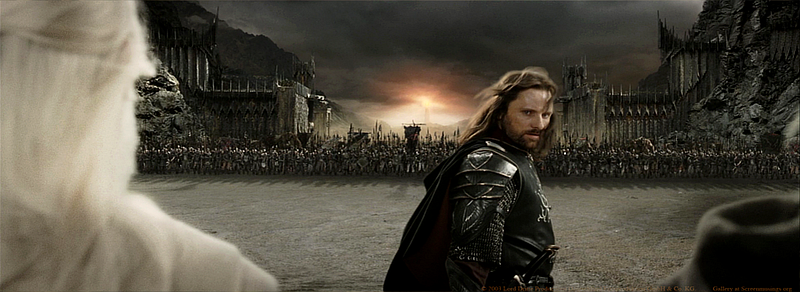
- The film was shot during 2000, though Sean Astin’s coverage from Gollum’s (played by Andy Serkis) attempt to separate Frodo (played by Elijah Wood) and Sam (played by Sean Astin) was filmed on 24 November 1999, when floods in Queenstown interrupted the focus on “The Lord of the Rings: The Fellowship of the Ring” (2001). Some of the earliest scenes shot for the film were in fact the last. Hobbiton, home of the Hobbits, was shot in January 2000 with early scenes from “The Lord of the Rings: The Fellowship of the Ring” (2001), with the exterior shot at a Matamata farm, while interior scenes shot at Stone Street Studios in Wellington, shared with the Grey Havens sequence. Due to the high emotions of filming the scene, the cast were in despair when they were required to shoot it three times, due to a continuity flaw in Astin’s costume, and then negatives producing out-of-focus reels. Also shared with the previous films was the Rivendell interior in May.
- The 2003 pick-ups were filmed in the Wellington studio car park, with many parts of sets and blue-screens used to finish off scenes, which the design team had to work 24 hours to get the right sets ready for a particular day. The shoot continued for two months, and became an emotional time of farewells for the cast and crew. The film has the most extensive list of re-shoots given for the trilogy. Peter Jackson took his time to re-shoot Aragorn’s (played by Viggo Mortensen) coronation, rushed into a single day under second unit director Geoff Murphy on 21 December 2000. Jackson also re-shot scenes in and around Mount Doom, and Théoden’s (played by Bernard Hill) death, right after Hill was meant to wrap.
- There was also the new character of Gothmog (played by Lawrence Makoare). This was a major new design addition for the film, as Jackson felt the Mordor Orcs were “pathetic” compared to the Uruk-hai of the second film after watching assembly cuts, and thus Weta created grotesque new “über Orcs” as antagonists for the audience to focus on. Storyboard artist Christian Rivers also redesigned the Witchking (played by Lawrence Makoare as well) and all of his scenes were re-shot, because of confusion from non-readers over whether or not Sauron (played by Bruce Spence) was on the battlefield.
- The film contains 1,488 visual effect shots, nearly three times the number from the first film and almost twice that of the second. Visual effects work began with Alan Lee and Mark Lewis compositing various photographs of New Zealand landscape to create the digital arena of the Pelennor Fields in November 2002. Gary Horsfield also created a digital version of the Barad-dûr during his Christmas break at home by himself, for the film’s climax. In the meantime, Peter Jackson and Christian Rivers used computers to plan the enormous battle up until February 2003, when the shots were shown to Weta Digital. To their astonishment, 60 planned shots had gone up to 250, and 50,000 characters were now 200,000. Nevertheless, they pressed on, soon delivering 100 shots a week, 20 a day, and as the deadline neared within the last two months, often working until 2 am.
- For the battle, they recorded 450 motions for the MASSIVE digital horses (though deaths were animated), and also had to deal with late additions in the film, such as Trolls bursting through Minas Tirith’s gates as well as the creatures that pull Grond to the gate, and redoing a shot of two mûmakil Éomer takes down that had originally taken 6 months in 2 days. On a similar note of digital creatures, Shelob’s head sculpture was scanned by a Canadian company for 10 times more detail than Weta had previously been able to capture.
- Post-production began in November 2002, with the completion of the 4½ hour assembly cut of the film that Annie Collins had been completing over 2001 and 2002, from 4-hour dailies. For example, Théoden leading the charge went from 150 minutes of takes to a finished 90 seconds. Peter Jackson reunited with longtime collaborator Jamie Selkirk to edit the final film. Like “The Lord of the Rings: The Two Towers” (2002), they would have to deal with multiple storylines, and Jackson paid attention to each storyline at a time before deciding where to intercut. Most importantly they spent 3 weeks working on the last 45 minutes of the film, for appropriate intercutting and leaving out scenes such as the Mouth of Sauron, and the fates of characters like Legolas (played by Orlando Bloom), Gimli (played by John Rhys-Davies), Éowyn (played by Miranda Otto) and Faramir (played by David Wenham). The film inherited scenes originally planned to go into the second film, including the reforging of Narsil, Gollum’s backstory, and Saruman’s (played by Christopher Lee) exit. But the Saruman scene posed a structural problem: killing off the second film’s villain when the plot has Sauron as the main villain. Despite pick-ups and dubs, the scene was cut, causing controversy with fans and Lee himself, as well as a petition to restore the scene. Lee nonetheless contributed to the DVDs and was at the Copenhagen premiere, although Lee said he would never understand the reason for the cut and his relationship with Jackson was chilly. They would, however, later reconcile upon Lee’s casting in Jackson’s “The Hobbit” trilogy. Jackson only had a lock on 5 out of 10 reels, and had to churn out 3 reels in 3 weeks to help finish the film. It was finally completed on 12 November 2003. Jackson never had a chance to view the film in full due to the hectic schedule, and only saw the film from beginning to end on 1 December at the Wellington premiere; according to Elijah Wood, his response was “yup, its good, pretty good”.
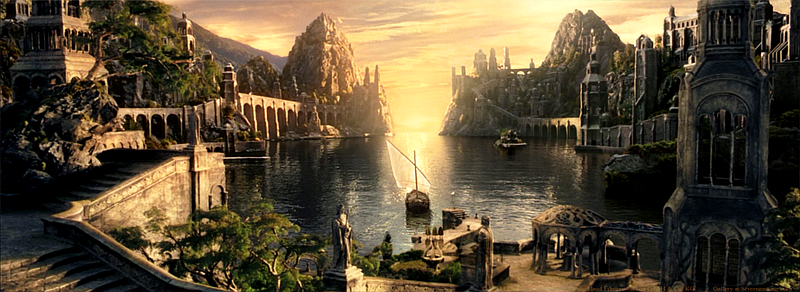
To conclude, Peter Jackson’s “The Lord of the Rings: The Return of the King” ultimately proves up to the series’ increasingly difficult task in making a chronicling narrative that echo legends, making legends that reflect life and reconciling it all with the fact that both legends and lives all eventually meet their ends in this impending and majestically climatic Arthurian trilogy. Peter Jackson’s virtuosity in handling the myriad challenges of such an immense production while managing the modulation of scale that shifts between the vast and the intimate, craftily balancing through a compilation of intertwining pace, a wealth of characterization, sumptuous ambience and exhilaratingly tense-filled blend. The film is a profound testament to the stirring power of moving images and sound that makes one gasp at the sheer spectacle of it all, that’s immobilized by emotion, suspense, action, grandeur and personal drama, imbedded with an exquisite ensemble and noble performances in this transcendent cinematic experience that’s richly textured, intensely captivating, visually scaled, emotionally touching and a dramatically moving extravaganza capstone of a storied masterpiece trilogy.
NOTE: The article contains sources from IMDb and Wikipedia.
Follow me and check out other articles of mine:


