
A FILM TO REMEMBER: “ROMAN HOLIDAY” (1953)
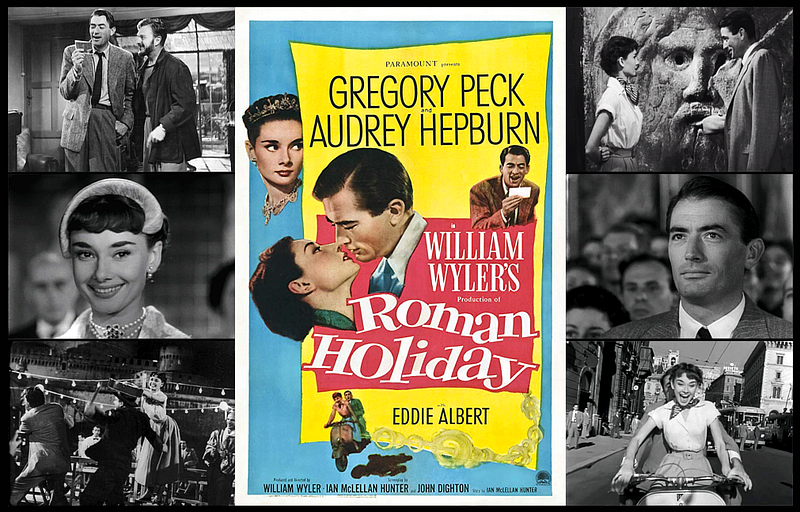
Before I get into this, I want to make mention “A FILM TO REMEMBER” will be a series about films that have reached a milestone anniversary since their origin in being culturally, historically, or aesthetically significant. The articles will contain the film’s plot outline, director, cast, a compilation of trivialities, various photos, movie trailer, critical reception and more. So, let’s start:
We are here to mark the celebration of the 65th Anniversary of William Wyler’s “Roman Holiday”. Let’s take an inside look at the film:
PLOT OUTLINE:
A bored and sheltered princess escapes her guardians and falls in love with an American newsman in Rome as their feelings for each other affect what both decide to do and if there is a future for them together.
STUDIO:
Paramount Pictures
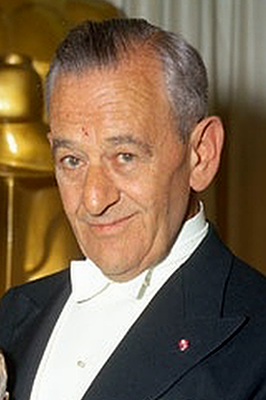
DIRECTOR:
William Wyler
CAST:
Audrey Hepburn … Princess Ann / Anya “Smitty” Smith
Gregory Peck … Joe Bradley
Eddie Albert … Irving Radovich
Hartley Power … Hennessy
Harcourt Williams … Ambassador of Princess Ann’s Country
Margaret Rawlings … Countess Vereberg
Tullio Carminati … General Provno
Paolo Carlini … Mario Delani
Claudio Ermelli … Giovanni
Paola Borboni … Charwoman
Laura Solari … Secretary
Alfredo Rizzo … Taxi Driver
Gorella Gori … Shoe Seller
GENRE(S):
Comedy | Romance
TAGLINE:
Romance in romantic Rome!
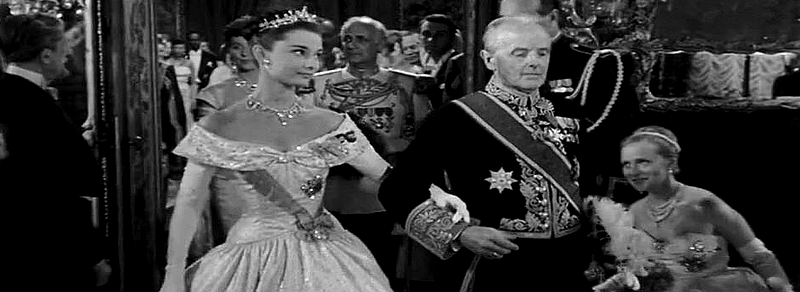
The film is known for being a beautiful snapshot into the past, both for the historic look of Rome and to witness the birth of the romantic comedy genre as director William Wyler displays an expert marksmen who had made “charm” his target with the mix of silly comedy and innocent love turning the viewer into a willing tourist. This eye-filling Romania extravaganzas fairy-tale also marks the American debut of the lively exquisite beguilement of Audrey Hepburn in her star-making performance opposite the charismatically charming Gregory Peck, who revel in their shared duplicity in this sparkling, pleasant and bittersweet, captivating romantic tale with one of the greatest endings in Hollywood’s cinematic history. The film is an original idea by John Dighton and Dalton Trumbo, it was widely acclaimed and has since become a touchstone of its genre in being the quintessential romantic comedy.
Here’s what some of the critical receptions have been for the film over the years:
Variety Staff from Variety says: “[Wyler] times the chuckles with a never-flagging pace, puts heart into the laughs, endows the footage with some boff bits of business and points up some tender, poignant scenes in using the smart script and the cast to the utmost advantage.”
David Parkinson from Empire Magazine says: “Timeless, exuberant classic, with Hepburn’s naïve sense of fun and perfectly charming performance matched equally by Peck’s charismatic worldly American.”
Ty Burr from Boston Globe says: “The film itself is a classic of romantic wish fulfillment, exactly the sort of beautiful lie that Hollywood specialized in.”
Dave Kehr from Chicago Reader says: “Wyler lays out all the elements with care and precision, but the romantic comedy never comes together — its charm by computer.”
TIME Magazine Staff from TIME Magazine says: “Audrey Hepburn gives the popular old romantic nonsense a reality it has seldom had before.”
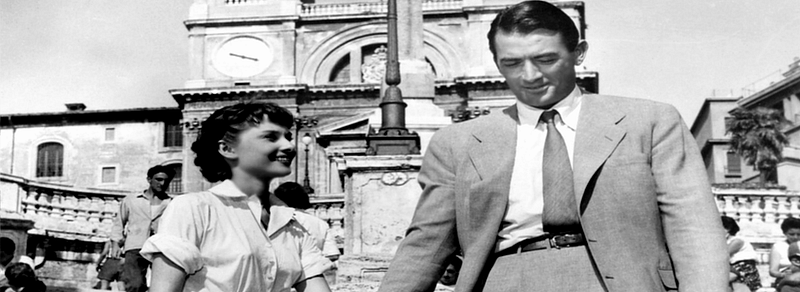
As you can tell by the critical reactions, the film is practically universally acclaimed though a very slight minority felt it doesn’t come fully together feeling it to be charmingly manufactured but nonetheless, it has fashioned a natural, tender and amusing yarn of a delicious romantic comedy. Wyler brings the style and grace of a Roman travelogue with scintillating monochrome images that contain stellar leading performances from Hepburn and Peck who are just magic together in leading to the captivating final moments, remembering that not all fairy-tale romances need to have a happily ever after ending in making it, one of the most moving, unfailingly lovely and memorable romantic comedy films of all-time. But I’ll let you decide…
So, to get a better look at the film, here’s a link to the movie trailer of William Wyler’s “Roman Holiday”:
Here I have provided 12 interesting and intriguing trivia facts (I wanted to keep it limited) about “Roman Holiday”:
- Paramount Pictures originally wanted to shoot the film in Hollywood. William Wyler refused, insisting it must be shot on location. They finally agreed, but with a much lower budget. This meant the film would be in black and white, not the expected Technicolor, and he would need to cast an unknown actress as the Princess, Audrey Hepburn.
- When Gregory Peck came to Italy to shoot the film, he was privately depressed about his recent separation and imminent divorce from his first wife, Greta Kukkonen. However, during the shooting he met and fell in love with a French woman named Veronique Passani. After his divorce, he married Veronique ( Veronique Peck) and they remained together for the rest of his life.
- Wyler had initially considered for his first choices for the part of Princess Ann were Jean Simmons and Suzanne Cloutier. Elizabeth Taylor was also considered for the part. Both Taylor and Simmons had to be immediately ruled out as they were preoccupied with other projects at the time. No word on why Cloutier didn’t take the part. Wyler wanted Jean Simmons to play Princess Ann as that was his top choice, and reportedly nearly canceled the project when Simmons proved unavailable. However, Thorold Dickinson made a screen test with this rather young and unknown actress in Hepburn and sent it to Wyler. Thanks in part to Dickinson (who Wyler would thank in a letter to him), Wyler was very excited in finding Hepburn, but Wyler did not choose her until after a screen test. Hepburn would win the role of Princess Ann thanks to a legendary screen test, although Wyler was not able to stay and film it himself, he instructed the assistant director to ask the cameraman and the sound man to continue recording after the assistant director said, “Cut” so that she would be seen in a relaxed state after having performed a dignified, subdued scene from the film. So, with the screen test footage and the addition several minutes of unrehearsed, spontaneous Hepburn captured on film combined with some candid interview footage, would lead her winning the role. As some of the footage was later included in the original theatrical trailer for the film, along with additional screen test footage showing Hepburn trying on some of Ann’s costumes and even cutting her own hair (referring to a scene in the film).
- In March 25, 1954, Hepburn was so overwhelmed at winning the Academy Award’s “Best Actress” for the film, that she took the wrong route to get to the stage, she accepted the award from the much revered Academy president Jean Hersholt. After accepting the award, Hepburn kissed him smack on the mouth, instead of the cheek, in her excitement and then in her bewilderment gave a breathless speech. Minutes after accepting her award, Hepburn realized that she’d misplaced the trophy and left it in the ladies’ room. She turned quickly on the steps of the Center Theater in New York, racing back to the ladies’ room, retrieved the award, and was ready to pose for photographs.
- Peck’s role was originally written with Cary Grant in mind. Grant, however, turned the role down as he believed he was too old to play Hepburn’s love interest. He did, however, play her onscreen love interest 10 years later in “Charade” (1963). The 2 became firm friends working on that film, and Grant highly considered her 1 of his favorite actresses to work with.
- In the famous “Mouth of Truth” scene, Hepburn’s reaction to Peck’s “bitten-off hand” was genuine. Just before the cameras rolled, Peck quietly told Wyler, the director, that he was going to borrow a gag from comedian Red Skelton, and have his hand hidden up his sleeve when he pulled it out of the sculpture’s mouth. Wyler agreed, but Hepburn was not told. When she saw Peck’s “missing hand,” she let out what she later described as “a good and proper scream.” The scene was filmed in only one take.
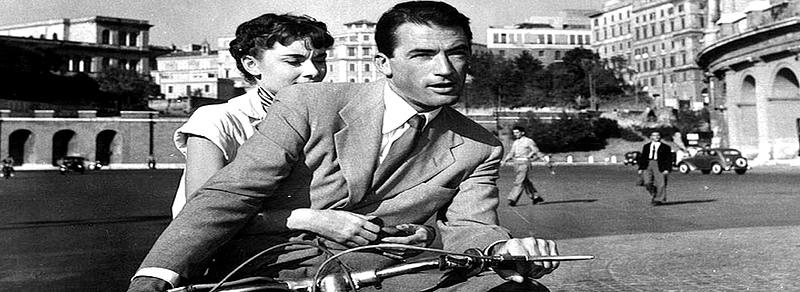
- At the end of production, Paramount Studios presented Hepburn with her entire wardrobe from the film, including hats, shoes, handbags, and jewelry. They were intended as wedding presents. Soon after production, Hepburn ended her engagement to James (later Lord) Hanson, a businessman.
- Hepburn was performing on Broadway in “Ondine” with her future husband Mel Ferrer when she won “Best Actress” for her role in “Roman Holiday”. Later that year, Hepburn would win the Tony Award for her performance in “Ondine,” making her the first ever actress to win both an Oscar and a Tony in the same year and is just 1 of only 2 actresses to do it in the same year. Ellen Burstyn is the other to do it, winning the Oscar for “Alice Doesn’t Live Here Anymore” (1974) and the Tony for “Same Time, Next Year.”
- Peck thought of ad-libbing the scene at the Bocca Della Verita to scare Hepburn. According to legend, it will bite off the hand of those who tell lies. Wyler agreed, and told Peck not to tell Hepburn he was going to do it. Hepburn’s reaction caught on film is spontaneous, and was filmed in one take.
- One of the reasons why Wyler was anxious to film in Europe was because he wanted to put some distance between himself and the House Un-American Activities Committee, which was threatening to embroil him in their investigations because of his liberal stance.
- Hepburn’s casting conflicted with her appearance in the title role of the Broadway production of “Gigi,” for which author Colette personally had picked her, but modern sources note that Wyler delayed production for six months to accommodate her schedule.
- The story was originally optioned by Frank Capra in 1949, who had hoped to cast Cary Grant and Elizabeth Taylor in what would essentially amount to being a variation on his Academy Award-winning classic, “It Happened One Night” (1934). However, Capra’s Liberty Films production company was beset with financial problems and he was forced to sell the property to Paramount, where a combination of political timidity (Capra discovered the involvement of blacklisted writer Dalton Trumbo) and a tight budget prompted him to withdraw from the project. Filmmaker George Stevens was the next director to inherit the project after Capra bailed, but Stevens declined to pursue it. The property was then offered to Wyler, who was coming off the back of 2 very weighty dramatic movies — “The Heiress” (1949) and “Detective Story” (1951) — and was only too glad to tackle a light romantic comedy, his first since the mid 1930s. Wyler had no compunctions whatsoever about working with Trumbo and was also very keen to work abroad in order to exploit a tax loophole.
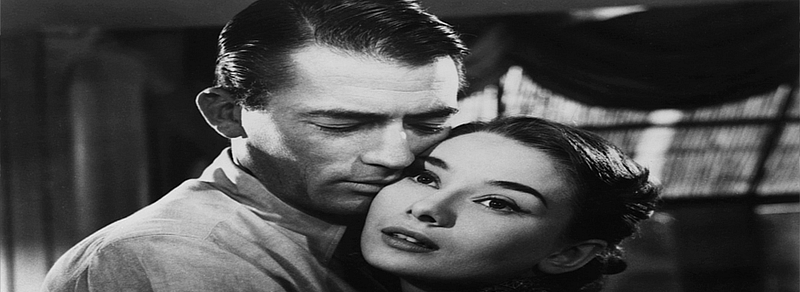
To conclude, William Wyler’s “Roman Holiday” is as welcome as a cooling gelato on a hot summer’s day as it sets the standard for the modern romantic comedy in this lovely, full of fun, beauty and playfulness on the cobbled streets of postwar Europe. William Wyler mixes the rom-com formula of an unlikely couple slowly falling in love with some classical slapstick that turns the viewer into a willing tourist to the splendor of the Italian capital, with stellar performances from Gregory Peck and particularly Audrey Hepburn, who places herself in the pantheon of cinematic icons in giving the customary, nonsensical romanticism, a reality it has rarely had before in this never-to-be-forgotten brief holiday, befitting one of filmdom’s true regal princesses in this timeless, charming, endearing, gamin-like delight of an exuberant romanic comedy landmark.
NOTE: The article contains sources from IMDb and Wikipedia.
Follow me and check out other articles of mine: