
A FILM TO REMEMBER: “RED RIVER” (1948)
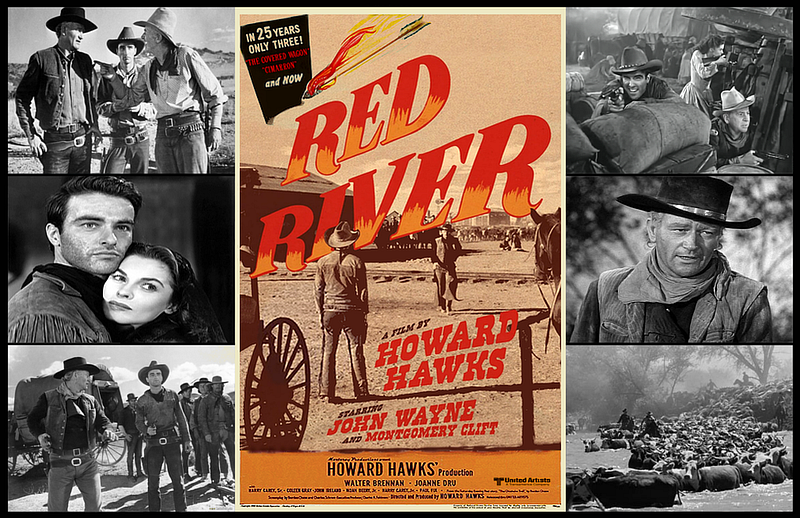
Before I get into this, I want to make mention “A FILM TO REMEMBER” will be a series about films that have reached a milestone anniversary since their origin in being culturally, historically, or aesthetically significant. The articles will contain the film’s plot outline, director, cast, a compilation of trivialities, various photos, movie trailer, critical reception and more. So, let’s start:
We are here to mark the celebration of the 70th Anniversary of Howard Hawks’ “Red River”. Let’s take an inside look at the film:
PLOT OUTLINE:
In 1851, a headstrong frontiersman from Texas leads a cattle drive, the culmination of over 14 years of work, to its destination in Missouri. But his tyrannical behavior along the way causes a mutiny, led by his adopted son.
STUDIO:
United Artists
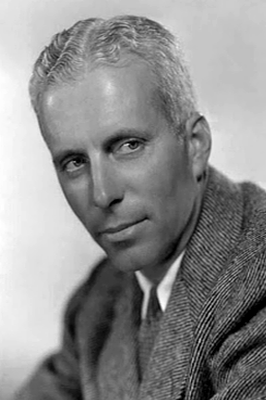
DIRECTOR:
Howard Hawks
CAST:
- John Wayne … Thomas Dunson
- Montgomery Clift … Matthew “Matt” Garth
- Walter Brennan … Nadine Groot
- Joanne Dru … Tess Millay
- Coleen Gray … Fen
- Harry Carey … Mr. Melville
- John Ireland … Cherry Valance
- Noah Beery Jr. … Buster McGee (Dunson Wrangler)
- Harry Carey Jr. … Dan Latimer (Dunson Wrangler)
- Chief Yowlachie … Two Jaw Quo (Dunson Wrangler)
- Paul Fix … Teeler Yacey (Dunson Wrangler)
- Hank Worden … Sims Reeves (Dunson Wrangler)
- Ray Hyke … Walt Jergens (Dunson Wrangler)
- Wally Wales … Old Leather (Dunson Wrangler)
- Mickey Kuhn … Matthew “Matt” Garth — Young
- Robert M. Lopez … Indian
- Shelley Winters … Dance Hall Girl in Wagon Train (uncredited)
- Dan White … Laredo (Dunson Wrangler) (uncredited)
- Tom Tyler … Quitter (Dunson Wrangler) (uncredited)
- Ray Spiker … Wagon Train Member (uncredited)
- Glenn Strange … Naylor (Dunson Wrangler) (uncredited)
- Chief Sky Eagle … Indian Chief (uncredited)
- Ivan Parry … Bunk Kenneally (Dunson Wrangler) (uncredited)
- Lee Phelps … Gambler (uncredited)
- William Self … Sutter (Wounded Wrangler) (uncredited)
- Carl Sepulveda … Cowhand (Dunson Wrangler) (uncredited)
- Pierce Lyden … Colonel’s Trail Boss (uncredited)
- Harry Cording … Gambler (uncredited)
- George Lloyd … Rider with Melville (uncredited)
- Frank Meredith … Train Engineer (uncredited)
- John Merton … Settler (uncredited)
- Jack Montgomery … Drover at Meeting (uncredited)
- Paul Fierro … Fernandez (Dunson Wrangler) (uncredited)
- Richard Farnsworth … Dunston Rider (uncredited)
- Lane Chandler … Colonel (uncredited)
- Davison Clark … Mr. Meeker (uncredited)
- Guy Wilkerson … Pete (Dunson Wrangler) (uncredited)
GENRE(S):
Action | Adventure | Romance | Western
TAGLINE:
Big as the men who faced this challenge! Bold as the women who loved them!
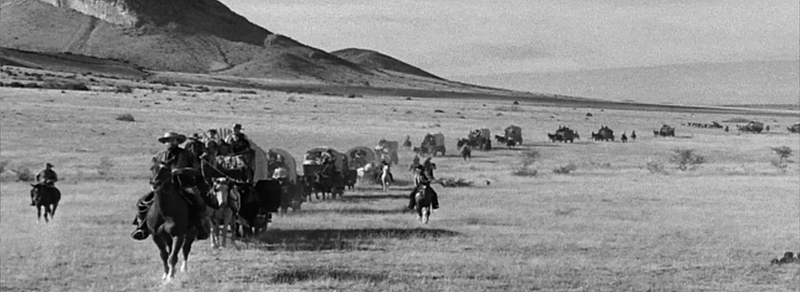
The film is known for being the finest Western film of the 1940s that stages the defining cow opera of a grand, sprawling tale of the civilizing of the West. Director Howard Hawks guides with his typical assurance and seeming lack of fuss with its overall structure and expositional integrity, proceeding via an internal dynamism which favors character over plot concession, letting scenes play out in long takes, and framing the action against vistas with an atmospheric grandeur and a first-string cast of fine performances from John Wayne, Montgomery Clift and Walter Brennan that displays the kinship complexities of the contrasting leadership styles and perception of manhood through the perverse and oppressive forces in showing there are limits decent men won’t cross in this outdoor cattle adventure of a shifted, moral viability and anti-climatic Western classic. The film is based on Borden Chase’s original story which was first serialized in The Saturday Evening Post in 1946 as “Blazing Guns on the Chisholm Trail,” it received overwhelming praise with only slight criticism against it but the film has been relatively deemed as one of the best Western films of all-time.
Here’s what some of the critical receptions have been for the film over the years:
Geoff Andrew from Time Out says: “Immaculately shot by Russell Harlan, perfectly performed by a host of Hawks regulars, and shot through with dark comedy, it’s probably the finest Western of the ‘40s.”
Emanuel Levy from EmanuelLevy.com says: “This brilliant Hawks Western, one of the decade’s best, has been interpreted in different ways, but at its core is the contrast between John Wayne’s and Montgomery Clift’s leadership style and perception of manhood.”
Roger Ebert from Chicago Sun-Times says: “It’s a sign of the movie’s complexity that John Wayne, often typecast, is given a tortured, conflicted character to play.”
TV Guide Staff from TV Guide says: “There have been many classic westerns but this Hawks’ masterpiece certainly ranks among the best of the genre.”
Bosley Crowther from New York Times says: “Even despite a big let-down, which fortunately comes near the end, it stands sixteen hands above the level of routine horse opera these days. So strap on your trusty six-shooters and race to the wind-swept Capitol, you lovers of good old Western fiction.”
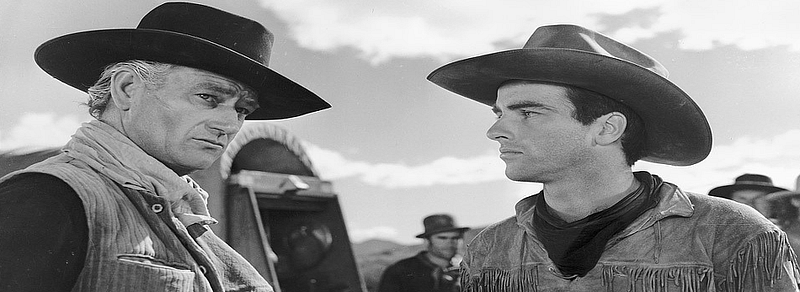
As you can tell by the critical reactions, the film is practically considered a cinematic masterpiece of the western genre, while there is one negligible criticism being in the form of the glamorized female (the character, not the performance), played by Joanne Dru but Hawks pushes to undercut the genre’s own myths, as few are more gorgeously conflicted and have been interpreted in different ways, all the while at its core is the contrasting performances between Wayne and Clift that establish the various complexities of manhood in this rattlingly grand, sweeping, epic cattle driving classic. But I’ll let you decide…
So, to get a better look at the film, here’s a link to the movie trailer of Howard Hawks’ “Red River”:
Here I have provided 12 interesting and intriguing trivia facts (I wanted to keep it limited) about “Red River”:
- Texas Longhorn cattle had been nearly extinct as a breed for about 50 years when this film was made. Only a few dozen animals were available. In the herd scenes most of the cattle are Hereford crosses with the precious Longhorns prominently placed in crucial scenes.
- There was some concern that John Wayne and Montgomery Clift would not get along, since they were diametrically opposed on all political issues, and both were outspoken on their views. Wayne was a staunch Republican while Clift was a stalwart Democrat. According to legend, they agreed not to discuss politics and which led to the filming to go smoothly. However, both Wayne and Walter Brennan still didn’t get along with Clift, and stayed away from the young actor when not shooting. Clift later turned down Dean Martin’s role in “Rio Bravo” (1959) because he did not want to be reunited with Wayne and Brennan.
- The film was shot in 1946 but held up for release for 2 years, in part due to legal issues with Howard Hughes who claimed it was similar to his film, “The Outlaw” (1943). This legal matter would later actually alter what Montgomery Clift’s debut feature film would be, because of the film being shelved for 2 years, Clift’s first film the public would see of him was in “The Search” (1948).
- Filmmaker John Ford after seeing John Wayne’s performance in the film, directed by “rival” filmmaker Howard Hawks, Ford is quoted as saying, “I never knew the big son of a bitch could act.” This led to Ford casting Wayne in more complex, multi-layered, and dramatic roles in films like “She Wore a Yellow Ribbon” (1949), “The Searchers” (1956), and “The Man Who Shot Liberty Valance” (1962).
- Burt Lancaster was offered the Montgomery Clift role by agent Charles K. Feldman, who was trying to sign the former acrobat, but Lancaster had just signed with agent Harold Hecht and so turned down the role to star in “The Killers” (1946), which was Lancaster’s film debut.
- Despite the reputed lack of rain, there were frequent unexpected downpours on location. John Wayne persuaded Howard Hawks to shoot in all weather, and the script was rewritten to accommodate a fierce storm.
- Howard Hawks was distressed by what he considered John Ireland’s unprofessional and lecherous behavior during filming, which were partially due to the actor’s alcoholism. This contributed to Ireland’s part, “Cherry Valance”, being drastically reduced in the finished film. However, others on the film — notably writer Borden Chase — have said that Hawks’ main problem with Ireland was that that they were both competing for the affections of Joanne Dru and Hawks found himself on the losing end (Ireland and Dru were married a year later) and took out his resentment at his loss on Ireland. Hawks later called Chase “an idiot,” a heavy drinker and philanderer who didn’t know what he was talking about, adding that the real reason he cut Ireland’s scenes was because the actor was always getting drunk, stoned on marijuana, and losing his hat and gun.
- Writer Borden Chase readily admitted that the storyline was “Mutiny on the Bounty” (1935) with saddles and stirrups.
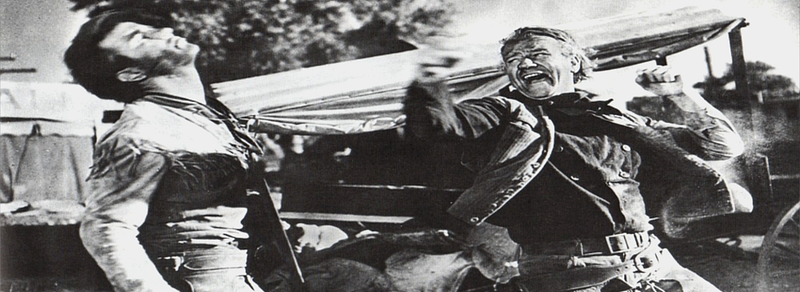
- Montgomery Clift was nervous about standing up to John Wayne but gained confidence when Howard Hawks told him to play his scenes like David against Goliath. He also urged the young actor to underplay in his scenes with Wayne, particularly the scene in which his character challenges Wayne’s character for the first time. Wayne was also not sure Clift could be convincing as a rugged cowboy, but after that first confrontation scene Wayne told Hawks his doubts were gone and “he’s going to be okay.”
- Montgomery Clift didn’t warm to either Howard Hawks, John Wayne or Walter Brennan. Clift did occasionally take part in the nightly poker games that they organized where “they laughed and drank and told dirty jokes and slapped each other on the back. They tried to draw me into their circle but I couldn’t go along with them. The machismo thing repelled me because it seemed so forced and unnecessary”.
- This was the only film in which Harry Carey, Jr appeared with his father Harry Carey, although they have no scenes together.
- Howard Hawks and John Wayne differed on how Wayne would play his aged character. Hawks thought that beyond the added gray hair and wrinkles, Wayne should move and talk differently and suggested he consult Brennan on techniques for appearing old. Wayne found the shuffling and tottering that Brennan suggested to be detrimental to his character and image and played it his own way, “standin’ tall.” Wayne did, however, interject some subtle movements to convey his advanced years, such as reaching out for Montgomery Clift’s assistance in rising to his feet from a crouch. Wayne recalled, “Oh, yeah, Hawks and I had a few fights along the way, but he accepted me as an expert, which I was, and we did not have any more trouble, and I was always happy to work for Hawks.” Hawks though had great respect for Wayne, even though many people didn’t consider him a great actor. “He’s a damn good actor. He does everything, and he makes you believe it,” Hawks later commented.
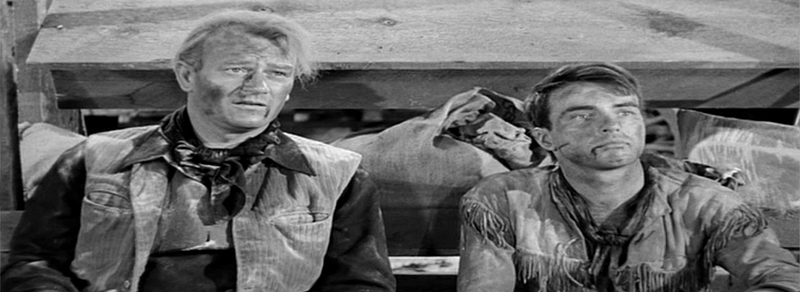
To conclude, Howard Hawks’ “Red River” stages the definitive westward vastness with beautiful, poignant, exciting sequences of stampeding, rough weather, cowboying and Indian skirmishes. Howard Hawks wasn’t only predisposed to experimenting with different narrative models, but preternaturally equipped to do so; his efficient approach to production, stylistic economy, and empathetic sense of psychology would render even the grandest concept or unpleasant characterization approachable in both scale and sympathy. Hawks’ genius to recognize the kindred between his leads of John Wayne and Montgomery Clift, and to understand that the “naturalism” of the Wayne’s persona was as deep and complex as the more intellectualized approach of the neurotic young stage actor, Clift, as its deep entanglement of the physical and emotional conflicts and restlessness of power, that implies a man out of his place. The film is perhaps the foremost example of duality, forging an intimate moral study from the extreme impositions fostered by such an unforgiving environment as the Old West that became a changing moment for Wayne’s career, enabling him to be cast in roles that were more than just macho posturing and gruff heroism in one of the categorical masterpieces of the Western genre.
NOTE: The article contains sources from IMDb and Wikipedia.
Follow me and check out other articles of mine: