
A FILM TO REMEMBER: “PORTRAIT OF JENNIE” (1948)
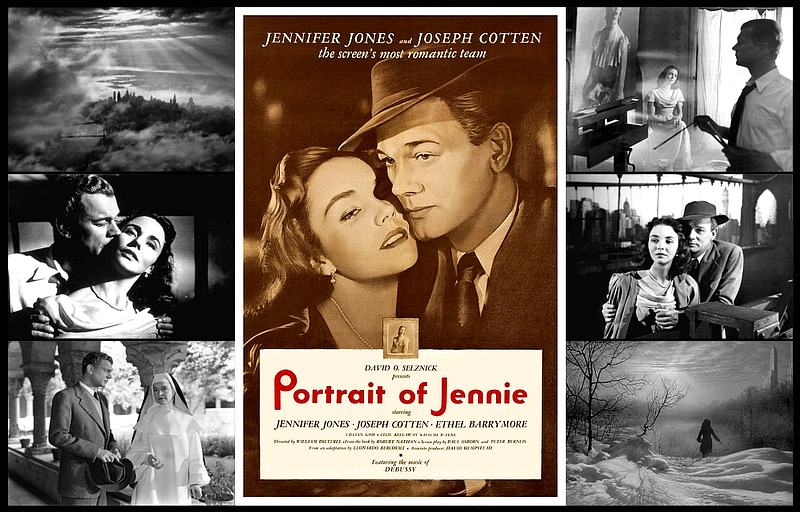
Before I get into this, I want to make mention “A FILM TO REMEMBER” will be a series about films that have reached a milestone anniversary since their origin in being culturally, historically, or aesthetically significant. The articles will contain the film’s plot outline, director, cast, a compilation of trivialities, various photos, movie trailer, critical reception and more. So, let’s start:
We are here to mark the celebration of the 70th Anniversary of William Dieterle’s “Portrait of Jennie”. Let’s take an inside look at the film:
PLOT OUTLINE:
A talented but struggling artist in Depression era New York who has never been able to find inspiration for a painting. One day, after he finally finds someone to buy a painting from him, a pretty but odd young girl appears and strikes up an unusual friendship with him.
STUDIO:
Selznick Releasing Organization
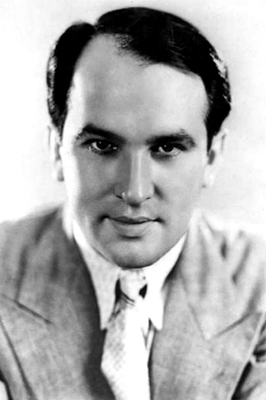
DIRECTOR:
William Dieterle
CAST:
- Jennifer Jones … Jennie Appleton
- Joseph Cotten … Eben Adams
- Ethel Barrymore … Miss Spinney
- Lillian Gish … Mother Mary of Mercy
- Cecil Kellaway … Matthews
- David Wayne … Gus O’Toole
- Albert Sharpe … Moore
- Henry Hull … Eke
- Florence Bates … Mrs. Jekes
- Felix Bressart … Pete
- Clem Bevans … Capt. Cobb
- Maude Simmons … Clara Morgan
- Anne Francis … Teenager in Art Gallery (uncredited)
- Brian Keith … Ice-Skating Extra (uncredited)
- Nancy Olson … Teenager in Art Gallery (uncredited)
GENRE(S):
Drama | Romance | Fantasy | Mystery
TAGLINE:
ARE YOU IN LOVE THIS WEEK? If you are — you’ll get a double thrill from this most romantic of all love stories about a man who was in love with a girl who lived twenty years before his time. If you aren’t — it may change your ideas on the subject for the rest of your life.
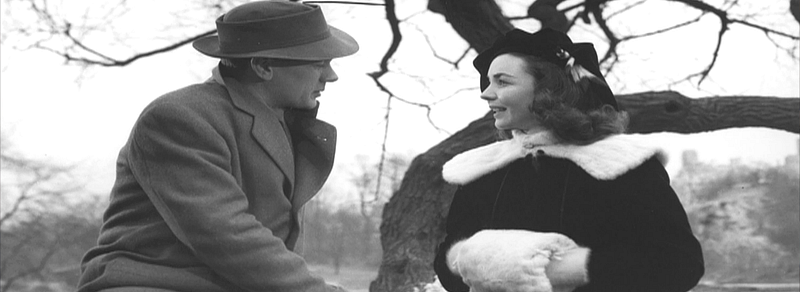
The film is known for being an unabashedly romantic melodrama but also an intriguing ghost narrative that delectably and tirelessly concerns itself with the nature of obsession through a haunting evocation of one man’s pained artistic process in learning to channel his artistic spirit via his paintbrush and the need to transcend the desperation of his loneliness and poverty. The man’s relationship to the womanly phantasm becomes an addiction of sorts and, therefore, an obstacle he must conquer that is repeatedly tested until he can create without the temptation that the apparition comes to represent. As such, the film is a unique testament and tribute to every artist who’s had to brave creative stasis. Director William Dieterle establishes a difficult duality between art and life as he delicately equates the creative impulse to an ever-evolving spiritual crisis with a remarkable use of color complimenting the spiritual evolvement displayed through a first-rate cast of performances imbedded by Jennifer Jones and Joseph Cotton in this wistful, dreamy and metaphorical fantasy classic. The film is based from Robert Nathan’s novel of the same name, it received initially some mixed critical praise but through reappraisal over the course, it’s garnered a positive critical reception as it is considered a magnum opus in the fantasy genre.
Here’s what some of the critical receptions have been for the film over the years:
Ken Hanke from Mountain Xpress (Asheville, NC) says: “William Dieterle’s Portrait of Jennie is quite possibly the most utterly romantic movie ever made. It’s a close-to-perfect blend of stylization and unabashed romance of the fatalist and fantasy kind.”
Variety Staff from Variety says: “‘Portrait of Jennie’ is an unusual screen romance. The story of an ethereal romance between two generations is told with style, taste and dignity. William Dieterle has given the story sensitive direction and his guidance contributes considerably toward the top performances from the meticulously cast players.”
Bosley Crowther from New York Times says: “The fantasy of the relation between the artist and the ghost is far-fetched, and it isn’t improved by the acting of Joseph Cotten and Jennifer Jones in the principal roles, the remaining aspects and actors, including Lillian Gish and David Wayne, are substantially the same as the whole thing, which is deficient and disappointing in the extreme.”
Dennis Schwartz from Ozus’ World Movie Reviews says: “There’s something genuinely beguiling about this innocent love story, the well-meaning New Yorkers who empathize with Joseph Cotten’s artistic plight to be independent and not sell out to join the system, and there’s great fun in the quizzical nature in the encounters between artist and model.”
Pauline Kael from The New Yorker says: “David O. Selznick’s deluxe exercise in mystical romanticism was taken from a Robert Nathan novel. William Dieterle directed, but Selznick poured on the gloppy grandeur-a Dimitri Tiomkin score based on themes from Debussy, an impressively large-scale skating scene, a hyper-dramatic hurricane sequence-and though the story may not make much sense, the pyrotechnics, joined to the dumbfounding silliness, keep one watching.”
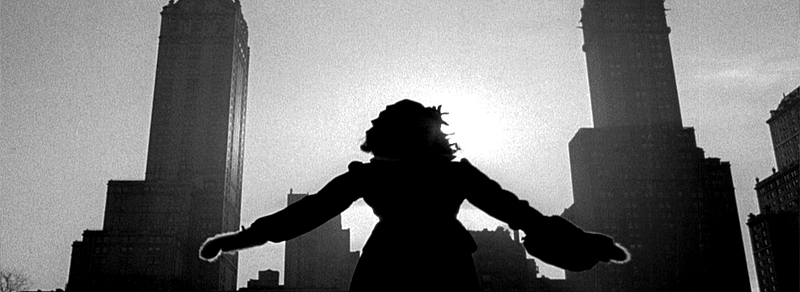
As you can tell by the critical reactions, the film initially got a mixed reaction critically varying from deficient and disappointing to being superb and persuasive but through the years it’s captured a positive reappraisal, as an astonishingly rich and atmospheric film that comes over one like a shroud. Dieterle was a master of sustained mood, of making a film feel like entering a fugue state, but what’s more impressive, however, was how the images worked hand-in-hand with the disparate audio, often seeming to be slightly out-of-sync or to be coming from a different source than the image suggested, to form a cinematic world completely on its own jarring terms that contributes to the top-rate performances of Jennifer Jones and Joseph Cotton in this haunting romanticism of life, death and art of an allegorical paradigm. But I’ll let you decide…
So, to get a better look at the film, here’s a link to the movie trailer of William Dieterle’s “Portrait of Jennie”:
Here I have provided 12 interesting and intriguing trivia facts (I wanted to keep it limited) about “Portrait of Jennie”:
- The Robert Nathan novella on which the film was based first attracted the attention of producer David O. Selznick, who immediately purchased it. Selznick initially considered shooting the film over a period of several years, casting a young actress in the role of Jennie Appleton (played by Jennifer Jones) and shooting portions of the film over time as the actress actually grew older in real life. Shirley Temple, then under contract to Selznick, was reportedly intended for the role, had the film been filmed that way. In the end, however, Selznick abandoned the idea as too risky and difficult to film properly. It shortly became a vehicle for Academy Award winner Jennifer Jones.
- Filming began in early 1947 in New York City and Boston, Massachusetts, but David O. Selznick was unhappy with the results and scheduled re-shoots as well as hiring and firing five different writers before the film was completed in October 1948. The New York shooting enabled Selznick to use Albert Sharpe and David Wayne who were both appearing on stage in “Finian’s Rainbow,” giving an Irish flair to characters and the painting in the bar that was not in Robert Nathan’s novel.
- As the film was a fantasy, David O. Selznick insisted on filming on actual Massachusetts (The Graves Light) and New York City locations (Central Park, The Cloisters, and The Metropolitan Museum of Art) as opposed to studio sets, which dramatically increased the film’s production costs. The film’s major overhaul came when Selznick added a tinted color sequence for the final scenes. The final shot of the painting, appearing just before the credits, was presented in three-strip Technicolor.
- The film was highly unusual for its time in that it had no opening credits as such, except for the Selznick Studio logo. All the other credits appear at the end. Before the film proper begins, the title is announced by the narrator (after delivering a spoken prologue, he says, “And now, ‘Portrait of Jennie’”).
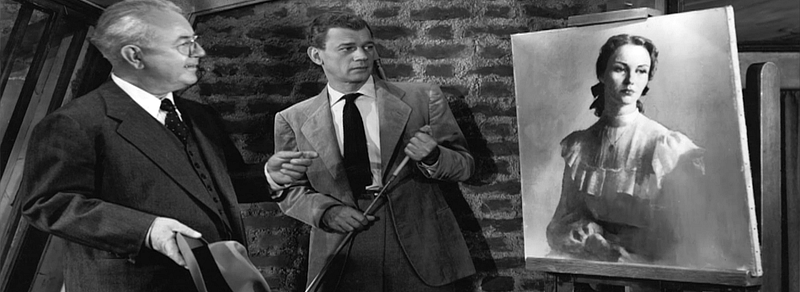
- The portrait of Jennie supposedly painted by the character of Eben Adams (played by Joseph Cotton), was painted by noted portrait artist Robert Brackman. Jennifer Jones came in for more than a dozen sittings in Brackman’s Connecticut studio. Actually, Brackman was obliged to paint, not only one, but two versions as the first one, described as “lush” and “opulent” by the artist, was scrapped after script changes necessitated a completely new and more simple one. A black-and-white photo of the first version can be seen in one of the books on Brackman. The painting became one of David O. Selznick’s prized possessions, and it was displayed in his home after he married Jones in 1949 until his death.
- The film is notable for Joseph H. August’s atmospheric cinematography, capturing the lead character’s obsession with Jennie, amongst the environs of a wintry New York. August shot many of the scenes through a canvas, making the scenes look like actual paintings. August, who used many lenses from silent film days, died shortly after completing the film. August was posthumously nominated for an Academy Award for Best Cinematography.
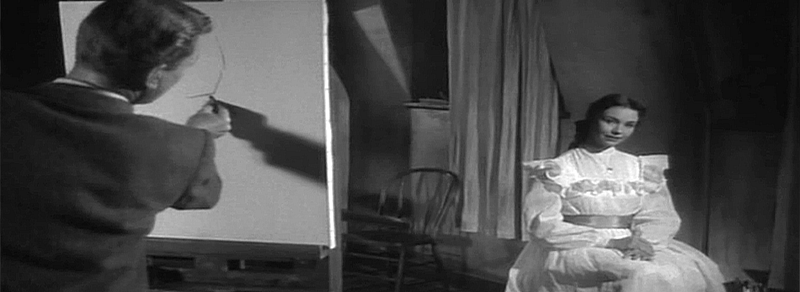
- There were 2 scenes that didn’t make it into the final cut of the film. The first scene was of Jennie and Eben having a picnic after witnessing the ceremony in the convent, features in the original screenplay. It was filmed but deleted when it looked as if Jennie’s hair was blending into the tree next to her. The second scene was one that featured Jennie doing a dance choreographed by Jerome Robbins took over ten days to film, but was not used in the completed film.
- Special effects: Although almost the entire film is in black and white, the tidal wave sequence towards the end is shown in green tint, and the final shot of the completed portrait of Jennie is in full Technicolor. The original theatrical releases in Los Angeles (Carthay Circle Theatre), New York (Rivoli Theatre) and Boston (Esquire & Mayflower Theatres) presented the tidal wave sequence in Magnascope on the Cycloramic screen with Multi-Sound. The Cycloramic screen was claimed to be more reflective than regular screens with no distortion visible from any seat in the theatre, Multi-Sound was an early version of a Surround Sound-type speaker installation.
- Composer Bernard Herrmann was hired to write an original background score and did compose several themes, but due to various production delays as well as the fact that Herrmann was tiring of David O. Selznick’s demands, he dropped out and was replaced by composer Dimitri Tiomkin who, at the insistence of Selznick, ended up using themes by composer Claude Debussy. At the time Tiomkin was condemned by his colleagues for his adaptations. All that remains of Herrmann’s contribution is the haunting song sung by Jennie entitled “Where I Come From, Nobody Knows”.
- In the original novella Jennie was visible to other characters beside Evan. In the film though she was not.
- This film essentially marked the end of David O. Selznick’s career as a powerhouse Hollywood producer, and he often regretted having embarked on the project (although it received many good reviews and has always been popular on television). The film went steeply over budget and its schedule became extremely elongated. Location shooting in New York proved immensely difficult, and Selznick kept insisting on script rewrites, mostly undertaken by himself. He quarreled with many key crew members, even firing his long-time editor and assistant Hal Kern — this was a movie he regretted immediately and ever after. Bernard Herrmann resigned as composer, whilst the cameraman Joe August actually died on the set in September of 1947. There were also many re-takes after the end of the main shooting period and the last shot was taken over a year after August’s death in October of 1948, just a couple of months before the film’s opening. It had actually cost more than Selznick’s most famous film, “Gone with the Wind” (1939), despite being much smaller in scale and less than half the length. It flopped at the box-office, following another expensive Selznick failure, “The Paradine Case”; he was forced to wind up his production company and made only one more film in his life, almost a decade later. This was the remake of “A Farewell To Arms” — another flop.
- After the film flopped at the box-office, the film was re-released under the title “Tidal Wave” in 1950, marketing it to a different audience in the hopes of making a profit. The re-release also flopped.
To conclude, William Dieterle’s “Portrait of Jennie” is mysterious and eerie metaphorical manifest of an engagingly peculiar story that pays profound and careful attention to the creative process in such a spiritual panic. William Dieterle’s direction is sensitive and the sequences are scrupulously constructed, drawing on his experiences in the German expressionist cinema of the 1920s while establishing a dose of artistically textured overlays, an effective musical score, bewitching effects, some tinted scenes, one Technicolor shot and a cast that draws forth stellar performances pillared by Jennifer Jones and Joseph Cotton but perhaps the most remarkable is the way the mise-en-scène and rigorously self-reflexive compositions bring to mind the malleable surface of a canvas as it manages to conjointly turn these rum goings-on into a distinguishably haunting, convincingly infatuating, dramatic fantasy of a cinematic paragon.
NOTE: The article contains sources from IMDb and Wikipedia.
Follow me and check out other articles of mine: