
A Far Smaller Birmingham: Origins
How Birmingham leaders shape and shirk the future
Post #16 of #20: I am reflecting on twenty years of personal and professional experiences in Birmingham and beyond. Visit www.medium.com/HonestlyEd to read the full #20For20 series.
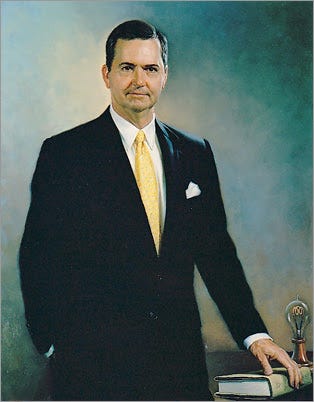
In March 2006, Alabama Power CEO Charles McCrary spoke at a Kiwanis Birmingham meeting to publicly criticize the lack of cooperation between governments and major shareholders in the Birmingham area. He proclaimed to the leaders of Birmingham that, “there will be a far smaller Birmingham to lead unless all of us take action.” His remarks helped propel the merger of the Birmingham Metropolitan Development Board, Birmingham Regional Chamber of Commerce and Region 2020 into the Birmingham Business Alliance. — Wikipedia
I was there.
It was the first (and rare) time I ever heard a major Birmingham CEO personally and publicly thrown down the gauntlet about the future of the City and the corporate community’s role in it. It wasn’t just his words — McCrary’s tone was strong and his energy was felt. Shockwaves of McCrary’s speech were felt for weeks through board rooms, news coverage and water coolers. Elektra could not have forged a stronger lightning bolt. In that moment, he was Zeus.
His speech should have been the status quo — the leader of a vocal and organized corporate community setting a vigorous and visible agenda. Instead, his speech turned out to be a much needed anomaly for our community.
This series will provide both historical and contemporary context for how we got where we are today and what we need to do to take our economic development community to the next level.
Part 1: A Far Smaller Birmingham: Origins
Part 2: A Far Smaller Birmingham: Sankofa (Click here to read)
Part 3: A Far Smaller Birmingham: The Best Version of Ourselves (Click here to read)
The Long and Short History
If you study the long and short history of Birmingham’s business community, it all makes sense.
For instance, by 2006 all five of Birmingham’s major economic development agencies were in or on the cusp of significant leadership transition with three retirement age CEOs at the Metropolitan Development Board (Ted VonCannon), Operation New Birmingham (Mike Calvert) and the Convention and Visitor’s Bureau (Jim Smither). Two younger CEOs leading Region 2020 (Ann Florie) and the Birmingham Regional Chamber of Commerce (David Adkisson) had transitioned out of their roles, in 2004 and 2005, respectively.
In fact, chatter about a possible merger of some or all of these organizations had begun around the time the Chamber CEO, David Adkisson, announced his departure in January 2005.
So, by the time McCrary took the podium at Kiwanis in March 2006, he was effectively giving voice to a sentiment that had been churning below the civic surface . What he said out loud was: “There will be a far smaller Birmingham to lead unless all of us take action.” The truth undergirding his admonition was a timely confluence of leadership transitions that created a generational opportunity to bring our economic development agencies together.
But, that is the short history.
The long history helps us understand why McCrary’s vocal declaration is so significant. For most of the 20th century, major investors and industry leaders in Birmingham had taken a quieter role in some civic affairs. This is not uncommon in many cities, especially in the South.
The South is where economic progress had been simultaneously fueled and impeded by exploitation of labor, class and race issues.
For the better part of 100 years, the City of Birmingham and region served as a national stronghold for racial exclusion and animus of working class people and Black people. At the same time, the reputation of the City was important to the City’s fathers and their descendants.
Thus, they employed avatars at their local chambers of commerce and supported elected officials like Bull Connor to project their version of a positive image of the City while protecting the wealth of the most entrenched business leaders in the city.
Unlike some other cities where major corporate leaders became vocal advocates for progress in the heat of challenging civic debates, many Birmingham business leaders ran the other way.
Instead of getting louder, they got quieter, choosing to work through their hired guns — appointed and elected.
They were on the wrong side of history.
Even when the business community evolved from the 1970s to the 2000s — when the mission was no longer to destroy the working class or advocate for racist policies that excluded a significant number of it’s peak 340,000 residents — the culture of working through their hired CEOs continued.
Let this be a lesson for every emerging corporate and civic leader in Birmingham — your mission, your people and your programs can change across decades, but until you affect the culture you will never rise above the past.
Until you affect the culture you will never rise above the past.
That’s why Charles McCrary’s speech was so significant.
Because Birmingham’s business leaders historically speak through people and not for people. And, because his clarion call for unity was not just about a timely period of leadership transition, it was also an ominous warning with a prescient seed of truth.
A far smaller Birmingham, indeed.
Looking Back to Go Forward
The City of Birmingham lost 100,000 — that’s 30% — of its population from 1960 to 2000. Let that sink in.
There was a palpable tension in the air in the mid-2000s when Birmingham was clearly presenting more potential than paths to actualize that potential.
A burgeoning young professionals and tech scene was rising along with frustrations of corporate leaders seeing peer cities whose growth rates were grossly exceeding Birmingham.
My next posts in this mini-series will include some colorful, behind the scenes stories of my time at the Birmingham Regional Chamber of Commerce, predictions about the future of economic development in Birmingham and why it all matters to the work I am doing to drive the economic agenda of Mayor Randall L. Woodfin.
Ed Fields is a marketer and strategist celebrating 20 years in Birmingham with #20For20 — a series of reflections, insights and homages. All posts are featured at www.medium.com/HonestlyEd. Follow Ed on LinkedIn, Medium, Instagram or Twitter.
Part 1: A Far Smaller Birmingham: Origins Part 2: A Far Smaller Birmingham: Sankofa (Click here to read) Part 3: A Far Smaller Birmingham: The Best Version of Ourselves (Click here to read)


