
A Digital Life
The Role of Apple in Our Lives
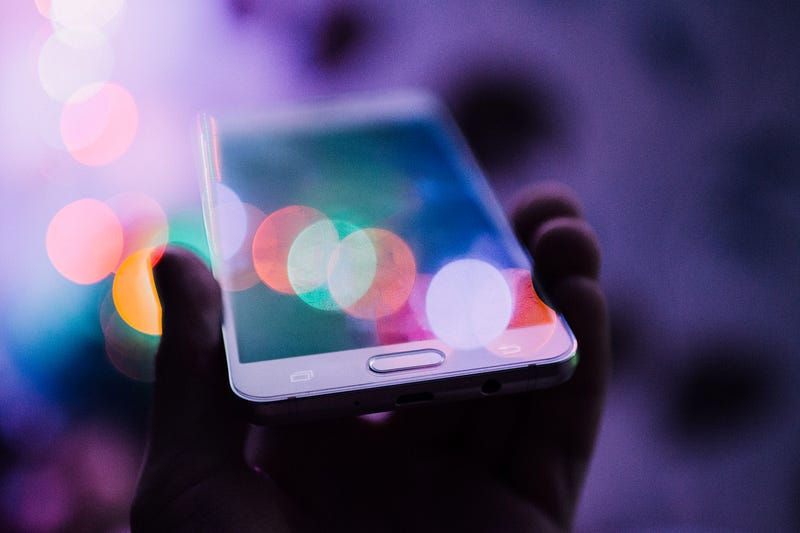
He speaks with punctuated pauses and pronounced gestures as he stands on the stage in a long black T-shirt. He’s wearing a pair of white New Balance sneakers for which he’s rather well known and a pair of jeans that are probably most at home in a 1980s department store. The year is 2007. It isn’t Steve Job’s first presentation, but this is one that’s going to change the world forever.
But he’s used to that by now. He’s already changed the world a few times over. He invented the Macintosh computer and played an instrumental role in the advent of the early internet. He changed what it was to listen to music. He invented the Macbook.
“An iPod, a phone and an internet communicator,” he says as the applications spin dramatically on the screen behind him. But the world of apps isn’t something that the audience is familiar with yet. They ooh and ahh as the colorful icons rotate before them in the crowded auditorium.
He’s practiced this speech a thousand times before. It’s a moment he’s been waiting on for years and there’s a measured gravity embedded within each of his words. It’s a gravity that appears undeniably rehearsed, but the orchestration only seems to heighten the spectacle. He’s had cancer since 2003 and his health has already begun to deteriorate, but his face beams with a divine passion.
“And we are calling it… iPhone,” he continues after another exaggerated pause and a roar of applause. For awhile now, many have suspected that Apple would sink their teeth into the cellphone market, but this is a moment that Jobs wants to get right.
“…and to unlock the phone I just take my finger and slide it across,” he says with calculated simplicity. He understands that this invention is going to change the world in ways that can never be taken back. He’s a pretentious man, but he’s one of the few minds who’s justified in his pretension. Even twenty years ago he’d already earned his place in history.
Sometimes I like to go back and revisit these old keynote addresses that have been sitting around in the forgotten archives of YouTube for the last decade. It fills me with a bittersweet nostalgia. In their muted colors they remind me of the home videos of my childhood. But in a way, to watch the unveiling of these products is to almost relive some of my earliest memories; it’s these presentations that provide the grand context to my life.
In the background of these speeches is a world accelerating at a dizzying pace. If my life is a novel, these Steve Jobs conferences are the foreshadowing in the earliest chapters. The introduction of the iPhone and iPad and iCloud are eery harbingers of our digital existence.
In those advertisements for the early iPods, I see the world of music change. I watch as the plate-sized CD/MP3 players of my Elementary school days are whisked away unceremoniously and replaced by pods with spinning dials. In the introduction of the iMac G3, I see my earliest years. I see the very first time that I interact with a screen. I see my father labor to get the hulking gizmo onto our desk as he talks to a friend of his on a warm October afternoon.
“These Macs are simply beyond belief! It’s incredible to think how many people are starting to have these things in their homes,” he says with a grunt as he waddles clumsily across the room with the lopsided object.
“Ya sure you don’t need any help with that?” his friend asks.
“I’ll be okay,” he says with another pronounced grunt as he rests it down, the legs of the old wooden desk wobbling underneath the weight of the colossal computer. There are beads of sweat dripping down his face now as he proudly examines the clunky contraption sitting atop its shaking pedestal. It’s our first at-home-internet-machine. But we’re still entrenched in the dial up days and Wi-fi is a novelty that hasn’t quite made it into homes yet. So I use the computer mostly to play Spy Fox, Putt Putt, Pajama Sam and Freddie the Fish.
In the announcement of the iPad, I see the future arriving at our doorstep. I see a heavyset woman in a beach chair at my local swimming pool captivated with the device in her hand. I marvel at the glowing tablet as I emerge from the chlorinated water on a sweltering July afternoon. I make my way gingerly toward my towel as I wonder about all that it can do. “Love the Way you Lie” is playing from a nearby speaker as a friend surprises me with an arm on my shoulder. “Did you see that lady had an iPad?” he asks.
But in the unveiling of the iPhone — I see something more. I see the birth of our entire world. I see the moment that the entirety of human knowledge enters our pockets. I see the first kid in my middle school to parade the halls with the high-tech future apparatus in his hands. I watch the way his classmates all revel at the multicolored piece of glimmering aluminum. He shows them how he can use it to play Fruit Ninja and Tiny Wings. Even the nearby onlookers are mesmerized.
In Jobs’ reveal of the iPhone, I see the way that one can turn into a billion. I see the way that these sudden shifts in our world aren’t always easy to recognize for what they are as they occur. I see the way entire paradigms can shift gradually. And I see the way they can shift suddenly.
I understand the way a pair of towers can collapse and change the world forever. I see those first iPhones that begin to checker the halls of my middle school echoed in the later arrival of the coronavirus. I see in January of 2020 as the first college student on my campus walks across the quad in a mask. “I wonder what he’s so paranoid about,” I say to a friend absent-mindedly as we make our way to class.
In this first iPhone presentation, I see an entire world change drastically and irrevocably. I see as home buttons begin reading our finger prints and then as our phones begin to scan our faces. I witness the advent of the AI in our pocket. “Hey Siri, where are my airpods?” I revel in the photography innovations and wallow in the losses in security.
I grow more and more disconcerted with the growing cloud above me. I worry more and more that these digital personas we’ve all spent so much of our lives cultivating could one day just… collapse. I fear that whatever part of me that’s buried within the pictures I’ve taken and the memes that I’ve posted and the songs that I’ve downloaded could one day all evaporate.
We’re digital creatures. We’ve relegated the task of remembering to these machines — these clouds. So now when we’re reminded of things that happened “ten years ago today,” we’re granted spectral glimpses into lost parts of ourselves: the things we said, the videos we captured and the people we were. It’s all just… information. And it hovers around us in a way that very few of us will ever truly understand. But we’re so accustomed to this undying overflow that if it were to ever cease, its absence would be unbearable.
As overwhelming as all of it is, though, it really is remarkable. It isn’t Steve Jobs’ fault that these computing technologies ushered in a digital revolution. It was something that was always bound to happen. We grow from our collective achievements at accelerating rates until suddenly, one day, we’re designing things like computers. A pinnacle point was always a place that we would reach, but now that we’re here — facetiming with people across the globe and knowing everything that there is to know — it’s a lot. These computers are a Pandora’s box whose implications we’ll be dealing with for the rest of our lives.
You know what costs just over 3/5 of a gum ball per day? Supporting the aspiring writer whose article you just finished! Additionally, by the powers vested in me, I’ll grant you unlimited access to the work of all the writers on this platform. All you have to do is sign up through this link here! Can you spare the equivalent of just over 3/5 of one gum ball per day? 🧐