
A Conversation with The Ballad of Buster Scruggs, Pt. 2: “Near Algodones”
Part 1, “The Ballad of Buster Scruggs,” can be found here.
When you’re done with this one, Part 3 (“Meal Ticket) is over here.
Just up yonder a spell, Part 4 (“All Gold Canyon”).
And there on the horizon, Part 5 (“The Gal Who Got Rattled”)
Till we settled down at last for our much-deserved rest with Part 6 (“The Mortal Remains”)
(Make no mistake, friends: The following article is rife with what’s known as “Spoilers,” and will probably be most rewarding to those who are already familiar with this strange and wondrous motion picture. Nonetheless, you’re invited to read it in any event.)
In approaching the richness and ambiguity of the Coen Brothers’ most recent film, the Wild West anthology The Ballad of Buster Scruggs, one is confronted with the question of just how deep to go. The Coens, after all, are masters of the understated reference and the revelatory detail. Paying attention to John Goodman’s eyepatch in O Brother Where Art Thou reveals the fact that the whole movie is in part a retelling of The Odyssey. Goodman’s Walter Sobchek is the key to the Gulf War symbolism of The Big Lebowski (revealed in David Haglund’s insightful analysis on Slate.com), just as his Charlie Meadows gives the biggest tip of the hand toward the WWII symbolism of Barton Fink. Go one step deeper, and you’ll find that Fink is inspired by the 1941 film Sullivan’s Travels, in which a Hollywood Screenwriter struggles against the big studio system in his effort to create a film for and about “the common man.” The title of the film he wants to make? “O Brother, Where Art Thou?” Goodman hasn’t appeared in a Coen film since Inside Llewyn Davis, so where shall we look for the key to Buster Scruggs?
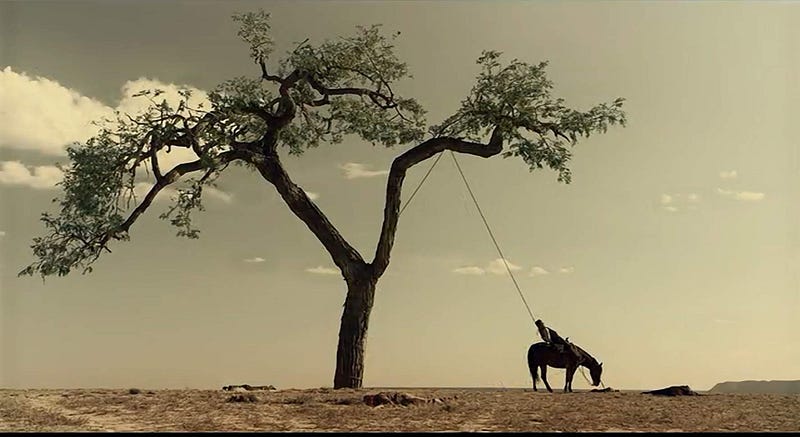
While reviewing Chapter 2 for this article, I found myself attracted to the details of the fictional book of stories that serves as our film’s framing device. The cover is an old dead tree, with the skull of a long-deceased cow at its base. Not just any tree, in fact, but an ideal tree for hanging, its single strong high branch jutting out at a 90-degree angle from its robust trunk. The first thing that happens in the film is that an invisible hand opens this book, revealing an interior cover illustration of a cowboy riding through a cemetery on horseback, the lowered heads of man and steed showing an abiding exhaustion. Death is the theme, and this film does not disappoint. Almost every major character in the film dies; save Tom Waits’ movie-stealing prospector in “All Gold Canyon,” Liam Neeson’s impresario in “Meal Ticket,” Bill Heck’s Billy Knapp in “The Girl Who Got Rattled,” and the mysterious bounty hunters of “The Mortal Remains.” For their part, all but one of those survivors (good old Billy Knapp) are shown to be killers onscreen, and two of them are strongly implied to be some manner of supernatural death angels. Even this considerable body count is dwarfed by the dispassionate massacre of minor players that occupies much of the film’s screen time. This is a movie about death, and a movie about killing, and we’re told this before a single word has been uttered.
It’s also about the related subject of growing old. The titular gunslinger, a living legend, is bested by a younger man called only “The Kid” who sends him off to heaven singing a song about trading his spurs for wings. The hero of Near Algodones is young and strong, but a clever old coot bests him in a gunfight through preparedness and guile. A young man arrives at the end of “All Gold Canyon” to steal the prospector’s gold, but the prospector’s patient and experienced response wins the day. The Impresario, in his twilight years, sacrifices his young compatriot so that he might live more easily. The grizzled old Mr. Arthur uses his cool-headed and methodical know-how to defeat an entire Siuox war party in defense of the young and inexperienced Alice Longabaugh, who gets “rattled” and shoots herself in the head because she thinks he’s going to lose. Last but not least, “The Mortal Remains” features a trio of deeply flawed elderly people debating the film’s big questions as they ride off to Heaven or Hell. It’s a movie about growing old and dying.
Drawn into the book device, I did something that I could not have done before the advent of digital video: I started freezing frames so I could read the paragraphs of text shown at the beginning and end of each chapter while the pages are being turned. It’s said that these were stories the Coen Brothers wrote over the course of 20 years. It’s also true that “All Gold Canyon” and “The Gal Who Got Rattled” are based on stories written by Jack London and Stuart Edward White in the 1900s, and those two segments show the existing opening and closing paragraphs from those authors verbatim. The rest, one presumes, are written by Joel or Ethan Coen.
The first chapter’s opening and closing paragraphs affirm the themes outlined in this article’s predecessor. On the first page, the lethal singing cowboy takes form in an immediate exaggerated defense of his virtuous nature:
“But he had no fear, this lone rider. His name was Buster Scruggs and he himself was feared. Not for any meanness in his heart — no! — but for his skill in the one art that mattered in this territory, that of drawing a side-arm quickly and firing it accurately.”
By the time Buster ascends winged into the big Western sky, a trail of murdered and dismembered bodies behind him and his own brain blown through a hole in his white 10-gallon Stetson, the narrative has tilted. At Buster’s funeral, the preacher remarks on his lifetime of free-wheeling murder:
“We give him to you as he gave you so many. We give him to you, Lord, and humbly ask that you never give him back.”
“As for The Kid,” the written chapter concludes, “he rode the West as Buster had, his exploits and adventures not unlike Buster’s, his songs also the same, his legend too, in time, like-sized. There is another kid out there now, just learning to sing, and sling a gun, and hoping to earn a legend of his own. Perhaps one day he will meet The Kid, and that will be another story — different, yet the same.”
Now, this article in particular is about Chapter 2, and rounding the bend to 1,000 words it’s high time we got into it.
We are left with a sense of thoughtful bemusement as the final page of “The Ballad of Buster Scruggs” is turned. “When a Cowboy Sheds His Spurs for Wings” really is such a lovely song, the accompanying visual a slow and misty Disney dissolve, the preceding 17 minutes of filmmaking so head-shakingly funny and confrontational; one expects another resonant image to be introduced. Perhaps The Kid, or Surly Joe; or some new archetypal figure of the fictive West.
Instead, the opening illustration is of an old man wearing a suit of armor built from lashed-together frying pans. He has a soup pot on his head in place of a helmet, and an old double barreled shotgun in his hands, charging at full speed from the door of a tiny bank toward his unseen foe. The caption: “’Pan-shot!’ cried the old man.”
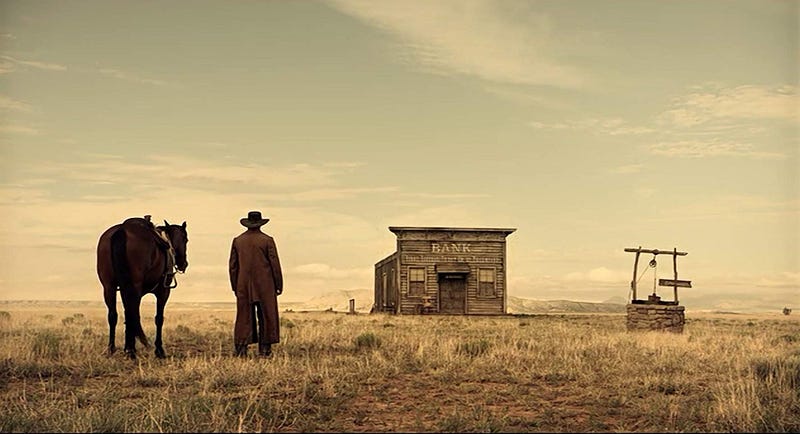
The viewer’s head, shaking still, performs a double-take. It’s remarkable that this image, the pay-off of the first half of the “Near Algodones” vignette and one that you couldn’t have seen coming without a crystal ball, is given up at the very start. This early reveal becomes a part of the joke, eliciting anticipatory chuckles when the grim-faced protagonist is first shown standing silently outside that same tiny bank. First, we’re shown an opening paragraph, a charming prelude explaining how the bank teller and his wife came up with the lengthy and grandiose name of their establishment a little bit at a time. We then proceed to the panoramic outdoor shot of a man and his horse, captured at the Magic Hour, in a classical Western movie location that looks like Utah or Colorado. The stillness stretches out, alternating establishing shots with Sergio Leone close-ups of the Cowboy’s facial tics. Here Chapter 2 differentiates itself from Chapter 1. Instead of a grinning singing Roy Rogers who won’t shut up, we’ve got a squinty Clint Eastwood of little words, dressed in a close imitation of Eastwood’s classic look from The Good, the Bad, and the Ugly (though he’s got on a duster instead of a poncho). The well-bucket rope squeaking in the breeze foreshadows the hangings to come, another reflection of that epochal Spaghetti Western. This Man With no Name (James Franco, whose performance here is an understated gem) is identified in the credits as “Cowboy,” but by the time we meet him he has abandoned that most honorable of Wild West professions in favor of bank robbery. He strides melodramatically through the front door and across the floorboards in an artsy tracking close-up of his boots. It’s Spaghetti Western time.
The bank teller, revealed in a hilariously broad comic performance by Stephen Root, cracks that seriousness wide open. We know, as he prattles on in his friendly Louisiana accent, that before too long this man is going to don a frying pan suit and engage in armed combat. The squinty man isn’t talking, but we suspect he might also not be listening so well as the teller describes his previous altercations in defense of the bank. Once there was a run on the bank, and he had to hop up on the counter with his shot gun and chase everyone off. Another time, a guy tried to rob the bank, and he shot him dead. The next time a robber came around, his legs got all torn up and the teller had to hold him there for days until the Marshall showed up. Instead of heeding these warnings, old squinty is visibly bugged by the loquacious teller, and cuts him off with a drawn pistol. Winding down like an unplugged record player, the barely-audible teller is telling us the ill-fated and leg-shredded robber was named something like “Chivalry? Shiverly?” and that “…his pappy was from France.” What is it with Frenchmen in this movie? Is this Chipolski, or the French gambler, making an appearance in the teller’s memory? (see Pt. 1 and Pt. 6)
The exchange between these two is an inversion of the relationship between Buster Scruggs and Surly Joe or the outlaws at the cantina in Medicine Hat. The Cowboy is the surly one here, grunting two or three words at a time and never cracking a smile; while the teller speaks in elaborate run-on paragraphs, his rosy outlook undimmed by the violence and chaos that he recollects. The clerk is also similar to Buster Scruggs, in that he appears harmless but is in fact a deadly and experienced killer. While Buster relies on his quick draw and infallible aim, the teller survives on his smarts, his preparedness, his experience — he rigged those shotguns and built that frying pan armor long before Franco showed up.
He’s quick to fire those shotguns in sequence, but the robber is quicker as he hops onto and over the counter — youth and virility vs age and trickery. Franco fills a bag with money, runs with all his speed toward his waiting horse, and takes a shot in the leg. Here comes the moment we’ve been waiting for since we saw that opening illustration. I would be remiss not to note that “pan shot” is a piece of filmmaking jargon, meaning a camera shot in which the camera pivots across a horizontal plane. When this occurred to me, I watched the entire chapter again to see if there was any sort of accompanying gag, like that the camera panned every time he yelled “pan shot” or that maybe the entire chapter was done with no pan shots, or with only pan shots. My search revealed nothing like that, but it was worth checking. It’s the Coen Brothers.
Also noteworthy, for those unfamiliar with guns, is that this suit of frying pans wouldn’t do much to keep our virtuous teller safe. Absent a one-in-a-million congruence of angles and velocities, any one of those pistol shots would have knocked him off his feet at the very least, and at the most would have punched right through those frying pans to the soft flesh below. It’s this moment that shows us “Near Algodones” has moved a bit further down a spectrum of Coen Brothers realism than “Buster Scruggs,” but not too far. It bears the most striking resemblance to O Brother and Raising Arizona: the fantasy realism, the bumbling hero with the deadpan face, the life-threatening and violent situations presented as slapstick misadventures. It even looks like those two films, a washed-out color pallet achieved through a combination of the desert locale of the latter film and the digital color correction of the former. It does not, however, sound like those films — this is the only chapter in Buster Scruggs that has no singing, and in fact a barely-existent score of occasional guitar notes against a backdrop of silence and subtle atmospheric sounds.
As the near-giddy teller knocks the robber unconscious with the butt of his shotgun, we wrap up another movement in our conversation with this film. Both men are virtuous in contrasting ways, but the teller’s virtue wins out against the robber’s. The robber is a grim and solitary man of the outdoors, physically formidable, living by his courage and his pistol, direct of speech, young, handsome. On the other hand, he is a thief who seeks to survive by the hard work of others, an arrogant man who underestimates and looks down upon those he perceives to be weaker, a foolish man who ignores clear signs of danger and fails to act in his own best interest. Like Ulysses McGill and H.I. McDunnough, the robber acts tough but falls apart under pressure, his bank robbery scheme dissolving into meaningless chaos as soon as things don’t go as planned, turning his back on an armed opponent and fleeing in panic with a small bag of cash that he almost immediately drops and allows to blow away in the wind. The teller is a contrast in every way: He is exceedingly friendly and warm toward a taciturn stranger, spends his days inside a building behind protective bars, frail and out of shape, making his living by his smarts and his prudent business sense, negotiating violence by means of strategies that Scruggs might call “downright Archimedean,” given to rambling endlessly, old, ugly, an honest and hard-working man, humble and shrewd in his approach to others. In his moment of crisis, he remains cool under pressure and follows his plan by the numbers. Were it not for the opening illustration, the viewer could reasonably assume this stock Western situation would play out as it generally does — the ridiculous elderly bank teller hands over the loot to the steely cowboy robber with shaky hands, and the robber rides off into the wilderness toward his next adventure. This expectation is subverted, and thanks to the illustration we get to watch it coming.
Our robber protagonist is not so lucky. He’s taken completely by surprise, outwitted and unconscious within seconds of drawing his pistol, and wakes up on horseback with a noose around his neck. A fellow strong-and-silent type asks if he has any last words. Surely this is the Marshall whose once-a-week visit to the bank was presaged in the teller’s rambling account of his past escapades, and the robber has been locked up in his concussed and “feverish” state for however long it took for him to get there. Care is taken to portray the Marshall himself as a man of quality, silencing the laughing crowd with a look and then dispassionately explains the robber’s predicament and the proper steps that have been taken while he was out. An informal trial has been convened, he has been found guilty and sentenced to death, which now seems imminent. The Cowboy’s intended last words are the longest statement he utters on camera:
“That pan-covered sumbitch back at the bank don’t hardly fight fair, in my opinion.”
Then, after a brief argument over who gets the robber’s horse after he dies, here come the Comanche. Surely someone has called out this film’s stereotypical portrayal of Native Americans by now, because these are whooping and murderous “Indians” in the Golden Age Hollywood sense. There’s no effort to be historically accurate or portray them as real human characters in the movie. By all appearances, these Comanche’s lives consist of riding around the desert in small groups, attacking and killing everyone they see. Myself, I think that’s all right — this is a cartoon version of the fictive West, and like the teller’s frying pan armor, the Comanche war party is not meant to be realistic. It is a little uncomfortable, and I think that’s OK too. It’s not the grueling racial caricatures of the Coens’ only bad movie, The Ladykillers. It’s OK, but it’s not great. Anyway, the Comanche kill the Marshall and his posse, and leave our protagonist tied up on horseback, still noosed up to that tree.
The man who rescues our hero almost kills him with a series of missed shots, tipping over the flimsy Western film trope (pivotal in TGTB&TU) of an expert marksman shooting through a hangman’s rope from a great distance. He’s introduced in another John Ford establishing shot of a man on a horse against a big sky, showing that he too is a rugged Western type; and we’ll soon find that he too has turned to crime. During their short ride together, our directors circle back around to a few essential themes: The cattle rustler won’t shut up, weaving at great length the fabricated tale of how he came to be riding alone with a herd of cows in the middle of nowhere. Does he spin this yarn to pass the time, or to establish his fake identity with the hope of a real future in cattle? As for the bank robber, he’s no more cheerful now than he was before his rescue. He is a deeply stoic individual. The rustler’s suggestion that our hero might become his sidekick elicits no response. He’s riding next to him, in the direction he’s going, simply because that’s what is taking place. It’s the road his life has taken. He neither wants nor accepts any plan for the future.
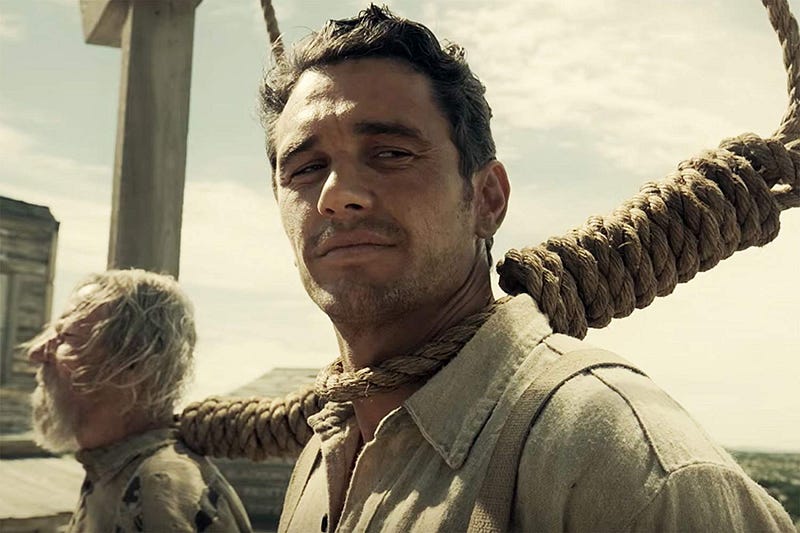
The final movement unfolds in a rapid, inexorable fashion. A second, unrelated posse chases the rustler off and mistakenly arrests the bank robber. He is dragged before a lazy town sheriff who can’t be bothered with any sort of trial — the informal frontier trial of the Marshall and his posse gave our Cowboy more of a fair shake than the so-called justice system of this established town. This dissolute Sheriff sat there on his porch while others went to capture the rustler, and he won’t even listen to what the Cowboy has to say before sending him off to be hanged at the town gallows.
Franco’s facial expression as he receives his second noose of the day is about as complex as a deadpan can be, but the man standing next to him is wailing and sobbing. A mild shift in his squint shows us The Cowboy looks down on his gallows-mate for this undignified emotional outburst, but he’s not mean about it. His unspoken thoughts on their circumstances lighten his own mood, so he shares them with the disconsolate man.
“First time?” is the punchline of “Near Algodones,” set up like a shaggy dog joke which leads to this disarming question. I would wager this moment is the original inspiration for the entire chapter, in fact. The Cowboy seems happier in this moment than he has in any of the preceding scenes. He is amused by the strangeness and silliness of the situation. Caught in freeze frame and only partly legible, the penultimate paragraphs of this written story seem to be talking about the robber’s last thoughts, that it’s about time (or even past time) for the winding journey of his life to end; and how all that is cut short by the snap of the rope. In the filmed version, our doomed antihero is afforded one reprieve before the black bag is placed over his head: He spots a young woman in the crowd assembled to watch him die. By her uniquely pretty face, her prim blue dress, and the vulnerable smitten expression when she notices that he has noticed her; the viewer and the Cowboy get to experience something akin to falling in love. The camera zooms slowly in from below as he drops his tough-guy façade and smiles with open childlike eyes, backlit and ecstatic like Joan of Arc
“There’s a pretty girl.” is all he has to say about that. Then they cover his head, hang him, and we hear the crowd go crazy with applause.
The final paragraph, clearly visible as the page is turned, explains how he and the other hanged men had to be buried in a farmer’s pasture, sold to the county “whose administrators did not care to have the bodies of bad man polluting the municipal cemetery.”
“Near Algodones” is the shortest chapter in The Ballad of Buster Scruggs — around 11 minutes from the wordless opening sequence to the sound of applause over darkness. It’s the least intense, too, and arguably the least engaging. Still, this episode is dense with information and purpose. It’s a shift from the wide-open Joseph Kane singing cowboy style of the 1940s to the tense and morally ambiguous Sergio Leone style of the 1960s, though as with Chapter 1 all the conventions of the genre are overturned like a stone in the forest and examined in all their pestilent complexity. It’s a response to the conversation started in that first chapter; positing some different angles on the debate of youth-vs-age, nice-vs-mean, speech-vs-action, civilization-vs-outlaw, vice-vs-virtue. Above all, this chapter examines a theme that was quieter in its preceding chapter: That we must accept our fate. That there’s no telling where life will take you. No matter how you plan, no matter how things seem to be going, life is a series of unpredictable and oft-ridiculous twists and turns that are completely out of your control. Thus, the best you can do is accept what comes and do your best to survive in the moment; right up to the moment of your death, which you may as well embrace.
The Cowboy’s uncooperative horse, walking away from the hanging tree (our book’s cover image) one step at a time, chasing little tufts of grass to eat while Franco sits helplessly in its saddle saying “whoa” under his breath — is one lighthearted way that we’re directed toward this chapter’s major theme. Shot by the Teller, in desperate need of a heroic equine escape, his horse ignores his calls and turns the other way. His Comanche deus ex machina about to be undone by a heedless steed, all he can do is lean back and try to keep things calm. His hands are tied. He is likewise unperturbed as he prepares to die in the chapter’s final moments. To state that the Teller didn’t fight fair seems to him a better way to spend his expected final breath than to argue for his release or elicit the Marshall’s sympathy, and when he breathes his last later on that day he uses it not to cry but to remark upon a pretty girl. These first two chapters are farces, dark though their sense of humor may be, and deliver conclusions that I personally find comforting and optimistic. Our table is set for a Coen Brothers comedy, but that’s not what comes out of the kitchen for the third course, which I shall write about next.
I just can’t help but dig deep into The Ballad of Buster Scruggs, in my thoughts and upon the page. Hopefully, friends, you’re up for taking this ride with me. Either way, I believe we must (as the French gambler reminds us) play the hand we’re dealt; and I’m holding all Buster Scruggs until the game is through. Watch the horizon for Pt. 3, pardner.