
A Conversation with The Ballad of Buster Scruggs, Part 4: “All Gold Canyon”
You should know that many “spoilers” can be found in this article. My advice is to watch the movie, then come back and read this article, and If you like it then read the rest of the series too.
Here’s Part 1, “The Ballad of Buster Scruggs”
Part 2, “Near Algodones”
Part 3, “Meal Ticket”
Part 5, “The Gal Who Got Rattled”
and Part 6, “The Mortal Remains”
The framing device of the latest Coen Brothers movie is that each of its six episodes is a story in a book of Western adventures. Lore has it Buster Scruggs traces its lineage to a film concept called The Contemplations that the Coens have mentioned in interviews, a book of stories in a dusty old library book. Tim Blake Nelson says he got the script for the first part of the movie in 2002, 16 years before its release, and I’ve read that the stories were written by Joel and Ethan over 20–25 years.
The title pages of the book in the film don’t identify an author, but there is a dedication to Gaylord Gilpin, who would seem by the description to have been a cowboy who told these stories to his fellows around a campfire. This is probably a tribute to Gaylord Dubois, a legendarily prolific contract writer of the 1940s-70s who wrote a passel of Western comic books like Roy Rogers, Gene Autry, Bat Masterson, and The Lone Ranger; and every other kind of pulp hero imaginable, from a long run on Tarzan to several issues of Lassie. He may or may not be the original creator of Turok the Dinosaur Hunter; best known for a series of console video games with cult status, and as a member of the Gold Key stable of comic book characters aligned with Doctor Solar and Magnus, Robot Fighter. He’s said to have written around 3,000 comic book stories in his lifetime, and I can’t find a number anywhere on how many books and short stories he wrote. Some of these were adaptations of famous novels by Mark Twain and Robert Louis Stevenson, some were non-fiction children’s books, some were on biblical themes, and some were originals. Gaylord DuBois was the real deal, and the Coens are the right age and of the right disposition to have seen his name everywhere when they were kids.
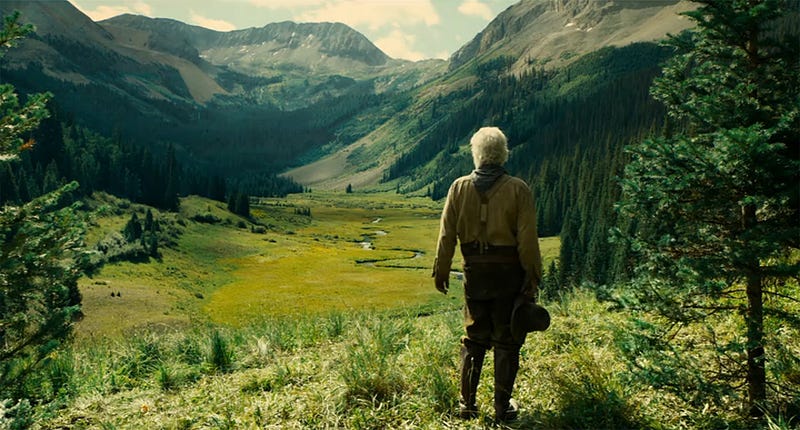
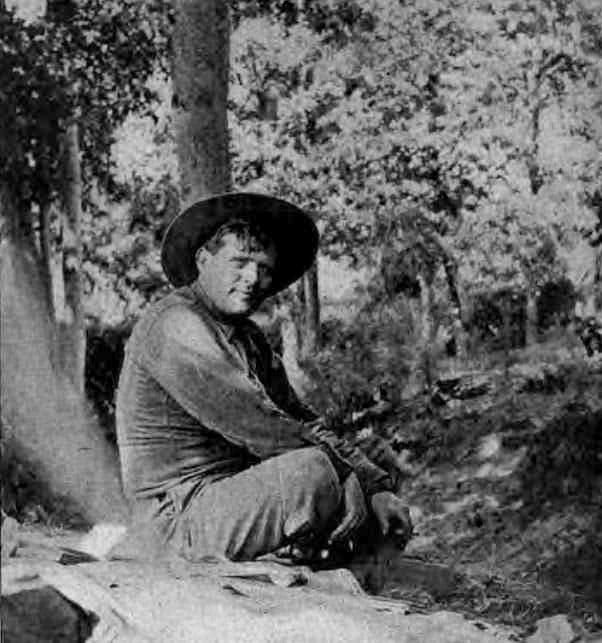
Part 4, “All Gold Canyon,” is in fact based on a story of the same name by Jack London (1876–1916), two-fisted socialist author of The Call of the Wild and just the sort of person Gaylord DuBois would have been hired to adapt. You can read the full text of that story here. London’s own short stories were anthologized in the sort of books I used to see at my grandparents’ house or in my school library, with the illustrated color plates listed by number and protected by onionskin overleafs. Our opening imagie for this chapter is a drawing of Bill as he surveys the picturesque canyon below. That’s his name in the story, anyway — the film credits call him simply “Prospector,” but we’ll use “Bill” in this article because I’m tired of referring the Scruggs characters by their tarot-esque handles (“The Impresario,” “The Kid,” et al.) The caption is straight from London’s original: “And in all that mighty sweep of earth he saw no sign of man or the handiwork of men.”
It’s a remarkably faithful adaptation, from the wry self-narration of Bill the prospector (“You heah me, Mr. Pocket? I’m gwine to get yer as shore as punkins ain’t cauliflowers!”) to the bit where the thief rolls a cigarette and slowly smokes it while watching to see if the back-shot Bill will move. The major theme of London’s story is how the purity of nature is broken and defiled by humankind’s ingenuity, greed, and determination. (“His slow progress was like that of a slug, befouling beauty with a monstrous trail.”) Bill is presented as an impressive and virtuous figure throughout. He’s not a despoiling villain. He is calm, independent, smart, strong, a man of the outdoors. When he needs to be, he is an effective and deadly fighter. He bests that “measly skunk” and gets away with the gold (“Sufferin’ Sardanopolis!… Lumps an’ chunks of it! Lumps an’ chunks of it!”). We love the prospector for all his virtues, and for his irascible and winning personality. The flow of words describing his thoughts and actions, his speaking to inanimate objects, tell a story of solitude — many years alone, doing this, searching for gold in the middle of nowhere. Bill is a highly sympathetic character. Still he is a symbol of the destruction of nature.
The first seven paragraphs of the story are a loving description of the canyon itself, not yet named, in perfect balance and peace — the species of flower and tree, the birds in the bushes, the merry song of the creek, the “red-coated many antlered buck” placidly observing. “It was a spirit of peace that was not of death, but of smooth-pulsing life, of quietude that was not silence, of movement that was not action, of repose that was quick with existence without being violent with struggle and travail. The spirit of the place was the spirit of the peace of the living, somnolent with the easement and content of prosperity, and undisturbed by rumors of far wars.”
This enraptured depiction of the canyon is expressed on screen in a long sequence of stunning nature photography. This episode has a lot of that — it is in part a filmic exercise in capturing beautiful landscape imagery. The opening sequence with the deer and the owl staring each other down over an enormous distance is a masterpiece. If all of this is real footage taken from life, as opposed to digital animation, it might be the finest wildlife footage I’ve ever seen. If it’s animation, which I suspect, then it’s incredible animation. After the harsh Winter of “Meal Ticket,” we’ve arrived in Spring.
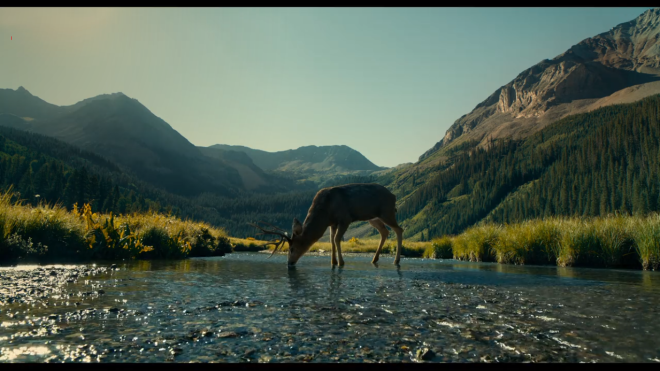
Bill’s arrival is announced by “a steady, monotonous singsong voice” and “the harsh clash of metal upon rock.” The buck snorts and runs away. Here is that reminder of war. The coming of humans, and the discovery of a precious metal buried underneath this sublime majesty, will bring the destruction of it all. This canyon will be a blasted wasteland. The trees will be chopped down and made into buildings. The animals will be killed and eaten. The flowers will be ground beneath bootheels. The very qualities that endear us to Bill, one small noisy mammal scuttling through the perfection of nature, will spell doom for this place — for every place. The Ballad of Busters Scruggs is about death, and London’s story plays the same trick of juxtaposing that grim theme with comedic characters and situations, then dropping brutal violence into the mix when it’s least expected. Jack London lived in the late days of the Wild West, and he wrote about the early days with nostalgia for the murdered frontier as well as the men of the previous generation who lived in the West before the rise of Civilization. Bill is just such a man, and “All Gold Canyon” gives him the sole spotlight as soon as he arrives on the scene. Nature, the star of the first seven paragraphs, is swept aside by his force of character. The eccentricity and audacity of this human and his methodical destruction of the countryside is so remarkable as to eclipse the majesty of nature.
To portray this archetypal figure, both mythic and earthy, our filmmakers chose the great Tom Waits. I can’t think of a Waits appearance on screen that’s anything less than iconic. Old Scratch in The Imaginarium of Doctor Parnassus, the world-weary limo driver in Short Cuts, Renfield in Bram Stoker’s Dracula, the bumbling criminal clown in Down By Law, even as himself in Coffee and Cigarettes — he just doesn’t miss. There aren’t many performers who I care about more than Tom Waits, in fact, who I would cautiously declare my favorite living musical artist after the near-simultaneous deaths of David Bowie and Prince. If you’re not familiar with his music, I would direct you toward a god-damned incredible album called Frank’s Wild Years, which comprises all the best tricks he had figured out by 1987 and is thought by many to comprise some of the finest songs ever written. If you like that one, some other essential Waits records (in my own ranked order of importance) are Bone Machine, Rain Dogs, Small Change, Swordfishtrombone, Blue Valentines, Alice, The Heart of Saturday Night, Blood Money,and The Black Rider. His distinctive music employs ideas from Kurt Weil and Bertoldt Brecht, Louis Armstrong, Harry Partch, Captain Beefheart, Cab Calloway, Townes Van Zant, Laurie Anderson, and Screamin’ Jay Hawkins — cabaret, the blues, old New Orleans jazz, jug bands, musical theater, performance art, gutbucket rock and roll, both country and western before and after their merger. Seeing him here makes me miss him in every other Coen Brothers movie, and I hope they bring him back for more in the future.
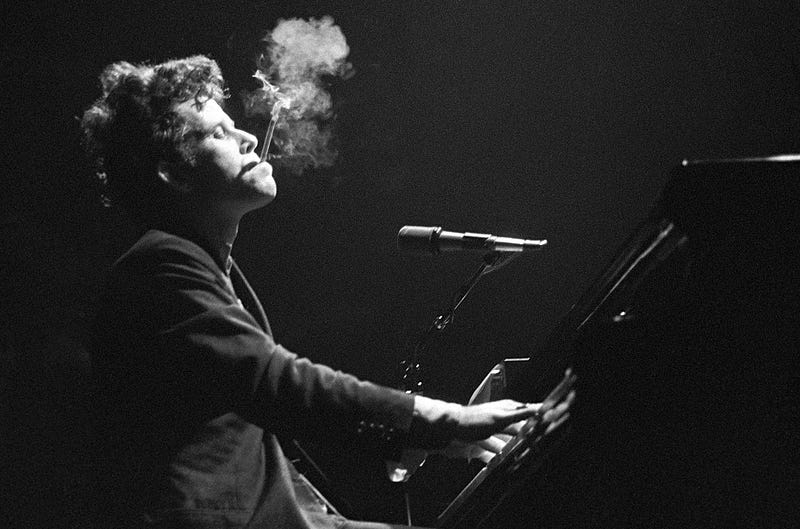
Tom’s iconic roar enters first, singing Mother Machree. It’s a simple song, without much of a subtext or encoded meaning to unravel — he loves his mother. Next comes the man himself, pulling a stubborn old mule in a send-up of the majestic man-on-a-horse shots which open Buster Scruggs’ other five chapters. I remember an interview in which Henry Fonda discusses the delayed reveal of his face in Once Upon a Time in the West, saying something like, “He wanted the audience to say, ‘Holy cow! That’s Henry Fonda!’”
Waits here pays homage to the great grizzled prospectors of cinema, Walter Huston in Treasure of the Sierra Madre and Roy Rogers/John Wayne sidekick Gabby Hayes. If you’re young or don’t know Westerns or whatever, think of Stinky Pete from Toy Story 2. This highly specific character recurs throughout the Western genre — the half-crazy old prospector who speaks in colorful anachronistic slang, gleefully mushmouthed, dancing and fidgeting with gold fever, white mustache and beard, even the white hat is standard. I find myself wondering whether “All Gold Canyon” might have popularized, or even originated, this stock character when it was published in 1906. Jack London was himself drawn to the Klondike Goldrush with his brother-in-law in 1897, and he’s a classic author of goldrush stories whose work was highly successful and popular in his own time. I’d wager that Gabby Hayes et al. were influenced by the character of Bill, directly or indirectly, just as Waits pays tribute to Gabby.
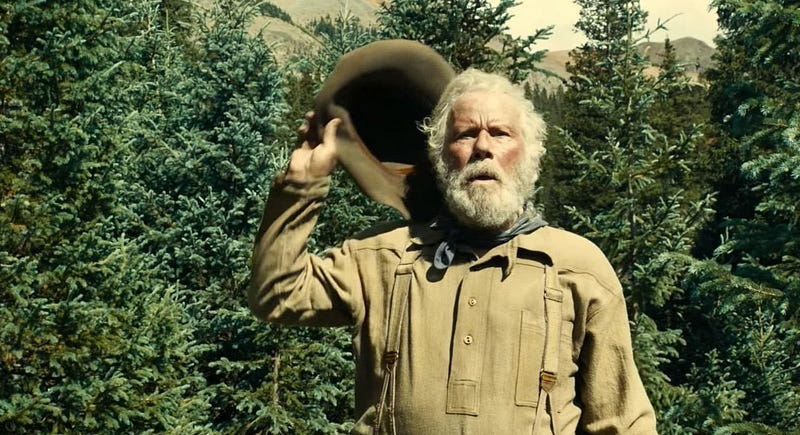
The second act of “All Gold Canyon” is both a continued spotlight on Bill, and a procedural study of gold panning. These sequences immediately reminded me of another Coen Western, No Country For Old Men. Much of that film consisted of tense, paced sequences showing Llewellyn’s cautious and methodical approach to solving problems. Consider the dual scene of he and hit man Anton Chigurh giving themselves medical attention in two different motel rooms, immediately following their gunfight; or his solitary and detailed work in hiding his bag full of money in an air duct. In this same way, Waits and the Coens show in detail how the patient, methodical craft of gold panning exchanges hard work and cleverness for potential great fortune. Panning for gold is something I’ve often heard discussed, but never explained to this extent. Surely Bill has done this many times before, so many times it’s second nature. He has become somewhat of a crackpot recluse, but retains his enthusiasm for the work, though he has not yet found a big enough score to settle down. He needs nothing. When he’s hungry, he fishes a fish out of the river and steals an egg from an owl’s nest (“How high can birds county, anyway?” he jokes in a callback to the previous episode, “Meal Ticket.”) I don’t hold the search for wealth in particularly high esteem, as occupations go, but that changes when portrayed on this microscopic level of one individual going from rags to riches through his own virtuous traits. This again, is the trick that “All Gold Canyon” plays. It shows how Western virtue leads to Western destruction.
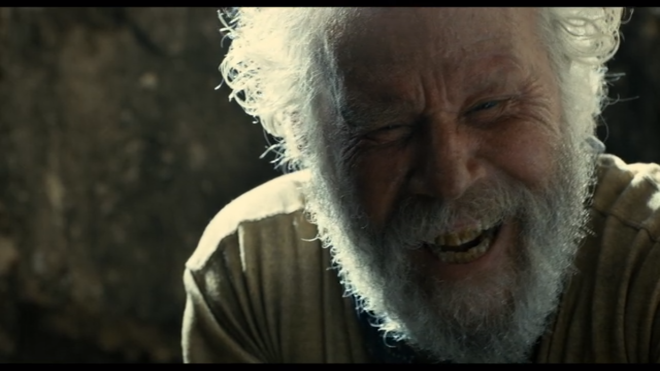
There’s a funny and uncomfortable aspect to writing in such detail about the moral and philosophical themes of what is, on the surface, a light-weight 15-minute comedic romp whose entire plot amounts to, “A crazy old man finds gold.” All of this is there in the film, though, and reading the original story has a way of revealing a proto-environmentalist subtext that’s overshadowed by the outsized Tom Waits performance. This vignette processes also the film’s theme of youth-vs-age. Throughout The Ballad of Buster Scruggs, young people are pitted against old people — Buster vs The Kid, The Cowboy vs The Bank Teller, The Impresario vs The Artist, and now The Prospector vs The Claim Jumper. Since this contest doesn’t get much play in “The Gal Who Got Rattled” or “Mortal Remains,” we’ll have to call it a win for old folks. Winning on the side of youth: The Kid. On the side of old age: The Teller, The Impresario, and Bill the Prospector. These victories are won by pitting the virtues of youth (strength, speed, loyalty, keen eyesight) against the virtues of old age (guile, experience, patience, foresight). The claim jumper who shoots Bill is not virtuous — he would rather hide in the bushes and let the older and smarter man do all the work, then shoot him in the back (itself a serious breach of Western ethics) and steal his gold. He’s clever, tho — he stops and smokes a cigarette to see if the prospector is dead or not, but he gets impatient and jumps down into the hole too soon. The scenario he’s worried about — that Bill is playing possum until he gets close enough to engage in hand-to-hand combat — is precisely what’s happening, but he jumps In anyway. Age and treachery, as an irascible father figure (also named Bill) often told me, beats youth and strength every time.
A brief pitched battle winds up with the younger man dead and Bill finding that “he didn’t hit nothin’ important!” He dresses his wound, packs up his newfound fortune in pure gold, and leads his mule-and-wagon through the treeline and back up the canyonside. In the film as in the story, our final image is of the canyon itself (named by Bill “All Gold Canyon), its mystic tranquility restored until the next skilled and greedy human discovers it.
“The song grew faint and fainter, and through the silence crept back the spirit of the place. The stream once more drowsed and whispered; the hum of the mountain bees rose sleepily. Down through the perfume-weighted air fluttered the snowy fluffs of the cottonwoods. The butterflies drifted in and out among the trees, and over all blazed the quiet sunshine. Only remained the hoof-marks in the meadow and the torn hillside to mark the boisterous trail of the life that had broken the peace of the place and passed on.”
A man I admire very much, the sideshow impresario Todd Robbins (who I’m sure has never murdered his quadriplegic son in favor of a counting chicken) commented on the previous article in this series that The Ballad of Buster Scruggs is a glowing example of a “movie” that exists strictly for fun and entertainment without striving for the deeper meaning of a “film” nor the grand spectacle of a big-budget “motion picture”. To him and to you, I can offer only apologies, because even this lightest of the movie’s six chapters strikes me as part of a complex conversation about Western Virtue, bursting with encoded information. Next, I shall vivisect Chapter 5: “The Gal Who Got Rattled,” the longest and most naturalistic episode. Then it’s “The Mortal Remains,” which brings all the ideas which have come before into a literal conversation in a stagecoach bound for Purgatory. Then I’ll just have to find something else to write about, I suppose. See ya next time!

📝 Read this story later in Journal.
🎨 Wake up every Sunday morning to the week’s most noteworthy stories in The Arts waiting in your inbox. Read the Noteworthy in The Arts newsletter.


