
The Black painter who dreamed a non-white Jesus
Henry Ossawa Tanner reimagined the Bible
A Black painter moved to Paris in 1891, and devoted his life to illustrating the Bible. Henry Ossawa Tanner is Christian legend that Christians wouldn’t know.
To art history, is a major painter and the first famous Black painter. He died in 1937, but his project grows more interesting all the time. He worked to strip ‘whiteness’ out of the Bible.
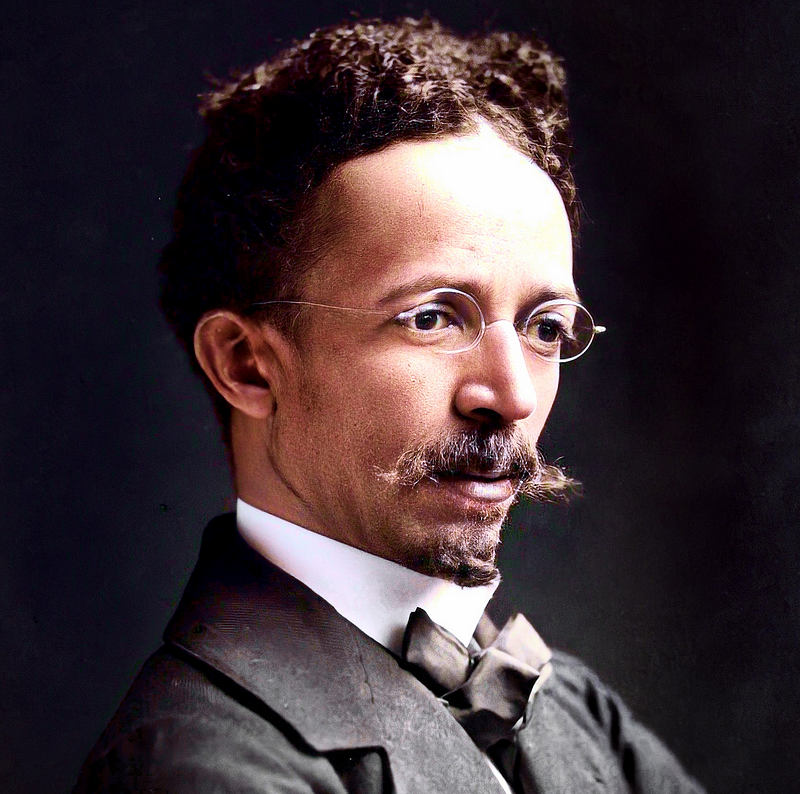
I’m taking a look at his religious works.
This is an unusual study as Tanner has been largely ignored by Christian commentators. He would be noted, certainly, to have portrayed a Jesus who, startlingly, wasn’t somehow looking like a Italian aristocrat.
This messiah was…a Palestinian man.
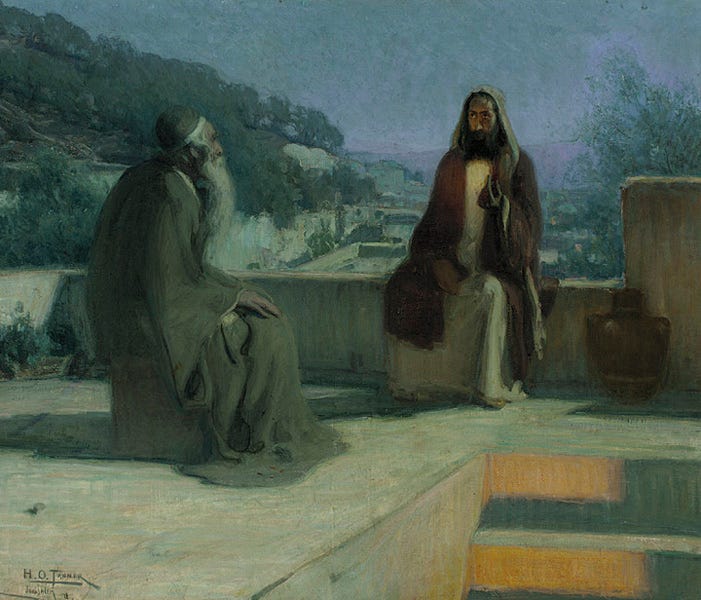
He wanted to paint the Bible in a different way.
His first idea was to make the scriptures more lifelike and more artistic, as new theological ideas accumulated along the way.
His foundational ideas was that ‘Christian’ art as it had come to be done had lost its way completely. “Religious art has come to mean an uninteresting, inartistic production,” as he wrote.
His art was a religious mission.
The son of a bishop in the African Methodist Episcopal Church, Tanner saw his work as to “preach with my brush.” Among his papers was a list of his daily affirmations:
“I invited the Christ spirit to manifest in me” “I follow the star (high ideal) that leads me to the Christ.”
He first registered on the art scene in 1896 with an image of Daniel in the lion’s den. The prophet is in shackles, a detail not found in the biblical story. The imagery may rely on slavery in America.
The ‘lions’ might then be Christians.
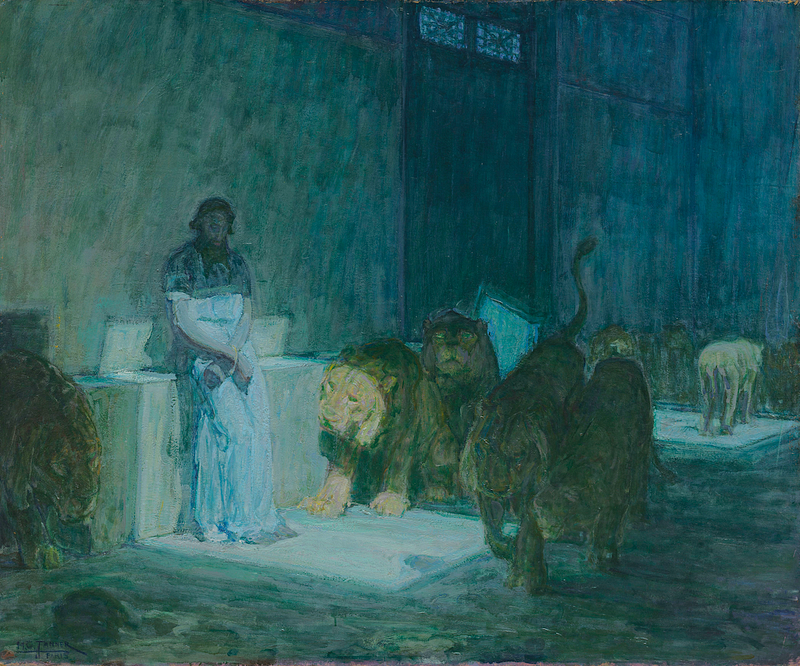
He painted a range of Old Testament scenes.
They were selected, it seems, to tell his personal history and also the Christian story. He’d managed some formal training in painting, then left America for Paris, he’d say, since he felt he couldn’t “fight discrimination and paint at the same time.”
He painted Sodom and Gomorrah a few times. The biblical story becomes a vision of exile. Heading to Europe, Tanner left the burning city that he saw as America.
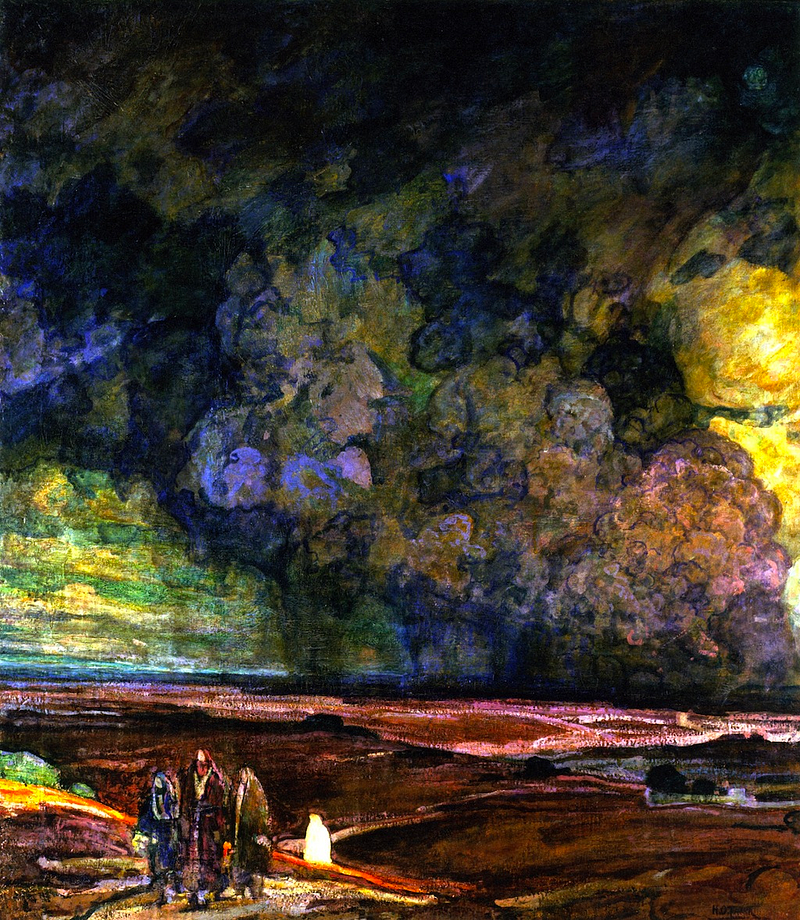
But a divine light enters the world.
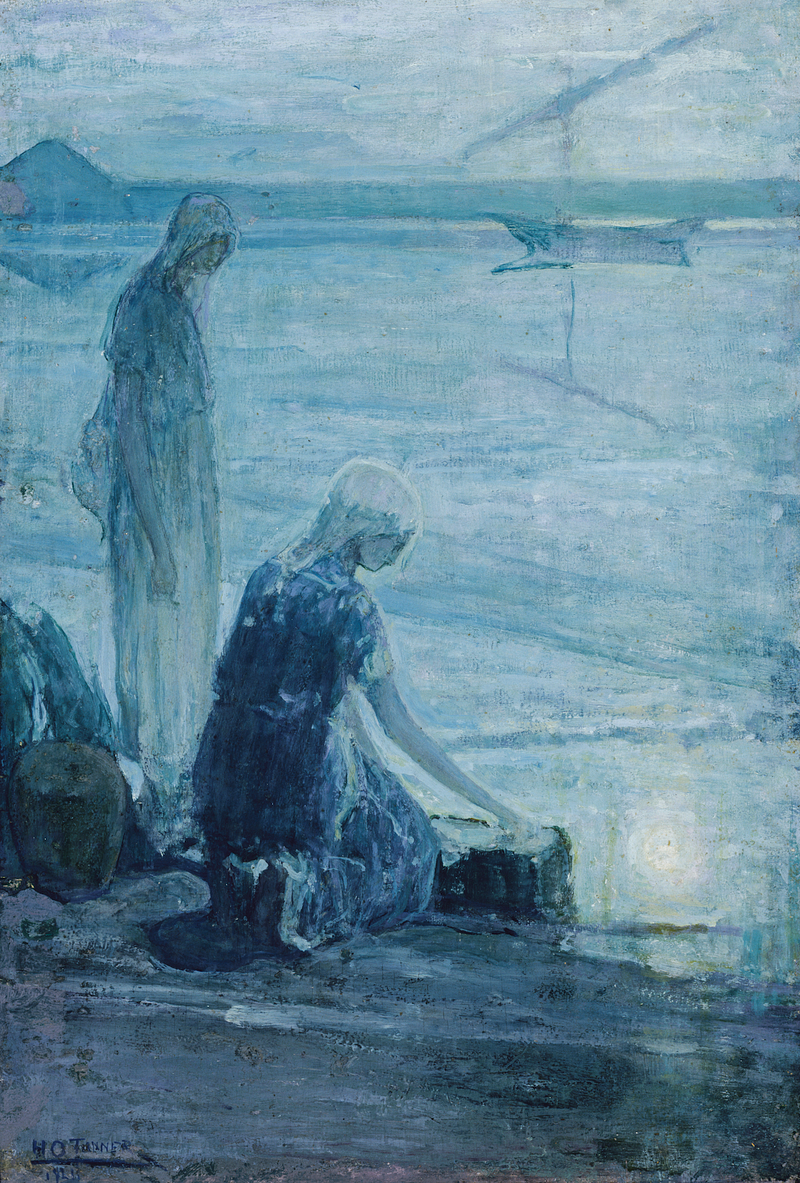
To ‘read’ a Tanner painting is to follow the emergence and flow of light. When Moses is found as a baby, there is a light on the water near the child in the basket. Is the moon’s reflection? Maybe not.
As often in Tanner’s biblical paintings, women are key figures.
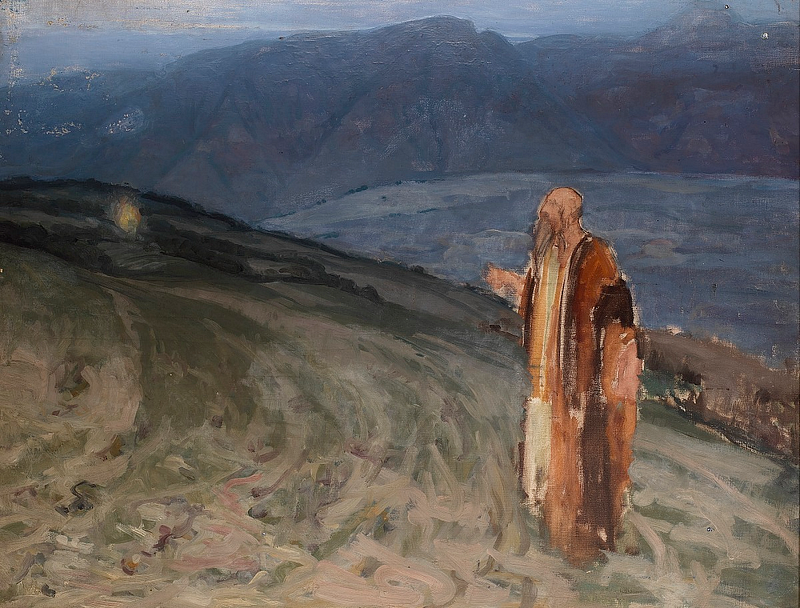
As he ascends the mountain, Moses sees a light that now has no natural status. It is a divine event.
He reaches toward it?
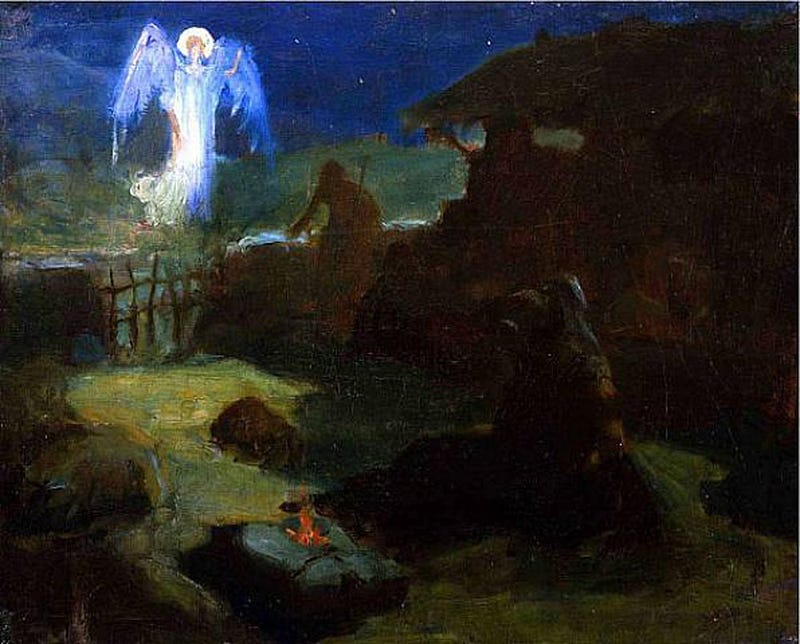
As the Jesus story begins, an angelic being appears.
Tanner did many versions of these same, as he thought and re-thought the artistic and theological terms. At first he saw angels as typically Christian forms, winged, with a halo.
And white?
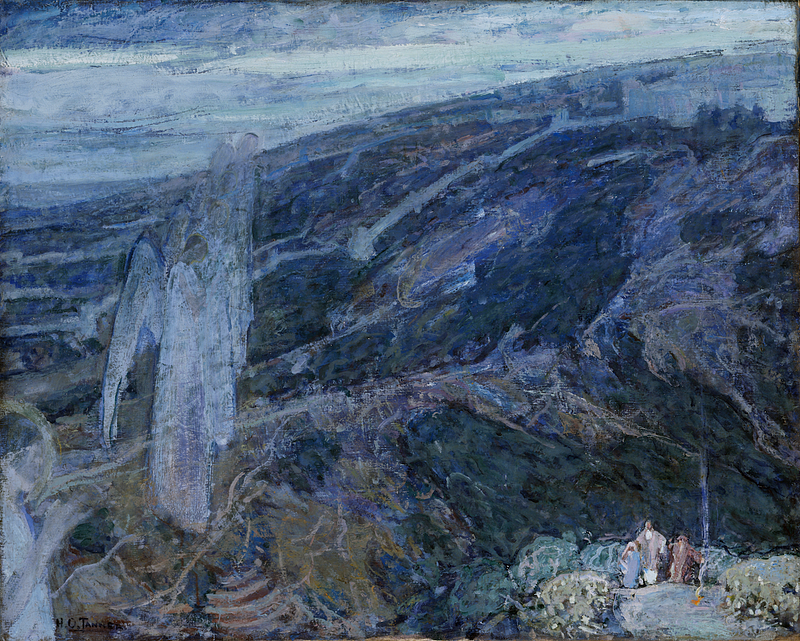
A version fifteen years later, Angels Appearing before the Shepherds, has the angel as a presence hovering above the earth—approaching the quality of a cloud.
Tanner lavished extreme interest in the scene of the angel visiting Mary.
His most famous painting might be The Annunciation in 1898. Here the young woman, in the gospel story, speaks with the angel who tells her she’s to receive the messiah.
But Tanner’s vision of the scene is different. His angel here is a bright line of energy. The scholar Hélène Valance suspects an influence from Nikola Tesla, whom Tanner may have met.
I’m perplexed by the expression on Mary’s face, which seems at some disconnect from the light—as if she can’t see it?
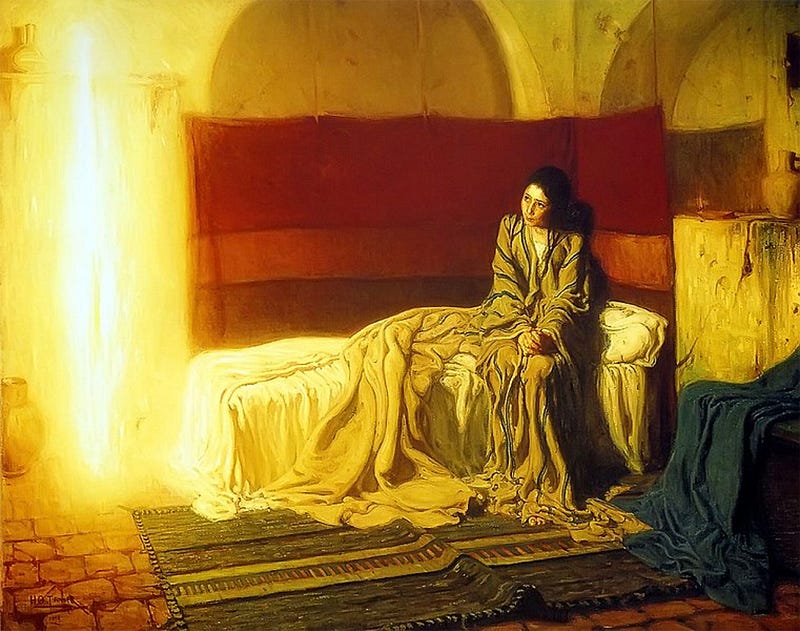
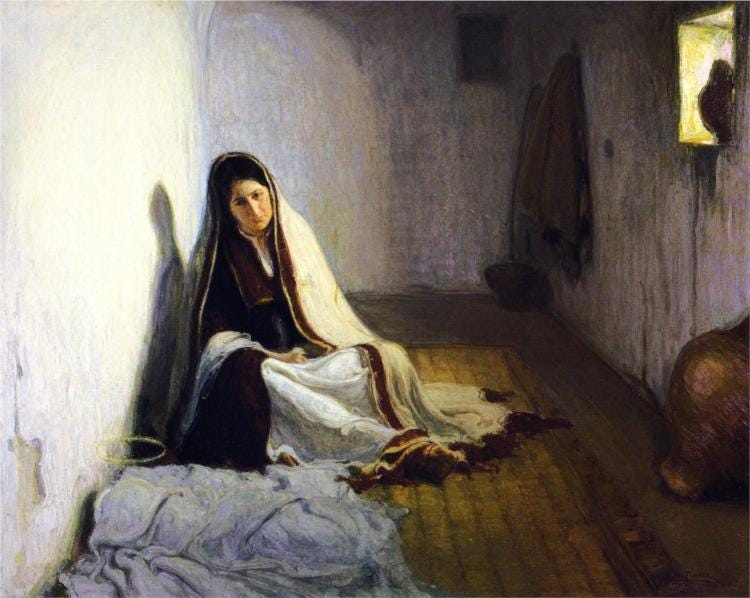
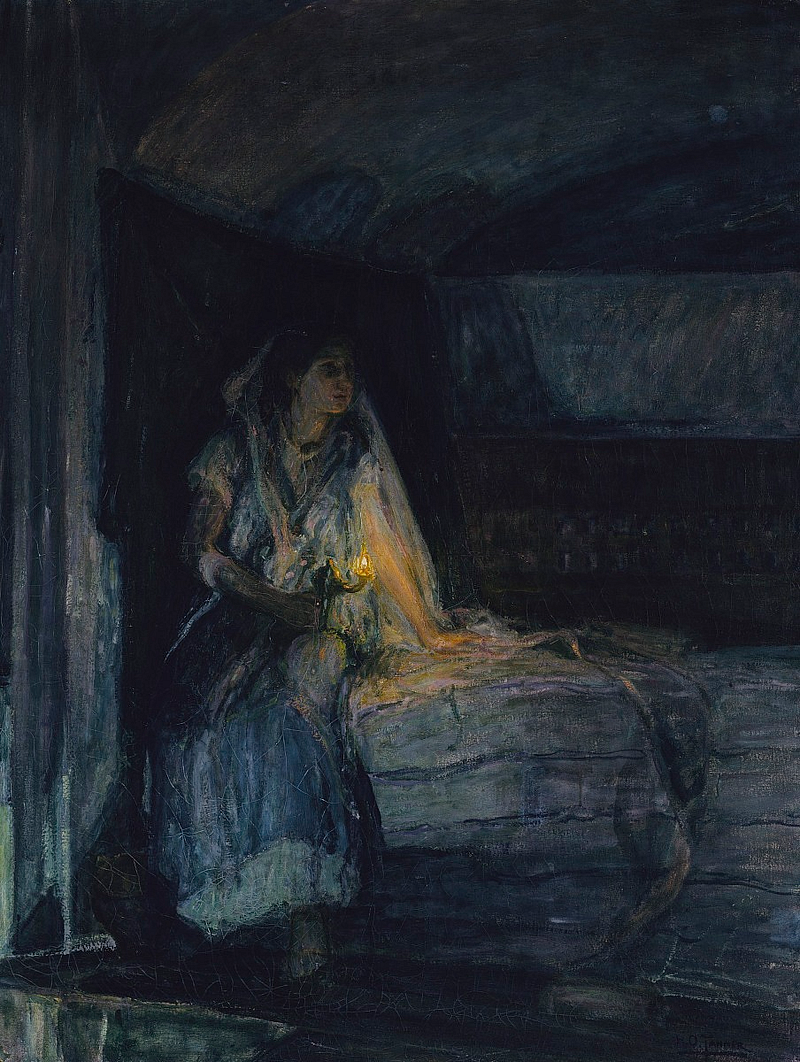
Tanner did several versions of the scene.
They are eerie, as if to further suggest Mary is unaware of her divine status and cannot perceive the angel.
Tanner’s Mary is a woman who is illuminated but seems unable to see.
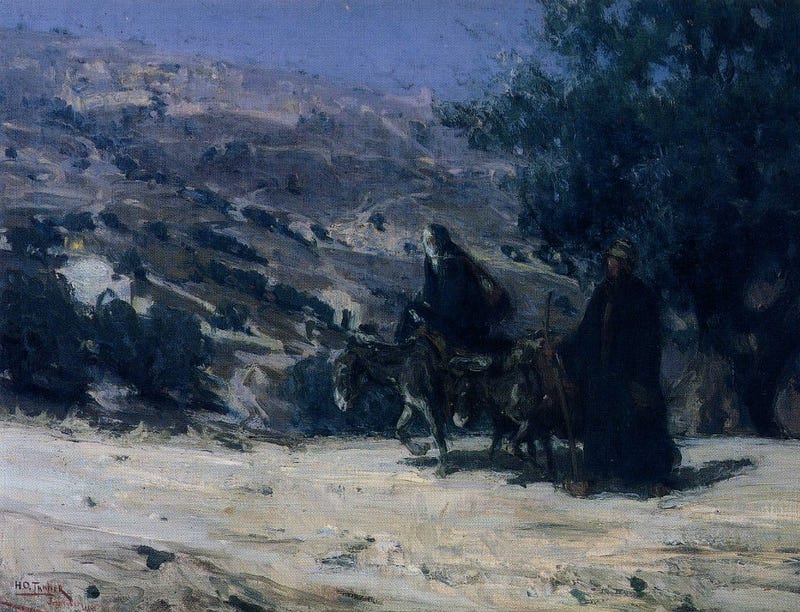
Tanner did many versions of the ‘flight into Egypt’.
Mary and Joseph are typically seen traveling. They are dark figures, without any illumination. There is no light. For Tanner, it seems, neither parent has any divine illumination.
The power that Jesus has is coming from his own being and from God. It will not owe to these humans who bring him into the world.
At times, Tanner’s Jesus seems white.
But there is some autobiography mixed in that complicates this reading. Take his well-known 1908 work, Christ and His Mother Studying the Scriptures. He’d used his wife and son as models.
Tanner had noted “my blond curly-headed little boy” would be viewed in America as ‘Negro’ owing to his father’s race.
This blond-haired boy is a Black Jesus.
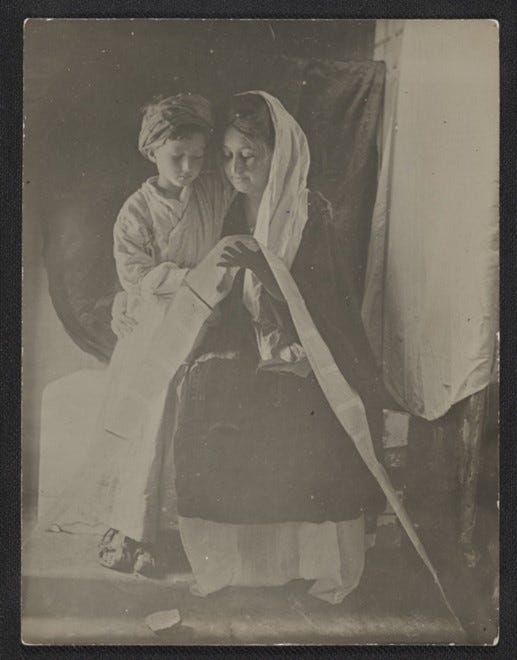
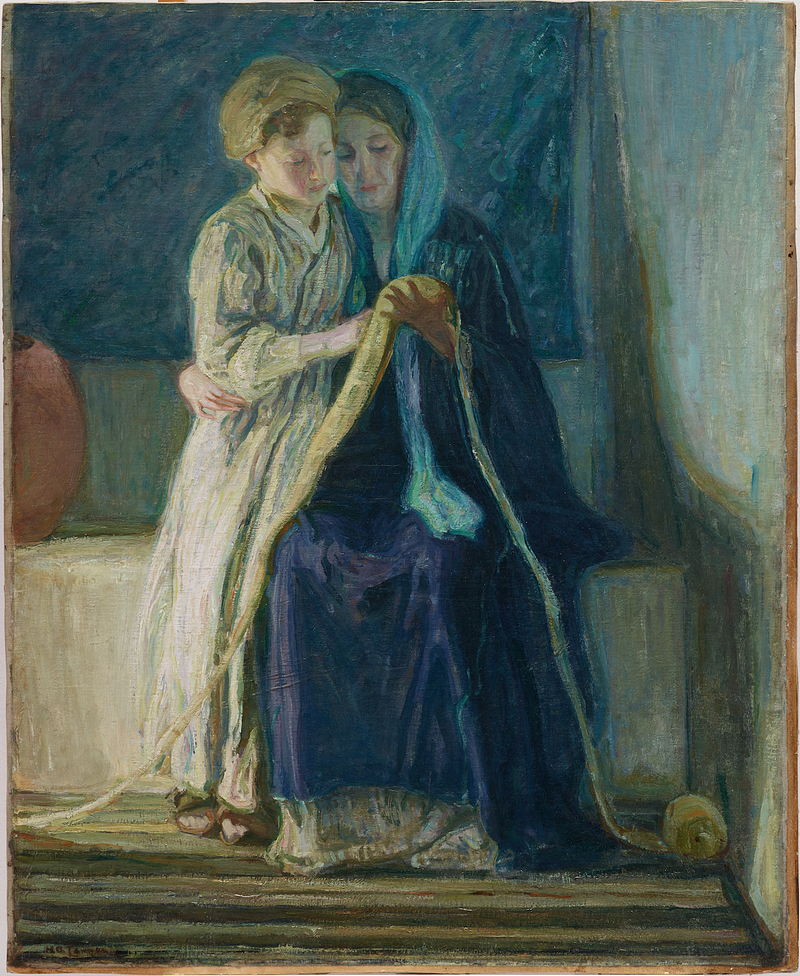
To ‘read’ a painting by Tanner is to have earlier paintings in mind.
Here is Rembrandt’s version of the raising of Lazarus.
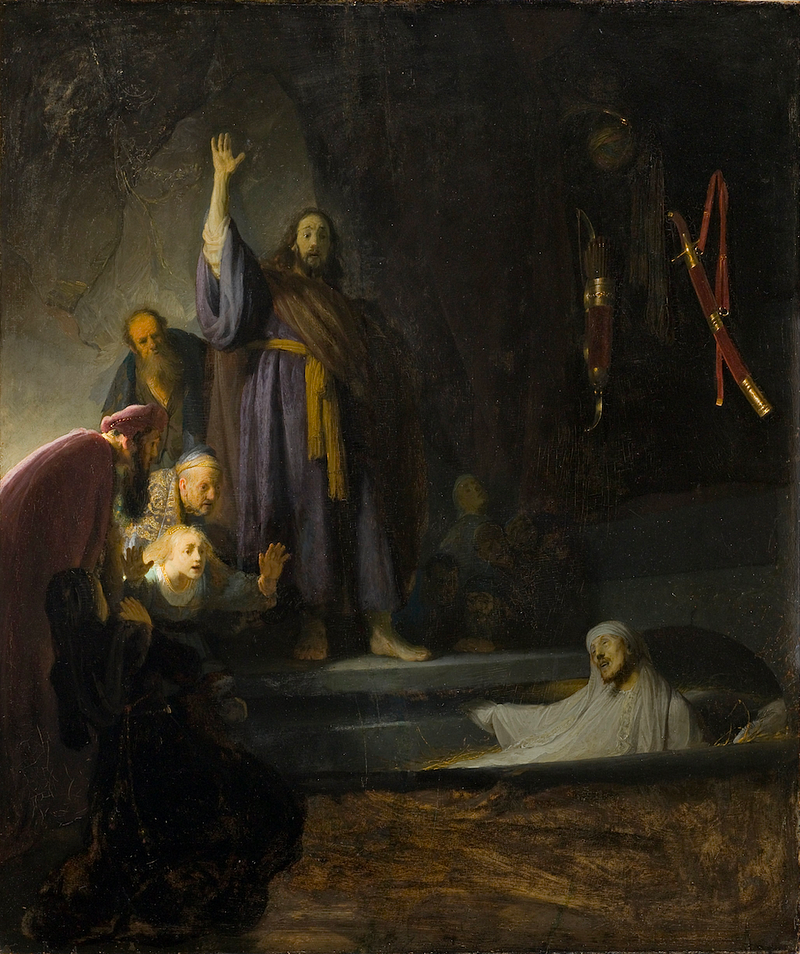
In Tanner’s version of the scene, The Resurrection of Lazarus from 1896, a Palestinian Jesus stands amid a distinctly multi-racial crowd.
There are no wild gestures or emotions or theatricality. The scene is lifelike. We are almost standing among them.
Tanner’s messiah is serene. This is a teacher of eternal life.
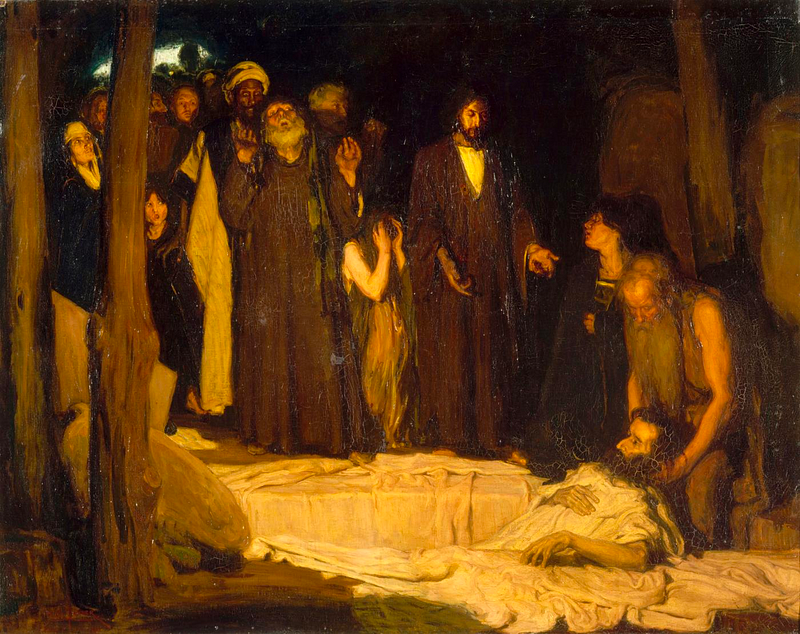
Tanner’s Jesus can seem like a dream-like being.
Tanner often painted images of the ‘Good Shepherd’, an image of Jesus from John 10. He’s the shepherd out looking for the lost sheep, lit by moonlight as he travels the dark world.
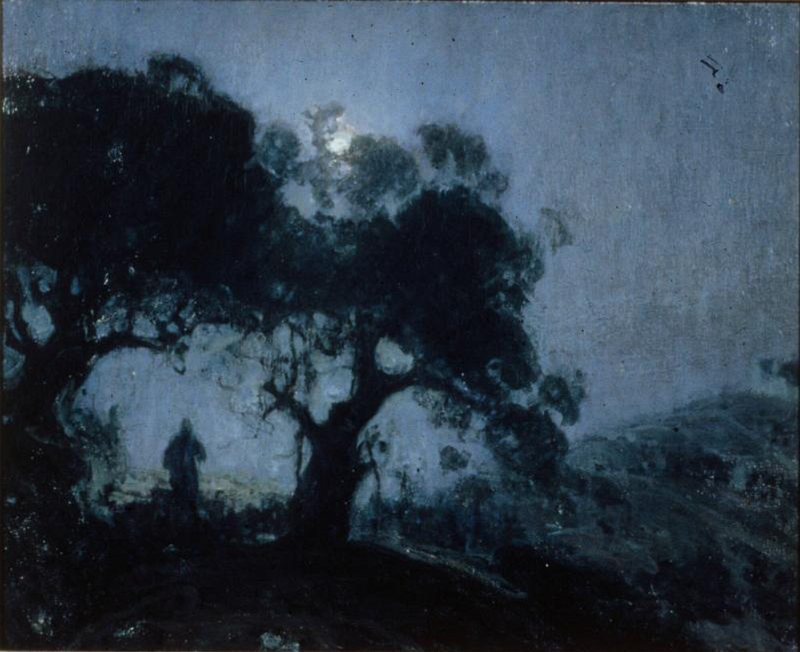
He’d cast the figure of the Good Shepherd into many landscapes—like the Atlas Mountains in Morocco after he visited.
The Good Shepherd is zen-like in his tininess against the vast landscape.
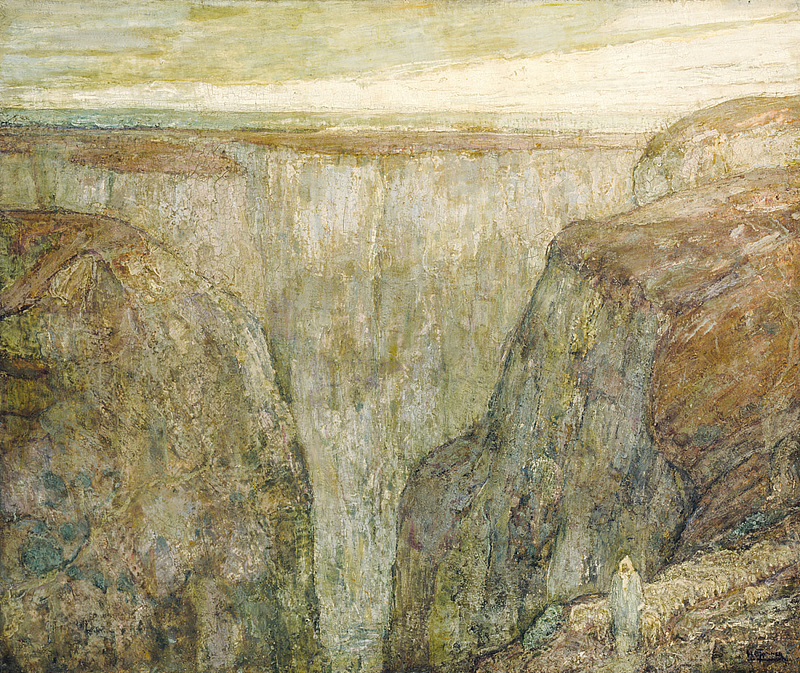
Jesus is often lit by a strange light.
In a world that is eerily dark, the messiah brings his own illumination, as humans are now seen—and also their shadows.
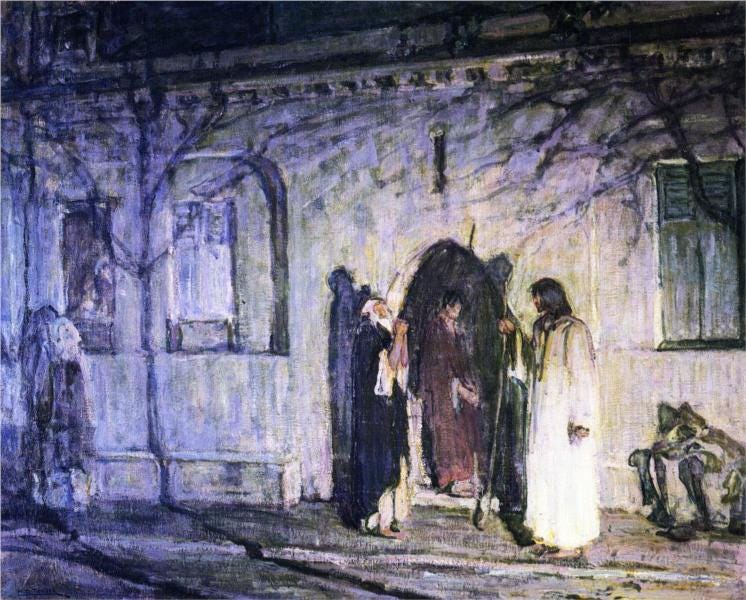
At times Jesus is little more than a light.
In The Disciples See Christ Walking on the Water, Jesus is a pale shape in the distance. The line between the water and sky can seem almost indistinct, as if Heaven and Earth are merging.
The messiah is the place they meet.
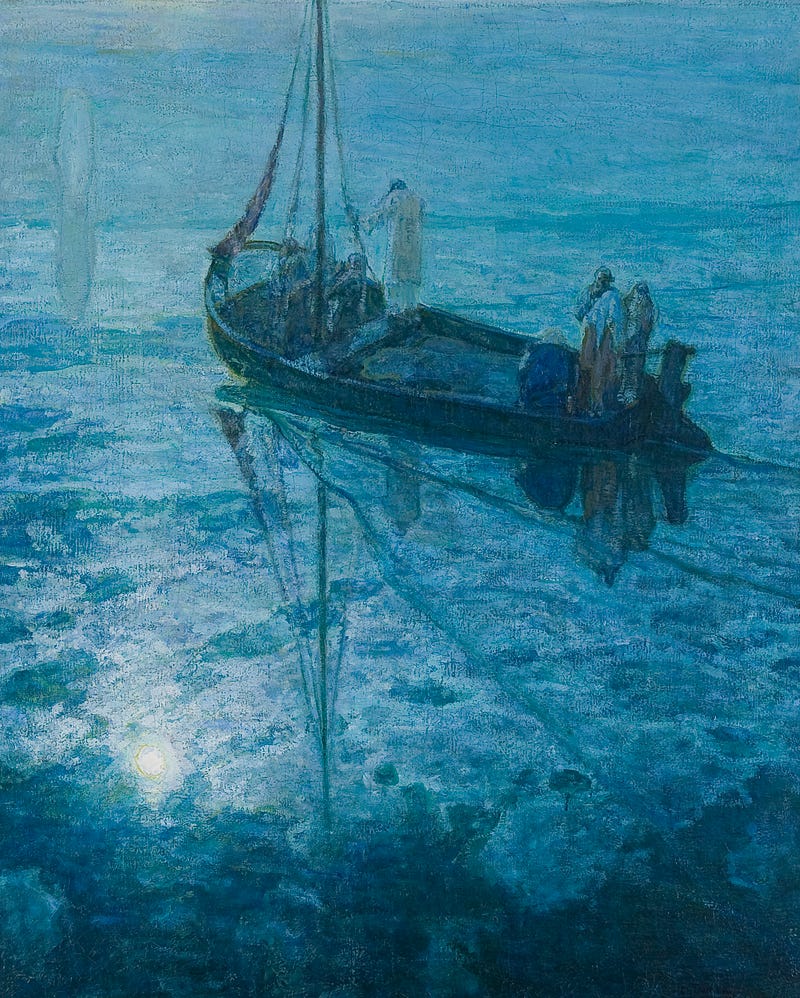
In a 1910 work, Christ and His Disciples on the Sea of Galilee, Tanner has the disciples nearly disappear into blots of dark paint—submerged in fear.
But a gleaming Jesus stands, facing and gesturing out at the calm sky. I suspect this is the moment after he has rebuked the storm. The disciples are then still fearful of their lives.
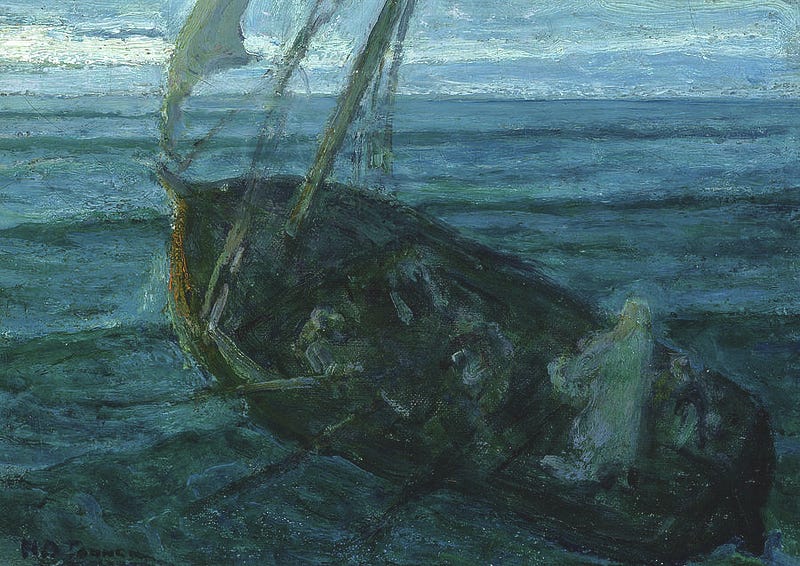
The paintings are often about a calm returning to the world.
The action of the painting is the humans in a process of having to think through the divine events, of having to change.
The scholar Robert Cozzolino has a helpful reading:
“It is remarkable how little happens in a Tanner painting: physical action, the imagining of martyrdom, the exposition of agony, unbridled celebration, and dramatic struggle do not occur. Instead, visions often take place out of sight, and we are left to imagine what has occurred. Tanner masterfully reveals the reactions of his figures and forces us to consider their response to the extraordinary.”
Tanner profiles many figures in the gospel story.
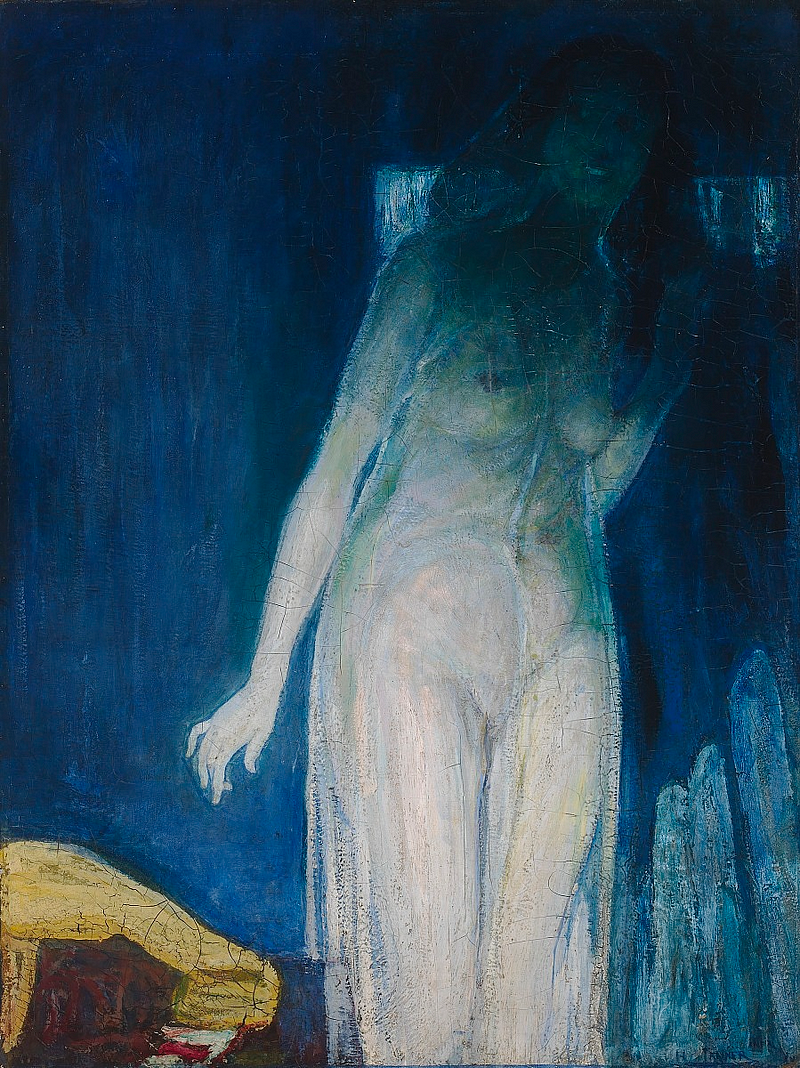
Take a 1900 painting, Salome. This is the woman who did a sexual dance to obtain the beheading of John the Baptist. Her sexual body is on view, and the prophet’s head she’s taken as her prize.
Her own head is nearly severed by shadow.
As Jesus teaches, you do nothing to others that will not be done to you.
Jesus reveals the spirituality of common people.
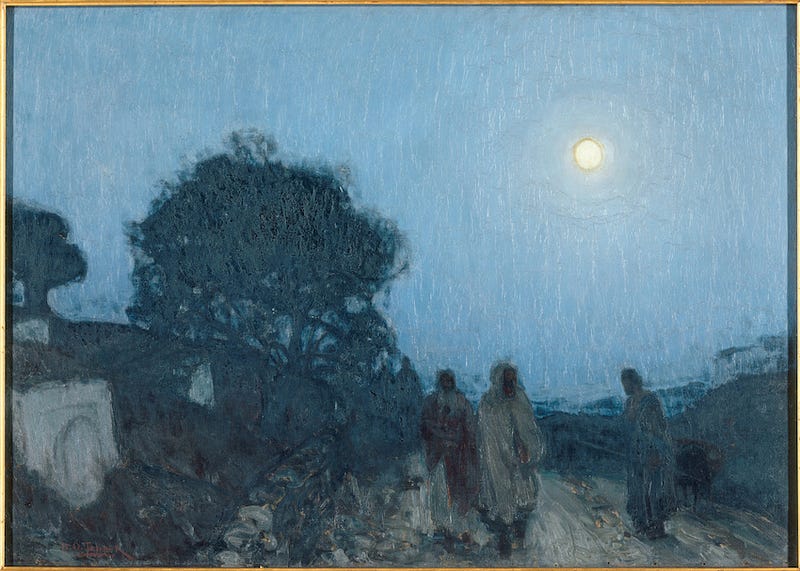
In Tanner’s Christ and His Disciples on the Road to Bethany, Jesus and his disciples are leaving Jerusalem after a run-in with religious authorities in the holy city who now seek to take his life.
But a shepherd on the road bows his head, reverently.
In this, we see a commentary, perhaps, on Christian clerics vs. ‘ordinary’ Christians. The divinity is in the ordinary.
Often framed against skies, Jesus can seem a cosmic agent.
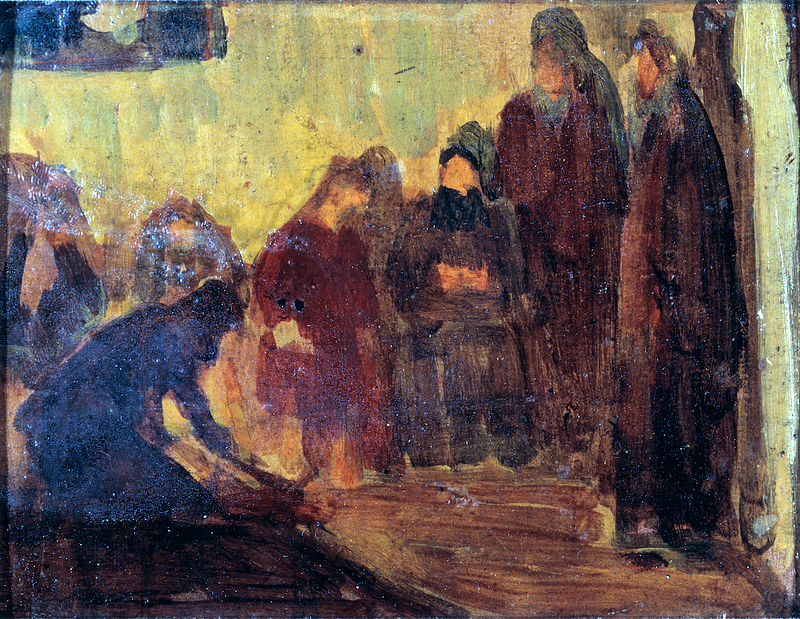
I love a study of Tanner’s Christ Washing the Feet of the Disciples. I can’t find if there was a finished work.
As he bends to his work of footwashing, Jesus just seems to be a mysterious outline, as if his body was a starry night sky.
Other times, it’s not clear that Jesus is ‘divine’.
Could he just be a man who knows what he’s seeing is wrong? Who feels there must be another way?
As he awaits the crucifixion, he prays, but this could just be any Palestinian man in a reverent state.
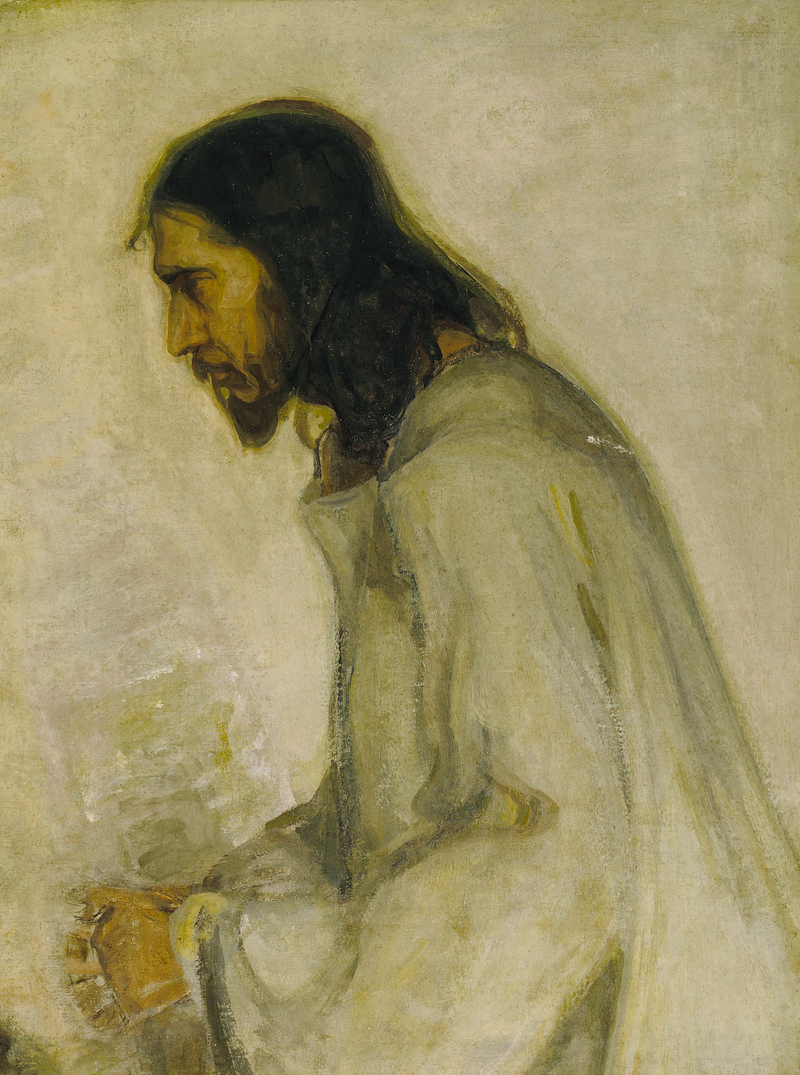
Tanner did two studies of Judas, though both are lost except for some photos.
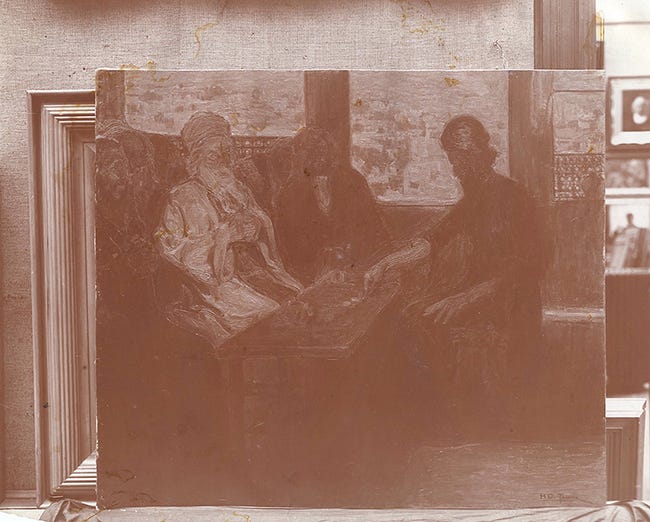
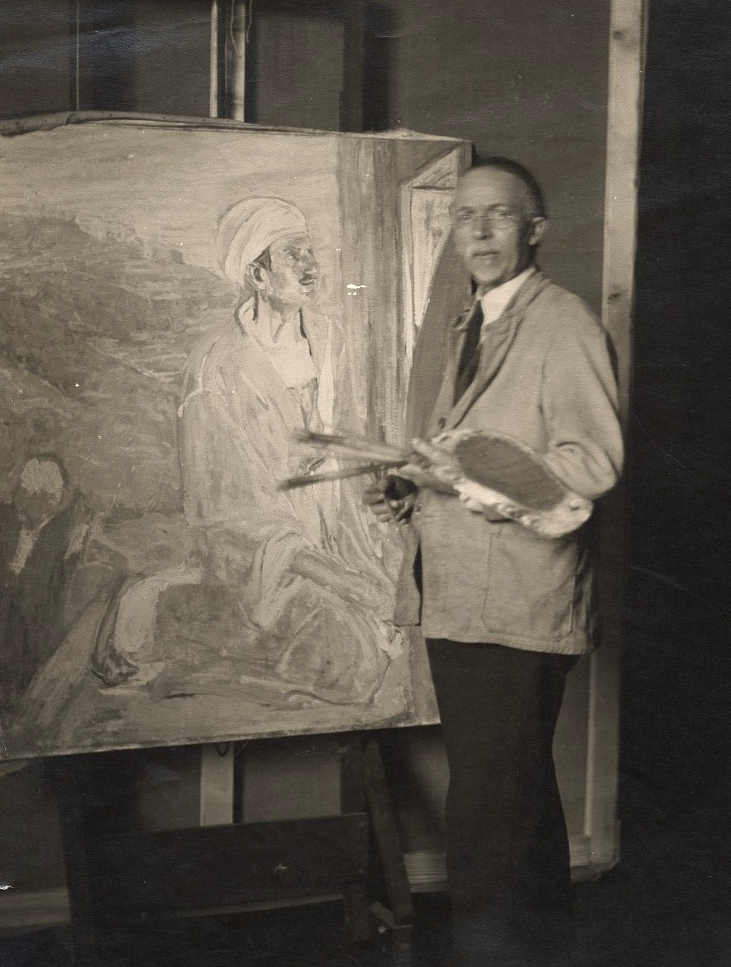
He seemed to view the followers of Jesus as lost in thought, lost in their own motivations, largely unaware of what was happening.
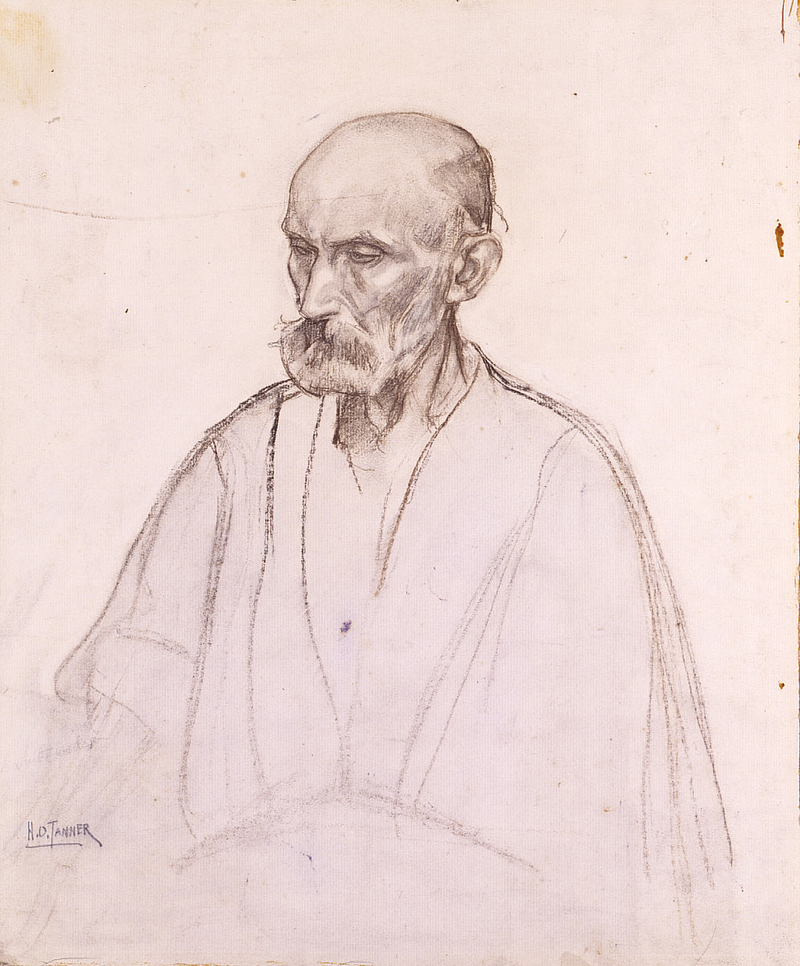
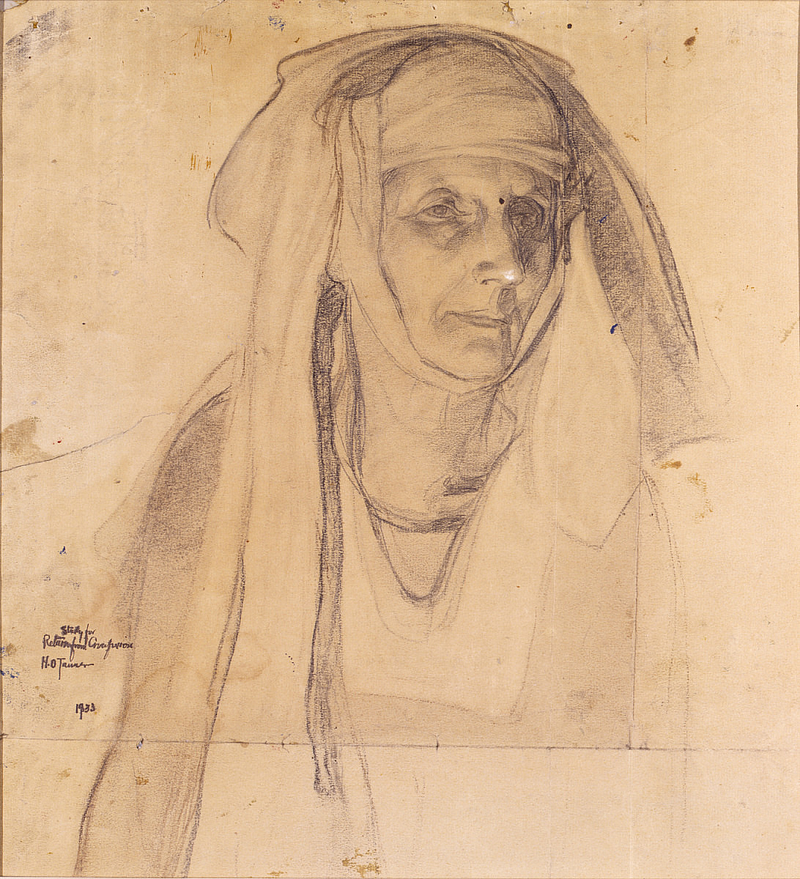
Tanner’s gospel story has an incredible omission.
I’ve not noticed anyone commenting on it. Why is there no crucifixion? Tanner seems never to have painted the scene.
It remains an unseen and unknown event. He picks up the story to after the Crucifixion, as the followers of Jesus are mournful and confused. The meaning of the messianic visit is unknown to them.
They are the darkness in a world that is now illuminated.
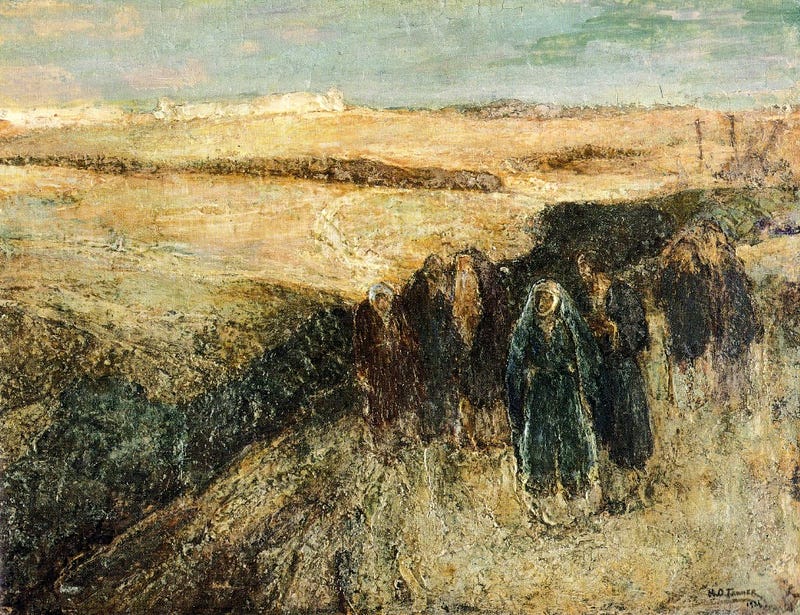
A resurrected Jesus appears—unrecognized.
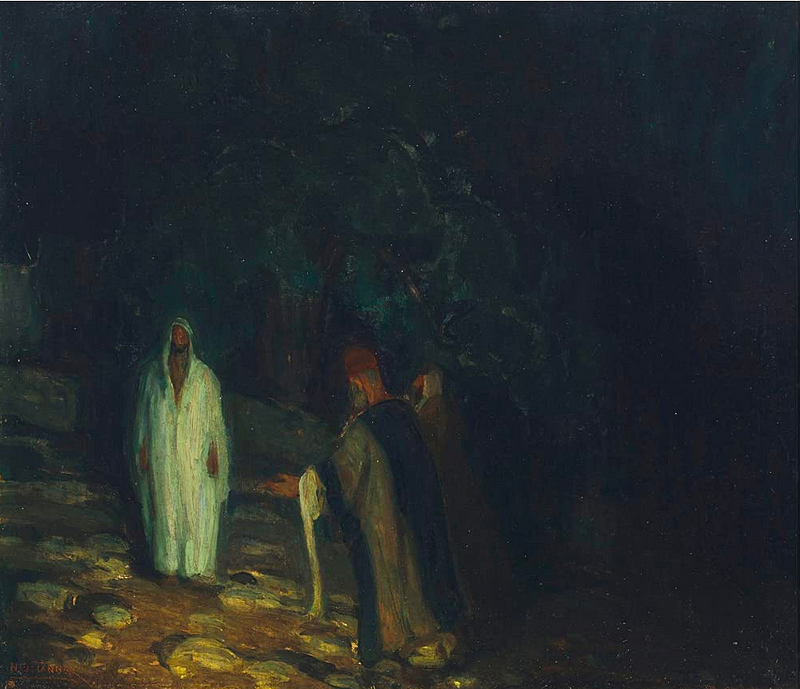
Tanner focused on the scene on the road to Emmaus, where a resurrected Jesus meets up with disciples at night.
They do not know the identity of this strange, bright presence. They are drawn to him though they do not know why.
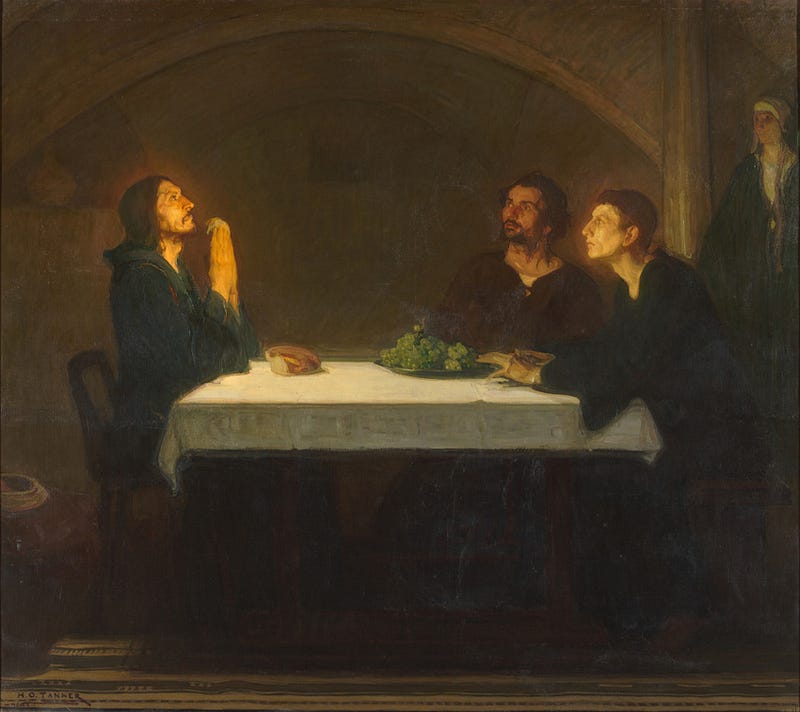
In a 1905 work, Pilgims of Emmaus, Jesus sits with the travelers—still not recognized. Tanner paints the scene as Jesus blessing the food.
The followers look at him, perhaps, with some puzzlement or dawning recognition, but not really knowing him.
A portrait, perhaps, of Christian people.
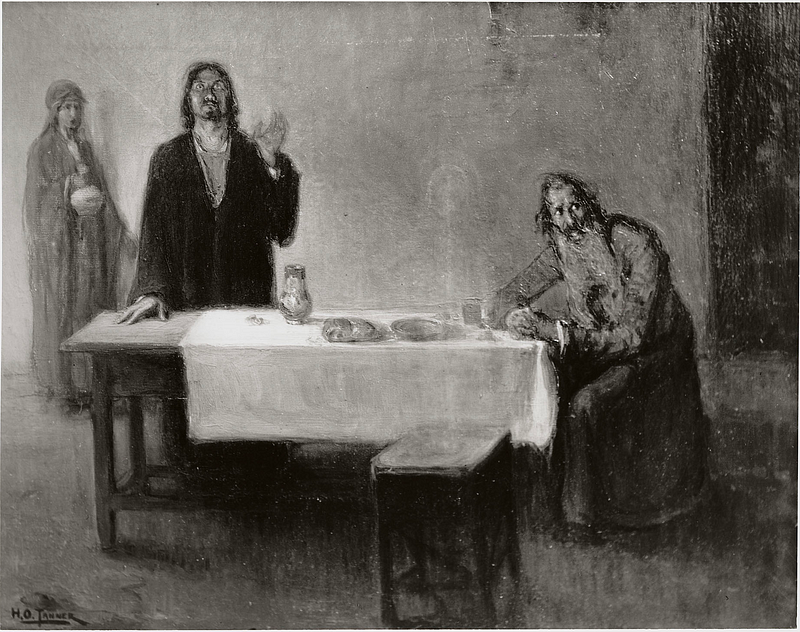
Tanner painted the following moment in 1901. That work, And He Vanished Out of Their Sight, is known only from a photograph.
As he sat at the table eating, Jesus fades away, leaving a faint outline that might recall the line of energy the angel had been at the start of the story. I also wonder if there’s a suggestion here of the Shroud of Turin.
As his mother had not really perceived the angel, his disciples seem not to know he’s there. Or whatever they understand to have happened makes them startled, or afraid.
Some critics thought Tanner wasted his talent.
Why had he not painted more Black people, asked the famous Black critic Alain Locke. “Tanner would have undoubtedly added a strong chapter to American regional art,” he wrote.
Or perhaps his vision had been somehow ‘post-racial’? In presenting a Jesus who was “an ambiguous racial median or mixture amid the complex ethnographic array of the Holy Land,” Alan C. Braddock suggests there was “a utopian Christian vision of world community…”
But Tanner himself had said:
“My efforts have been to not only put the biblical incident in the original setting . . . but at the same time give the human touch ‘which makes the whole world kin’ and which ever remains the same.”
‘Jesus’ is found everywhere. Jesus is everyone. 🔶


.jpg)