avatarJeremy Roberts

Free AI web copilot to create summaries, insights and extended knowledge, download it at here

11624

Abstract

ord with them, and he feared an album of sad songs would hurt that. That was his real reason for suing Chips to have the record blocked. Poor Chips, he didn’t want or need that kind of trouble right then.</p><p id="9b8b"><b>Didn’t Ringo also reveal that he was drunk during the sessions?</b></p><p id="7977">Ringo said he was drinking, but Mike Leech didn’t recall anything about Ringo being drunk or out of control in any way during the sessions.</p><p id="8cb8"><b>What other notable artists visited 3 Alarm?</b></p><p id="473f">Bobby Womack’s album with “When the Weekend Comes” [<i>Womagic</i>, No. 68 R&B, 1986] was recorded at 3 Alarm and so was part of <i>Highwayman 2</i> [1990] featuring Waylon Jennings, Willie Nelson, Kris Kristofferson, and Johnny Cash [lead single “Silver Stallion” rose no further than No. 25 C&W].</p><p id="de6d">3 Alarm was active for about four years until 1989, but Chips had an awful time with that studio. I know the building is still there. As usual the city has done nothing with it, in spite of all the money the city fathers put into trying to bring Chips back to town. That was as disastrous as Atlanta in 1972, maybe more so. Chips never cut another record in Memphis.</p><figure id="e005"><img src="https://cdn-images-1.readmedium.com/v2/resize:fit:800/1*XtywatuvIEpAMr8tvqjYxQ.jpeg"><figcaption><b>Jeremy Roberts meets Memphis music producer Chips Moman on August 13, 2014. The cigarette-clasping maverick and his family were waiting for their ride home after an exhilarating Memphis Boys concert held directly across the street from Graceland during Elvis Week. Moman sat in the front row during the sold out show and was acknowledged by <a href="https://readmedium.com/wearin-that-loved-on-look-terry-mike-jeffrey-salutes-chips-moman-and-the-memphis-boys-3c41040751d4">guest vocalist Terry Mike Jeffrey</a> from the stage. Although in poor health, Moman’s beaming smile and twinkling eyes were still as present as ever. Photography by Jane Calhoun Moman / The Jeremy Roberts Collection</b></figcaption></figure><p id="3f39"><b>What was Chips’ final project?</b></p><p id="dc65">Chips’ last project that was released was a 2001 Billy Joe Royal album called <i>Now and Then, Then and Now</i>, recorded shortly after he moved back to LaGrange. Chips hoped to launch a label from which other recordings could come, but that didn’t happen.</p><p id="c7db">Around 2002 when I began the book, they had just finished an album with B.J. Thomas that never got distributed because the suits Chips shopped it to weren’t interested. I don’t think some of them even knew who either Chips or B.J. were.</p><p id="51c3">The last project Chips worked on was a set of recordings he attempted with Willie Nelson and Jerry Lee Lewis in 2004 and 2005. Nothing came of it, and the session pretty much fell apart. I’ve never had an opportunity to hear any of these abandoned sessions. I assume they are in Chips’ tape vault.</p><p id="822a">As a matter of fact, when Chips found out I was a collector, he asked <i>me</i> to send him some albums he’d lost for his vault. There had been a fire some years back, and a few of his tapes were destroyed. Of course, I sent him the CD’s that he requested — an older B.J. Thomas album and maybe a Merrilee Rush one. It was an honor.</p><p id="9122"><b>What else can you reveal about Chips’ unreleased music vault?</b></p><p id="2db6">Chips had a tape archive at his farm in LaGrange. Everything appeared to be well stored and cataloged. His son Casey would probably be the one who knows about it in more detail, or his daughter Monique. I imagine they would be the ones to approve whatever does get out.</p><p id="11d8">I’d love to see Chips’ library unearthed and hear all that is there. Roy Hamilton’s lost January 1969 album springs to mind. We need more beautiful things to listen to in life.</p><p id="f40c"><b>Did Chips give you any feedback after the book was published?</b></p><p id="28f4">Chips was pleased with some of the individual chapters, but overall he did not like the book. He told me he was “very disappointed” in it. I don’t think I totally succeeded in capturing Chips’ complicated personality, although I tried. I told him so, and he nodded.</p><p id="1de6">Chips didn’t exactly say why he disliked it. He probably felt it wasn’t universally flattering to him, but I went out of my way to emphasize his many gifts and talents.</p><figure id="c635"><img src="https://cdn-images-1.readmedium.com/v2/resize:fit:800/1*aicqMuv8Q8D7RW7W-g61HA.jpeg"><figcaption><b>“It’s lonely out tonight, and the feelin’ just got right for a brand new love song, somebody done somebody wrong song:” Chips Moman demonstrates his Fender Stratocaster dexterity at his LaGrange, Georgia, home on January 31, 2008. Photography by Tami Chappell / The Associated Press</b></figcaption></figure><p id="2f24"><b>Why did Memphis drag its heels into the twenty-tens before finally giving Chips his rightful due?</b></p><p id="6c41">The City of Memphis left Chips and American out of the 1972 Memphis Music Awards, despite them having recorded some important material the previous year, including songwriter John Prine’s self-titled first album.</p><p id="302a">Chips was hurt and more than anything, their exclusion from the awards was his impulse to leave Memphis for a temporary sojourn in Atlanta. Eventually settling in Nashville as a country producer, Chips really didn’t do anything different than he had done at American — his style was the same, he used the same band, and made the same types of records with the same themes.</p><p id="66d0">One of the most admirable things about Chips was that he never played music industry politics. He just wanted to be left alone to create. The music industry didn’t like that. He wasn’t above telling off the suits if need be, which is why he never got his due in Memphis till he was almost too old and sick to enjoy it.</p><p id="2a4d">Graceland set the ball rolling in the right direction during Elvis Week 2009 when Chips and the Memphis Boys were interviewed by former Turner Classic Movies Vice President of Original Productions Tom Brown to promote the 40th anniversary of the Elvis sessions and the issue of the deluxe 2-CD Legacy edition of <i>From Elvis in Memphis</i>. The Memphis Grammy chapter surprised them with a certificate for “Suspicious Minds.”</p><p id="3605">Chips was given a Blues Note on Beale Street during Elvis Week 2010. Two years later, the Memphis Boys received their note. Chips had already had his stroke but had recovered from it more or less. He was beginning to look frail. And you never thought of Chips as frail. He had an incredibly strong spirit. I’m amazed he made it to 79 years old [Moman passed away on June 13, 2016, the day after his birthday]. He gave the world so much beauty and so much to think about.</p><p id="6918">There’s plenty more the city of Memphis could do to honor Chips. I’d like to see them name a street after him and a street for the Memphis Boys. After all, his hometown of LaGrange dedicated a then–unfinished six-mile section of highway known as the Pegasus Parkway in Chips’ name in 2011 [Moman used an early 1960s Rambler American to cut the ribbon by driving through it].</p><figure id="a41c"><img src="https://cdn-images-1.readmedium.com/v2/resize:fit:800/1*dljqU-twxOFCWyd31gIAxA.jpeg"><figcaption><b>Chips Moman takes a black fine point Sharpie to autograph lucky fan Gary Saunders’ memorabilia on August 13, 2014, during the unveiling of the legendary Memphis Boys’ Shelby County historical plaque marking the site where American Sound Studio once stood, which is currently home to a Family Dollar store. Memphis Mafia foreman Marty Lacker is directly behind Saunders. Image Credit: The Gary Saunders Collection</b></figcaption></figure><p id="9c6b"><b>When did you last speak with Chips?</b></p><p id="27ca">It was for the ceremonies when the city of Memphis put up a plaque at 827 Thomas Street, in front of the Dollar Store that’s there now, to commemorate American. Graceland unleashed their second Elvis Week concert featuring the Memphis Boys later that night [August 13, 2014].</p><p id="43ab">That’s when Chips told me he didn’t like the book. He was in a wheelchair then, because he had had another stroke. His emphysema was getting the better of him as well. I hated to see him in that kind of shape. He tried to quit smoking several times, poor man, but never succeeded. Unfiltered Camels, the worst.</p><p id="93c0">But I was glad he had lived long enough to see his beloved city bestow recognition. They said at the ceremony that they took my book in to the City Council and the Memphis Historical Society and showed them pages and chapters from it to demonstrate why American had been so important.</p><figure id="798e"><img src="https://cdn-images-1.readmedium.com/v2/resize:fit:800/1*DZFcajwdDbe5tkwAvOkeyg.jpeg"><figcaption><b>Producer extraordinaire Chips Moman and the Memphis Boys — Reggie Young, Bobby Emmons, Bobby Wood, and Gene Chrisman — are captured on the front porch of dear friend and former Sheriff Donny Turner’s lake house. The group convened circa March 22, 2014, at Turner’s LaGrange, Georgia, home to visit and go out for dinner. LaGrange was Moman’s hometown, and the trailblazing “Do Right Woman, Do Right Man” songwriter would succumb to emphysema in a hospice facility there on June 13, 2016. Only Wood and Chrisman are still among the living. Photography by Jenny Lynn Young</b></figcaption></figure><p id="875d"><b>What keeps you contented these days, and is another book on your radar?</b></p><p id="fe3b">I’ve been doing the housewife thing for almost two years now…and I love it. I married my longtime companion, James Fetterly. We found an old 1940s house in Gallipolis, where I’ve been since I was 14 when my family came here. We’ve been doing a lot to it, putting our stamp on it you might say.</p><p id="0417">This might seem funny to many people, but ever since the book came out I haven’t been able to write a thing. Just a complete case of writer’s block. I wanted to write a biography of Grady Martin, and maybe I will if my “voice” ever comes back. I imagine it will eventually.</p><p id="6668">When that happens, I not only want to write about Grady but do poetry as well, and get a memoir about growing up in the West Virginia coal camps my mother wrote published. Mom wanted to get it all down on paper before she died because it was a way of life that is now gone. She and one of her older sisters both always wanted to be a writer, and that’s why I became one.</p><p id="6259">I haven’t given up writing by any means, but after <i>Memphis Boys</i> and all that happened during and as a result of the book, I just burned completely out. It’s only now I realize how much I poured into the writing of that very simple story. I think my whole life went into it.</p><p id="5071">But I was and am honored to be the one to tell it. I’m kind of happy I was able to put my writing to the purpose of giving recognition to others, rather than have it be just an ego thing about me and what I was doing.</p><figure id="c395"><img src="https://cdn-images-1.readmedium.com/v2/resize:fit:800/1*r1-Ro25M3lL-ZHI8TnD8qw.jpeg"><figcaption></figcaption></figure><figure id="eca9"><img src="https://cdn-images-1.readmedium.com/v2/resize:fit:800/1*wEIsjZcFEz5BbpOB8nIL5Q.jpeg"><figcaption><b>“Instrumentally Yours,” April 1965, and “A Touch of Country,” June 1967, both Grady Martin albums distributed by Decca. Image Credits: Universal Music Group / Records by Mail</b></figcaption></figure><p id="4dc5

Options

"><b>Why a bio about Nashville A-Team alum Grady Martin [1929</b>–<b>2001]?</b></p><p id="d952">Grady is my favorite session guitarist next to Reggie Young. His work was so varied, so versatile, but always done with passion and heart. The song that turned me on to Grady was “The Partisan” with Joan Baez [<i>Come from the Shadows</i>, 1972].</p><p id="c4c9">His collaborations with Marty Robbins remain definitive, especially <i>Gunfighter Ballads and Trail Songs </i>[1959] — e.g. “El Paso,” “Big Iron,” and “The Little Green Valley.” He unleashed the electric guitar solo on Elvis’s “Devil in Disguise” [No. 3 POP, 1963] and is the mandolin player on Larry Gatlin’s “Broken Lady” [No. 5 C&W, 1975], which he recorded with the Memphis Boys under Fred Foster’s direction.</p><p id="4742">Grady released solo singles as well as 13 albums [1951–1977 on Decca, Capitol, and Monument]. On his 1965 <i>Instrumentally Yours</i> he did a slow ballad called “Theme from Malamondo [Funny World].” Superb. “Ribbon of Darkness,” that he did both with Marty [No. 1 C&W, 1965] and as a solo piece [<i>A Touch of Country,</i> 1967], is phenomenal. On his final <i>Cowboy Classics</i> LP [1977] he arranged and played a version of “Shenandoah” that would break your heart. That’s just for starters.</p><p id="f882"><b>What doors have been opened in the decade since <i>Memphis Boys</i> was distributed?</b></p><p id="15aa">I got to write the profile of Chips that appears now in the <a href="https://memphismusichalloffame.com/inductee/chipsmoman/">Memphis Music Hall of Fame at his exhibit</a> [Moman was inducted in 2014]. I got to live a dream come true when Ace Records asked me to help choose the selections for the <a href="https://www.amazon.com/Memphis-Boys-Story-American-Studios/dp/B006WAF3ZO/ref=cm_cr_arp_d_product_top?ie=UTF8"><i>Memphis Boys</i> companion CD</a> [2012], and I also got to write an essay for the collection. That was a true honor, and I’m most grateful.</p><p id="7fb8">The true honor, though, was all the great people I met and in many cases befriended…so many of whom are dead now. I miss them all. Doing the book was such a privilege, a trust, and a labor of love. I really wanted that spotlight to shine on some topnotch talents who never got the credit they deserved.</p><h1 id="8348">Don’t go anywhere yet! Both previous chapters of the Roben Jones interview can be accessed below.</h1><div id="aa5a" class="link-block"> <a href="https://readmedium.com/straight-shooter-roben-jones-rights-an-unjustly-neglected-memphis-music-saga-7bc0ce733656"> <div> <div> <h2>Straight shooter Roben Jones rights an unjustly neglected Memphis music saga [PART TWO OF THE INTERVIEW]</h2> <div><h3>Chips Moman and the Memphis Boys are the stars of an American Sound interview also covering Elvis Presley, Neil…</h3></div> <div><p>medium.com</p></div> </div> <div> <div style="background-image: url(https://miro.readmedium.com/v2/resize:fit:320/1*7zv-8RvIs-vp43-HXaQtlw.jpeg)"></div> </div> </div> </a> </div><div id="fb87" class="link-block"> <a href="https://readmedium.com/a-primer-60s-soul-playlist-for-chips-moman-and-the-memphis-boys-9411923ce471"> <div> <div> <h2>A primer ’60s soul playlist for Chips Moman and the Memphis Boys [PART ONE OF THE ROBEN JONES INTERVIEW]</h2> <div><h3>Biographer Roben Jones distills the best of the session cats who cut Elvis‘ Suspicious Minds and rivaled the Wrecking…</h3></div> <div><p>medium.com</p></div> </div> <div> <div style="background-image: url(https://miro.readmedium.com/v2/resize:fit:320/1*bHEPtPymC-n3Dl2Me7xafw.jpeg)"></div> </div> </div> </a> </div><figure id="e933"><img src="https://cdn-images-1.readmedium.com/v2/resize:fit:800/1*DUrKaj2pa9jhgTG8ee25iw.jpeg"><figcaption><b>In her lavender “Delta Dawn” dress, “Memphis Boys” biographer Roben Jones bids farewell to ace American Sound guitarist Reggie Young on August 13, 2010, the morning after the “Back in Memphis” benefit for second soprano Myrna Smith of the Sweet Inspirations held at the Michael D. Rose Theater, part of the University of Memphis. Drummer Jerry Carrigan, bassist Norbert Putnam, keyboardist Shane Keister, Austrian singer Dennis Jale, Billy Swan, Mary Holladay, and younger sister Ginger Holladay were all part of the Graceland-boycotted show that was sparsely attended but enthusiastically received by fans. All except Jale played with Elvis Presley or wrote a song he tackled [i.e. Swan’s “I Can Help”] in the 1970s. Image Credit: The Roben Jones Collection</b></figcaption></figure><div id="41f5" class="link-block"> <a href="https://readmedium.com/back-when-memphis-was-electric-b-j-thomas-on-chips-moman-and-the-memphis-boys-dcf626f5bd40"> <div> <div> <h2>Back when Memphis was electric — B.J. Thomas on Chips Moman and the Memphis Boys</h2> <div><h3>The impact of producer Chips Moman and the Memphis Boys is still being felt 45 years after the unceremonious closing of…</h3></div> <div><p>medium.com</p></div> </div> <div> <div style="background-image: url(https://miro.readmedium.com/v2/resize:fit:320/1*H__c8UULuXiQjtsJcowf5A.jpeg)"></div> </div> </div> </a> </div><div id="fff4" class="link-block"> <a href="https://readmedium.com/wearin-that-loved-on-look-terry-mike-jeffrey-salutes-chips-moman-and-the-memphis-boys-3c41040751d4"> <div> <div> <h2>‘Wearin’ That Loved on Look’ — Terry Mike Jeffrey salutes Chips Moman and the Memphis Boys</h2> <div><h3>Elvis Presley-inspired singer Terry Mike Jeffrey divulges his deep-rooted admiration for hit-making team Chips Moman…</h3></div> <div><p>medium.com</p></div> </div> <div> <div style="background-image: url(https://miro.readmedium.com/v2/resize:fit:320/1*H1aM34LU4c3bMPxLl_zF6g.jpeg)"></div> </div> </div> </a> </div><div id="d688" class="link-block"> <a href="https://readmedium.com/more-thunder-on-the-piano-ronnie-milsap-relives-memphis-days-with-elvis-presley-17803848f24b"> <div> <div> <h2>More thunder on the piano — Ronnie Milsap relives Memphis days with Elvis Presley</h2> <div><h3>Ronnie Milsap auspiciously bridged the gap between country and pop in the early ’80s, and his influence still permeates…</h3></div> <div><p>medium.com</p></div> </div> <div> <div style="background-image: url(https://miro.readmedium.com/v2/resize:fit:320/1*uK3PlQV_o_y4f-hzpyeQyw.jpeg)"></div> </div> </div> </a> </div><div id="3f7f" class="link-block"> <a href="https://readmedium.com/the-memphis-boys-triumphantly-declare-hit-filled-legacy-during-elvis-week-d4f02e5589ad"> <div> <div> <h2>The Memphis Boys triumphantly declare hit-filled legacy during Elvis Week</h2> <div><h3>Get the lowdown on the Memphis Boys’ final hometown show. The American Sound Studio gang played on 120 hits such as…</h3></div> <div><p>medium.com</p></div> </div> <div> <div style="background-image: url(https://miro.readmedium.com/v2/resize:fit:320/1*U0zEpr_aL5N7fryfZKs0og.jpeg)"></div> </div> </div> </a> </div> <figure id="7130"> <div> <div> <img class="ratio" src="http://placehold.it/16x9"> <iframe class="" src="https://cdn.embedly.com/widgets/media.html?src=https%3A%2F%2Fwww.youtube.com%2Fembed%2FR0BAoo7sYf4%3Ffeature%3Doembed&amp;display_name=YouTube&amp;url=https%3A%2F%2Fwww.youtube.com%2Fwatch%3Fv%3DR0BAoo7sYf4&amp;image=https%3A%2F%2Fi.ytimg.com%2Fvi%2FR0BAoo7sYf4%2Fhqdefault.jpg&amp;key=a19fcc184b9711e1b4764040d3dc5c07&amp;type=text%2Fhtml&amp;schema=youtube" allowfullscreen="" frameborder="0" height="480" width="640"> </div> </div> </figure></iframe></div></div></figure> <figure id="d110"> <div> <div> <img class="ratio" src="http://placehold.it/16x9"> <iframe class="" src="https://cdn.embedly.com/widgets/media.html?src=https%3A%2F%2Fwww.youtube.com%2Fembed%2Fm_9tqndgIlc%3Ffeature%3Doembed&amp;url=https%3A%2F%2Fwww.youtube.com%2Fwatch%3Fv%3Dm_9tqndgIlc&amp;image=https%3A%2F%2Fi.ytimg.com%2Fvi%2Fm_9tqndgIlc%2Fhqdefault.jpg&amp;key=a19fcc184b9711e1b4764040d3dc5c07&amp;type=text%2Fhtml&amp;schema=youtube" allowfullscreen="" frameborder="0" height="480" width="854"> </div> </div> </figure></iframe></div></div></figure> <figure id="93b3"> <div> <div> <img class="ratio" src="http://placehold.it/16x9"> <iframe class="" src="https://cdn.embedly.com/widgets/media.html?src=https%3A%2F%2Fwww.youtube.com%2Fembed%2FPXonzb3uIcU%3Ffeature%3Doembed&amp;url=https%3A%2F%2Fwww.youtube.com%2Fwatch%3Fv%3DPXonzb3uIcU&amp;image=https%3A%2F%2Fi.ytimg.com%2Fvi%2FPXonzb3uIcU%2Fhqdefault.jpg&amp;key=a19fcc184b9711e1b4764040d3dc5c07&amp;type=text%2Fhtml&amp;schema=youtube" allowfullscreen="" frameborder="0" height="480" width="640"> </div> </div> </figure></iframe></div></div></figure> <figure id="cf33"> <div> <div> <img class="ratio" src="http://placehold.it/16x9"> <iframe class="" src="https://cdn.embedly.com/widgets/media.html?src=https%3A%2F%2Fwww.youtube.com%2Fembed%2F-3hXodMRBfk%3Ffeature%3Doembed&amp;url=https%3A%2F%2Fwww.youtube.com%2Fwatch%3Fv%3D-3hXodMRBfk&amp;image=https%3A%2F%2Fi.ytimg.com%2Fvi%2F-3hXodMRBfk%2Fhqdefault.jpg&amp;key=a19fcc184b9711e1b4764040d3dc5c07&amp;type=text%2Fhtml&amp;schema=youtube" allowfullscreen="" frameborder="0" height="480" width="854"> </div> </div> </figure></iframe></div></div></figure><div id="65bf" class="link-block"> <a href="https://jeremylr.medium.com/bob-dylan-and-ringo-starrs-secret-memphis-collision-on-pseudo-protest-song-5c78ea565e64"> <div> <div> <h2>Bob Dylan and Ringo Starr’s secret Memphis collision on pseudo-protest song</h2> <div><h3>Professor Sam Shoup relays the long-buried 1987 session where the Beatle, the Bard, and “Suspicious Minds” producer…</h3></div> <div><p>jeremylr.medium.com</p></div> </div> <div> <div style="background-image: url(https://miro.readmedium.com/v2/resize:fit:320/1*qu_sqxpzVJiQl5tkw65a8A.jpeg)"></div> </div> </div> </a> </div><p id="85b9"><i>© Jeremy Roberts, 2019. All rights reserved. To touch base, email <a href="mailto:[email protected]"></a></i><a href="mailto:[email protected]">[email protected]<i></i></a><i> and mention which story led you my way. I appreciate it sincerely.</i></p></article></body>

A beautiful mess with ‘Memphis Boys: The Story of American Studios’ wordsmith Roben Jones

“The only two things in life that make it worth livin’, is guitars that tune good and firm feelin’ women:” Outfitted in blue denim and a dark poorboy cap, the Gibson-endorsing Chips Moman is right at home alongside an acoustic guitar in LaGrange, Georgia. The professional shot appeared in the November 18, 2001, issue of the since-defunct Atlanta Constitution morning newspaper. Photography by Jean Shifrin / The Atlanta Journal-Constitution Archives

Chips Moman had to leave Memphis for a little while. The only man to effectively produce Elvis Presley besides Sam Phillips at Sun, Moman wore his heart on his sleeve, refused to play music biz politics, and abhorred self-promotion. The Memphis Boys, Moman’s crack team of session personnel at American Sound Studio, were not confined to a sole music style or record label like Motown or their neighbors five and a half miles to the south at Stax. But the stats speak for themselves — a record 122 Billboard Top Ten hits in a five year period culminating with Moman’s misguided move to Atlanta in 1972.

Moman reimagined himself as a hot Nashville songwriter and producer, winning a Best Country Song Grammy for B.J. Thomas’s “[Hey Won’t You Play] Another Somebody Done Somebody Wrong Song.” Memphis council members and bankers urged Moman to give the Birthplace of Rock ‘n’ Roll a second chance in the mid-’80s. The city of Memphis leased an abandoned fire house to Moman for one dollar, a 99-year agreement with an option to purchase. Christened 3 Alarm Studio, Moman convinced Johnny Cash, Roy Orbison, Jerry Lee Lewis, and Carl Perkins to celebrate their diamond recording anniversary with the Class of ’55. Listeners were lukewarm.

Business deals gone south, Ringo Starr’s cursed sessions, hidden archival treasures, and final conversations occupy the final chapter of an engrossing interview with Jones. The Ohio-raised historian will be involved with the second volume of Ace Records’ upcoming Memphis Boys CD [the first arrived in 2012; Ace is the leading reissue label in the United Kingdom]. When Jones conquers her writers’ block, expect a bio on “El Paso” Nashville session guitarist Grady Martin. To rewind to part two, entitled “Straight Shooter Roben Jones Rights an Unjustly Neglected Memphis Music Saga,” just click on the link.
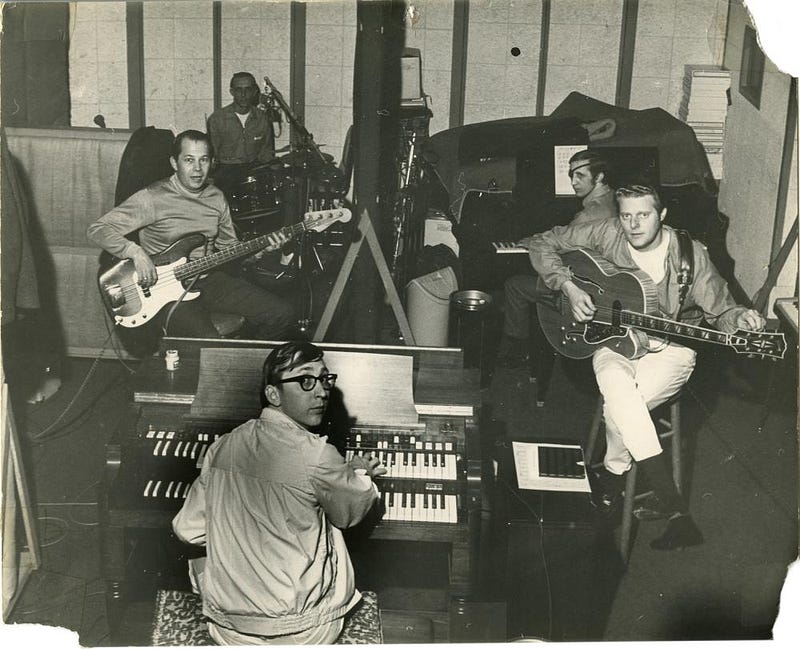
Clockwise from bottom center are organist Bobby Emmons, bassist Tommy Cogbill, drummer Gene Chrisman, pianist Bobby Wood, and guitarist Reggie Young of the 827 Thomas Street Band inside Chips Moman and Don Crews’ American Sound Studio in Memphis circa 1968. Bassist and arranger Mike Leech is not pictured. Thirty years later Moman sold the sunburst 1956 Gibson Super 400 CES at a Christie’s auction for over $98,000. Originally traded to Moman by Scotty Moore, Young used the Super 400 prolifically on Elvis Presley’s critically praised “From Elvis in Memphis” and “From Memphis to Vegas” albums. Image Credit: The Commercial Appeal Archives / The Marty Lacker Collection

The Roben Jones Interview, Part Three [Conclusion]

Did Chips Moman exhibit any deficiencies as a producer?

Chips had a lot going for him artistically — a creative vision, musical talent, technical ability — he was a great sound man. He could paint the most beautiful pictures with sound and sum up feelings of hard times, despair, and sorrow like nobody else ever could. That vision took place over every other factor. Sometimes Chips emphasized the song so much that he didn’t consider the style and voice of the singer. Cases in point are Dionne Warwick’s 1970 version of Spanky and Our Gang’s “Give a Damn” and Cymarron’s sole LP Rings [1971].

As a businessman, he had a lot of shortcomings. He was a very trusting man who operated on old-school word is bond dealings. Suits didn’t always operate that way. He got taken advantage of time and time again, no matter how wary he taught himself to be, because he just couldn’t think in terms of that dollar sign above all things.

What Chips was all about was the art. That’s where Don Crews came in. Don had a solid head for business, and for that matter so did Marty Lacker, who replaced Don. As long as Chips had someone like that operating the business end of the studio, he did fine.
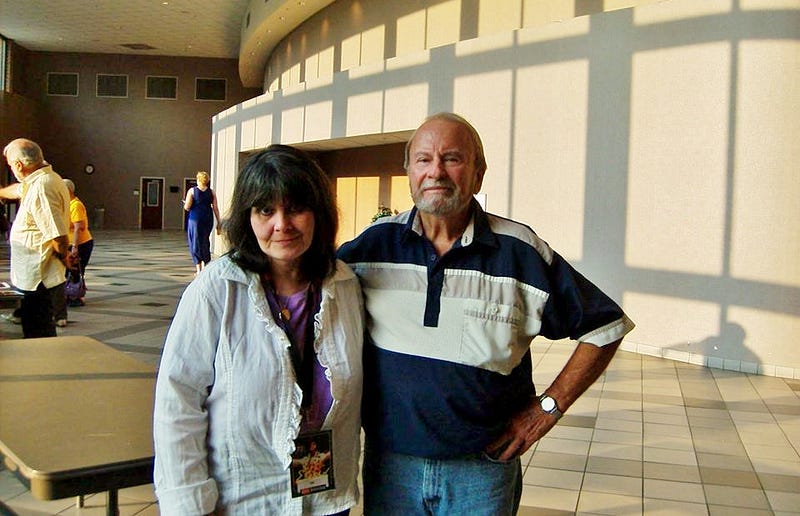
“Memphis Boys” chronicler Roben Jones finally comes face to face with Don Crews, Chips Moman’s original partner at American Sound Studio, on August 12, 2010, in the lobby of the Michael D. Rose Theater, part of the University of Memphis. The occasion was Jones’ debut book signing as well as the “Back in Memphis” benefit for second soprano Myrna Smith of the Sweet Inspirations. Crews died at age 85 on September 4, 2016, less than three months after Moman. Jones divulges, “I don’t think American Sound would have lasted so long as it did without Don to handle the business end of things. It was a perfect division of labor. Chips handled the creative end, and Don took care of the business side of things. Marty Lacker did the same thing after the partnership between Chips and Don broke up in early 1970. Chips needed the good head and strong common sense that people like Don and Marty provided. Just like everyone else did, Chips always knew where he stood with them. Don was a great man, and a gentleman all the way.” Image Credit: The Roben Jones Collection

What was the worst instance where unscrupulous folks took advantage of Chips?

Probably when he was young at Stax Records in 1962. Chips was tossed out after he had helped build the company, and then Seymour Rosenberg approached Chips with the suggestion that he sue Stax and settle for a pittance. Chips didn’t know it, but Rosenberg was working for Stax co-founder Jim Stewart. Chips never really got over that. It hurt him till the day he died.

Was Chips justified in his decision to leave Memphis in June 1972 and unveil American Studios in Atlanta? Was it a successful venture?

Yes, Chips had some very sound reasons for leaving. The Memphis Boys weren’t getting any work at all. The whole city was dying, and the music industry there was slowly running out of steam. American couldn’t help but be affected by it.

Chips had a restless, questing nature. He had a lot of the old pioneer spirit in him. He wanted to strike out and do something new, and Atlanta was close to where he had lived as a boy. He wanted to make his life back there again.

Chips produced a moderate hit for Roger Miller in Atlanta that earned encouraging reviews — “Hoppy’s Gone,” a moving tribute to William “Hopalong Cassidy” Boyd’s then-recent death b/w “The Day I Jumped from Uncle Harvey’s Plane” [No. 42 C&W December 1972, Mercury Records].

Cymarron was a one hit wonder soft rock trio whose lead singer Richard Mainegra also co-wrote “Separate Ways” with founding Memphis Mafia member Red West for Elvis. Chips was behind the console in Memphis for their debut A-side “Rings” [No. 17 POP April 1971, Entrance Records] and continued to guide them when they tracked “Start Again” b/w “Keep Me Warm” [October 1972] in Atlanta. A beautiful single that got no airplay at all. There was an obscure Willie Hightower single — “Easy Lovin’” b/w “I Love You So.” Sadly, not much else. By 1973 Chips pulled up stakes and headed to Nashville for greener pastures.
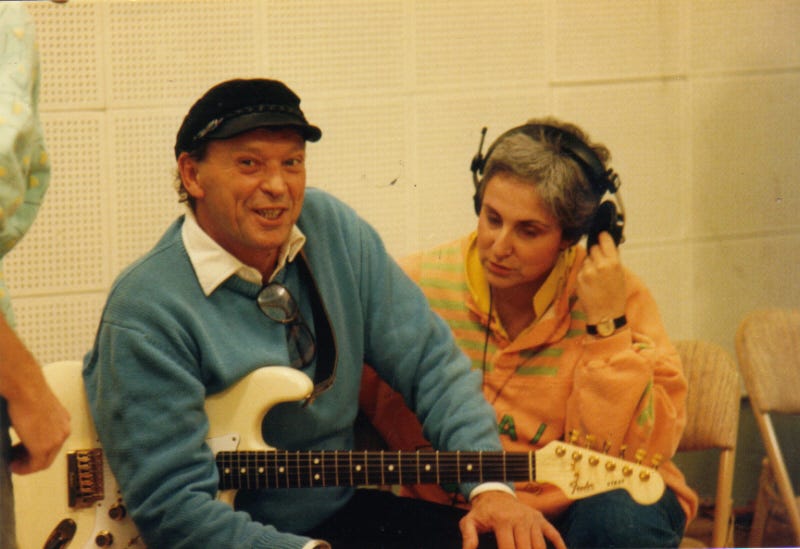
Chips Moman and second wife Toni Wine [Moman was married to Lorrie Goff from 1958 to 1974] shoot the breeze while cutting Ringo Starr’s still-unreleased rock ’n’ roll album of vintage covers and original material at Sam Phillips’ legendary Sun Studio in Memphis in April 1987. Wine, who helped Starr with his vocals by reducing his tendency to croon, is best known for co-composing “A Groovy Kind of Love” for Wayne Fontana [Phil Collins had a number one hit in the late 1980s], “Black Pearl” for Sonny Charles, and “Candida” for Tony Orlando and Dawn. Besides producing and bankrolling the album, Moman also pitched in on a white Fender Telecaster. Photography by Stephony Smith / The Sam Shoup Collection [he played doghouse and electric bass]
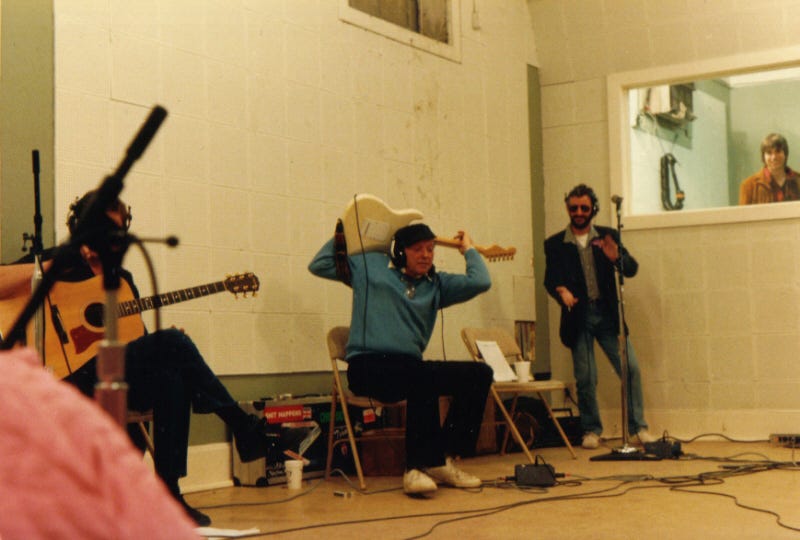
Jimi Hendrix and Glen Campbell — eat your heart out! Producer Chips Moman has a bit of fun playing his white Fender Telecaster behind his head while Ringo Starr enthusiastically claps along during the sessions for the Beatle drummer’s still-unreleased rock ’n’ roll album of vintage covers and original material at Sam Phillips’ legendary Sun Studio in April 1987. Sessions also occurred at Moman’s 3 Alarm Studio on 200 Linden Avenue in Memphis. That’s a partially obscured J.R. Cobb, formerly of the Classics IV and Atlanta Rhythm Section, on acoustic guitar. Photography by Stephony Smith / The Sam Shoup Collection [he played doghouse and electric bass]

Let’s explore the aborted Ringo Starr sessions at Chips’ 3 Alarm Studio in Memphis.

There are some of them already released on YouTube [i.e. “I’ve Changed My Mind” and a cover of Billy Swan’s “I Can Help.” “They are from a cassette recorder that somebody snuck into the control room during playback. That’s why they sound so bad,” says bassist Sam Shoup. Between 14 and 16 songs were recorded over two weeks in February and April 1987 with Starr on vocals only, including Fats Domino’s “Ain’t That a Shame,” Stevie Wonder’s “Shoo-Be-Doo-Be-Doo-Da-Day,” Grand Funk Railroad’s “Some Kind of Wonderful,” “Beat Patrol,” “I’ve Changed My Mind,” and “Whiskey and Soda”].

Of course, they’re worthy of reissue. Ringo thought they weren’t. He wanted to put the All-Starr Band together and do a record with them, and he feared an album of sad songs would hurt that. That was his real reason for suing Chips to have the record blocked. Poor Chips, he didn’t want or need that kind of trouble right then.

Didn’t Ringo also reveal that he was drunk during the sessions?

Ringo said he was drinking, but Mike Leech didn’t recall anything about Ringo being drunk or out of control in any way during the sessions.

What other notable artists visited 3 Alarm?

Bobby Womack’s album with “When the Weekend Comes” [Womagic, No. 68 R&B, 1986] was recorded at 3 Alarm and so was part of Highwayman 2 [1990] featuring Waylon Jennings, Willie Nelson, Kris Kristofferson, and Johnny Cash [lead single “Silver Stallion” rose no further than No. 25 C&W].

3 Alarm was active for about four years until 1989, but Chips had an awful time with that studio. I know the building is still there. As usual the city has done nothing with it, in spite of all the money the city fathers put into trying to bring Chips back to town. That was as disastrous as Atlanta in 1972, maybe more so. Chips never cut another record in Memphis.
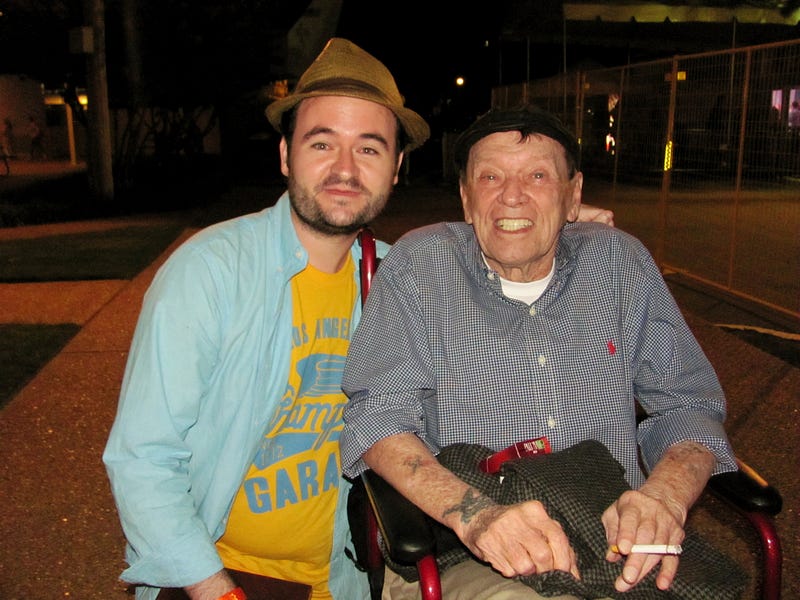
Jeremy Roberts meets Memphis music producer Chips Moman on August 13, 2014. The cigarette-clasping maverick and his family were waiting for their ride home after an exhilarating Memphis Boys concert held directly across the street from Graceland during Elvis Week. Moman sat in the front row during the sold out show and was acknowledged by guest vocalist Terry Mike Jeffrey from the stage. Although in poor health, Moman’s beaming smile and twinkling eyes were still as present as ever. Photography by Jane Calhoun Moman / The Jeremy Roberts Collection

What was Chips’ final project?

Chips’ last project that was released was a 2001 Billy Joe Royal album called Now and Then, Then and Now, recorded shortly after he moved back to LaGrange. Chips hoped to launch a label from which other recordings could come, but that didn’t happen.

Around 2002 when I began the book, they had just finished an album with B.J. Thomas that never got distributed because the suits Chips shopped it to weren’t interested. I don’t think some of them even knew who either Chips or B.J. were.

The last project Chips worked on was a set of recordings he attempted with Willie Nelson and Jerry Lee Lewis in 2004 and 2005. Nothing came of it, and the session pretty much fell apart. I’ve never had an opportunity to hear any of these abandoned sessions. I assume they are in Chips’ tape vault.

As a matter of fact, when Chips found out I was a collector, he asked me to send him some albums he’d lost for his vault. There had been a fire some years back, and a few of his tapes were destroyed. Of course, I sent him the CD’s that he requested — an older B.J. Thomas album and maybe a Merrilee Rush one. It was an honor.

What else can you reveal about Chips’ unreleased music vault?

Chips had a tape archive at his farm in LaGrange. Everything appeared to be well stored and cataloged. His son Casey would probably be the one who knows about it in more detail, or his daughter Monique. I imagine they would be the ones to approve whatever does get out.

I’d love to see Chips’ library unearthed and hear all that is there. Roy Hamilton’s lost January 1969 album springs to mind. We need more beautiful things to listen to in life.

Did Chips give you any feedback after the book was published?

Chips was pleased with some of the individual chapters, but overall he did not like the book. He told me he was “very disappointed” in it. I don’t think I totally succeeded in capturing Chips’ complicated personality, although I tried. I told him so, and he nodded.

Chips didn’t exactly say why he disliked it. He probably felt it wasn’t universally flattering to him, but I went out of my way to emphasize his many gifts and talents.

“It’s lonely out tonight, and the feelin’ just got right for a brand new love song, somebody done somebody wrong song:” Chips Moman demonstrates his Fender Stratocaster dexterity at his LaGrange, Georgia, home on January 31, 2008. Photography by Tami Chappell / The Associated Press

Why did Memphis drag its heels into the twenty-tens before finally giving Chips his rightful due?

The City of Memphis left Chips and American out of the 1972 Memphis Music Awards, despite them having recorded some important material the previous year, including songwriter John Prine’s self-titled first album.

Chips was hurt and more than anything, their exclusion from the awards was his impulse to leave Memphis for a temporary sojourn in Atlanta. Eventually settling in Nashville as a country producer, Chips really didn’t do anything different than he had done at American — his style was the same, he used the same band, and made the same types of records with the same themes.

One of the most admirable things about Chips was that he never played music industry politics. He just wanted to be left alone to create. The music industry didn’t like that. He wasn’t above telling off the suits if need be, which is why he never got his due in Memphis till he was almost too old and sick to enjoy it.

Graceland set the ball rolling in the right direction during Elvis Week 2009 when Chips and the Memphis Boys were interviewed by former Turner Classic Movies Vice President of Original Productions Tom Brown to promote the 40th anniversary of the Elvis sessions and the issue of the deluxe 2-CD Legacy edition of From Elvis in Memphis. The Memphis Grammy chapter surprised them with a certificate for “Suspicious Minds.”

Chips was given a Blues Note on Beale Street during Elvis Week 2010. Two years later, the Memphis Boys received their note. Chips had already had his stroke but had recovered from it more or less. He was beginning to look frail. And you never thought of Chips as frail. He had an incredibly strong spirit. I’m amazed he made it to 79 years old [Moman passed away on June 13, 2016, the day after his birthday]. He gave the world so much beauty and so much to think about.

There’s plenty more the city of Memphis could do to honor Chips. I’d like to see them name a street after him and a street for the Memphis Boys. After all, his hometown of LaGrange dedicated a then–unfinished six-mile section of highway known as the Pegasus Parkway in Chips’ name in 2011 [Moman used an early 1960s Rambler American to cut the ribbon by driving through it].
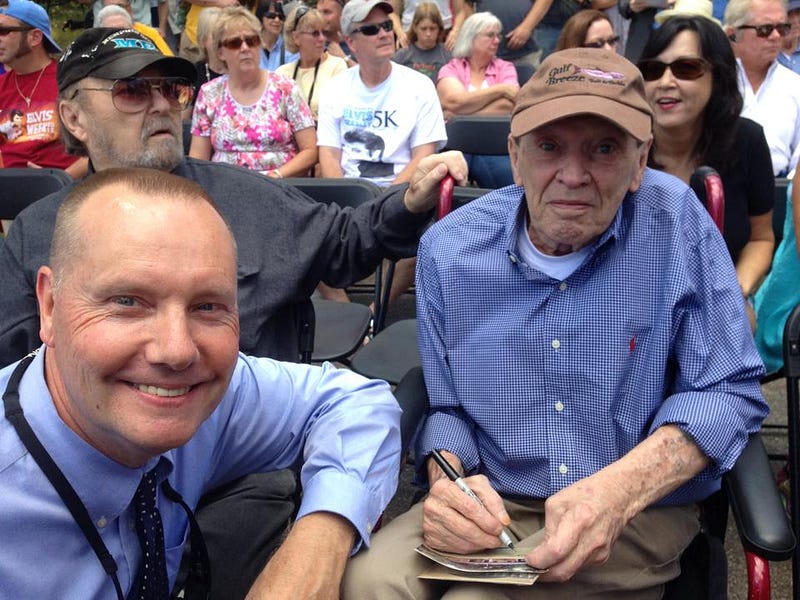
Chips Moman takes a black fine point Sharpie to autograph lucky fan Gary Saunders’ memorabilia on August 13, 2014, during the unveiling of the legendary Memphis Boys’ Shelby County historical plaque marking the site where American Sound Studio once stood, which is currently home to a Family Dollar store. Memphis Mafia foreman Marty Lacker is directly behind Saunders. Image Credit: The Gary Saunders Collection

When did you last speak with Chips?

It was for the ceremonies when the city of Memphis put up a plaque at 827 Thomas Street, in front of the Dollar Store that’s there now, to commemorate American. Graceland unleashed their second Elvis Week concert featuring the Memphis Boys later that night [August 13, 2014].

That’s when Chips told me he didn’t like the book. He was in a wheelchair then, because he had had another stroke. His emphysema was getting the better of him as well. I hated to see him in that kind of shape. He tried to quit smoking several times, poor man, but never succeeded. Unfiltered Camels, the worst.

But I was glad he had lived long enough to see his beloved city bestow recognition. They said at the ceremony that they took my book in to the City Council and the Memphis Historical Society and showed them pages and chapters from it to demonstrate why American had been so important.
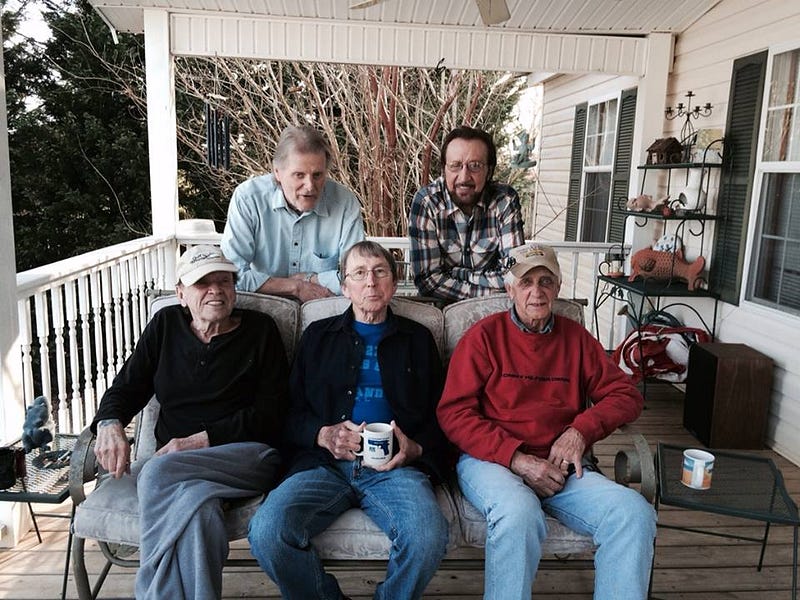
Producer extraordinaire Chips Moman and the Memphis Boys — Reggie Young, Bobby Emmons, Bobby Wood, and Gene Chrisman — are captured on the front porch of dear friend and former Sheriff Donny Turner’s lake house. The group convened circa March 22, 2014, at Turner’s LaGrange, Georgia, home to visit and go out for dinner. LaGrange was Moman’s hometown, and the trailblazing “Do Right Woman, Do Right Man” songwriter would succumb to emphysema in a hospice facility there on June 13, 2016. Only Wood and Chrisman are still among the living. Photography by Jenny Lynn Young

What keeps you contented these days, and is another book on your radar?

I’ve been doing the housewife thing for almost two years now…and I love it. I married my longtime companion, James Fetterly. We found an old 1940s house in Gallipolis, where I’ve been since I was 14 when my family came here. We’ve been doing a lot to it, putting our stamp on it you might say.

This might seem funny to many people, but ever since the book came out I haven’t been able to write a thing. Just a complete case of writer’s block. I wanted to write a biography of Grady Martin, and maybe I will if my “voice” ever comes back. I imagine it will eventually.

When that happens, I not only want to write about Grady but do poetry as well, and get a memoir about growing up in the West Virginia coal camps my mother wrote published. Mom wanted to get it all down on paper before she died because it was a way of life that is now gone. She and one of her older sisters both always wanted to be a writer, and that’s why I became one.

I haven’t given up writing by any means, but after Memphis Boys and all that happened during and as a result of the book, I just burned completely out. It’s only now I realize how much I poured into the writing of that very simple story. I think my whole life went into it.

But I was and am honored to be the one to tell it. I’m kind of happy I was able to put my writing to the purpose of giving recognition to others, rather than have it be just an ego thing about me and what I was doing.
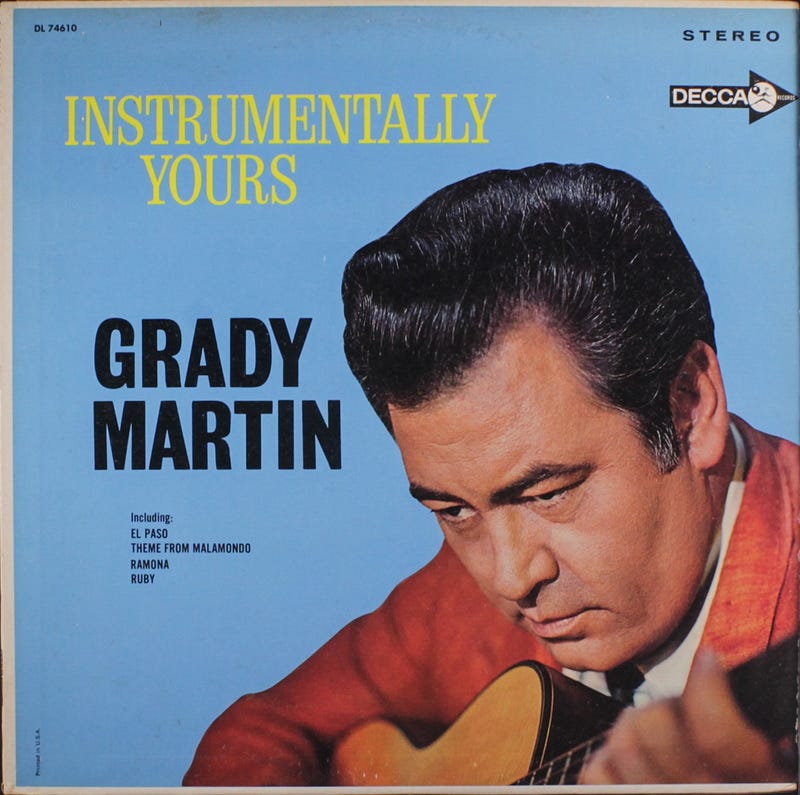
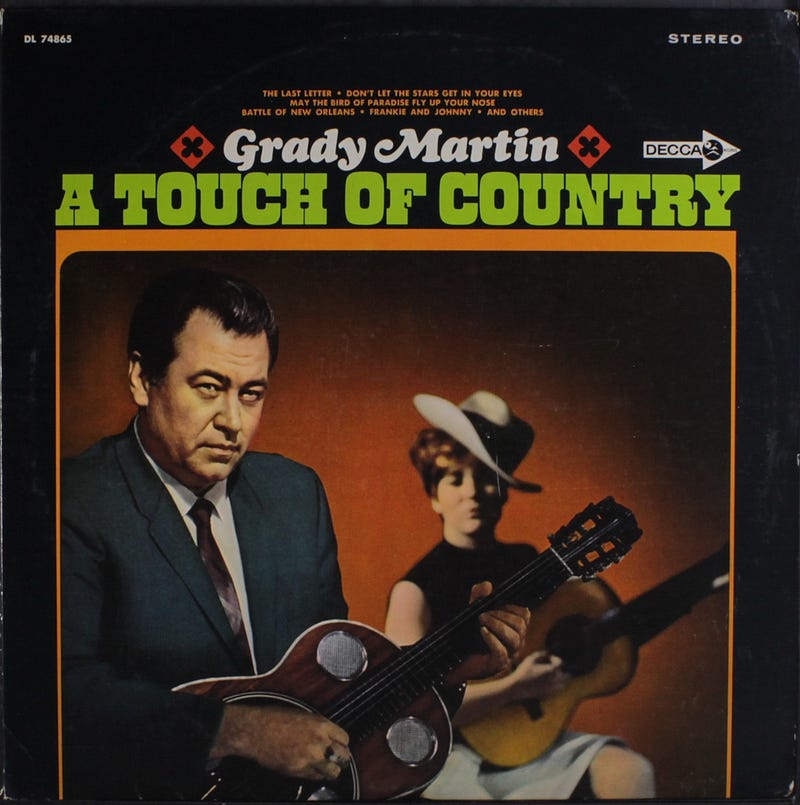
“Instrumentally Yours,” April 1965, and “A Touch of Country,” June 1967, both Grady Martin albums distributed by Decca. Image Credits: Universal Music Group / Records by Mail

Why a bio about Nashville A-Team alum Grady Martin [1929–2001]?

Grady is my favorite session guitarist next to Reggie Young. His work was so varied, so versatile, but always done with passion and heart. The song that turned me on to Grady was “The Partisan” with Joan Baez [Come from the Shadows, 1972].

His collaborations with Marty Robbins remain definitive, especially Gunfighter Ballads and Trail Songs [1959] — e.g. “El Paso,” “Big Iron,” and “The Little Green Valley.” He unleashed the electric guitar solo on Elvis’s “Devil in Disguise” [No. 3 POP, 1963] and is the mandolin player on Larry Gatlin’s “Broken Lady” [No. 5 C&W, 1975], which he recorded with the Memphis Boys under Fred Foster’s direction.

Grady released solo singles as well as 13 albums [1951–1977 on Decca, Capitol, and Monument]. On his 1965 Instrumentally Yours he did a slow ballad called “Theme from Malamondo [Funny World].” Superb. “Ribbon of Darkness,” that he did both with Marty [No. 1 C&W, 1965] and as a solo piece [A Touch of Country, 1967], is phenomenal. On his final Cowboy Classics LP [1977] he arranged and played a version of “Shenandoah” that would break your heart. That’s just for starters.

What doors have been opened in the decade since Memphis Boys was distributed?

I got to write the profile of Chips that appears now in the Memphis Music Hall of Fame at his exhibit [Moman was inducted in 2014]. I got to live a dream come true when Ace Records asked me to help choose the selections for the Memphis Boys companion CD [2012], and I also got to write an essay for the collection. That was a true honor, and I’m most grateful.

The true honor, though, was all the great people I met and in many cases befriended…so many of whom are dead now. I miss them all. Doing the book was such a privilege, a trust, and a labor of love. I really wanted that spotlight to shine on some topnotch talents who never got the credit they deserved.

Don’t go anywhere yet! Both previous chapters of the Roben Jones interview can be accessed below.
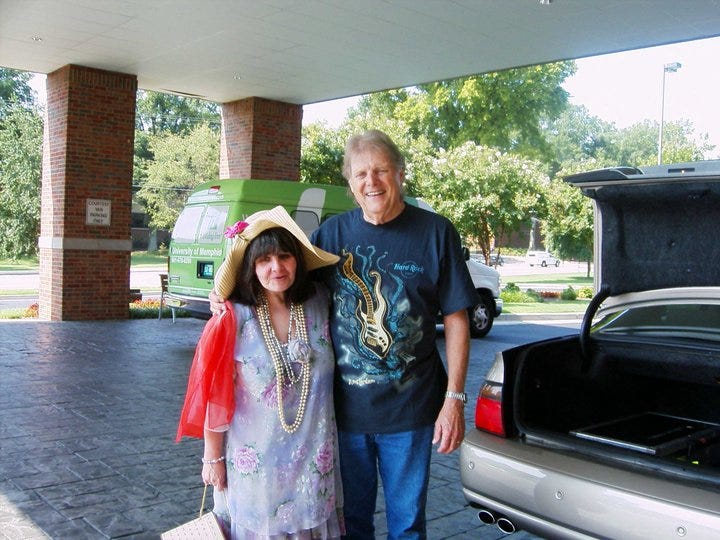
In her lavender “Delta Dawn” dress, “Memphis Boys” biographer Roben Jones bids farewell to ace American Sound guitarist Reggie Young on August 13, 2010, the morning after the “Back in Memphis” benefit for second soprano Myrna Smith of the Sweet Inspirations held at the Michael D. Rose Theater, part of the University of Memphis. Drummer Jerry Carrigan, bassist Norbert Putnam, keyboardist Shane Keister, Austrian singer Dennis Jale, Billy Swan, Mary Holladay, and younger sister Ginger Holladay were all part of the Graceland-boycotted show that was sparsely attended but enthusiastically received by fans. All except Jale played with Elvis Presley or wrote a song he tackled [i.e. Swan’s “I Can Help”] in the 1970s. Image Credit: The Roben Jones Collection

© Jeremy Roberts, 2019. All rights reserved. To touch base, email [email protected] and mention which story led you my way. I appreciate it sincerely.

Music
History
Interview
Books
Creativity
Recommended from ReadMedium