.com/gardening-birding-and-outdoor-adventure"><i>Gardening, Birding and Outdoor Adventure</i></a> for more descriptive stories of hiking and gardening, with some quite successful stories about <a href="https://readmedium.com/abundant-wild-blueberries-in-the-alps-e3c7c6139b98">collecting</a> and <a href="https://readmedium.com/edibles-from-the-forest-funghi-porcini-beefs-919185a7fe38">cooking</a> edibles from the forest.</li><li><a href="https://medium.com/new-writers-welcome"><i>New Writers Welcome</i></a> for stories on writing here - to be consistent with the critique I made above, let me clarify that I try my best to contribute only meaningful content!</li><li><a href="https://medium.com/geekculture"><i>Geek Culture</i></a> and <a href="https://towardsdatascience.com/"><i>Towards Data Science</i></a> for stories on science and technology, in which I had a couple of quite impactful articles (for my standards at least :)</li></ul><h1 id="dcac">4. Organizing talks online (and also giving some)</h1><p id="7fd7">We all felt a bit disconnected from the world during the lockdowns, and at the same time knew others who felt isolated too. The pandemic was an opportunity to learn new and better ways to connect online. I started regular dinners and lunches over Skype, I even remember a birthday over zoom too, and a couple of times I played online alternatives to board games with some friends.</p><p id="9f83">But one particular thing that I enjoyed much, and made me feel very connected, was organizing a series of online talks about science (specifically about biophysics, which is one of the areas in which I work). Similar talks were already taking place all around the world, but I saw the community in Argentina delayed, resilient to start. Together with some friends and colleagues living there, we organized a series of talks that ran for around 4 months, quite successful and with the twist of happening in Spanish only facilitating discussion and including participants from Latin America and Spain. The talks were transmitted live through YouTube by using the fantastic free system provided by StreamYard. And they are still online!</p>
<figure id="c72a">
<div>
<div>
<img class="ratio" src="http://placehold.it/16x9">
<iframe class="" src="https://cdn.embedly.com/widgets/media.html?src=https%3A%2F%2Fwww.youtube.com%2Fembed%2Fvideoseries%3Flist%3DPLZqPrSO9_r69YZlujS4N-h3Io2zUF17jh&display_name=YouTube&url=https%3A%2F%2Fwww.youtube.com%2Fplaylist%3Flist%3DPLZqPrSO9_r69YZlujS4N-h3Io2zUF17jh&image=https%3A%2F%2Fi.ytimg.com%2Fvi%2FPcDIBoMzY9I%2Fhqdefault.jpg%3Fsqp%3D-oaymwEWCKgBEF5IWvKriqkDCQgBFQAAiEIYAQ%3D%3D%26rs%3DAOn4CLCbEOrwyyCCPDelqs1JFNdkUhW1PA%26days_since_epoch%3D18890&key=a19fcc184b9711e1b4764040d3dc5c07&type=text%2Fhtml&schema=youtube" allowfullscreen="" frameborder="0" height="480" width="853">
</div>
</div>
</figure></iframe></div></div></figure><p id="a592">Each session (that took place every two weeks) took around 2 hours because we had 2 talks each day, and although each talk was only around 30 min long, we allowed the public to ask questions through YouTube’s live chat system. It was quite a lot of work, securing speakers, arranging schedules, setting up the broadcast, preparing and distributing advertisements, etc. Beyond the possibility itself of facilitating the continuation of scientific activities and connecting people, another important outcome was that quickly many other groups of researchers followed on the idea and created their own topic-specific series of online seminars!</p><p id="5b0e">Of course, during the pandemic I could also talk myself in other cycles of seminars and online conferences, which was quite cool especially to boost the reach of my different works.</p><h1 id="3419">5. Composting at home</h1><p id="d7ad">As <a href="https://lucianosphere.medium.com/how-winter-compost-went-how-summer-compost-is-going-lessons-on-composting-in-the-form-of-a-story-be3ace21824e">I describe here</a>, composting feels like a very noble activity that closes cycles, and… well it just feels great to know that you are making something useful out of your waste!</p><p id="33b8">I hadn’t prepared compost in years, since I was a kid. And I wasn’t sure it would work in the balcony… but it did, as you can read more here:</p><div id="a67c" class="link-block">
<a href="https://lucianosphere.medium.com/how-winter-compost-went-how-summer-compost-is-going-lessons-on-composting-in-the-form-of-a-story-be3ace21824e">
<div>
<div>
<h2>How winter composting in the balcony went; how summer composting is going.</h2>
<div><h3>Composting is to me a quite “noble” activity. It closes cycles: that of plants that reached their ends, that of edibles…</h3></div>
<div><p>lucianosphere.medium.com</p></div>
</div>
<div>
<div style="background-image: url(https://miro.readmedium.com/v2/resize:fit:320/1*Np0qZ2qRHClwH6E42_BS8w.jpeg)"></div>
</div>
</div>
</a>
</div><p id="f1ab">And here an update of my second batch of balcony compost, which matured during the summer:</p><figure id="a046"><img src="https://cdn-images-1.readmedium.com/v2/resize:fit:800/1*v0ipBxhzByuq1kFr9FR76w.jpeg"><figcaption>Summer compost, just in the Ikea bag as I explained in my previous story. Photo by author Luciano Abriata.</figcaption></figure><h1 id="0f2d">6. Crafting hobbies</h1><p id="64f3">A hobby I had before leaving my country to work here was making pots out of cement and any kinds of natural materials I could mix with it: sand, clay, small stones, smashed bricks, even moss and just soil. Well, I just bought some cement, laid some layers of newspapers on the floor in my balcony, and started playing again.</p><p id="08ea">As simple as that! And here you have my first pot already with plants inside:</p><figure id="7675"><img src="https://cdn-images-1.readmedium.com/v2/resize:fit:800/0*NKH8QRSDklvge3Z_.jpg"><figcaption></figcaption></figure><h1 id="4cbb">7. Learning about the stock market</h1><p id="b455">The world of finances has always been difficult for me. Even the very concept of money was never entirely clear, despite my brother’s efforts to explain me. With the pandemic, I could start reading some new books (among which I especially highlight Yuval Noah Harari’s <a href="https://www.ynharari.com/es/book/de-animales-a-dioses-sapiens/"><i>Sapiens: A brief history of mankind</i></a>) and then jump to blogs specialized on finances and the stock market. In particular, <a href="https://thepoorswiss.com/">this blog</a> taught me lots, perhaps because it’s written by a computer/data scientist who uses a vocabulary not too far from my own.</p><figure id="2427"><img src="https://cdn-images-1.readmedium.com/v2/resize:fit:800/1*Ze0n5LVZPqo21JPHQy83Vw.png"><figcaption>Evolution of the S&P 500 index in the last 5 years, taken from Yahoo Finance. Figure based on screenshot by author Luciano Abriata.</figcaption></figure><p id="ca75">Well, I haven’t learned a lot, but I’m better off than before. And although I wouldn’t risk doing any investments myself, I did engage with RoboAdvisors as a first way to practically do something about it. I’m now collecting lots of data along the process while I keep studying (although I admit I have been leaving this a bit on the side lately), and I am doing some simple analyses that probably make little sense for an expert / serious investor yet keep me busy and interested. Perhaps someday I will present some of my findings in this platform.</p><h1 id="777d">8. Learning about cryptocurrencies and the crypto-world</h1><p id="df59">This was even far less familiar than finances and the stock market. In fact I’d say all the crypto-stuff was kind of taboo for me, until I began reading blogs and watching videos prepared by experts or in some cases science+technology communicators who brought experts to their b(v)logs.</p><p id="31a3">It’s still not clear to me (partly because I know little, partly because even experts disagree) what will happen with cryptocurrencies, crypto art, NFTs, etc. What I’m sure about (although I can well be wrong, so don’t take any of this as advi
Options
ce!) is that blockchain technology is in fact useful, already with several applications beyond cryptocurrencies. And regarding the cryptocurrencies themselves, I think that the original motivation was excellent, but I see in practice that most if not all people investing on them are simply speculating and don’t give a damn about decentralization and the benefits associated to crypto-stuff.</p><p id="a2a6">Despite these negative comments, I did try to buy and exchange cryptos for around 2 months. I first lost and then recovered, even won a small margin; at that point I quickly sold everything and moved out. I will explain more about all this in a dedicated story. For the moment, let me clarify that the learning process was super interesting; in fact, it motivated me enough to go write programs that use free APIs to download and process data. See here:</p><div id="873a" class="link-block">
<a href="https://towardsdatascience.com/obtaining-historical-and-real-time-crypto-data-with-very-simple-web-programming-7b481f153630">
<div>
<div>
<h2>Obtaining historical and real-time crypto data with very simple web programming</h2>
<div><h3>While learning about cryptocurrencies, I desperately needed data that I could manipulate myself to do my own plots and…</h3></div>
<div><p>towardsdatascience.com</p></div>
</div>
<div>
<div style="background-image: url(https://miro.readmedium.com/v2/resize:fit:320/1*s-HkYvBq7QyIzzY2ztRJ_w.png)"></div>
</div>
</div>
</a>
</div><h1 id="c0c0">9. Learning to program in online notebooks</h1><p id="1618">I learned to program in the mid-90s when I was around 13 years old. I went the hard way: nobody at home knew much about computers, let alone about programming; there was no Internet (luckily my father could borrow some easy books from a programmer friend); and the only programming language I had at hand was the <a href="https://en.wikipedia.org/wiki/QBasic">QBASIC</a> that came with <a href="https://en.wikipedia.org/wiki/MS-DOS">DOS</a>.</p><p id="ba4e">Fortunately for youngsters, nowadays it is far easier to learn programming. There are many more resources, languages, online information, ways to try without breaking, etc. And probably the coolest resource are the so-called call “Notebooks”, like Jupyter, that I never had the time to try. Until the pandemic.</p><p id="a791">I haven’t become an expert, but I’ve worked for some time with two online notebooks called <i>Google Colab</i> and <i>Codepen.</i></p><p id="2ba0"><i>Codepen </i>is an online notebook for trying out client-side web code i.e. HTML, CSS, and JavaScript. With it, users can edit code online, share it, and test modifications (and thus teach, learn, and debug) in real-time. I find it extremely powerful for developing, especially when I want to try, improve or modify small scripts or functions.</p><p id="91ad"><i>Google Colab(oratory)</i> is a Jupyter notebook environment that runs in the cloud using resources (memory, GPUs, etc.) provided by Google itself. The notebooks are stored on Google Drive and can read and write inputs and outputs for the programs you write. As you may have seen in other stories, several great Google colab notebooks have been released that allow you to use/extend/tailor the work of great programmers to your needs. Among others I have analyzed in my stories, there are the Colab notebooks to run AlphaFold:</p><div id="6ac8" class="link-block">
<a href="https://towardsdatascience.com/google-colab-notebooks-are-already-running-deepminds-alphafold-v-2-92b4531ec127">
<div>
<div>
<h2>Google colab notebooks are already running Deepmind’s AlphaFold v. 2</h2>
<div><h3>Hundreds of scientists around the world are already profiting from this revolutionary software. And at no cost.</h3></div>
<div><p>towardsdatascience.com</p></div>
</div>
<div>
<div style="background-image: url(https://miro.readmedium.com/v2/resize:fit:320/1*puMXYM0XxkZN5JkCzOkWUQ.png)"></div>
</div>
</div>
</a>
</div><div id="ad42" class="link-block">
<a href="https://towardsdatascience.com/the-hype-on-alphafold-keeps-growing-with-this-new-preprint-a8c1f21d15c8">
<div>
<div>
<h2>The hype on AlphaFold keeps growing with this new preprint</h2>
<div><h3>Check out this new work democratizing access to the full power of AlphaFold2 by integrating it with a powerful protein…</h3></div>
<div><p>towardsdatascience.com</p></div>
</div>
<div>
<div style="background-image: url(https://miro.readmedium.com/v2/resize:fit:320/1*6ICMcLnZyF6ZaJk-AaszGw.png)"></div>
</div>
</div>
</a>
</div><p id="af80">Also this notebook to run molecular dynamics simulations online:</p><div id="99f9" class="link-block">
<a href="https://towardsdatascience.com/new-preprint-describes-google-colab-notebook-to-efficiently-run-molecular-dynamics-simulations-of-9b317f0e428c">
<div>
<div>
<h2>New preprint describes Google Colab notebooks to efficiently run molecular dynamics simulations of…</h2>
<div><h3>Following the success of AlphaFold on Google Colab, this new work brings the OpenMD package for molecular dynamics…</h3></div>
<div><p>towardsdatascience.com</p></div>
</div>
<div>
<div style="background-image: url(https://miro.readmedium.com/v2/resize:fit:320/1*WOkV1zNSlXTfDIHOa1vuIw.png)"></div>
</div>
</div>
</a>
</div><p id="619e">And one of my favorites, a neural network that “dreams” art from a given set of keywords:</p><div id="daa5" class="link-block">
<a href="https://towardsdatascience.com/how-this-artificial-dreaming-program-works-and-how-you-can-create-your-own-artwork-with-it-387e5fb369d9">
<div>
<div>
<h2>How this “artificial dreaming” program works, and how you can create your own artwork with it</h2>
<div><h3>You don’t need to know any programming -just have a Google account. Here is an article straight to the point, reviewing…</h3></div>
<div><p>towardsdatascience.com</p></div>
</div>
<div>
<div style="background-image: url(https://miro.readmedium.com/v2/resize:fit:320/1*cKcC_-spIPoOoXwFDUvOCg.png)"></div>
</div>
</div>
</a>
</div><p id="7035">For other cool Google Colab notebooks up there for you to use, I strongly recommend this article by <a href="undefined">Vlad Alex (Merzmensch)</a>:</p><div id="73b4" class="link-block">
<a href="https://towardsdatascience.com/12-colab-notebooks-that-matter-e14ce1e3bdd0">
<div>
<div>
<h2>12 Colab Notebooks that matter</h2>
<div><h3>StyleGAN, GPT-2, StyleTransfer, DeOldify, Magenta etc. to try out</h3></div>
<div><p>towardsdatascience.com</p></div>
</div>
<div>
<div style="background-image: url(https://miro.readmedium.com/v2/resize:fit:320/1*WeFdLATk1ljYzMTc4TpAbQ.jpeg)"></div>
</div>
</div>
</a>
</div><p id="b648"><b>I hope you have found my experiences inspiring, motivating you to pursue your new (and/or forgotten) interests and hobbies.</b></p><p id="eff4"><i>I am a nature, science, technology, programming, and DIY enthusiast. Biotechnologist and chemist, in the wet lab and in computers. I write about everything that lies within my broad sphere of interests. Check out my <a href="https://lucianosphere.medium.com/lists">lists</a> for more stories. <a href="https://lucianosphere.medium.com/membership">Become a Medium member</a> to access all stories by me and other writers, and <a href="https://lucianosphere.medium.com/subscribe">subscribe to get my new stories</a> by email (original affiliate links of the platform).</i></p></article></body>
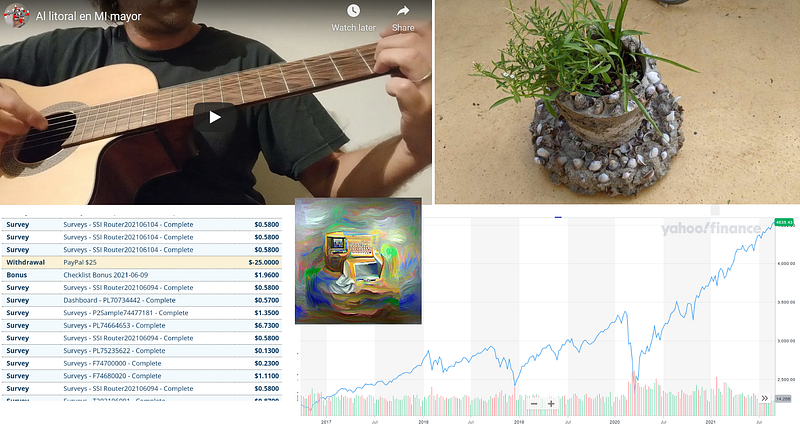
Music, programming for art, writing here, crafting, side-hustles, and lots of learning. Figure composed by author Luciano Abriata.
It’s never too late
9 studies, side hustles, and hobbies I started from scratch during (and thanks to) the pandemic -to inspire you to start your own!
I should have engaged in these activities and studies years ago. But I only started them thanks to the time freed and home-locking that came with the pandemic. Fortunately, it’s never too late, so go find out and develop your own!
There was a pretty nice guitar at home that I had never touched. It stood right next to the desk that became my new workplace when the pandemic sent us to work at home. While working, I here and there touched (not played) it by the side. And I kind of liked how it sounded, even though all the strings were “open” (i.e. not pressing on any fret).
I always saw the guitar as a totally unapproachable instrument, totally unlike the only other instrument I can (barely) play, the drums. But talking to a friend on zoom (you know, the typical chit-chat before you begin to work) she recommended that I try out lessons on zoom with her husband. And wow… a year and a half have passed of almost uninterrupted lessons, and I regret so much not having started earlier!
Since I started in April 2020, now each time I wait for scripts to complete or files to move up or down the internet in my work desk at home, I take the guitar and practice. And practice again. And over and over.
The lessons I take include learning about the guitar itself, and also some basic theory on music, which I found fascinating. In the last few months I could even begin to compose small pieces, like this one:
2. Doing side hustles online
As I explained in this other story, I always had a strong tendency to overwork far outside normal hours and days. And the pandemic made it worse, especially because I collaborated with a colleague living in a country 9 hours behind me which meant that I worked on my stuff from the morning until around 16 hs, and then started working with him, easily staying connected until 22 or 23 hs at night, every day until October when he moved here.
I won’t go into details because it’s all in that other story, but yes, I wanted to overwork less and eventually use some of the release time to start side hustles. As I explained in that other story, without the commitment to start these side hustles, I wouldn’t be writing here at all!
One particular side hustle had to do with writing, especially here. I count it separately from the point above because it's by far the side hustle I enjoy most.
I started without any subscription, just posting small stories and trying to read a lot of the content of other writers. But of course, I couldn’t read much due to the limitation of 3 free stories per month. So as I explained in the story posted above, I began by making a small income from paid online surveys, selling old stuff, and doing a few other small hustles; and with part of these gains I purchased a 1-year subscription to this platform (you may wonder why I didn’t just pay the subscription… well, because I took all this as a kind of self-supported project starting from scratch -see the story above and you’ll get it).
It turned out that becoming a member had lots of benefits, as I describe here:
By far, the most important benefit was the possibility of having access to read all the stories I wanted, which allowed me to connect with the community: With so much reading, I could understand the mechanisms of how things work out here. And although the app and site kept proposing me large numbers of boring stories about how people succeed in the platform, essentially void of content, by reading more I reached people and publications that really mattered and wanted to hear what I had to say:
Anne Bonfert -she surely doesn’t know it but I try to learn from her posts as much as possible, always distilling her style from her articles! -I’m not jumping from planes like her and will never do that (I think) but I feel we share many interests, ways of writing, and ways of viewing things.
The World Travelers Blog for articles on traveling, to which I have so far contributed only one article but have quite some material for the future.
New Writers Welcome for stories on writing here - to be consistent with the critique I made above, let me clarify that I try my best to contribute only meaningful content!
Geek Culture and Towards Data Science for stories on science and technology, in which I had a couple of quite impactful articles (for my standards at least :)
4. Organizing talks online (and also giving some)
We all felt a bit disconnected from the world during the lockdowns, and at the same time knew others who felt isolated too. The pandemic was an opportunity to learn new and better ways to connect online. I started regular dinners and lunches over Skype, I even remember a birthday over zoom too, and a couple of times I played online alternatives to board games with some friends.
But one particular thing that I enjoyed much, and made me feel very connected, was organizing a series of online talks about science (specifically about biophysics, which is one of the areas in which I work). Similar talks were already taking place all around the world, but I saw the community in Argentina delayed, resilient to start. Together with some friends and colleagues living there, we organized a series of talks that ran for around 4 months, quite successful and with the twist of happening in Spanish only facilitating discussion and including participants from Latin America and Spain. The talks were transmitted live through YouTube by using the fantastic free system provided by StreamYard. And they are still online!
Each session (that took place every two weeks) took around 2 hours because we had 2 talks each day, and although each talk was only around 30 min long, we allowed the public to ask questions through YouTube’s live chat system. It was quite a lot of work, securing speakers, arranging schedules, setting up the broadcast, preparing and distributing advertisements, etc. Beyond the possibility itself of facilitating the continuation of scientific activities and connecting people, another important outcome was that quickly many other groups of researchers followed on the idea and created their own topic-specific series of online seminars!
Of course, during the pandemic I could also talk myself in other cycles of seminars and online conferences, which was quite cool especially to boost the reach of my different works.
5. Composting at home
As I describe here, composting feels like a very noble activity that closes cycles, and… well it just feels great to know that you are making something useful out of your waste!
I hadn’t prepared compost in years, since I was a kid. And I wasn’t sure it would work in the balcony… but it did, as you can read more here:
And here an update of my second batch of balcony compost, which matured during the summer:
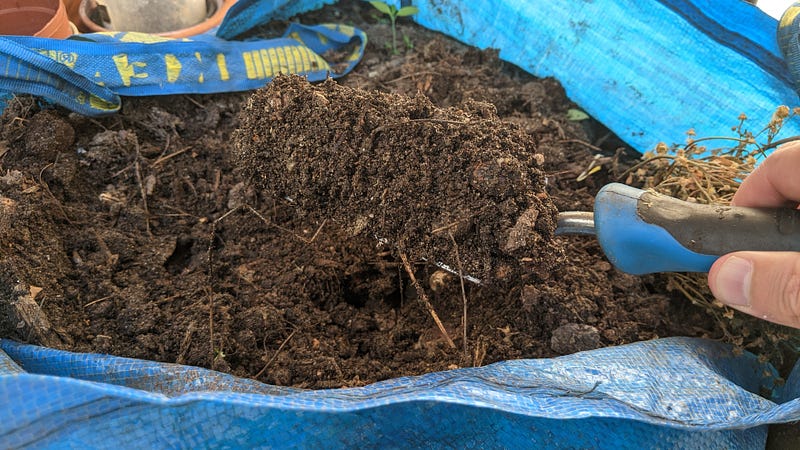
Summer compost, just in the Ikea bag as I explained in my previous story. Photo by author Luciano Abriata.
6. Crafting hobbies
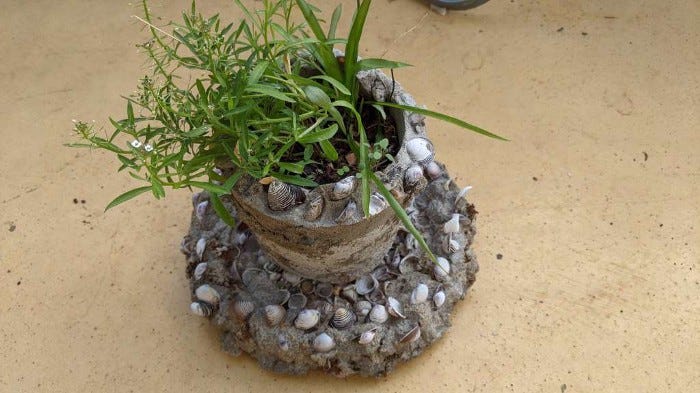
A hobby I had before leaving my country to work here was making pots out of cement and any kinds of natural materials I could mix with it: sand, clay, small stones, smashed bricks, even moss and just soil. Well, I just bought some cement, laid some layers of newspapers on the floor in my balcony, and started playing again.
As simple as that! And here you have my first pot already with plants inside:
7. Learning about the stock market
The world of finances has always been difficult for me. Even the very concept of money was never entirely clear, despite my brother’s efforts to explain me. With the pandemic, I could start reading some new books (among which I especially highlight Yuval Noah Harari’s Sapiens: A brief history of mankind) and then jump to blogs specialized on finances and the stock market. In particular, this blog taught me lots, perhaps because it’s written by a computer/data scientist who uses a vocabulary not too far from my own.
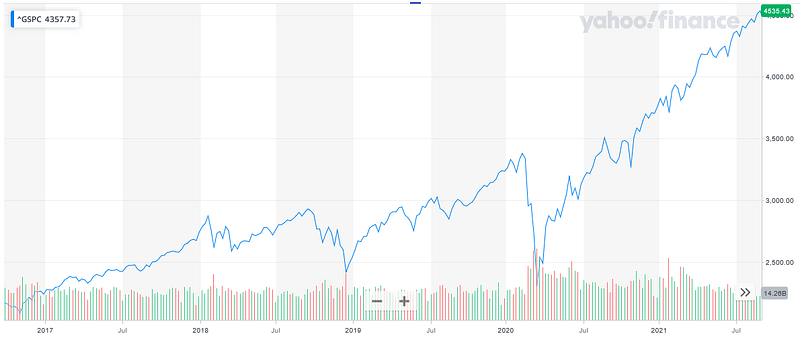
Evolution of the S&P 500 index in the last 5 years, taken from Yahoo Finance. Figure based on screenshot by author Luciano Abriata.
Well, I haven’t learned a lot, but I’m better off than before. And although I wouldn’t risk doing any investments myself, I did engage with RoboAdvisors as a first way to practically do something about it. I’m now collecting lots of data along the process while I keep studying (although I admit I have been leaving this a bit on the side lately), and I am doing some simple analyses that probably make little sense for an expert / serious investor yet keep me busy and interested. Perhaps someday I will present some of my findings in this platform.
8. Learning about cryptocurrencies and the crypto-world
This was even far less familiar than finances and the stock market. In fact I’d say all the crypto-stuff was kind of taboo for me, until I began reading blogs and watching videos prepared by experts or in some cases science+technology communicators who brought experts to their b(v)logs.
It’s still not clear to me (partly because I know little, partly because even experts disagree) what will happen with cryptocurrencies, crypto art, NFTs, etc. What I’m sure about (although I can well be wrong, so don’t take any of this as advice!) is that blockchain technology is in fact useful, already with several applications beyond cryptocurrencies. And regarding the cryptocurrencies themselves, I think that the original motivation was excellent, but I see in practice that most if not all people investing on them are simply speculating and don’t give a damn about decentralization and the benefits associated to crypto-stuff.
Despite these negative comments, I did try to buy and exchange cryptos for around 2 months. I first lost and then recovered, even won a small margin; at that point I quickly sold everything and moved out. I will explain more about all this in a dedicated story. For the moment, let me clarify that the learning process was super interesting; in fact, it motivated me enough to go write programs that use free APIs to download and process data. See here:
I learned to program in the mid-90s when I was around 13 years old. I went the hard way: nobody at home knew much about computers, let alone about programming; there was no Internet (luckily my father could borrow some easy books from a programmer friend); and the only programming language I had at hand was the QBASIC that came with DOS.
Fortunately for youngsters, nowadays it is far easier to learn programming. There are many more resources, languages, online information, ways to try without breaking, etc. And probably the coolest resource are the so-called call “Notebooks”, like Jupyter, that I never had the time to try. Until the pandemic.
I haven’t become an expert, but I’ve worked for some time with two online notebooks called Google Colab and Codepen.
Codepen is an online notebook for trying out client-side web code i.e. HTML, CSS, and JavaScript. With it, users can edit code online, share it, and test modifications (and thus teach, learn, and debug) in real-time. I find it extremely powerful for developing, especially when I want to try, improve or modify small scripts or functions.
Google Colab(oratory) is a Jupyter notebook environment that runs in the cloud using resources (memory, GPUs, etc.) provided by Google itself. The notebooks are stored on Google Drive and can read and write inputs and outputs for the programs you write. As you may have seen in other stories, several great Google colab notebooks have been released that allow you to use/extend/tailor the work of great programmers to your needs. Among others I have analyzed in my stories, there are the Colab notebooks to run AlphaFold:
I hope you have found my experiences inspiring, motivating you to pursue your new (and/or forgotten) interests and hobbies.
I am a nature, science, technology, programming, and DIY enthusiast. Biotechnologist and chemist, in the wet lab and in computers. I write about everything that lies within my broad sphere of interests. Check out my lists for more stories. Become a Medium member to access all stories by me and other writers, and subscribe to get my new stories by email (original affiliate links of the platform).