
9 Practical Life-Saving Facts You Should Know
We all have the potential to save someone’s life

You have a chance to save lives! If you don’t take it, you may regret it! — Widad Akrawi
On the fateful day of 14th April 2008, Uganda lost 19 young souls (aged 9 to 12) to an inferno that devoured a children’s dormitory. The news spread like wildfire across the country.
All children were girls in Budo Junior School, and while they slept, the dark was interrupted with fury tongues of flames that would later decimate the entire structure they had felt safe in so many times. I was traumatized.
It was later determined that most of the children had died from suffocation and not from the flames of the fire. This made me realize that we should be educating each other on practical ways to react in times of emergency.
The world needs more people who save lives.
Here are 10 life-saving facts that you should know.
1. If caught in a fire, stay as close to the ground as possible and move away from the fire source
Endeavour to inhale as little smoke as possible.
According to this paper by Gordon Andrews in the Research Gate, the leading cause of death for fire victims around the world has been smoke inhalation for many decades. Also, fires occurring in buildings are responsible for over 75% of total fire fatalities.
Several major fire accidents, where fire toxicity was the cause of death for almost all victims, are highlighted. Statistical reviews of fire casualties for several decades in the UK and the USA show that fire toxicity is the major cause of death for fire victims.
The greatest threat during a fire comes from carbon monoxide fumes, not burns. To avoid inhaling poisonous smoke, try to stay as close to the floor as possible — right until you vacate the danger area.
2. Learn the Heimlich maneuver for choking
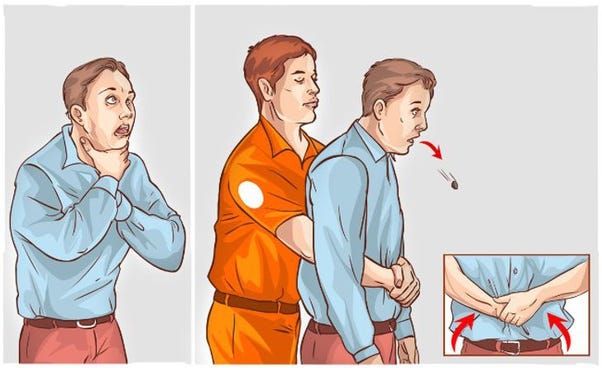
Anyone can choke on anything, anywhere, at any time, and everyone should be prepared in a choking emergency. Ending preventable choking deaths has an answer — the Heimlich Maneuver.
Learning the Heimlich is a series of four simple steps. If you do not know the maneuver, you should learn it! You can save a life.
- Place your fist, thumb side in, just above the person’s navel.
- Grasp the fist tightly with your other hand and move it upwards, applying strong pressure to their rib cage.
- Repeat such quick upward and inward thrusts until you dislodge the object blocking their airway.
- If none of the above-mentioned actions produces an effect, lean the person over a fixed horizontal object, such as a table edge, chair, or railing, and press their abdomen just above the navel against the edge to produce a quick upward pressure. Repeat until the object is expelled.
Here is a more detailed article from the Heimlich Heroes blog if you want to read more on the Heimlich Maneuver.
3. What you can do if someone may be having a heart attack
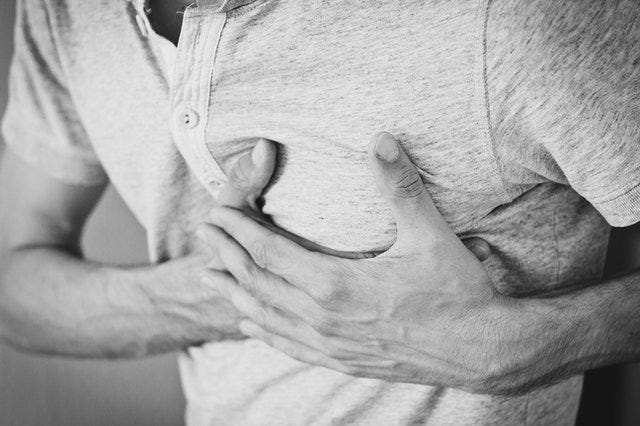
According to the Center for Disease Control, CDC, about 805,000 Americans have a heart attack annually. Of these, 605,000 are a first heart attack. 200,000 happen to people who have already had a heart attack.
With one out of every seven deaths happening in the US because of heart disease, it’s important to know the common signs of heart attacks and what you can do to help a person going through it.
Sometimes the symptoms are cardiac arrest (which would require CPR), and at other times they’re not so dramatic and could just seem like heartburn. After calling for help, if the person is over the age of 16 and confirms he/she isn’t allergic to aspirin — and isn’t taking any medications that could interact with it — offer a tablet of aspirin, which the Mayo Clinic says could reduce damage to the heart.
4. In case of vegetable oil catching fire on a gas stove, quickly turn off the gas and put something over the pan to smother the flames
Do not pour water on the flames.
Firefighters warn never to use water when trying to extinguish burning fat or oil. Water particles will immediately end up at the bottom of the pan and evaporate, making the flames even stronger.
The correct action is to cover the burning pan with something such as a heavy cloth, or another pan, as this will cut off the fire’s supply of heat and oxygen.
5. Always remember the Rule of Three when it comes to your body’s endurance limits
3 minutes without air;
3 days without water;
3 weeks without food.
According to Wikipedia, the rule of threes involves the priorities to survive. Depending on the place where one lives, the rule allows people to effectively prepare for emergencies and determine decision-making in case of injury or danger posed by the environment.
For real survival situations, it is better to remember and prioritize by the four levels of the Survival Rules of 3:
- You can survive for 3 minutes without air (oxygen) or in icy water
- You can survive for 3 hours without shelter in a harsh environment (unless in icy water)
- You can survive for 3 days without water (if sheltered from a harsh environment)
- You can survive for 3 weeks without food (if you have water and shelter).
6. What you can do to save someone who is drowning
Drowning is one of the most common causes of accidental death, especially among children. If you’re not a skilled swimmer who knows how to swim with a possibly flailing person, the most important thing to know is that swimming out to the person should be the last resort.
A paper by the American Red Cross offers this mnemonic: Reach, Throw, Don’t Go.
Reach: If the person is near the edge of a pool or dock, lie flat on the ground and try to reach the person. Use a tree branch, oar, towel, or shepherd’s hook to lengthen your reach. If you have to, get in the water and hold on to the pool edge or dock while trying to reach the person.
Throw: Throw a safety ring, if available
Don’t go, row: Get a boat if one is available and row out to the person
Go: As a last resort, swim out. Bring a rescue safety ring, towel, or shirt with you so you can tow the person in.
7. Do not remove a knife or other sharp object from a wound
According to the U.S. National Library of Medicine and National Institutes of Health, experts say that under no circumstances should you remove a knife or any other sharp object from a wound.
As long as the knife stays in the wound, it prevents bleeding — possibly the most dangerous consequence of any stabbing. What you should do is try to minimize the bleeding even further as you wait for medical help to arrive.
8. Be especially careful during the first three minutes after takeoff and the last eight minutes before landing
A 2020 research study conducted by Boeing indicates that takeoff and landing are statistically more dangerous than any other part of a flight. Boeing is the world’s largest aerospace company and leading manufacturer of commercial jetliners and defense.
According to the study, 49% of all fatal accidents happen during the final descent and landing phases of the average flight, while 14% of all fatal accidents happen during takeoff and initial climb.
The best way to behave is to remain extra vigilant and focus on memorizing your required actions during an emergency.
9. Memorize the basic rules of conduct in case of an emergency wherever you are
My friends laugh about me being overly careful. Whenever I am in a new place, I ensure that I know all the exits and how to get to them. I check where the fire extinguishers are placed in case of a fire. I endeavor to understand where I am located in the building.
It is a habit I picked up over a decade ago because I was still young but traveling on my own quite a lot. It helped me feel more secure.
All too often, when faced with a never-before-experienced crisis, we tend to freeze up and do nothing to save ourselves. Survival specialists advise you always to check out the emergency exit map in any building you happen to visit frequently.
Best to do it beforehand and not wait for a possible emergency to occur!
Bonus Practical Tips
This one was so generously provided by Jaya Daniel (thank you so much).
10. If trapped inside a car that is sinking into water, use the headrests.
Another important one to know is that if you get trapped inside a submerging car, you can pull your headrest out and use the pointed end of the posts to smash the window.
They design them to be used for that purpose.
Thank you Jaya!
This one was so generously provided by peter dohan, MD (thank you so much).
11. Aspirin
All adults should carry a baby aspirin with them. If an MI is suspected, it should be chewed to speed its anti-coagulant function to the clot causing the MI.
An MI is myocardial infarction, aka heart attack.
This one was so generously provided by Franklin (thank you so much).
12. Unlearn the heimlich manoeuvre and learn the proper way to dislodge food that isn’t itself dangerous!
You tilt the person forward and use the flat of your hand to forcefully hit their back. Heimlich manoeuvre can genuinely be deadly and is a far less efficient, and more disruptive action.
And now your thoughts…
I hope you found these useful. What are some other facts you think everyone should know?
Please consider signing up for membership HERE to directly support my writing.
You may share this link with others who like to read up on love, life, relationships, and mental health. Thank you ❤ ❤ ❤
You may also enjoy reading these stories


