
Andy Stanley is dropping truth bombs on Evangelicals
Why is a pastor taking on his own religion?
A viral video made the rounds of Evangelical social media, as the religion was once again horrified by Andy Stanley. He does say the most upsetting things.
Back in 2018 he claimed that Evangelicals should “unhitch” from the Old Testament. But that was nothing compared to talking about “gay Christians”—a concept the religion doesn’t even recognize. He went on and on.
“After the way the church has treated the gay community, I’m telling you, they have more faith than I do. They have more faith than a lot of you.”
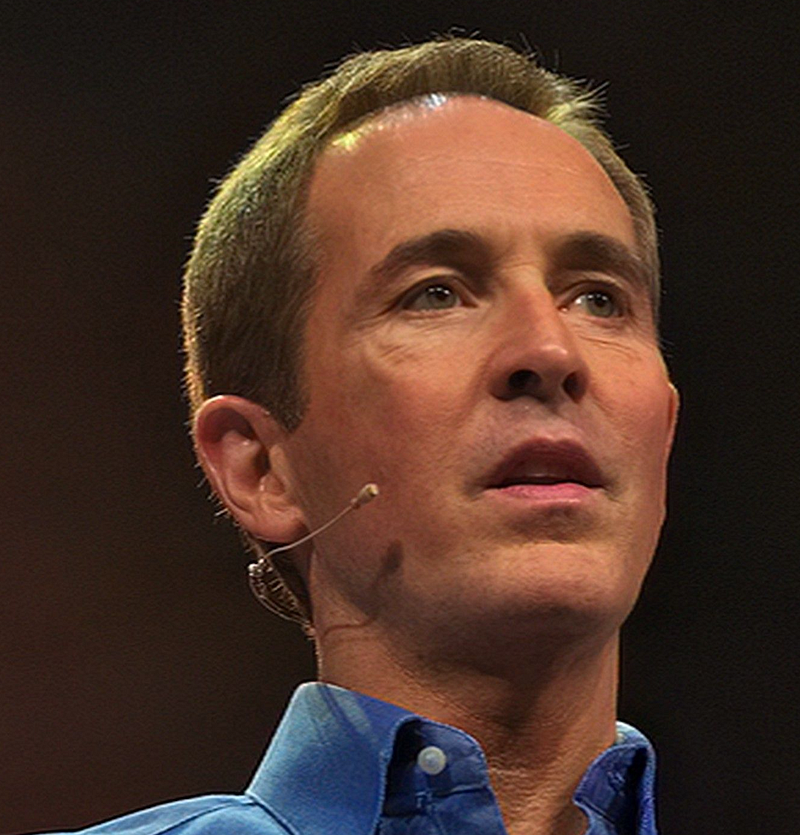
His reviews poured in—like hot lava.
Many Evangelicals wanted to make quite clear that gays are not Christians—and neither is Andy Stanley.
Liberal Christians were into it.
Andy Stanley is an interesting case study in Evangelicalism.
He often doesn’t even seem Evangelical. He’s different? But when the religion looks at him, they see one thing, and that is his father.
Let’s discuss, briefly, a subject that Evangelicals don’t speak about openly.
The religion deeply believes that males are the vehicle of God’s “work” on earth. But the divinity is seen to intensify around a man who is his father’s first son. He is closest to God!
Leaders of the religion are all but required to be the first son of a prominent pastor or noted evangelist.
There’s Franklin Graham—the first son of Billy Graham.
There’s John MacArthur—the only son of Jack MacArthur.
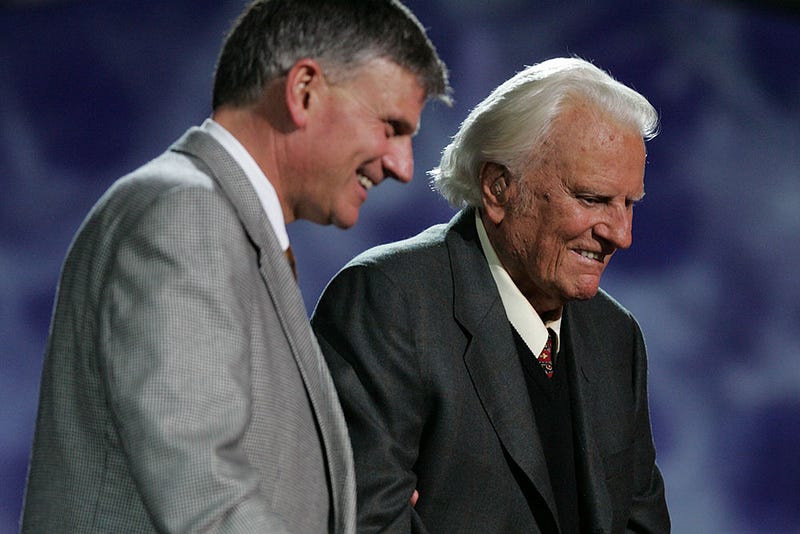

Some clerics become stars and never have sons.
The name Oral Roberts used to be well-known in the religion. The faith-healing pastor from Oklahoma had two sons, and greatly desired his eldest, Ronnie, to take over from him.
Ronnie could’ve become the face of Christianity in America. But he was gay and self-destructive, and killed himself in 1982.
Rick Warren was positioned to create a pastoral lineage, but his only son, Matthew, killed himself in 2013, to sighs about mental illness.
John Piper—the son of the evangelist Bill Piper—had four sons, but the only one gifted with public presence was Abraham, the androgynous jester who dissected his father on social media.
Jerry Falwell reigned for decades as a showman of the religion—rivaling Billy Graham himself. His eldest son, Jerry Jr., was never even a Christian, but played the role of ‘first son’ publicly until a toxic tabloid exposé took him down. Then he went out to burn down his father’s legacy.
It’s not easy being the son of a powerful pastor.
But one first son had carefully nurtured the connection—even though he and his father weren’t much alike. Crisp and professional, pleasant and smiling, Andy Stanley isn’t very Evangelical at all.
But he was Charles Stanley’s eldest and only son, and that meant Andy was a star in America’s largest religion.
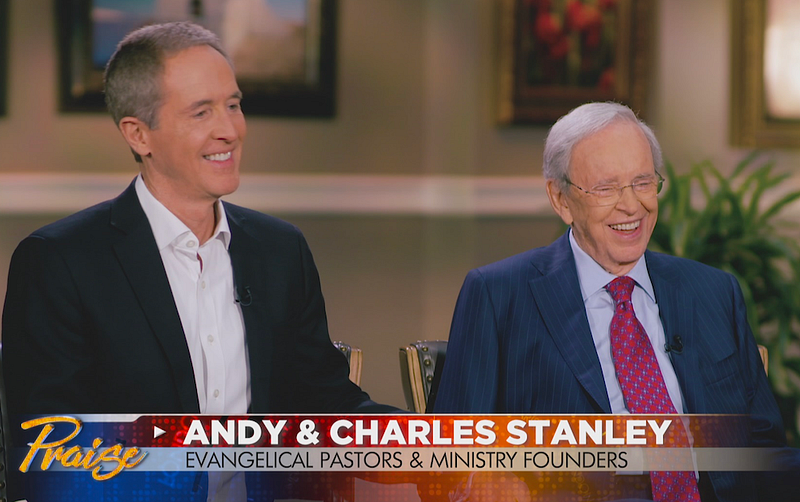
He did his best to distance himself from the core Evangelical concerns.
Andy’s 2012 memoir, Deep and Wide, narrates his early years working under his father at First Baptist in Atlanta, when he began to realize there was ongoing warfare between his church and the local gay community.
He writes:
“For some reason that nobody can remember, our church got crossways with the gay community in Atlanta. This was back when nobody really talked about that kind of thing in church. So I’m not sure what created all the hoopla.”
He knows very well what created the ‘hoopla’. At the height of the AIDS epidemic, his father was the key national messenger for the great Evangelical idea that the virus was “God’s punishment.”
Andy recalls a scene in 1987, when a Gay Pride parade passed in front of his father’s church—to hateful exchanges on both sides. Meanwhile, the Methodist church across the street was handing out bottled waters.
“It was embarrassing,” he writes.
In 1995, Andy founded his own church.
North Point Community Church in Alpharetta, Georgia wasn’t Southern Baptist, but was Evangelical. With smooth managerial skill, he worked for a kinder, gentler branding on the religion.
But year after year, Evangelicalism is ever more insistently a religion whose central and even only teaching is that gays are ‘bad’.
Evangelicals worship masculinity, preferably in a style that’s tough and punishing. They see their great worship practices as marrying, producing children, and controlling them.
An Evangelical man need do nothing else. It’s a religion whose central practice is being—or obeying—a “man.”
And it works, or has for years.
Lately, Southern Baptist attendance and ‘giving’ are plummeting. But the key problem the religion faces is the age of the major clerics. The leaders seen as images of divine super-masculinity are old.
Franklin Graham is 70. He was never a leader who much inspired, finally, and his sons never interested the religion.
John MacArthur has been the nominal leader of the faith, and he’s 83. He produced only disappointing sons. The eldest, Mark, has mostly been in the news for securities fraud.
That leaves Andy Stanley. His views have prominence despite the religion not really liking him. Even when he goes on about Evangelicalism being in a “state of emergency,” he has to be regarded.
It seems he wants to close out his career by leaving a mark on the gay issue.
That’s how I’m reading this new wave of controversy. At age 64, Andy is in view of retiring. His father has died. He is apparently now feeling free to make protests he’d never made in his youth.
He has two sons, but neither are interested in being prominent pastors. There is no Stanley legacy to protect. The lineage is ending.
In the mix, there might also be his nephew, Matt.
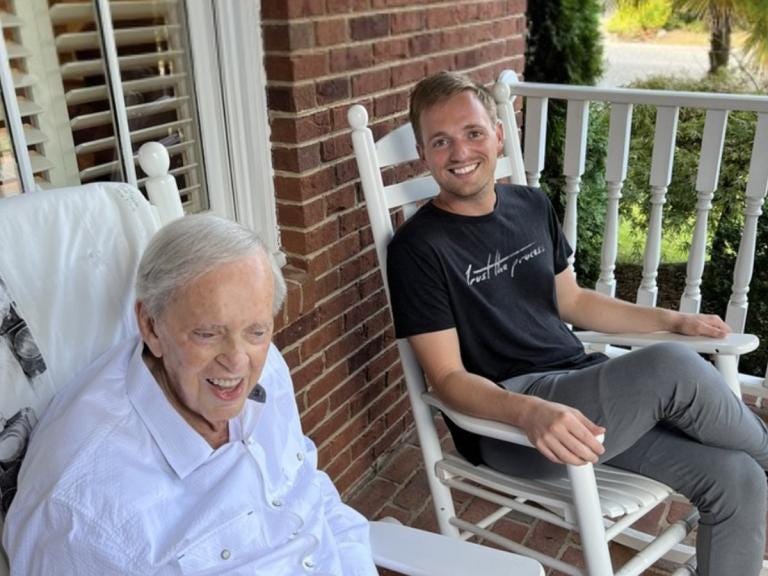
But Andy always worked for a Christianity that was mostly a good-natured experience.
He viewed ‘religion’ as an ethic of service and friendly interactions—more like the Methodists, or Episcopals.
Like Catholics, he mostly dismisses the Bible as a regular reference, except the gospels, which he calls “mostly reliable.” He believes in Christians being able to disagree, as he argues in his 2022 book Not in It to Win It: Why Choosing Sides Sidelines The Church.
He seems to have wanted for awhile to renegotiate the very difficult “gay problem” in the Evangelical world. I find myself moved by this, for it was a situation his father did so much to intensify, now his son has something like a karmic role to play in dealing with the resulting crisis.
He’s tried different tactics. In 2019 he was heard saying — privately — that he’d perform gay weddings. But he never did.
Perhaps Christians could think of homosexuality as a “disability,” he suggests. That didn’t work.
He doesn’t even try to argue Bible references—which Evangelicals would disregard.
He tries humor. The ‘gay Christian’, he offers, is very bold:
“Where do you go where you’re not sure you’re gonna be accepted and you go over, and over, and over and over. Only your in-laws house.”
He makes cursory reference to the Bible:
“I know 1 Corinthians 6, and I know Leviticus, and I know Romans 1, so interesting to talk about all that stuff. But just, oh my goodness, a gay man or woman who wants to worship their heavenly Father, who did not answer the cry of their heart when they were 12 and 13 and 14 and 15. God said, ‘No,’ and they still love God?”
It’s music to non-Evangelical ears.
On Twitter, the gay religion journalist Jonathan Merritt (son of a star pastor, James Merritt), chimes in:
Why would Evangelical men renegotiate their sweet deal?
They have a religion that calls them God’s favorites, as requires nothing other than being straight and ‘in control’. With the added perks of being white and American, it’s ‘God’ enough for them.
And the congregation says…Amen. 🔶


