
8 essential product mindset enablers to unlock your success
Break free from the framework nonsense.

Creating the right product is like sculpting. The development framework you choose is no different from your selected chisel. True, you can perfect your use of the chisel to shape and refine the raw stone. But it’s your mindset — your intent, your creativity, and your adaptability — that makes great art.
“Can you point me to a framework that will help me build great products?”
— A product manager seeking a foothold
As such, emerging the right product is not dependent on the silver bullet framework you select. It’s much more a factor of your mindset. So, don’t get led astray by latching onto a framework.
Forget the frameworks; hone your product mindset instead.
Your mindset affects how you show up for your product challenge. The wrong mindset will lead you to select the wrong tools or misuse the tools you have. But the right mindset will give you the correct instincts to pick and use the right tools to fit your context.
What are the enablers of an effective product mindset?
The right product mindset can be elusive.
The only thing that is predictable in the product space is our desire to predict what will happen. We put in significant effort to determine both the value our product will deliver and how long it will take us to produce it. And we do all this in the beginning, at the moment of highest uncertainty.
Product development is not deterministic in nature — something many get wrong. Once you come to terms with this domain as complex and uncertain, your mindset must align to this reality. You must orient to experimentation versus prediction.
Likewise, you will find no one framework fits your unique product situation. Your product is singular, so your approach should be too.
With the correct mindset, you can be selective in the tools you use. Rather than tie yourself to one framework, you can pull fit-for-purpose patterns from many frameworks. Then, you can try them and tweak them to meet your custom needs.
So, it makes sense to begin our product journey with the right product mindset. But as you quickly find out after searching, there is not much concise guidance on this topic. This is precisely why I have written this article.
Through my own ups and downs, I’ve emerged eight foundational enablers of a product mindset. I treat these as behavior orientation helpers.
Aligning to these behavior guides breaks through the noise. They allow you to focus on the essentials that emerge great products.
No frameworks are necessary.
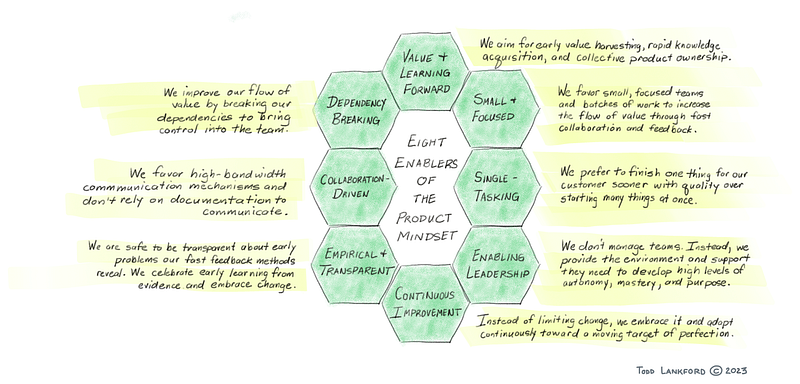
Enabler №1: Put value and learning first
Perfecting your output technique is not your key to product success.
Instead, you should put your customers front and center and let their needs chart your course.
Output is defined across scope, schedule, and budget dimensions and often includes quality. But value is the result of your output. It is a combination of desired customer outcomes and business impact.
Value should lead your efforts. Delivering something not needed is, to be honest, wasteful.
Your “right” product emerges by focusing on maximizing customer outcomes with minimum output. And you can best achieve this with rapid, small experiments and a high dose of customer empathy. If you deeply know and please your customers, a positive business impact will follow suit.
I’m sure you are shaking your head in an agreement up to this point. But taking value orientation to the next level is not as straightforward. It is where the territory becomes foreign to many.
To fire on all cylinders with value, you must have the entire team focused on it, not only the “leads.” That’s right, the entire team.
Don’t make the mistake of keeping value focus siloed to a select few — a centralized intelligence. Instead, create an environment of intense care for value by democratizing its ownership. Engaging all team minds taps into collective wisdom to reach success sooner.
Collective value orientation is your key to delivering the right product.
Enabler №2: Keep it small for big results
A small team focused on small steps will put your feedback flywheel in motion.
Imagine the opposite — large, lumbering teams working on giant batches of work. They need weeks, months, or years to finish. This combination really sucks the wind out of your sails.
Big teams and big batches of work don’t fit the mold. Team members struggle to stay connected. And the feedback loop won’t be timely enough to make a difference.
But there is beauty with small. Small has two aspects — a small team and small increments of work.
The most effective teams are small, stable, and dedicated to the effort at hand. Richard Hackman found the most effective teams to be five people in size and long-lived¹. I thoroughly agree with this notion from my experience.
A five-person team has an odd number, which is great when you require a tie-breaker vote. Moreover, it is the perfect size for reaching rapid, shared understanding. The small team is better able to work as a team through real-time collaboration on the work, and nobody feels left out.
But don’t mistake small for puny. Small is the way you work; it’s not the way you think. You think big and work small.
Small steps in the direction of your target are safer. The impact radius is simply not big with a small step. Not much can go wrong, and if it does, you can easily recover.
Learning thirsts for frequent, inexpensive, speedy feedback. You can get this with small teams working on small, experimental batches of work. Small speeds up learning.
A small team takes one small step and observes the situation. It orients and takes the next best small step, repeating the pattern until its goal is reached. This is the way to chart the shortest path to the best outcome with minimal risk.
Small is good.
Enabler №3: Finish one thing at a time
As the saying goes, you want to stop starting and start finishing.
Many organizations make the mistake of trying to keep everyone busy all the time. Each team member picks a request and starts running with it in parallel. This happens for many reasons, but here are the most common ones:
- Showing progress. When a customer or stakeholder makes a request, starting it is the signal of taking it seriously. It illustrates forward progress and a clear expression of urgency to the requestor. But if we start too much in parallel, all requests take longer to finish, and everyone loses.
- Keeping specialists busy. People gravitate to what they know, and managers seeking efficiency keep specialists busy. In this mode, team members will only work on things within their skill set. To serve this goal, lower priority work often gets started ahead of higher priority work.
- Obstacles. If what is being worked currently is blocked, it is much easier to pick up something new than fix a thorny obstacle. With this choice, again, lower priority work takes precedence.
High work-in-progress, obstacle apathy, and no slack, produces several precursors of failure:
- High degrees of wasteful context switching.
- Work sits and waits on decisions from busy or unavailable team members.
- Minimal cross-pollination of knowledge within the team.
- Increased defects due to lower-quality, single-mind decisions.
- No time to fix obstacles or defects.
- Hidden problems due to unintegrated work or unintegrated team minds.
- Low shared understanding of the work.
- Longer cycle times for work.
- Dependence on specialists.
- Cutting of corners to address the pressure of delays resulting from multitasking.
Instead of starting many things at once, you should finish what you start and minimize what you start. How many things should you start at once? Ideally, you start one thing at a time as a team — one task, one feature, and one goal.
The best way to keep cycle time low is to 1) finish what you start, and 2) don’t start something until you finish what’s in flight. This is simple, yet few practice this powerful behavior.
Having extreme focus will require you to obliterate obstacles in your path. If you can’t do this alone, you must ask for help; resist starting something else and focus on the blocker removal. Then, when the obstacle is gone, finish the work.
When stakeholders or customers hound you about the status of their work, don’t panic. Instead, help them understand the benefit they get when you focus on finishing what you start. They, and other requesters, will get their needs met much sooner and with higher quality.
Stop Starting. Start Finishing. This works wonders for sooner, high-quality value delivery.
Everyone wins with focus.
Enabler №4: Don’t tolerate dependencies
When you have dependencies, you lose control over your work.
Dependencies go by many names:
- Hand-offs
- Silos
- Turfs
- Centralized intelligence
- Shared services
- Specialization
- Escalation
A dependency destroys value flow in three critical ways:
- Team engagement plummets. When you don’t control your work, your purpose, your autonomy, and your mastery erode. In essence, team engagement takes a hit. And a disengaged team is an ineffective team when it comes to flow.
- All lean wastes skyrocket. Every single lean waste increases when dependencies exist. Waiting, defects, work-in-progress, hand-offs, task switching, over-processing, and over-production all get worse. These wastes obliterate your flow of value.
- Transparency sinks. When many teams work on one request, progress and problems become opaque. There is no clear owner of the work, and competing priorities or turfs become the focus. The value of the work and its flow take a back seat.
Eliminating all dependencies is unlikely. But you should do everything in your power to eradicate the most painful, frequent ones.
Notice, the recommendation is not to coordinate better with dependencies. Instead, you must break them. This means, you remove the dependency and bring the control into your team.
Breaking a dependency requires you perform the work yourself to keep value flowing. This can be a workaround or the permanent solution. Or, less optimally, you can wait until upstream dependencies finish before you start.
Regardless of your technique, you don’t want any control to be outside your product team once you start the work.
Please note, dependencies are not exclusively external to the product team. You can easily have dependencies inside the team. And these hand-offs between team members are just as deadly to flow.
Cross-pollination of knowledge is a great antidote for breaking dependencies. Working together on small items enables effective knowledge and skill transfer. We learn best when we work together as a team.
Breaking dependencies — internal or external — is a critical enabler of flow. Embrace the act of gaining control over your work.
Enabler №5: Harness collaborative power
Are you a team or a collection of individuals?
Many times, I have seen the latter in the way product teams operate. You will find the smoke signals below give away the presence of this fire:
- Communication by documentation. Asynchronous communication is the norm. Tickets, emails, documents, and instant messaging are favored over real-time conversation.
- Solo parallelism. In this mode, each team member works on something different. They each have a distinct feature or task of a feature they are working on alone.
- Teams as feature factories. Requirements get formed upfront and fed to the team as a backlog of tickets. The team has no contact with their stakeholders and users. They simply take items off the backlog, build them, and rinse and repeat.
When individuals work solo, they become separated from the power of the team dynamic. Individual effectiveness gets swayed by the whims of the day and the person’s own experience level, knowledge, and skills. Everyone has bad days and may not have strong capabilities for the task at hand.
Teams, on the other hand, focus all hearts and minds on the same thing to wield the power of collective wisdom. A bad day for one teammate may be a good day for another. Inexperience in a skill for one person may be an expertise area for a teammate.
You likely have heard the saying, “A team is greater than the sum of its parts.” This is only true if its members co-create to achieve the goals of the team. Harnessing this power requires a full-team focus on the same work at the same time.
The members of effective product teams collaborate in real-time. They practice face-to-face conversation even when remote, and they visualize concepts to align. Collaboration produces a team mind to deliver the right product, in the right way, at the right time.
And collaboration is not only within the team boundary. The act of collaboration extends to frequent stakeholder and customer engagement. Community collaboration is the final link to becoming one team working toward a common goal.
Collaborative teamwork is the lifeblood of a successful product.
Enabler №6: Supportive leaders who promote team engagement and flow
Effective leaders create an environment of high team trust, where teams feel safe to take ownership. This is the best expression of leadership.
The opposite situation, of command and control, destroys team effectiveness. In this mode, the team lacks trust and settles for waiting for orders before acting. All decisions and ownership rest on the shoulders of their managers.
An externally managed team is a disengaged team. They feel like a cog in a wheel as their freedom gets repressed under tight command and control. The result is a limited, stagnant culture.
Alternately, what you want is for the product team to manage itself. Self-management requires a high degree of team autonomy, mastery, and purpose². This produces an engaged team.
Engaged teams outperform ones oppressed through centralized, far-removed management and control, every time.
Trusted teams who have a safe space to grow and experiment will happily take ownership. Innovation will skyrocket through the engagement of all team minds. Problem-solving becomes democratized, distributed to those closest to the work.
Those who directed teams in the past must shift to become product team enablers. They spend political capital to build an environment of high team engagement and become a heat shield to protect the team. And when the team needs help in removing an obstacle, these leaders are quick to jump in and do so.
Behind the scenes of every engaged product team is a supportive, enabling leader.
Enabler №7: Embrace the “red” and learn early
Without safety, you won’t have transparency.
And without transparency, you can’t inspect and adapt. Leaders play a big role in creating a safe environment for transparency to take flight. Unfortunately, they can also play a big role in creating an unsafe environment if not careful.
The absence of safety freezes a team into inaction. The result is opaqueness. The status of the work gets the watermelon treatment — green on the outside but red on the inside.
You want the people closest to the work to feel safe to decide on the best course of action. They need to feel safe regardless of the outcome of the chosen path.
A leader’s reaction to a poor outcome of a team’s choice can make or break a team’s psychological safety. Blaming breaks safety.
Instead, the better route is to embrace the “red” as learning. This builds safety.
Now, this frightens many, as nobody likes a failed experiment. But employing other enablers, such as keeping experiments small, minimizes the impact radius. And if you can learn early and often, you will reach your product goals sooner.
The path to product success is not a straight line. The faster you can reveal and pivot to the turns you must take, the sooner you will reach your intended target.
To make all this work, managers should abandon the status report. They must get out of their office and engage with their teams as and where the work happens. This is called “going to the gemba” — the real place of work.
When you are in the trenches with the team, you will see the good, the bad, and the ugly. It will become clear how to help your team remove their obstacles. And you can encourage and reward them for taking bounded risks, regardless of the outcome.
Embracing the “red” creates safety and encourages early learning; practice it daily. So, when problems appear, get curious, not furious, and learn faster.
Enabler №8: Improve continuously
Embracing change early and often produces greatness.
Instead of limiting change, strive to meet it head on. Adapt continuously towards a moving target of perfection. Don’t sit on your laurels; you will stagnate and not be able to effectively meet your goals.
Many make the mistake of bounding their improvement. They do it periodically or isolate it to a specific period. The rest of the time, they practice getting better at their status quo — and they stand still.
Even worse, some don’t think about change until an effort is over. Retrospection at the very end is too late. You can’t change to produce a better outcome after the work is done.
The best product teams improve with deliberate practice to get better daily as they work. They recognize change as their competitive advantage. To deliver the right products, in the right way, at the right time, embracing change by all involved is the only way.
Small changes daily add up to tremendous improvement.
Putting it all together
Any framework will have pros and cons. So, you should not tie yourself to one. Instead, select from each and form a unique approach for your product context.
Often, the way we apply a framework is to blame, rather than the framework itself. The way we use a framework is heavily dependent on the mindset we use in applying it.
The best mindset to guide your product journey will follow guidelines that promote:
- Value orientation
- Small increments
- Extreme focus
- End-to-end control
- Real-time collaboration
- Enabling leadership
- Embracing transparency for early learning
- Continuous improvement
You may have noticed that each of these mindset enablers cross-connect. Movement in one will affect one or many others. They don’t work well in isolation and work better in concert as shown in Figure B.
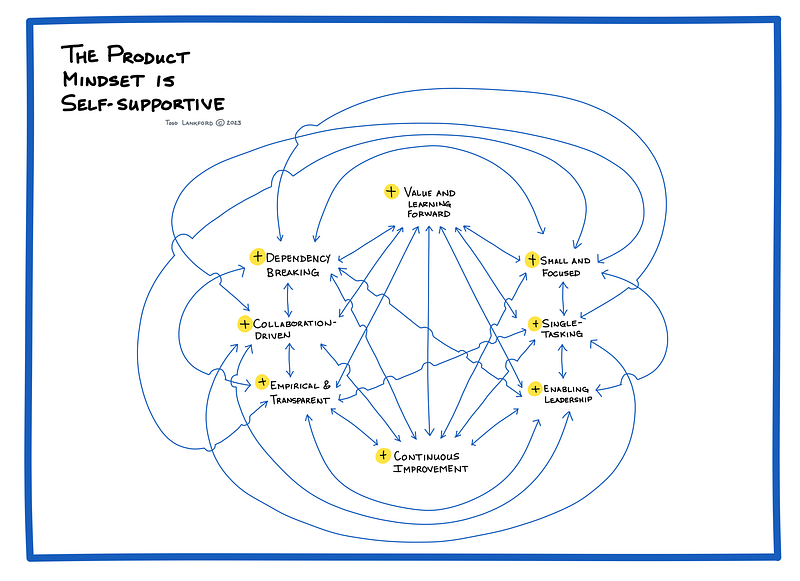
The great thing about how these enablers influence each other: it does not matter where you start to improve. When you improve one, you positively influence others. All enablers benefit, and so does your overall product mindset.
I recognize these guidelines are not revolutionary. You might notice they borrow from agile values, lean thinking, and basic common sense. But this does not mean they are in common usage; we need more widespread practice of these enablers.
I get fired-up when I imagine a team who:
- Aligns with their customer.
- Experiments in small increments of value.
- Focuses on finishing one piece of value at a time.
- Has complete control over the delivery of value to customers.
- Co-creates solutions using all team minds.
- Has leadership that fosters high levels of team autonomy, mastery, and purpose.
- Is not afraid to raise problems early to learn early.
- Finds small improvements daily to inch closer to a moving target of perfection.
Now, that’s what I’m talking about. An unwavering, complete product mindset such as this is unbeatable. No framework can compete with a team driven by those attributes.
If you are on a product team or in its community, I challenge you to join me in getting better at these eight enablers. Instead of perfecting your framework execution, perfect your mindset. Herein lies the path to great products, happy customers, and happy teams.
🔥 Work directly with me, Todd Lankford, to elevate your business agility with a FREE, expert-guided assessment and improvement game plan. Craft your custom path to agility with this proven method used by hundreds of teams.
Related Posts
If you liked this article, you can read similar posts below:
References
- The Power of Number 4.6, Fortune Magazine, June 12, 2006
- Drive — The Surprising Truth About What Motivates Us, Daniel H. Pink, 2011


