
Nine ways to revive collaboration and unleash the full promise of agility
Remove your collaboration killers.

It’s clear to me, collaboration isn’t understood in many organizations; in fact, it’s often absent. And a lack of collaboration can be a real barrier when companies begin to adopt more agile ways of working. Without healthy and persistent collaboration, responsiveness to change (agility) is severely limited.
I want you to understand why collaboration is so critical to agility. My thinking is simple: a team working together is worth much more than the sum of its parts. Many perspectives lead to better decisions and novel solutions to problems. And succeeding collectively builds stronger pride and momentum.
Individuals and interactions over processes and tools
— 1st value of the Agile Manifesto
Unfortunately, many anti-collaboration behaviors and norms have been hardened into corporate cultures today. Reversing these troublesome habits will take time and deliberate action. And the first step is awareness.
To bring these collaboration-killing patterns to light, I have compiled a list of nine I see in the wild. Each one is coupled with an alternative approach you can use to boost collaboration.
Collaboration killer 1: Soloing
Working alone, or soloing, hinders the collaborative potential of a team. Soloing leads to team members making decisions in a vacuum, diluting decision quality. As a result, value flows slow and the success potential of the team is diminished.
To fully realize the benefits of teamwork, many minds must be put to use in solving problems. This is particularly relevant to product work, as decision-making is prevalent.
Despite this, soloing persists, whether through personal preference or a mandate from management. While working solo appears more “efficient” on the surface, it is far from it. It results in siloed knowledge, one-dimensional decisions, and rework, increasing outcome lead time.
A better path: Swarm as a team
Being available to help a colleague “if needed” is not the same as genuine collaboration. When team members work together, they overcome the limitations of soloing. An active collaboration culture is crucial to the success of an agile team.
Collaboration with two or more people is superior to soloing. It’s as simple as that. Instead of starting many work items in parallel, start less to collaborate more. An excellent technique for this is swarming.
Swarming takes collaboration to the next level. It allows the entire team to focus on completing one valuable thing at a time. The result: the team’s potential channels to a single focus.
Swarming also amplifies decision-making. More perspectives lead to higher-quality decisions. Plus, when a team member gets stuck, teammates are ready to help without delay or context-switching.
Many focused hands and minds make for light work and better results. Give it a try, and you’ll find you won’t miss working alone.
Collaboration killer 2: Staying in your lane
The desire of team members to stay in their lane of specialty is a close cousin to soloing. It drives team members to work alone, stopping collaboration and weakening the team. In essence, we have a collection of individuals working alone on pieces and parts and not as a cohesive unit.
This can even happen to a team who has all skills to complete value work. If the team members don’t work together, the essence of a true, cross-functional team gets lost. When team members focus only on their specialty, missteps and context-switching slow progress.
To make things worse, the future team potential is weaker when specialists stay in their lane. This narrow focus limits a team member’s ability to contribute to tasks outside of her specialty. So, if a team member needs help or if a team member is unavailable, the value flow slows or halts as nobody is able to assist.
Staying in your lane as a team member is a lose-lose activity. Customers lose as value takes longer to realize, and the team loses its effectiveness.
A better path: Be a team player
Becoming a team player requires one to step outside a lane of specialty and face new challenges. It favors a curious and open-minded approach and a willingness to leave one’s comfort zone.
The short-term cost of cross-skilling is outweighed by its long-term benefits. When team members build diverse skills, they become stronger value contributors over time. This results in more effective stewardship of customer needs.
I must underscore the need for strong leadership support to promote successful cross-skilling.
Consider if a team member is incentivized to become a better specialist. These team members may not have the motivation or the space to expand their skills. Instead, effective leadership must provide encouragement and make space for varied skill acquisition.
Collaboration killer 3: Falling in love with tickets
The love of the ticket has gone too far. Take these comments I have heard:
- “Another team must log a ticket with details of its request for help before we will work on it.”
- “Our Product Owner must first create a user story in the backlog outlining our tasks, so we know what we have to build.”
- “We log all our work into the ticketing system to keep everyone informed of our progress and show we are working.”
As these statements reveal, tickets have become a poor substitute for real collaboration. Tickets have become the default to request help, document user needs, and prove a team is working.
But with tickets, we rely on documentation to communicate. Documentation is the worst way to do this. With documentation, the bandwidth for information absorption and understanding is at its slowest.
Alistair Cockburn depicts communication quality on a continuum¹. And he finds documentation comes in dead last (see Figure 1).
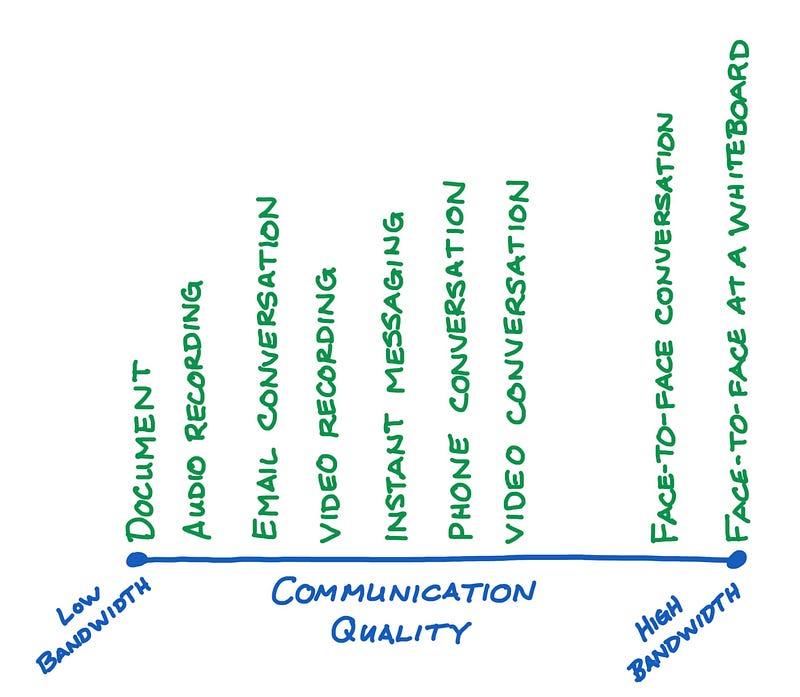
When you envision high levels of collaboration, does a ticketing system come to mind? If you require something from your colleague, would you write it down on a piece of paper and hand it to her? This does not embody healthy collaboration, and I think you can agree with me, it is far from ideal.
A better way: Just talk (to the face)
Face-to-face conversations, especially those at a whiteboard, can greatly improve shared understanding. Real-time, synchronous conversation is superior to any attempt to communicate through a ticket. It is the basis of true team collaboration.
Invariably, when I speak of face-to-face conversation, people say, “What about remote teams? They can’t be face-to-face.” While true, we still must strive for the highest bandwidth communication possible. Being remote means we must try harder to keep communication quality high.
For example, remote team members tend to shy away from turning on cameras in virtual meetings. And in doing so, they miss out on tremendous amounts of non-verbal communication. Seeing your team members makes a huge difference in better communication outcomes.
So, if you can’t be face-to-face in person, get as close as possible to this. Choose a real-time video conversation, coupled with a collaborative digital whiteboard. Your shared understanding and collaboration will immediately improve.
Let me be clear on this point: ticketing systems are not evil. But the way people use them often destroys collaboration. Recording the result of a conversation in a ticket can be useful to remember key decisions. But the document should not replace the collaborative conversation.
Collaboration killer 4: Keeping the peace
Keeping the peace can silence voices and stifle collaboration and creativity.
Many teams face challenges when it comes to debate and divergence of opinion. Rather than fostering a constructive environment for differing perspectives, some teams shy away from it and view it as a sign of disorder. As deadlines and pressure escalate, the inclination to dismiss alternative views only intensifies.
Unfortunately, for these teams who avoid considering all options, they miss out on the potential for improved outcomes. By rushing down a single path without considering other alternatives, they commit too early. This forfeits the benefit found in other options, and their risk of failure increases.
A better way: Encourage healthy debate
Making time to consider many points of view seems risky and wasteful at first glance. But it actually reduces risk.
Most of us believe it is more efficient to quickly choose a path and act. This is the same as making one, big bet.
Instead of committing early, it’s better to invite alternate ideas. You have a better chance of succeeding if you keep your options open for as long as possible. Instead of one, big bet, make many small bets.
Richard Hackman, the late leading expert on teams, studied teams for fifty years. He found effective teams have healthy conflict and encourage diverse opinions². Innovation is born through this friction.
So, instead of striving for harmony and peace, mix it up and embrace healthy divergence. Invite different perspectives, and let collaboration take root and feed better decision-making.
Collaboration killer 5: Too many spinning plates
When a team has too much work in progress, collaboration takes a hit.
If every team member is busy with too much work in flight, there is simply no time to collaborate. Stopping work to discuss options with peers is not an option. Collaboration would be like the straw that broke the camel’s back, adding stress to a tense situation.
Too much work in flight also leads to soloing, where every team member works alone on separate tasks. And as we discussed in the first section, soloing has a huge negative impact on collaboration.
As the number of items in flight goes up, the amount of collaboration goes down.
A better way: Start less, collaborate more
To speed up collaboration, teams need to make space for it by starting less work at the same time.
For example, consider a five-person team working on five features, one for each team member. Each team member is busy working on his or her own feature in parallel. This leaves very little room to collaborate.
What would happen if we reduce the number of items in flight to one user feature? All at once, collaboration can’t be ignored. Team members either need to help to finish the user feature or sit idle; the vast majority will choose to pitch in.
Many benefits surface when you have many minds and hands contributing:
- Faster feature completion
- Innovative solutions
- Better decisions
- Higher defect prevention
- Faster debugging when defects slip through
- Easier obstacle removal
- Increased momentum through team focus
- Higher dopamine rush when the team succeeds as one
Collaboration builds energy and collective purpose. Starting less, makes this a reality.
Collaboration killer 6: Putting on the status mask
Status reporting has a way of masking reality and hiding risk. And teams can’t collaborate to solve what is not transparent. Over-reliance on reporting a pristine update can drown out true collaboration.
Optics take over with status. We become obsessed with finding a creative way to depict the state of affairs. This overshadows revealing and collaborating to solve the real problems at hand.
Consider how many status meetings you have attended where the status is green. The vast majority of status reports are massaged to provide only good news and no problems. But the real issues lurk right under the surface, unannounced.
Most projects give a status that is green on the outside and red on the inside, like a watermelon. And when problems are not transparent, collaboration dampens.
After all, if everything is going great, why bother collaborating? Staying in your lane and completing your task on the plan is all you need to do.
But these watermelon projects show their true red color when your time and money have run out. So, don’t be fooled by a pristine status. See it for what it is: a cloak masking your problems.
A better way: Embrace the “red” and collaborate to “green”
We need to drop the charade by deemphasizing status reporting.
One way to do this is to recognize every product journey starts in the same state: red. Then, the focus can shift to learning instead of messaging and optics.
In this approach, the burden is on the team to collaborate to unearth problems fast. Then the team can work together to generate solution options, and solve the problems. This is how a team collaborates to earn their way to green.
Imagine a daily huddle where the only focus is revealing impediments and how to solve them. Imagine the effectiveness of a team who has no tolerance for hiding obstacles. Imagine how flow would improve on this team, collaborating early to solve problems.
With the absence of status angst, the teams can focus on what matters. They can use collaboration to its full effect — solving relevant problems through teamwork.
Collaboration killer 7: Mandated standards
Standardizing teams is a mandate I often hear from the management ranks. It goes something like, “We need all teams operating in the same way.”
So, they form a center of excellence to spend months, and sometimes years, laying out the standards. They create the rules in a vacuum, publish them on a wiki, and roll them out with mass training and fanfare. Then, the standards stay in stasis as the organization morphs to meet its context.
It is not uncommon for teams to completely forget and never refer to the standards. After all, they were not involved in co-creating these standards. The standards do not reflect reality and add more confusion than guidance.
Standards mandated by a centralized team clash with context and die a quick death.
A better way: Community-driven pattern libraries
You may have heard this truism in agile circles, “There are no best practices. What you have are good practices in a given context.” This speaks to the reason mandated standards don’t work.
The solution to this is simple — allow each team to find the right path for its ever-changing context. Standards also don’t make sense within a team boundary. Since change is the only constant on product teams, effective teams will morph over time to meet it.
We should expect and applaud when each team operates in accordance to their context. No team should act like another. Plus, team differences in operation can feed a multi-faceted, shareable library of patterns.
Take a pattern library of good practices seeded by all teams. Compare it with a centrally mandated set of standards generated in isolation by a select few. There is no contest — the pattern library is superior.
Team-generated patterns are a force multiplier. All teams can speed up their journey through the learnings of their peers.
And remember, those that write the plan don’t fight the plan; they embrace it. So, let your teams grow and share patterns appropriate to their context. And stay away from those centralized, forced standards.
Collaboration killer 8: Only smart people decide
When only a select group of smart, experienced people make decisions, collaboration plummets. Here are a few common types of these centralized decision-making groups:
- Strategy teams
- Governance teams
- Centers of excellence
- Review boards
- Architecture teams
- Specialist design teams
- Expert estimation teams
- Senior code reviewers
- Expert testing teams
When decisions are siloed to these groups, collaboration stops. Accordingly, knowledge cross-pollination, autonomy, ground-truth context, team ownership, and team pride reduce significantly. Teams who lack control over decisions relevant to their work are a pale shadow of what they could become.
A better way: Let the team decide
From my advice up to this point, you can guess the alternative to “only smart people decide”. The antidote to limited decision-making is to democratize it.
This goes deeper than simply giving the team a seat at the decision-making table. Instead, it moves the table to the team and provides room for other external parties to take a seat at the team’s table.
Your best decisions get made by bringing them to the team, those closest to the work. This one act streamlines the most prevalent activity in product development: making decisions. Teams are best positioned to inform a decision and learn from it if it doesn’t work.
And complex decisions are no exception. Difficult decisions invite collaboration. Tough problems need all team minds together to innovate on solutions.
Collaborating to make tough decisions brings with it a sense of team pride and ownership. Though, when things don’t pan out with a hard decision, the team needs a safe space to learn from it. Managers must make this safety non-negotiable.
So, instead of protecting teams from decisions, put teams in charge of them. Your teams will reach new heights as they forge the right path to achieve their product value.
Collaboration killer 9: One-way meetings
We have all been in a one-way meeting. These meetings are devoid of collaboration. All information is shared with attendees, with no active participation or feedback.
Most people tune out in these unidirectional meetings. The intended message falls flat, and any action desired post-meeting fizzles.
Inputs from the diverse perspectives of attendees are not considered. So, naturally, attendees will value the delivered information less.
These types of one-way information-sharing sessions are common for product teams. Consider these situations:
- The product vision and goals are elaborated behind closed doors. Then they get relayed to the team in a kick-off meeting.
- User research is performed by an upfront user experience group. It is then handed off to a product team in a findings review session.
- Product features are predetermined by a separate leadership or strategy team. Then, the features get delivered to the product team in a backlog review meeting.
- An estimate or deadline is created without the team’s involvement and given to the team in a plan review meeting.
One-way meetings don’t invite collaboration. It is too late to collaborate when decisions have already been made.
A better way: All-way meetings
Don’t rely on one-way meetings to roll out decisions. Instead, hold collaborative working sessions to co-create decisions.
When those who need to carry out a decision are part of making it, the chances of success get amplified. Teams will understand the decision and get behind it if they have had a hand in making it.
And best of all, team purpose gets enhanced when teams become an integral part of the solution. Purpose is a critical element of intrinsic motivation and employee engagement. A team with high engagement benefits everyone — team members, stakeholders, and customers.
So, bring decisions to be made to a meeting. Then, create an open format for collaborating to solve these decisions. Trust me, you will never want to go back to the boring, one-way information-sharing format.
The shift to real collaboration requires deliberate action and practice
I’ve provided a few starter ideas on how you can reverse the tide on non-collaborative behavior. I’m sure you have some of your own. And I’d love to hear about these in the comments.

The fight for better collaboration requires deliberate effort to change minds and reverse habits. You can’t do it alone. Healthy collaboration can only be achieved together, by collaborating.
”The strength of the team is each individual member. The strength of each member is the team.”
— Phil Jackson
What will you do today to boost the focus on collaboration within your team and in your organization?
THANK YOU!
I hope this article helps you in your journey.
For more content on my pursuit of lean leverage delivered to your inbox, you can join my email list.
Related Reads
You can read similar posts from the author below.
References
- Agile Software Development, Alistair Cockburn, 2001
- The Six Common Misperceptions About Teamwork, Robert J. Hackman, June 7, 2011