
Agile Leaders Must Build a Problem-solving Culture
As an Agile Leader, help your teams get back to their innate curiosity and build a problem-solving habit.

Problem-solving goes by many names these days. A few common ones are below, which may be familiar to you:
- Curiosity
- Growth Mindset
- Learning
- Scientific Thinking
- Experimentation
- PDCA (Plan, Do, Check, Act)
- Design Thinking (Think, Make, Check)
- Lean Startup (Build, Measure, Learn)
- Continuous Improvement / Kaizen
To say the least, it is a popular topic. Whether we are using Scrum, Kanban, XP, LeSS, SAFe, or some other Agile framework, we want a problem-solving mindset. Want is too soft. We need this mindset.
We all arrive curious by nature.
So, can we flip a switch and embrace a problem-solving culture? Most of us believe we can. We assume we are born with innate problem-solving skills. Are we? Absolutely. We all arrive curious by nature. It is critical for acclimating to the world when we come into it.
While it is true we are born curious, blending in with social norms requires us to dampen our curiosity to fit in. We follow the rules. Stepping outside of the box takes courage. Many of us don’t want to stand out or receive criticism for doing so. As a result, the status quo sucks us in. And our natural curiosity shrinks. Over time, we lose our instinct. But it is still there. All we have to do is get back into practice.
As an Agile coach, curiosity is a key piece of the puzzle as I coach teams along the Agile journey. So, I am invested in cultivating a problem-solving culture. Playing it safe will not work in our complex, uncertain modern places of work. We have to fight back against this tendency to do things the way we always have. To thrive, we have to adapt to our changing, complex environments.
The role of the manager is crucial to make this work. Traditional management enforces and protects the status quo. We need managers to transition to Agile Leaders. Managers, if you are reading, you must coach your teams on how to solve problems. You have to reacquaint them with their innate curiosity. An Agile Leader fosters team improvement and growth. And problem-solving skills are a critical team capability.
Let’s dive into what tends to get in our way, a framework for growing problem-solving capability, and the results we can expect.
What Gets in Our Way
We all have existing beliefs. The behavior, results, and belief loop as shown in Figure A reinforces our standing beliefs. This is what forms the basis of our cultural norms.
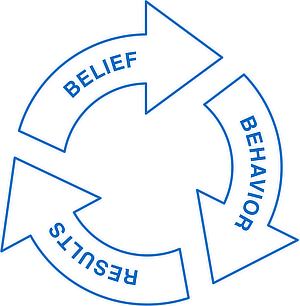
When we form habits, supported behavior becomes our status quo. We operate on autopilot without realizing we are stuck. This can work against us responding to change. It is easy to fall into this trap. If you have a fixed mindset and protect the status quo, you may not even realize it. When you don’t adapt to changing conditions, you are stagnating.
When you don’t adapt to changing conditions, you are stagnating.
This might be a result of a traditional command-and-control environment. In this type of environment, you get your behavior rules from your manager. Your manager gets their behavior rules from their manager. This continues up the chain until you get to the top of the organizational hierarchy. Everyone upholds the rules up and down the chain. We are encouraged to stay inside the boundaries. And rewards are often based on our ability to play by the existing rules. This reinforces the belief in the status quo. It also resists change and reduces problem-solving behavior.
The Empowerment Fallacy
When we are on the Agile journey, we are often transitioning from a fixed mindset to a growth mindset. We expect teams to self-organize to solve problems on their own. We say to our teams, “You are now empowered.” Then, we sit back and wait for the magic to happen. It often does not.
Empowerment stalls out because our teams are conditioned to the old way of working. They have learned that managers call the shots and make decisions on how the teams work. Teams expect managers to solve the problems. Teams are out of practice when it comes to problem-solving.
In our fast-paced, complex, and uncertain work environments, managers become a decision bottleneck. A manager can’t standardize all behavior patterns for every possible scenario. So teams will need to rely on the manager to help them decide when new situations emerge. Too many decisions are reliant on the manager. Management ownership behavior is well established. It is hard to change for both the manager and the team member.
Teams will need to reacquaint themselves with their innate curiosity.
To make empowerment a reality, teams need to reacquaint themselves with their innate curiosity. When problems arise, we need teams to feel free to experiment. And not be afraid if the experiment does not work. As a manager, you need to coach them to get there.
You may be asking, “How do I do this?” The path to a problem-solving culture is not simple. But with practice and deliberate action, you and your teams can get there.
Let’s walk through a technique I use to coach Agile teams on a path to a growth mindset—a problem-solving culture. It may be something that will work for your context.
A Framework for Growing Problem Solving Capability
The approach I use for developing problem-solving muscle is straightforward and simple. But it does require deliberate practice and time to form a new habit. You must be patient.
The framework helps you assess where you currently stand. And it provides you target states for progressing along your problem-solving journey. It pairs well with the Toyota Improvement and Coaching Katas by Mike Rother¹ as described here.
I will walk you through the approach for self-assessment of your current state first. Then, I will describe your role as an Agile Leader, the role of the team, and the role of an Agile coach in the process.
Current State Assessment and the Journey to a Problem Solving Habit
I use a rubric (Figure B) and a self-assessment to coach teams from predictive, command-and-control behavior towards a problem-solving habit.
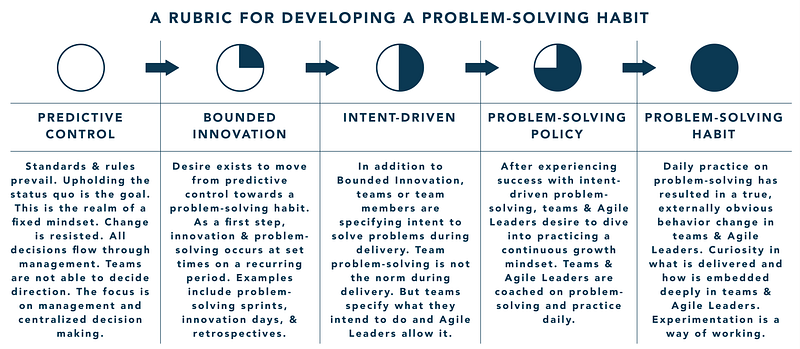
Each Harvey Ball² in the rubric represents a waypoint on the journey to developing a problem-solving habit. While creating an Improvement Kata, teams and their leadership use the rubric to self-assess their current state.
Based on their self-assessed level, they will set their next target state on the Improvement Kata. The next target state is the next level up on the Rubric. As such, this rubric provides a steady improvement path for both teams and their leadership.
The Role of the Agile Leader
To build problem-solving skills in your teams, as an Agile Leader, you will need to avoid making decisions for them. Instead, use collaborative problem solving to coach your teams to find a solution. You should refrain from making decisions and allow the team to decide on a course of action. Asking questions versus giving answers is a solid technique to allow the team to decide. Use the Coaching Kata as a guide. This is how teams take ownership and move towards a problem-solving mentality.
Also, you will have to support all outcomes of team decisions. If experiments do not succeed, celebrate the learning. Experiments do not always succeed. That is why we call them experiments.
So you must celebrate the act of team decisions and experiments. Every experiment is a step along the journey to a problem-solving culture.
The Role of the Team
Your team members will need the courage to decide on a course of action instead of relying on you as the Agile Leader. You will need to encourage them to take action and try out their ideas. Teams will need to practice problem-solving on their own daily. And you will need to support them daily as an Agile Leader.
Every decision the team makes may not work out. But this is a good thing. When they try something that does not work, they have learned something new. Curiosity is a key component for dealing with uncertainty and complexity. And as a leader, you must nourish it for it to thrive.
The Role of the Coach
You and your teams need an experienced coach with you along this journey. Coaches have the experience to see when old behaviors start to creep in. Sometimes you and your teams will fall back into your old patterns without knowing it. A coach can see this and course correct in the moment.
What Results to Expect
When you have a problem-solving culture, you will experience several benefits. These will happen at each stage of the journey.
- Innovation Increases: More heads solving problems will put innovation into overdrive.
- Happiness Increases: The increased freedom and control of teams will produce happy teams. A problem-solving culture will produce a better product and reduce waste. Better products will produce happy customers. Less waste makes everyone happy.
- True Self-Organizing Behavior Emerges: Teams will achieve self-organizing behavior and be able to solve problems on their own. This will build confidence in their problem-solving capability. This is how you achieve empowered teams.
Developing problem-solving is not like flipping a switch. It requires hard work. But with deliberate action, you can build a new habit. Tap into and wake up the innate curiosity within you and your teams. Your products, teams, customers, and business will thank you.
For more content like this on my pursuit of Lean Leverage, delivered to your inbox, you can just join my email list. Or see my other related posts below to dive even deeper.
Read more about each evolutionary stage of the rubric below:
Related Posts
- Nine Proven Ways to Make Your Scrum Team Hyper-productive
- Reboot Your Scrum Retrospective
- Don’t Forget the Customer of Your Change Initiative
- Overcoming the Fear of the Incapable Team
- Agile Leader Pattern 5 for Building Awesome Teams: Enable Self-Organization
- Do We Need a Manifesto for Managers?
- We Need Managers to Become Agile Leaders
- Out With the Old, in With the New
References
- Toyota Kata by Mike Rother 2010
- Harvey Balls, Wikipedia
Originally published at https://coachlankford.com on January 19, 2020.


